Most meditators are leaving an enormous amount of depth on the table. Not because they’re doing anything wrong, exactly, but because they’re sitting in silence or pressing play on some vague “relaxing music” playlist and hoping for the best. Here’s the thing: binaural beats enable brainwave entrainment, actively shifting your brain into the alpha and theta states associated with deep relaxation, in ways that silence simply cannot replicate. This guide breaks down the science, compares every major technique, and gives you practical tools to genuinely transform your next session.
Key Takeaways
| Point | Details |
|---|---|
| Brainwave entrainment | Advanced audio can synchronise your brainwaves, helping you relax and deepen meditation. |
| Right technique matters | Tailor audio choices—binaural beats, orchestral music, or 3D sound—to your specific meditation goals. |
| Science meets artistry | Mixing scientific insights with musical creativity offers a richer, more mindful experience. |
| Evidence is nuanced | Research points to strong possibilities but results vary, so self-testing is key. |
| Safe experimentation | Most enthusiasts can safely explore advanced audio; adapt based on your personal responses. |
How advanced audio influences the meditative brain
Let’s start with the biology, because honestly it’s fascinating and a little bit mind-bending (pun absolutely intended).
Your brain runs on electrical oscillations called brainwaves, and different states of consciousness correspond to different frequencies of these waves. Wide awake and answering emails? That’s beta waves, humming along at roughly 13 to 30 Hz. Slipping into a warm bath of calm focus? Welcome to alpha, sitting between 8 and 13 Hz. Drifting towards that delicious twilight state just before sleep, or deep in meditation? That’s theta territory, roughly 4 to 7 Hz. The holy grail for many meditators is getting reliably into theta or deep alpha without spending years on a cushion.

This is where advanced audio earns its keep. The mechanism is called the Frequency Following Response (FFR). Feed your brain a consistent, rhythmic audio stimulus at a specific frequency, and your brainwaves will literally begin to synchronise with it, like a pendulum clock gradually matching the swing of another clock in the room. It’s a real, measurable neurological phenomenon.
Binaural beats work by playing two slightly different tones, one in each ear. Your brain perceives the difference between them as a single, pulsing tone. Play 200 Hz in your left ear and 208 Hz in your right, and your brain generates an 8 Hz beat, nudging you straight into alpha. It’s a bit like a secret back door into your own nervous system, and audio healing benefits extend well beyond the meditative session itself.
Vibroacoustic and frequency-based sound therapies shift brainwaves into these relaxation states, and the knock-on effects include measurable reductions in cortisol, the body’s primary stress hormone. Isochronic tones work differently, using a single pulsing tone that switches on and off at a set rate, but the destination is the same. Vibroacoustic therapy takes things further still, using physical vibration through speakers or mats so you literally feel the frequency in your body. The research on enhancing healing with soundscapes points to benefits reaching into anxiety reduction, improved sleep quality, and even pain management.
| Brainwave state | Frequency range | Associated mental state | Common audio trigger |
|---|---|---|---|
| Delta | 0.5 to 3 Hz | Deep sleep, unconscious | Very low-frequency binaural beats |
| Theta | 4 to 7 Hz | Deep meditation, creativity | Theta binaural beats, isochronic tones |
| Alpha | 8 to 13 Hz | Calm focus, light relaxation | Alpha binaural beats, orchestral music |
| Beta | 14 to 30 Hz | Active thinking, alertness | Upbeat rhythmic audio |
| Gamma | 31 to 100 Hz | Peak cognition, insight | Gamma binaural beats |
Not all audio is created equal, though. The masking noise you layer over binaural beats matters enormously. White noise, pink noise, and brown noise each interact differently with the brain’s ability to latch onto the embedded frequency. The carrier tone frequency also plays a role in how easily your brain detects and follows the beat. In short, the details matter.
“The specific parameters of advanced audio, including carrier tone frequency, beat frequency, and background noise type, directly influence how effectively the brain entrains to the target state.”
Pro Tip: Keep a brief meditation journal for two weeks and note your frequency choices alongside how quickly you felt yourself settling into a relaxed state. You’ll likely spot a clear personal preference emerging, and that information is gold.
Comparing advanced audio techniques: what works for different goals
Now that we have the science sorted, let’s look at the actual toolkit. There are four main techniques most practitioners work with, and each has its own personality, if you’ll allow the anthropomorphism.
Binaural beats are the most studied and the most accessible. Pop on a pair of headphones (this is non-negotiable, as they won’t work over speakers), and the brain does the rest. Binaural beats with specific parameters, particularly a gamma frequency beat embedded over a low carrier tone with white noise, have been shown to improve general attention performance. That said, sustained attention effects are less consistent across individuals, so don’t throw away your focus playlist just yet.
Isochronic tones are the underappreciated workhorse of the audio meditation world. Unlike binaural beats, they don’t require headphones (though headphones still improve the experience). The pulsing is more explicit and some people find it easier to entrain to. Others find it a bit like someone flicking a light switch next to them during meditation, which is… less than ideal. It really comes down to personal neurology. A thorough breakdown of the differences is worth reading in this isochronic tones vs binaural beats comparison.
Vibroacoustic sound therapy is the full-body experience. Whether through a purpose-built sound therapy table or a well-designed speaker setup, you feel the frequencies resonating in your chest, your bones, your skin. For people who struggle to “get out of their head” during meditation, this somatic grounding can be transformative. The downside is accessibility: a quality vibroacoustic setup is a serious investment.
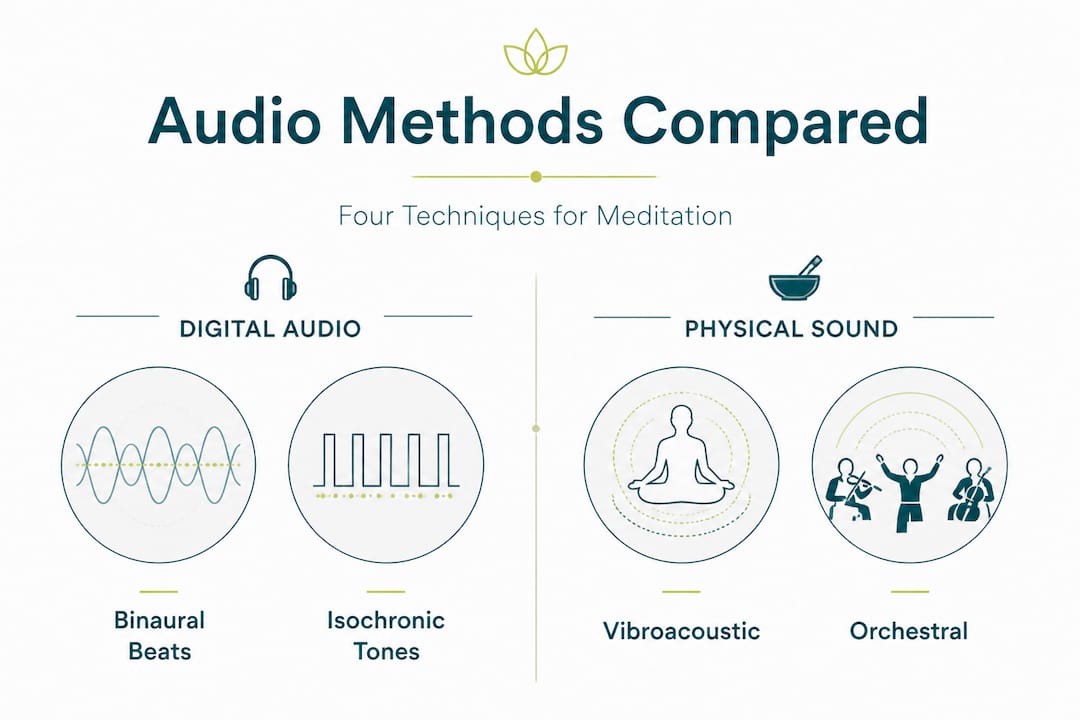
Orchestral soundscapes are often overlooked in the “advanced audio” conversation, which strikes us as rather peculiar given how powerful they can be. A live orchestral recording carries harmonic complexity, dynamic range, and emotional resonance that a synthetic tone simply cannot replicate. The brain engages with orchestral music differently, tracking multiple melodic lines, responding to shifts in dynamics, and processing rich timbre. This multi-layered cognitive engagement can deepen mindfulness rather than passively induce it.
Empirical studies show mixed results for binaural beats on anxiety and stress reduction specifically. Alpha-frequency binaural beats appear more consistently beneficial for relaxation, while interestingly, theta beats in some studies appear to increase stress in certain individuals. This is a useful reminder that “more intense” does not always mean “more beneficial.” The right binaural beats parameters genuinely matter, and experimenting with binaural healing beats best practices will help you find your sweet spot.
| Technique | Mechanism | Best for | Key pro | Key limitation |
|---|---|---|---|---|
| Binaural beats | Dual-tone FFR entrainment | Focus, light-to-deep meditation | Well researched, accessible | Requires headphones, mixed anxiety results |
| Isochronic tones | Single pulsing tone | General relaxation, entrainment | No headphones needed | Some find it distracting |
| Vibroacoustic | Physical vibration | Somatic grounding, deep relaxation | Full-body experience | Expensive equipment |
| Orchestral soundscapes | Harmonic complexity, emotional resonance | Holistic relaxation, mindfulness | Richly immersive, no special setup | Less targeted entrainment |
Here’s a quick guide to matching technique to intent:
- Need sharp focus before meditation: Try gamma or alpha binaural beats with white noise.
- Want deep relaxation or sleep: Alpha binaural beats or brown-noise-layered orchestral music.
- Struggling with body tension or somatic stress: Explore vibroacoustic options or low-frequency orchestral bass.
- Seeking emotional depth and mindfulness: Orchestral soundscapes with dynamic variation.
- Prefer no headphones: Isochronic tones played through quality speakers.
- Combining techniques: Layer soft orchestral music beneath binaural beats for a richer, more engaging experience.
The role of orchestral soundscapes and 3D audio in modern meditation
Here’s where things get genuinely exciting. Synthetic tones are useful tools, no doubt about it, but they do have something of a flatness to them. A single pulsing frequency, however cleverly engineered, doesn’t breathe. Orchestral music does. It swells and retreats, carries emotional colour, and speaks to parts of the brain that a 40 Hz tone simply can’t reach.
Live orchestral recordings, particularly those made with high-quality microphones in acoustically rich spaces (Abbey Road Studios, for instance, has a rather legendary acoustic signature), carry spatial information in the audio itself. Your brain unconsciously processes this spatial data, and it contributes to a sense of immersion and presence during meditation. You’re not just hearing music. You’re inside it.
The science around 3D sound meditation benefits is increasingly compelling. 3D VR soundscapes affect the autonomic nervous system for stress response modulation, though research suggests this works primarily through the parasympathetic nervous system rather than via the HPA axis (the hypothalamic-pituitary-adrenal axis, which governs cortisol). Translation: 3D audio reliably reduces heart rate and promotes calm, but may not always lower cortisol specifically. That’s still a very meaningful outcome for meditation purposes.
3D audio works by encoding directional information into a stereo signal using a technique called binaural rendering. Done well, sounds appear to come from above, behind, or around you, not just left and right. In meditation, this creates a remarkable sense of spatial freedom that can feel almost like dissolving the walls of the room. For those who practise body-scan meditation or visualisation, a scientific meditation soundscapes approach using 3D audio adds a dimension that genuinely enhances the experience.
Here’s how to set up an immersive orchestral or 3D audio meditation session at home:
- Choose quality headphones. Open-back, over-ear headphones reproduce spatial audio most accurately. They let the sound breathe rather than trapping it in a pressurised bubble around your ears.
- Source genuine 3D or binaural recordings. Not all “3D audio” is created equal. Look for content specifically mixed in binaural or Ambisonic formats, or recorded with high-quality orchestral ensembles in naturally reverberant spaces.
- Set your listening volume. Loud is not better. A volume where you can comfortably hear detail without straining is ideal, roughly conversational level or slightly above.
- Prepare your space. Dim the lights, remove visual distractions, and ideally adopt a comfortable posture that you can hold without fidgeting for 20 to 45 minutes.
- Settle before pressing play. Spend two to three minutes in silence to allow your nervous system to shift down from daily gear. Then introduce the audio as the session begins.
- Avoid actively listening. Let the music wash over you rather than following it analytically. Your brain will do the rest.
Pro Tip: True 3D audio loses much of its spatial effect if you listen on phone speakers or earbuds. Invest in a decent pair of over-ear headphones, and the immersive difference will genuinely surprise you.
Scientific boundaries, myths, and best practice for choosing your audio
Right, we need to have an honest conversation here, because the wellness audio space does have a tendency to get a little… enthusiastic with its claims.
Let’s clear the air on a few persistent myths:
- “Advanced audio techniques work for everyone.” They don’t. Individual variation in how the brain responds to audio entrainment is real and significant. Genetics, prior meditation experience, and even current stress levels all influence the effect.
- “Any theta frequency will produce deep meditation.” Frequency choice matters, as does the delivery mechanism, the carrier tone, and the listening context. A crudely made theta track is not equivalent to a precision-engineered binaural session.
- “More sessions automatically means better results.” There’s no compelling evidence for a simple dose-response relationship. Quality of attention during the session matters as much as frequency of use.
- “Advanced audio replaces the need for meditation practice.” It doesn’t, and it was never meant to. Think of it as a tool that lowers the barrier, not a substitute for the practice itself.
- “Solfeggio frequencies have all been scientifically proven.” Some frequency-based approaches carry far more robust evidence than others. Be curious, but be discerning.
“While binaural beats and related techniques show promise for relaxation and mindfulness support, the current evidence remains preliminary and mixed. Well-designed randomised controlled trials are still needed before standardised recommendations can be made.” (Contrasting views on BB effects)
What does this mean practically? It means you should approach advanced audio as a healing with meditation music practitioner rather than a passive consumer. Experiment actively. Try a specific technique for two weeks, note your subjective experience, track your sleep quality and stress levels, then compare with a different approach.
If you want a structured way into this, start with healing frequencies for meditation and build from there. And if you have a neurological condition, epilepsy in particular, please consult a specialist before experimenting with rhythmic audio entrainment. This is not dramatic caution, it’s simply sensible.
The honest truth is that the science is genuinely exciting, genuinely promising, and genuinely incomplete. Sitting in that productive uncertainty, experimenting with rigour and curiosity, is actually the most advanced thing you can do.
What most meditation guides miss about advanced audio
I’ll be frank: the majority of mainstream meditation guides treat audio as an afterthought. “Put on some calming music” or “try silence” is about as specific as most of them get, which is a bit like a chef saying “add some heat” without specifying temperature, technique, or duration. It misses the entire craft.
The assumption seems to be that advanced audio is somehow complicated or niche, the kind of thing reserved for sound healing specialists or neuroscience researchers. But using a theta binaural beat track during your morning sit is no more “advanced” than choosing a particular tea to drink beforehand. It’s a small, considered choice that makes a tangible difference. The barrier to entry is genuinely low.
What separates effective audio-supported meditation from ineffective attempts is personalisation. The person who finds alpha binaural beats profoundly relaxing may find the same track mildly annoying, because their resting brain activity is already in alpha. The person who thrives with orchestral soundscapes may find isochronic tones irritating rather than calming. None of this represents failure. It represents neurodiversity, and it’s an invitation to explore rather than a reason to give up.
My strong suggestion is this: treat your audio environment as an active, ongoing experiment. Log what you use, note how quickly you settle, track whether your post-meditation state feels genuinely different from baseline. After a month of this, you’ll have genuinely useful personal data that no article or study can give you.
Meditation is as much art as science. The frequencies, the harmonics, the spatial audio are your palette. The practice of sitting, breathing, and allowing the mind to settle is your canvas. What you create at the intersection of the two is, in the truest sense, yours. The deeper meditative states that serious practitioners describe are not mystical accidents. They’re the product of conscious, repeated choices about environment, technique, and attention. Advanced audio is simply one of the most elegant tools available for making those choices count.
The broader meditation community, I think, is slowly catching up to this understanding. The tide is turning away from dogmatic silence and towards a more nuanced, evidence-curious approach to practice. If you’re reading this, you’re probably already ahead of the curve. Stay curious.
Enhance your meditation with orchestral audio
Everything we’ve covered points to one practical conclusion: the quality and intentionality of your audio environment matters enormously for meditation depth. If you’re ready to move beyond generic playlists and experience what precisely crafted, immersive orchestral soundscapes can actually do for your practice, we’d love to show you.
At Orchestral Meditations, our recordings are made with live musicians, including sessions at Abbey Road Studios with the National Philharmonic, and engineered specifically for meditative use. We layer binaural beats, theta frequencies, and 3D spatial audio within full orchestral compositions, creating a listening experience that is genuinely unlike anything produced synthetically. Browse our orchestral meditation music library, or if you’d like a curated starting point, explore our guide to the best meditation music for your personal practice.
Frequently asked questions
What are the best frequencies for meditation using advanced audio?
Frequencies in the alpha and theta ranges (8 to 13 Hz for alpha, 4 to 7 Hz for theta) most reliably support relaxation and meditative depth, but individual responses do vary, so personal experimentation is always worthwhile.
Can binaural beats relieve stress and anxiety?
Some studies show alpha binaural beats may reduce stress, but as mixed results across studies indicate, responses are highly individual and further robust research is still needed before firm recommendations can be made.
Do orchestral and 3D soundscapes improve meditation outcomes?
3D soundscapes modulate the autonomic nervous system, reliably promoting parasympathetic calm, though effects on cortisol specifically are less consistent and individual preference plays a significant role in overall benefit.
Are there any risks to using advanced audio techniques in meditation?
For healthy adults, most advanced audio techniques are considered safe for regular use, but anyone with epilepsy, a seizure history, or other neurological conditions should consult a qualified specialist before experimenting with rhythmic entrainment audio.
How can I know which audio technique will work best for me?
Experiment methodically with one technique at a time over at least two weeks, keep brief notes on your relaxation depth and post-session state, and let your lived experience guide you towards what genuinely works for your unique neurology.