Finding a relaxation technique that actually works for you is a bit like wandering into an enormous bookshop with no idea what you want to read. There are hundreds of options, they all look promising on the cover, and you could easily spend an hour browsing before leaving with nothing. The good news is that the research on relaxation is genuinely rich, the variety of techniques is genuinely useful, and immersive auditory experiences, think orchestral soundscapes layered with binaural frequencies, can be the thread that ties everything together and keeps you coming back to your practice day after day.
Key Takeaways
| Point | Details |
|---|---|
| Regular practice matters | Daily routines with guided audio greatly improve relaxation outcomes. |
| Diverse methods available | Techniques range from breathing and PMR to mindfulness, imagery, and movement-based practices. |
| Immersive audio enhances results | Auditory guidance helps deepen relaxation responses and makes practices easier to follow. |
| Evidence supports short-term benefits | Relaxation techniques reduce anxiety, blood pressure, and assist sleep, especially when practised consistently. |
| Best results combine methods | Mixing relaxation methods with self-care, exercise, and nutrition provides greater long-term wellness impact. |
Criteria for selecting effective relaxation techniques
Before we charge headlong into the buffet of relaxation options, it helps to know what you are actually looking for. Not every technique suits every person, and the wrong fit can make you feel more stressed than when you started (which is, to put it mildly, counterproductive).
Here are the core criteria worth considering when choosing a technique:
- Consistency potential: Will you actually practise this regularly, or does it feel like something you will try once and abandon like a gym membership in February?
- Personalisation: Does it align with your comfort level, personality, and wellness goals? A competitive personality might find passive body scans frustrating at first.
- Integration: Can it sit alongside your existing habits, such as exercise, good nutrition, and self-care routines?
- Accessibility: Is it something you can do at home, at work, or while travelling without specialist equipment?
- Immersive audio compatibility: Does pairing it with guided audio or ambient soundscapes deepen the experience and make it easier to sustain?
The audio healing benefits of pairing orchestral sound with these techniques are well documented and genuinely significant. Research consistently shows that immersive audio boosts adherence, meaning you are more likely to keep practising, and deepens the physiological relaxation response so that short sessions produce more tangible results.
One critical nuance worth flagging: expert guidance notes that you should practise when calm rather than waiting for a crisis, individualise your approach, combine methods with broader lifestyle habits like exercise and self-care, and remember these techniques are complements to, not replacements for, medical care. That last point matters more than people realise. Relaxation techniques are powerful tools, but they are not a substitute for professional healthcare when that is what you need.
Pro Tip: Start with whichever technique feels least intimidating. The best relaxation method is the one you will actually use. Build the habit first, then refine the method.
Short-term benefits from almost all evidence-backed techniques are strong. The challenge is sustaining them, and that is precisely where consistent practice, combined with the right auditory environment, makes all the difference.
Progressive muscle relaxation (PMR) and deep breathing
These two techniques are the bread and butter of evidence-based relaxation, and I say that with enormous affection rather than dismissiveness. They are foundational because they work, they are teachable, and they pair beautifully with guided audio.
Progressive muscle relaxation step by step:
- Find a comfortable position, either lying down or seated in a supportive chair.
- Close your eyes and take three slow, natural breaths.
- Begin with your feet. Tense the muscles firmly for five to seven seconds, then release completely for twenty to thirty seconds. Notice the contrast.
- Move upward through your calves, thighs, abdomen, hands, arms, shoulders, neck, and face.
- With each release, let your breath out slowly and allow the tension to dissolve.
- At the end, rest for a few minutes in the stillness before returning to activity.
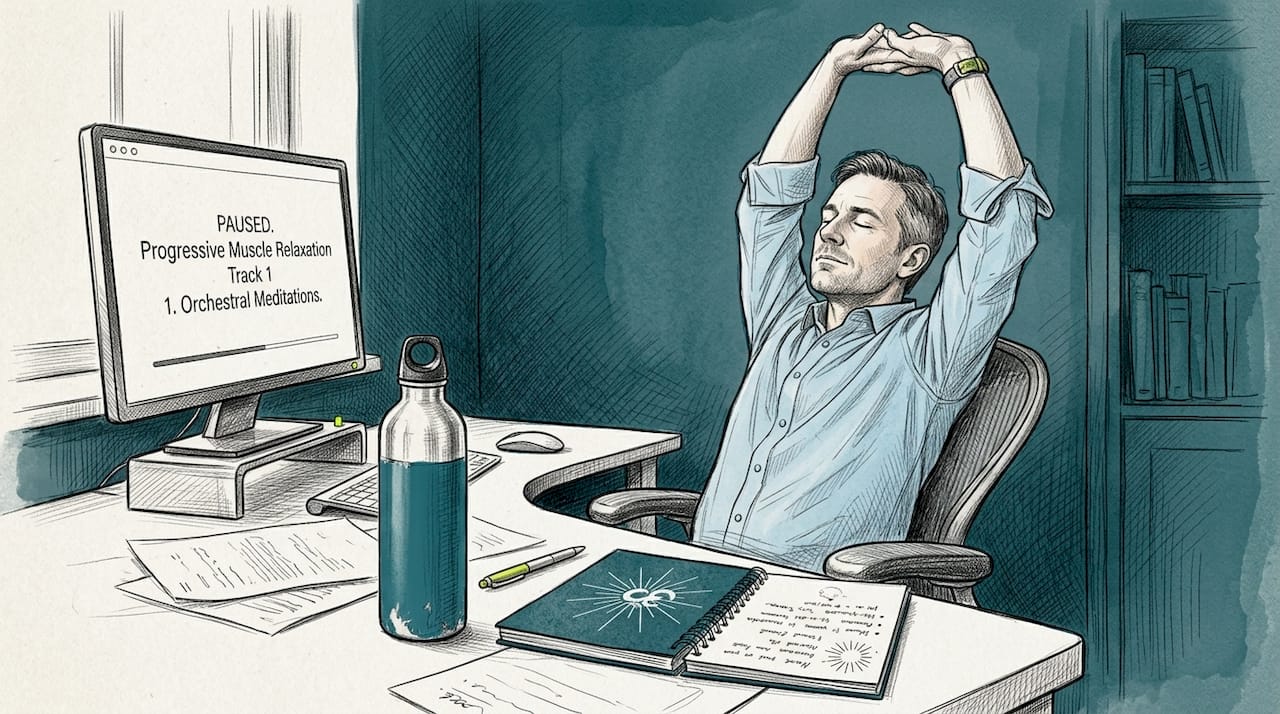
Progressive muscle relaxation works by having you sequentially tense and then relax muscle groups from feet to head, releasing physical tension and promoting genuine mental calm. The contrast between tension and release is what makes it so effective: your nervous system essentially gets a lesson in what relaxation actually feels like in the body. People who struggle with anxiety often carry chronic muscle tension without even realising it, and PMR is remarkably good at surfacing and dissolving that.
Deep breathing techniques:
Box breathing and 4-7-8 breathing are the two most studied structured breathing methods. The 4-7-8 breathing method, where you inhale for four counts, hold for seven, and exhale for eight, directly activates the parasympathetic nervous system, the “rest and digest” counterpart to our stress-driven fight-or-flight response. Box breathing, inhaling for four, holding for four, exhaling for four, and pausing for four, is used by everyone from Navy SEALs to anxious commuters, and for good reason.
Statistic: Deep breathing exercises done consistently have been shown to reduce systolic blood pressure by up to 10 mmHg in short-term studies, making them one of the most accessible cardiovascular tools available without a prescription.
Adding guided audio to both PMR and breathing practice transforms them considerably. Rather than counting silently in your head (which often becomes a distraction spiral), a deep relaxation guide with orchestral accompaniment gives you an external anchor. The music fills the silence, the guidance gives your mind structure, and the frequencies embedded in the audio do additional physiological work beneath your conscious awareness.
Pro Tip: Practise 4-7-8 breathing for just four cycles before bed. It feels slightly ridiculous the first time. By the third night, you will wonder how you managed without it. Pair it with guided meditation steps to anchor the practice in a fuller routine.
Mindfulness, body scan, and guided imagery
If PMR is the practical workhorse of relaxation, mindfulness is the philosopher king: slightly more abstract, requiring patience, but capable of genuinely transforming your relationship with stress over time.
Mindfulness in practice:
Mindfulness is deceptively simple. You pay attention to the present moment without judging what you find there. That is it. No special equipment, no complicated postures. Mindfulness exercises can take the form of focused breath awareness, mindful walking (genuinely underrated as a starting point), or even mindful eating. The key is gentle, curious attention rather than forced concentration.
The body scan is a specific form of mindfulness that deserves its own spotlight. You move your attention slowly through each area of the body, noticing sensations, tension, or discomfort without trying to fix anything. Think of it as a kind, unhurried inventory of your own physical state. Most people are genuinely surprised by what they discover: jaw tension, shoulder tightness, a low-grade ache they had been ignoring for weeks.
Guided imagery:
Guided imagery takes a different angle entirely. Rather than observing what is present in your body, you actively construct a mental environment, typically a peaceful scene drawn from nature or memory, and breathe into that space. Visualisation techniques like these are sometimes combined with what therapists call “squeegee breath,” which is exactly as entertaining as it sounds: you imagine breathing out negativity as if wiping it away like condensation from a window. Slightly cartoonish? Yes. Effective? Also yes.
Here are the core benefits each technique brings:
- Mindfulness: Builds long-term resilience to stress; supports emotional regulation; compatible with almost any lifestyle.
- Body scan: Increases somatic (body-level) awareness; particularly useful for those who tend to intellectualise rather than feel.
- Guided imagery: Engages creative and emotional faculties; useful for those who find pure breath awareness frustrating.
A mindfulness meditation guide with orchestral accompaniment is particularly effective here because the music gives the imagination something rich to work with. When you pair guided imagery with layered orchestral sound, the mental landscape becomes far more vivid, which enhances the emotional depth of the session. Exploring the right soundscapes for relaxation matters more than people typically acknowledge when setting up a home practice.
Movement-based techniques and autogenic training
Not everyone can sit still. I say this with complete empathy because I am one of those people. If the idea of sitting quietly for twenty minutes makes you want to crawl out of your skin, movement-based relaxation is not a compromise: it is a genuinely excellent alternative with strong evidence behind it.
Yoga, tai chi, and qigong:
All three of these practices integrate movement, breath, and mental focus in ways that produce the relaxation response reliably. They differ in character: yoga tends toward held postures and strength; tai chi uses slow, flowing sequences with martial origins; qigong focuses on energy cultivation through gentle movement and breathwork. But the underlying mechanism is similar. When you synchronise movement with breath and pay deliberate attention to the body, you activate the same parasympathetic response as sitting meditation, often more easily because the body’s movement gives the restless mind something to track.
Benefits across all three include improved balance, greater flexibility, reduced cortisol levels, and enhanced mood. For those new to meditation who find stillness counterproductive, these are the ideal entry points.
Autogenic training:
Autogenic training is perhaps the most underrated technique on this list. Developed by psychiatrist Johannes Heinrich Schultz in the early 20th century, it uses a series of verbal cues, either spoken aloud, read from a script, or delivered via guided audio, to induce physical sensations of warmth and heaviness throughout the body. You essentially talk your nervous system into relaxing, which sounds improbable but is backed by decades of research.
| Technique | Primary mechanism | Best for | Audio compatibility |
|---|---|---|---|
| Yoga | Movement and breath | Flexibility, strength, stress | Ambient/orchestral |
| Tai chi | Slow movement flow | Balance, calm, older adults | Gentle instrumental |
| Qigong | Energy and breath | Energy cultivation, focus | Nature sounds, soft music |
| Autogenic training | Verbal self-suggestion | Deep physiological relaxation | Guided spoken audio |
Adding 3D sound meditation to autogenic training is a particularly compelling combination. The spatial audio wraps around you like a warm room, reinforcing the physical sensations of warmth and heaviness that autogenic training aims to produce. Understanding how sound frequencies drive relaxation also helps you choose the right accompaniment for each practice.
Comparison and evidence: Relaxation techniques at a glance
Let us look at the actual evidence rather than just the theory, because this is where things get interesting and occasionally humbling for those of us who assumed we already knew which technique was “best.”
Statistic: Relaxation techniques reduce systolic blood pressure by 6 to 10 mmHg in short-term studies among people with hypertension, and evidence supports their role in improving sleep quality, reducing anxiety, managing depression, and lowering fatigue.
| Technique | Evidence for sleep | Evidence for anxiety | Evidence for blood pressure | Ease of learning |
|---|---|---|---|---|
| PMR | Strong | Strong | Moderate | Easy |
| Deep breathing | Moderate | Strong | Strong | Very easy |
| Mindfulness | Strong | Very strong | Moderate | Moderate |
| Body scan | Moderate | Strong | Low | Moderate |
| Guided imagery | Moderate | Moderate | Low | Easy |
| Yoga | Strong | Strong | Moderate | Moderate |
| Autogenic training | Moderate | Strong | Moderate | Requires learning |
The mechanisms underlying these effects include parasympathetic nervous system activation, reduced cortisol and adrenaline, altered brain wave patterns, and a shift toward slower, more coherent neural activity. These techniques work best as adjuncts to a healthy lifestyle rather than standalone interventions, which echoes the expert guidance mentioned earlier.
Key practical takeaways from the evidence:
- Combine methods: Layering PMR with mindfulness or deep breathing with guided imagery produces stronger outcomes than any single technique used in isolation.
- Daily practice matters: Brief daily sessions outperform occasional long ones in terms of sustained benefit.
- Guided audio enhances outcomes: Apps, recordings, and immersive audio tools significantly improve both adherence and depth of relaxation.
- Manage expectations: Some people experience immediate calm; others need several weeks of consistent practice before noticing meaningful change.
The science behind relaxation music confirms what most of us sense intuitively: sound shapes our physiological state in ways that conscious intention alone often cannot. If you are building a personal practice, a relaxation checklist can help you select the right audio accompaniment for each method. And for those whose primary goal is better sleep, meditation and sleep music designed specifically for that transition state is particularly worth exploring.
Pro Tip: Track your practice for just two weeks with a simple journal note after each session: what you did, how long, and how you felt after. The patterns that emerge will tell you more about your personal ideal technique than any article ever could.
Beyond the list: What really works for lasting relaxation
Here is something most relaxation guides will not tell you, and I think it matters enormously. Not every meditation state is purely relaxing in the traditional sense. Some forms of focused meditation actually produce a state of “relaxed alertness” rather than deep sedation, with mild sympathetic arousal running beneath the calm. This is not a failure. It is a different mode of consciousness, one that has its own value and its own applications.
The implication is that if you finish a mindfulness session feeling gently alert rather than drowsy, that is not evidence the technique did not work. It may simply have done a different kind of work. Context matters: a body scan before bed calls for something different from a mindfulness session before a creative project.
I have also noticed, both personally and through the feedback we receive, that people often abandon relaxation techniques not because they do not work but because they make the practice feel like another item on the to-do list. That framing is lethal. Relaxation practice has to be something you are drawn to, not something you dutifully complete. That is precisely why the quality and character of your auditory environment is not a trivial detail. The right music, at the right frequency, delivered through the right spatial audio experience, can transform a reluctant obligation into something you genuinely look forward to.
The research comparing relaxation techniques to cognitive behavioural therapy (CBT) is genuinely interesting too. Effects are comparable in several domains, particularly anxiety and sleep, though methodological limitations mean we should hold those findings with appropriate care. What it does suggest is that these are not lightweight lifestyle tweaks. They are meaningful psychological interventions worth taking seriously.
My honest advice? Build a small repertoire rather than committing dogmatically to one method. Do PMR on high-stress evenings. Use a mindful walk on restless mornings. Reserve guided imagery for those days when your mind is buzzing so loudly that stillness feels impossible. And let immersive audio healing weave through all of it as the consistent auditory thread that tells your nervous system: we are doing this now, it is safe to let go.
Enhance your practice with orchestral meditation resources
If you have made it this far and you are thinking “right, I know what I want to try, now where do I find something worth actually listening to,” then you are asking exactly the right question.
At Orchestral Meditations, every recording is produced with the depth and care your practice deserves. Our library of meditation music, recorded at Abbey Road Studios with the National Philharmonic, spans everything from theta frequency soundscapes for deep PMR sessions to sweeping orchestral compositions built for guided imagery and mindfulness. Explore our best meditation music curated for individual needs, or browse the full range of music for meditation uses to find the recordings that match your specific relaxation goals. Whether you are a beginner building your first practice or an experienced meditator seeking richer auditory depth, there is something here for you.
Frequently asked questions
Which relaxation technique is most effective for improving sleep?
Mindfulness and progressive muscle relaxation are both evidence-backed for sleep, with PMR particularly useful for people who carry physical tension into the night and mindfulness effective for those whose minds race at bedtime.
How do immersive audio experiences enhance relaxation techniques?
Guided audio deepens relaxation by providing external structure for the mind, reducing the cognitive effort of self-guidance, and embedding frequency-based cues that shift brain wave activity toward calmer states.
Can relaxation techniques help with anxiety and stress?
Yes, and substantially so: evidence shows consistent reductions in anxiety, blood pressure, and perceived stress across multiple populations, with effects strong enough to be comparable to structured psychological interventions in some contexts.
Do I need to practise relaxation techniques daily for best results?
Daily practice is strongly recommended because regular sessions sustain the benefits in ways that occasional practice simply cannot; even ten minutes a day produces measurable physiological and psychological changes over time.
Are relaxation techniques a replacement for medical care?
No: as expert guidance makes clear, these techniques are powerful complements to a healthy lifestyle and, where relevant, to professional medical or psychological care, but they are not substitutes for either.