
You know that feeling when you’ve finally sat down to meditate, closed your eyes, and then immediately started composing a mental shopping list? Yes, we’ve all been there. Proper deep relaxation is genuinely hard to achieve, and modern life is essentially conspiring against you at every turn. The encouraging news is that music interventions measurably reduce salivary cortisol by up to 7.0 µg/dL, which is the kind of scientific shortcut that makes a stressed meditator sit up and pay attention. This guide will walk you through how to use orchestral relaxation music effectively, how to personalise your sessions, and how to tell whether any of it is actually working.
Key Takeaways
| Point | Details |
|---|---|
| Science-backed relaxation | Orchestral music can significantly reduce stress hormones and deepen mindfulness. |
| Optimal setup matters | Carefully preparing your environment and session tools boosts relaxation benefits. |
| Guided process for success | Following a structured approach ensures consistently effective relaxation sessions. |
| Personalisation enhances results | Adapting playlists and approaches to your preferences drives greater engagement. |
| Continuous tracking improves outcomes | Regularly assessing your sessions helps you avoid mistakes and refine your practice. |
Preparing for an effective deep relaxation session
After understanding the profound effects music can have on your nervous system, it’s essential to create the right atmosphere for your session. Think of it like cooking a proper roast: the ingredients matter, yes, but so does having a functioning oven and not attempting it in a room full of screaming toddlers.
Choosing a calm, distraction-free space isn’t just polite advice; it’s genuinely critical. Your nervous system needs a consistent environmental cue that says “we are relaxing now,” and that cue cannot include notification pings, the neighbour’s lawnmower, or someone in the hallway asking where the sellotape is. A quiet room with the door closed, ideally at a comfortable temperature, is the non-negotiable baseline.
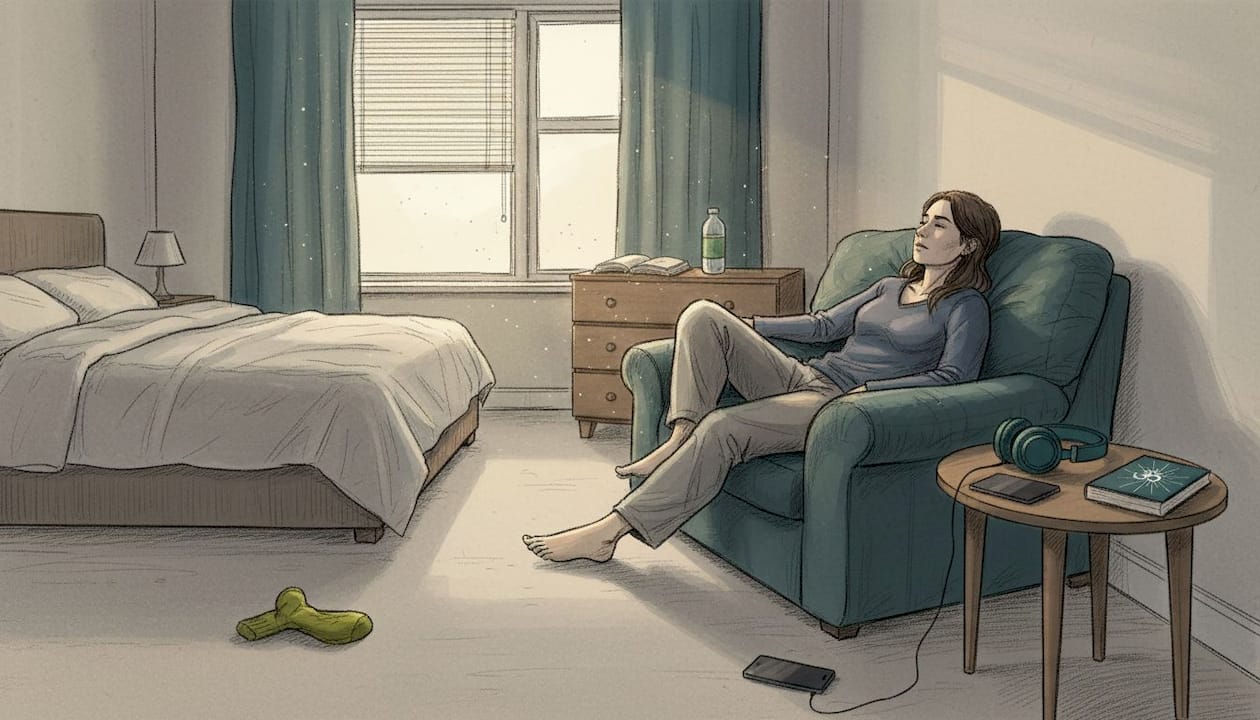
Here’s what you’ll actually need, broken into the essentials versus the pleasant extras:
| Essential | Nice-to-have |
|---|---|
| A quality orchestral track or playlist | Surround sound speakers or audiophile headphones |
| Headphones or speakers with decent frequency response | Aromatherapy diffuser with lavender or sandalwood |
| Comfortable seating or lying surface | Weighted blanket or bolster cushion |
| Dimmed or natural lighting | Eye mask to block residual light |
| A timer set to your session length | Journalling notebook for post-session reflections |
| Loose, comfortable clothing | A dedicated meditation cushion |
Notice that the essentials list is refreshingly short. You don’t need a spa. You need decent audio, something comfortable to sit or lie on, and a space that isn’t actively hostile to peace. Everything else is lovely but optional, especially when you’re just starting out and still figuring out whether you’re even a “relaxation music person” (spoiler: you probably are).
When it comes to choosing your audio setup, quality matters more than people realise. Orchestral music, particularly the kind recorded with the full dynamic range of a live ensemble, loses enormous depth when played through tinny laptop speakers. A decent pair of over-ear headphones makes a disproportionate difference. If you want to check which features to look for before committing to a track or playlist, this relaxation music checklist covers the selection criteria clearly.
One more thing before you press play. Research shows that combined progressive muscle relaxation and music produces significantly better outcomes for stress, anxiety, and depression than music alone. So if you’re inclined, spend two or three minutes before your session doing a quick body scan or tensing and releasing major muscle groups from your feet upward. It primes your nervous system beautifully and makes the subsequent music experience feel almost embarrassingly good.
A few practical tips for your environment:
- Keep your phone on aeroplane mode or in another room entirely (you know you won’t resist it otherwise)
- Set a gentle alarm so you’re not mentally calculating elapsed time
- Adjust room temperature beforehand; getting up mid-session to fiddle with the thermostat is profoundly unhelpful
- Inform anyone in your household that you’re unavailable for the next 20 minutes (firmly, but without drama)
- Dim screens and artificial lighting at least five minutes before starting to help your eyes and nervous system shift down a gear
Pro Tip: Try to begin your session at the same time each day if possible. Your nervous system learns rhythms surprisingly quickly, and within a week or two, just sitting down in your chosen spot will start triggering a relaxation response before the music has even begun. Pavlov would be delighted.
Step-by-step guide: Using orchestral music for deep relaxation
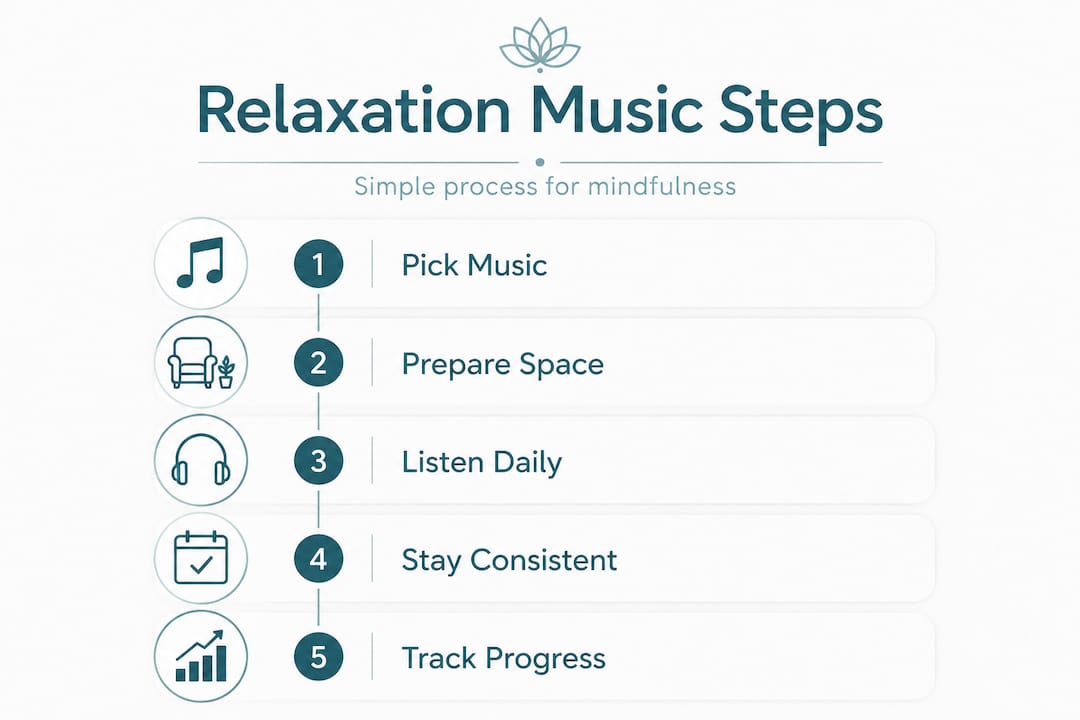
With your space and mindset prepared, you can now follow a structured approach to relaxation with orchestral music. This isn’t a rigid protocol, but having a loose framework prevents that slightly awkward “wait, now what?” moment that derails many first attempts.
Here is a straightforward 20-minute session structure that we’d genuinely recommend as your starting point:
-
Settle into your position (minutes 0-2). Sit or lie comfortably. Close your eyes. Take three slow, deliberate breaths, making each exhale slightly longer than the inhale. Don’t force anything; just let your body arrive in the room.
-
Begin your orchestral track (minute 2). Start with something that opens quietly and builds gradually. Avoid pieces that begin with dramatic brass fanfares, which is not quite the vibe we’re after here.
-
Follow the music with passive attention (minutes 2-10). Rather than analysing what you’re hearing, let the sound wash over you. If a thought appears (and it will, probably about emails), acknowledge it without judgement and return your attention to the music. The strings are doing the heavy lifting. Trust them.
-
Deepen with breath synchronisation (minutes 10-16). Once you feel genuinely settled, try gently synchronising your breath with the musical phrasing. Long melodic lines naturally encourage longer exhales. This isn’t a strict exercise, more a soft suggestion to your body.
-
Rest in stillness (minutes 16-19). As the music fades or softens, remain still. This is when many of the parasympathetic benefits consolidate. Resist the urge to check your phone. It can wait genuinely another 60 seconds.
-
Return gradually (minute 19-20). Wiggle fingers and toes, take one deep breath, and open your eyes slowly. Give yourself a moment before standing. You’ve just done something genuinely useful for your wellbeing, and that deserves a brief pause for acknowledgement.
The science behind why this works is worth understanding briefly. Orchestral meditation music can lower cortisol by up to 7 µg/dL, which is a genuinely meaningful physiological shift. Cortisol is your primary stress hormone, and reducing it measurably within a single session is the kind of result most wellness practices take weeks to demonstrate. If you want to understand more about why this happens at a neurological level, the music for stress relief science behind it is worth reading, as is this broader exploration of holistic orchestral soundscapes and their therapeutic applications.
Now, a question worth addressing: should you use a prescribed orchestral track or your own self-selected playlist? Both have merit, but they suit different situations.
| Prescribed orchestral music | Self-selected playlist | |
|---|---|---|
| Best for | Acute stress, clinical or high-pressure situations | Daily mindfulness, ongoing practice |
| Key benefit | Scientifically structured for optimal relaxation response | Higher personal engagement and enjoyment |
| Potential drawback | May feel clinical or unfamiliar at first | May include pieces that inadvertently trigger memories or emotions |
| Recommended session length | 20-30 minutes | 15-45 minutes depending on preference |
| Ideal listener | Beginners or those seeking measurable outcomes | Experienced meditators personalising their practice |
Pro Tip: Brief daily sessions of 15-20 minutes genuinely outperform occasional marathon efforts of an hour or more. Your nervous system responds to consistency the way a garden responds to regular watering: show up reliably with modest amounts, and things bloom. Neglect it for two weeks and then drench it with a single enormous session, and the results are considerably less impressive.
Personalising your experience: Playlists, frequencies, and alternative approaches
Now that you know the standard process, you can adapt and enhance your sessions for maximum resonance with your personal needs. This is where relaxation music goes from effective to genuinely transformative, because no two nervous systems are identical.
Building a playlist for deep relaxation is not quite the same as building a playlist for a dinner party. Different relaxation goals call for different musical architectures. Someone working through acute anxiety needs something quite different from a practitioner using music to deepen an established meditation practice.
Here are some practical playlist-building tips to help you tailor your experience:
- Start slow, build gently, end even slower. Open with 2-3 quieter, lower-tempo pieces before introducing anything with more orchestral complexity. Ending with something minimal and sparse helps your nervous system transition out of the session gracefully.
- Aim for 40-60 BPM for deep relaxation. This is the range most commonly associated with a relaxed heart rate and parasympathetic activation. Many classical adagio movements sit naturally in this range.
- Blend orchestral and frequency-based pieces thoughtfully. You might begin with a theta frequency track (4-7 Hz entrainment embedded in orchestral music) to encourage brainwave slowing, then move into purely acoustic orchestral pieces once you’ve settled.
- Keep session playlists relatively consistent. Rotating one or two tracks at a time rather than completely reshuffling every session prevents the mental effort of adjusting to unfamiliar material mid-relaxation.
- Avoid pieces with sudden dynamic shifts in early sessions. A dramatic fortissimo swell when you’re half-asleep is not a spiritual awakening; it’s a fright.
- Revisit tracks you initially dismissed. Something that felt too quiet or too slow on a stressed Tuesday afternoon may feel absolutely perfect on a calmer Saturday morning. Context changes perception.
Now, for those of you curious about alternatives to purely orchestral arrangements: solfeggio frequencies are worth knowing about. These are specific tonal frequencies (396 Hz, 528 Hz, 741 Hz, and others) that have roots in ancient musical tradition and are increasingly studied for their potential therapeutic effects.
Solfeggio frequencies operate on a different principle from orchestral music: where an orchestra immerses you in emotional and acoustic richness, solfeggio tones target the body through sustained vibrational resonance. Many practitioners find that combining both approaches, using solfeggio frequencies to open a session and orchestral music to sustain it, creates a uniquely layered experience that neither approach achieves alone.
Personalisation maximises engagement in sustained practice, and sound-based approaches like solfeggio tones are effective in their own right, even if their character differs substantially from orchestral music. If you’d like to explore which frequencies suit which goals, our solfeggio frequency guide breaks it down clearly. There’s also a very readable solfeggio tones guide that’s particularly useful if you’re coming to this for the first time. And if you’re not sure where to begin with different sonic environments altogether, this overview of types of soundscapes will help you find your footing.
When does personalisation outweigh a prescribed approach? Generally, once you’ve established a consistent practice and understand your own patterns, self-direction becomes the more powerful tool. The prescribed approach is excellent scaffolding. Personalisation is what you build once you no longer need it.
Measuring your results and avoiding common pitfalls
Deep relaxation isn’t just about the session itself; verifying benefits and learning from pitfalls is key to long-term success. This is the part most guides either skip entirely or dress up in vague language about “noticing how you feel.” We can do better than that.
Research confirms that music interventions lower anxiety and depression along with cortisol levels, and these changes are measurable with some basic self-monitoring. You don’t need a cortisol testing kit. You need honest observation and a bit of patience.
Tracking your outcomes can be as simple as keeping a brief weekly log. Rate your general stress level on a 1-10 scale before and after each session, note your sleep quality for the following night, and jot down any mood observations. After two to three weeks, patterns become visible. Most people notice that even modest improvements compound meaningfully once they start paying attention.
If you want a structured approach to this kind of tracking, these curated meditation playlists include guidance on matching music to specific relaxation goals, which makes self-assessment considerably more useful.
Warning signs that your setup or music selection may be suboptimal:
- You feel more agitated or restless after sessions than before them (this often signals the music is too fast, too loud, or emotionally activating in unhelpful ways)
- You consistently fall asleep within the first five minutes (the music may be too sedating for active mindfulness, or your baseline fatigue is too high)
- You find yourself switching tracks repeatedly mid-session, which is a clear signal of distraction rather than relaxation
- Sessions feel like obligations rather than nourishing experiences
- You notice no change in mood or stress after three or more consecutive weeks of daily sessions
- Your attention is drawn more to the music’s complexity than to your own internal state
Common pitfalls to sidestep, listed bluntly:
Overthinking the music selection. Spending 25 minutes choosing the perfect track before a 20-minute session is a magnificent way to avoid actually relaxing. Pick something and commit to it.
Constant track changes. Switching pieces every three minutes because something “doesn’t feel right” is the auditory equivalent of rearranging the furniture during a nap. Give each track at least one full listen before deciding.
Inconsistency. A single magnificent session followed by a two-week gap is enjoyable but largely ineffective for building lasting physiological change. Regular modest sessions produce better outcomes than irregular grand ones.
Expecting immediate transformation. Orchestral relaxation music works cumulatively. The first session may feel lovely or slightly odd; the tenth will likely feel qualitatively different in ways that are hard to predict but easy to notice.
If things aren’t working after a genuine four-week effort, the fix is usually small: different tempo, different frequency, different time of day, or the addition of a complementary technique like breath work. Rarely is the answer “this entire approach doesn’t work.” More often, it’s “this particular combination isn’t quite right for me today.”
Our perspective: What most guides get wrong about relaxation music
Having explored practical processes and personalisation, it’s worth considering a few deeper truths that mainstream advice consistently overlooks.
The most common piece of guidance floating around wellness circles is “just find something relaxing to listen to.” As advice goes, it’s not wrong exactly, but it’s about as useful as telling someone to “just eat well.” The nuance matters enormously. We’ve seen experienced meditators plateau for months because they were using loosely curated Spotify playlists when their nervous systems were clearly signalling a need for something more precisely structured.
Here’s the thing: prescribed orchestral music outperforms self-selected choices under high-stress conditions, while personalisation maximises engagement for sustained daily practice. This is not a contradiction. It’s a spectrum, and knowing where you sit on it at any given time is genuinely the skill that separates effective practitioners from well-intentioned ones.
Most guides treat the choice as binary. Either you use prescribed therapeutic music or you follow your personal taste. In reality, the most effective approach shifts depending on your current stress load, your experience level, and your specific goal for any given session. Acute stress calls for scientifically structured compositions, the kind built with intentional dynamic contour, specific tempo ranges, and frequency considerations. Ongoing mindfulness maintenance is where personal preference earns its place.
We’re also sceptical of the idea that more is always better. The science behind orchestral music makes clear that the mechanism operates through entrainment and parasympathetic activation, not through sheer volume or duration of exposure. A 20-minute session with high-quality, purposefully crafted orchestral music can outperform 90 minutes of background ambience that happens to be inoffensive.
The practical takeaway: treat your relaxation music practice with the same intentionality you’d bring to any evidence-based wellness habit. Use prescribed, science-crafted compositions when stress is acute. Lean into personalisation when maintaining a flourishing practice. And resist the comfortable inertia of doing the same thing indefinitely simply because it once worked rather well.
Ready to experience deep relaxation with expertly crafted orchestral music?
If this guide has given you a solid foundation, the natural next step is putting it into practice with music that’s actually been designed with all of this in mind. Not assembled from a general music library, not algorithmically generated, but composed and recorded with therapeutic intention by professionals who understand what your nervous system needs.
At Orchestral Meditations, our recordings are made with live orchestral musicians, including sessions at Abbey Road Studios with the National Philharmonic, and they incorporate binaural beats, theta frequencies, and 3D surround sound precisely because the evidence supports their effectiveness. Whether you’re just beginning or deepening an established practice, our curated orchestral meditation music library offers options for every stage. If you’d like somewhere specific to start, browse our best meditation music selections and find the recordings that match your current relaxation goals. Your nervous system will thank you, possibly in the form of a very good night’s sleep.
Frequently asked questions
How quickly does orchestral relaxation music lower stress?
Studies show measurable cortisol reduction within a single 20-minute session, making it one of the faster-acting evidence-based relaxation tools available. Most people notice a subjective shift in mood even sooner.
Is it better to use prescribed or self-selected music for relaxation?
Prescribed orchestral may outperform self-selected choices in high-stress situations, while self-selected music tends to boost engagement and consistency in daily mindfulness practice. The wisest approach uses both strategically.
Can I combine relaxation music with other techniques for better results?
Absolutely, and the evidence strongly suggests you should. Combined progressive muscle relaxation and music produces significantly greater reductions in stress, anxiety, and depression than either approach on its own.
What makes orchestral music different from solfeggio frequencies?
Orchestral music creates immersive, emotionally rich soundscapes that guide the nervous system through dynamic musical architecture, while solfeggio tones target healing through sustained vibrational resonance at specific frequencies. Many practitioners find the two approaches complement each other beautifully.
How do I know if my relaxation sessions are working?
You should notice lower stress, improved mood, and better sleep quality after consistent sessions. Music interventions measurably lower anxiety and cortisol with regular use, so tracking your stress levels weekly on a simple scale will make progress visible within two to three weeks.