
Not all meditation music is created equal. In fact, some of it is precisely engineered using neuroscience principles to nudge your brain into states of deep relaxation, focused awareness, and genuine stillness. Scientifically crafted meditation music refers to audio designed using brainwave entrainment techniques like binaural beats, isochronic tones, and specific frequencies such as 528Hz solfeggio to induce targeted brain states, particularly the theta range of 4 to 8Hz, associated with deep meditation. If you’ve ever wondered why one playlist leaves you genuinely calm while another just gives you a nice background hum, this article is for you.
Key Takeaways
| Point | Details |
|---|---|
| Neuroscience drives sound design | Scientifically crafted meditation music uses brainwave entrainment to target relaxation and mindfulness states. |
| Evidence is promising but nuanced | Peer-reviewed studies show positive effects, yet results depend on individual response and track quality. |
| Personalisation enhances efficacy | Tailored parameters and personal testing lead to better outcomes compared to generic solutions. |
| Practical selection matters | Instrumental, predictable genres and mindful experimentation yield the most rewarding meditation experiences. |
What is scientifically crafted meditation music?
Now that you know meditation music can be scientifically engineered, let’s unpack what makes it distinct and how it’s actually created. Because there’s a meaningful difference between someone uploading rain sounds to a streaming platform and a composer deliberately designing audio to shift your neurological state. The gap between those two things is, frankly, enormous.

Scientifically crafted meditation music is built on a concept called brainwave entrainment. The idea is relatively simple: your brain has a tendency to synchronise its electrical activity with rhythmic external stimuli. Play the right kind of audio signal, and your brainwaves will follow along, much like how you naturally tap your foot to a beat without consciously deciding to do it. Researchers have been designing entrainment-based audio for decades, and the science has become increasingly precise.
The three main techniques used in this space are:
- Binaural beats: Two slightly different frequencies are delivered separately to each ear through headphones. Your brain perceives a third frequency, the mathematical difference between the two, and begins to synchronise with it. So if your left ear hears 200Hz and your right ear hears 190Hz, your brain registers a 10Hz beat, which sits in the alpha frequency range associated with calm alertness.
- Isochronic tones: A single tone that pulses on and off at a specific rate. Unlike binaural beats, these don’t require headphones, though they can sound a bit more mechanical to some listeners.
- Solfeggio frequencies: Specific tones, like 528Hz or 432Hz, said to carry particular healing or resonant properties. The evidence here is more contested, but the frequencies are widely used in wellness contexts.
The relaxation science behind all of this points particularly to the theta brainwave state (4 to 8Hz) as the sweet spot for deep meditation. Theta is the state you’re in just before sleep, during vivid daydreaming, or in the deepest stages of mindfulness practice. It’s associated with reduced cortisol, heightened creativity, and a loosening of the mental chatter that makes meditation so difficult for most people. Getting there without years of dedicated practice is, quite naturally, appealing.
Here’s a quick comparison of the main entrainment approaches to help you choose what suits your practice:
| Method | Headphones needed? | Sound experience | Best for |
|---|---|---|---|
| Binaural beats | Yes | Subtle, tonal hum | Deep meditation, sleep |
| Isochronic tones | No | Rhythmic pulsing | Focus, alertness |
| Solfeggio frequencies | No | Tonal/musical | Relaxation, spiritual practice |
| Orchestral ambient | No | Rich, immersive layers | Sustained mindfulness sessions |
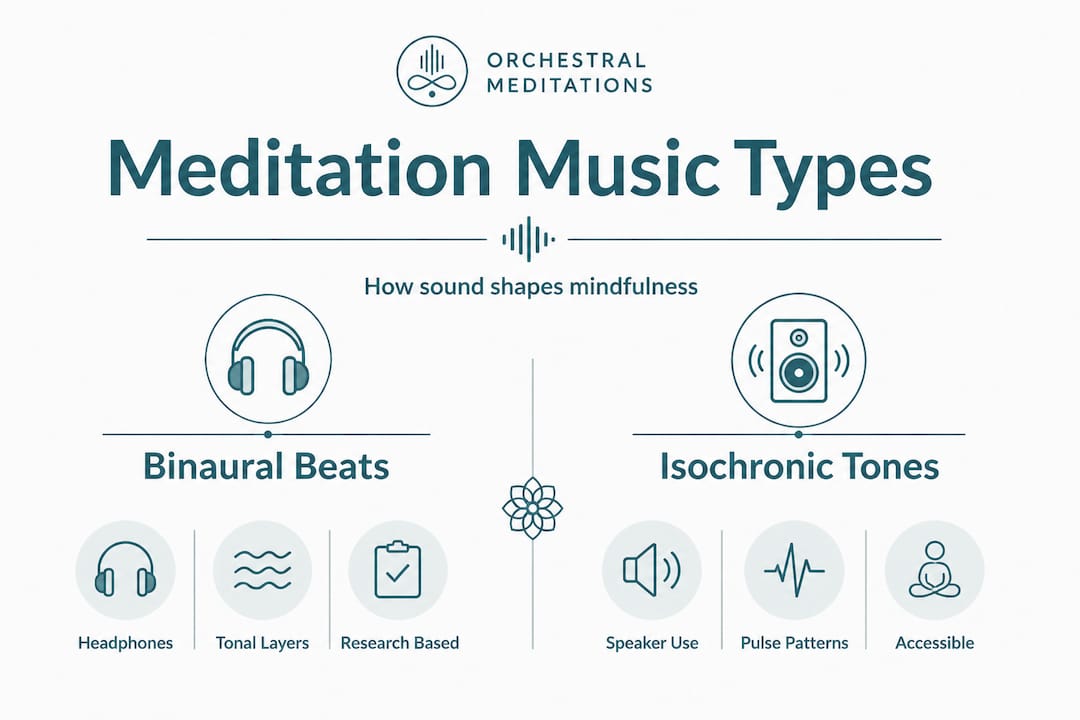
Each approach has its strengths. Binaural beats are the most rigorously studied. Isochronic tones are more accessible. Solfeggio frequencies sit at the intersection of tradition and emerging research. And orchestral ambient music, particularly when layered with entrainment techniques, offers something arguably more nourishing: a genuinely beautiful listening experience that supports rather than disrupts your practice.
How scientifically crafted meditation music works
Understanding the unique creation of this music is one thing. But let’s get into the actual mechanics of how it influences your brain, because this is where things get genuinely fascinating.
Binaural beats are processed in the superior olivary complex, a region of the brainstem involved in processing spatial sound. When two slightly different frequencies reach each ear, this region detects the discrepancy and generates what’s called a frequency-following response (FFR). Your brain essentially “creates” the beat that doesn’t physically exist in the audio. EEG studies confirm that brainwave activity does shift toward the target frequency following exposure. It’s not a placebo. The electrical signature is measurable.
What’s particularly interesting is the research on gamma binaural beats. Gamma brainwaves (above 30Hz) are associated with heightened attention and cognitive clarity. Studies show that gamma binaural beats combined with a low carrier frequency and white noise can measurably improve attention in ways that standard binaural beats in the theta or alpha range do not. So the parameters genuinely matter, which is why a thoughtfully designed track will differ substantially from a hastily assembled one.
Here’s a quick summary of the brainwave states most relevant to meditation music:
- Delta (0.5 to 4Hz): Deep, dreamless sleep. Rarely targeted during active meditation but relevant for sleep-focused tracks.
- Theta (4 to 8Hz): Deep relaxation, dreaming, early-stage meditation. The primary target for most scientifically crafted meditation music.
- Alpha (8 to 13Hz): Calm alertness. Ideal for relaxed focus and light mindfulness.
- Beta (13 to 30Hz): Active thinking, problem-solving. Generally what you’re trying to move away from during meditation.
- Gamma (30Hz and above): High-level cognition, attention, and flow states.
The empirical evidence for binaural beats is genuinely promising. Studies show they increase theta activity, which is exactly what you want for a meditative state. Additionally, combining music with mindfulness practices has been shown to reduce symptoms of anxiety and depression in clinical settings. That’s not a trivial finding.
“Music and mindfulness together appear to amplify the benefits of each other, creating a more powerful combined effect on mental health markers than either approach alone.” This insight, drawn from multiple clinical studies, underscores the value of intentional sound design in wellness practice.
Our healing meditation music guide explores these mechanisms in more depth if you want to follow the thread further. But the core takeaway is this: when you listen to properly designed meditation music, your brain is genuinely responding to it on a measurable, neurological level. That’s not marketing language. That’s EEG data.
And our binaural beats guide breaks down the specific Hz ranges for focus and relaxation if you’d like a more granular look at which frequencies suit different goals.
Personalisation, limitations, and nuances
Having traced the core mechanisms, it’s vital to consider the subtleties. Because here’s the thing: not everyone responds identically to the same track. The research is quite clear on this point, and any honest discussion of scientifically crafted meditation music has to acknowledge it.
Effects vary significantly depending on the parameters of the audio itself: the carrier tone, the presence or absence of background noise, the onset speed of the beat, and the duration of exposure. For gamma binaural beats, for instance, entrainment appears stronger without additional noise layered in. For other frequency ranges, a gentle background texture can actually improve the experience by masking the more mechanical qualities of the beat. There’s no universal recipe.
One of the most interesting findings involves what researchers call the Individual Alpha Frequency (IAF). Essentially, everyone has a slightly different baseline alpha brainwave frequency. Binaural beats tailored to someone’s personal IAF produce more measurable frontal alpha changes than generic tracks. Think of it like a personalised dose. A blanket approach works reasonably well, but a tailored one works better.
Here’s what’s worth knowing before you press play:
- Headphones are non-negotiable for binaural beats. Without them, each ear isn’t receiving a separate signal, so the beating effect simply doesn’t occur. Speakers won’t cut it here. Isochronic tones and solfeggio-based tracks don’t have this restriction, but binaural beats absolutely do.
- Meditation experience matters. Contrasting research suggests that experienced meditators tend to show stronger responses to theta entrainment than beginners, possibly because they already have more established neural pathways associated with deep meditative states. So if you’re new to meditation, don’t be discouraged if results feel subtle at first.
- Some benefits may be placebo-adjacent. EEG data confirms entrainment happens. But whether the downstream cognitive benefits (improved focus, reduced anxiety) come directly from the brainwave shift, or from the general relaxation and expectancy effect, is still an open question in the research.
- Sustained attention improvements are mixed. Some studies show clear benefits. Others show modest or no effects. Individual differences in baseline cognitive function, listening environment, and track design all appear to influence outcomes.
Pro Tip: Start with a ten to fifteen minute session rather than jumping straight into an hour. This lets you observe your own response without overcommitting. Note how you feel before and after. Over several sessions, you’ll start to notice which frequencies and styles genuinely work for you.
Our meditation music for relaxation collection and the meditative soundscapes guide both offer a good starting point for testing what resonates with your own nervous system.
The honest summary here is that scientifically crafted meditation music is effective for many people, measurably so in neurological terms, but it isn’t a magic switch. Your response will be shaped by your own brain, your listening conditions, and the specific design choices in the track itself. That nuance is important. And it’s one that the best producers in this space take very seriously.
Practical tips for choosing and using scientifically crafted meditation music
With the technical nuances properly explored, let’s move to what you actually do with this information. Because understanding the science is only useful if it helps you build a better practice.
Here’s a step-by-step approach we’d genuinely recommend:
-
Start with instrumental music. Lyrics activate language processing centres in the brain, which is almost the opposite of what you want during meditation. Instrumental, ambient, or orchestral music keeps the analytical mind quieter and allows the entrainment or tonal qualities of the music to do their work without interference.
-
Choose predictable, structured compositions. Sudden dynamic shifts, jarring transitions, or unexpected sounds can jolt you out of a meditative state. Orchestral and ambient styles with gradual, flowing progressions are particularly effective because they hold the mind gently without demanding attention.
-
Test before committing. This sounds obvious, but many people simply pick a popular playlist and stick with it out of habit. Spend a few sessions deliberately comparing tracks. How do you feel during the session? How do you feel twenty minutes after? Your subjective experience is valid data.
-
Look at the evidence behind commercial claims. Parameter optimisation matters, and not every track marketed as “528Hz healing frequency” or “deep theta meditation” has been designed with genuine care. Before trusting a commercial claim, look for references to peer-reviewed research, transparent track design information, or producer credentials.
-
Consider live or high-quality orchestral recordings. There’s something worth noting about the social and neurological impact of music performed by live musicians. Live music adds a social connection dimension that recorded synthesised audio simply cannot replicate. The micro-variations in tone, breath, and dynamics from live performers create a richness that many listeners find more nourishing over sustained practice.
-
Build consistency over novelty. It’s tempting to chase the newest, most elaborately described track. But familiarity with a piece can actually deepen its meditative effect over time, because your nervous system begins to associate it with relaxation and drops into the desired state more quickly.
Pro Tip: If you’re using binaural beats, keep the volume at a comfortable, low to moderate level. Louder isn’t better here, and high volumes can be distracting rather than settling. Aim for the level you’d use to listen to soft background music while reading.
Our best meditation music guide explores personalisation in more depth, and the music and mental health article covers the evidence base if you’d like to read more broadly about how music serves wellbeing beyond the meditation session itself.
The uncomfortable truth most experts won’t tell you about meditation music
Let me be candid with you here, because I think you deserve it. A lot of what’s sold under the banner of “scientifically designed meditation music” is, to put it diplomatically, optimistic branding. The science exists and it’s genuinely interesting. But the gap between “brainwave entrainment has been studied” and “this specific £9.99 track will align your chakras and rewire your neural pathways” is about the size of the Pacific Ocean.
The evidence is clear that EEG confirms entrainment happens. It’s equally clear that the cognitive and psychological benefits are mixed across studies, and some of what people experience may reflect general relaxation and expectancy rather than a direct neurological mechanism. That’s not a reason to dismiss the practice. It’s a reason to approach it intelligently.
Here’s what I’d genuinely encourage: become a careful consumer of your own experience. Try different tracks. Observe what shifts and what doesn’t. Read the meditation music benefits research, but don’t let it override your own honest assessment. If a theta track leaves you feeling genuinely settled and a solfeggio track does nothing for you, that’s your data. It’s worth more than any marketing copy.
The most experienced meditators I’ve spoken with don’t treat meditation music as a shortcut. They treat it as a support. A carefully crafted orchestral piece doesn’t replace the practice of sitting with yourself. It creates conditions in which that practice becomes easier. That framing, honest and modest, is the one that actually serves people well.
The wellness industry has a habit of overselling and underdelivering. Scientifically crafted meditation music, at its best, is genuinely valuable. At its worst, it’s noise with a frequency label stuck on it. The difference lies in transparency, track design, and whether you’re willing to test rather than simply trust.
Explore scientifically crafted meditation music for deeper mindfulness
With practical strategies in hand, you can take the next step towards deepening your practice with truly evidence-based meditation music. Finding the right sound for your mind is a personal journey, and having a curated library built on real neuroscience principles makes that journey considerably shorter.
At Orchestral Meditations, every track in our library is crafted using established sound design principles, including binaural beats, theta frequencies, and immersive 3D orchestral recordings made at Abbey Road Studios with the National Philharmonic. We don’t just use the word “scientific” as decoration. Our approach is transparent, research-informed, and built around what genuinely supports your practice. Whether you’re just beginning to explore this space or you’re a seasoned meditator looking for deeper layers, you can explore our full meditation music library or browse our personalised meditation recommendations to find what resonates most with your own nervous system.
Frequently asked questions
Does scientifically crafted meditation music actually work?
Studies confirm it can increase theta brainwave activity and reduce anxiety and depression symptoms, though results vary by individual and depend heavily on proper track design.
Do I need headphones for binaural beats music?
Yes, headphones are essential for binaural beats because each ear must receive a separate frequency for the brain to generate the perceived beat. Speakers won’t produce the effect.
Can anyone benefit from scientifically crafted meditation music?
Most people can benefit, though meditation experience enhances responsiveness to entrainment, and individual differences in brain baseline frequencies mean some tracks will suit you better than others.
Is scientifically crafted meditation music a substitute for therapy?
Not a cure-all, it should not replace professional therapy or medical treatment, but it can meaningfully support relaxation, mindfulness practice, and emotional regulation as a complementary tool.
How do I choose the best meditation track for me?
Prefer instrumental orchestral or ambient styles without lyrics, and test several tracks across different sessions to discover which frequencies and compositions your mind responds to most naturally.