Orchestral binaural and frequency-based soundscapes are an effective backing for tai chi-style mindful movement, provided the tempo and frequency are matched to the phase of the session. Teacher-led classes, recorded guided sessions, and therapeutic movement work all benefit from this approach far more than looping ambient pads. Orchestral Meditations, recorded at Abbey Road Studios with the National Philharmonic, is a production-grade, royalty-free source built for exactly this purpose.
TL;DR:
- Tempo guidelines recommend 60 to 70 bpm for warm-ups, 70 to 90 bpm for flowing movements, and 50 to 65 bpm for cool-down phases to maximize relaxation and movement coherence.
- Binaural effects require stereo headphones, with theta frequencies suited for stillness and beta frequencies for alert, flowing movement, but most effects diminish through speakers.
- Tracks should be carefully sequenced with gradual tempo and phase transitions, and licensed from professional sources like Abbey Road recordings for consistent quality and legal use.
- Personal responses to frequency-based audio vary, so testing with actual participants is essential, especially for therapeutic or movement-focused classes.
- Using orchestral binaural music with proper sequencing significantly improves participants’ pacing, focus, and relaxation during tai chi sessions.
What is orchestral binaural meditation music?
Orchestral binaural meditation music combines live orchestral recording with frequency-based audio engineering, specifically binaural beats and Solfeggio tones layered beneath the musical arrangement. A binaural beat isn’t a sound you hear directly. It’s an auditory illusion your brain creates when each ear receives a slightly different tone frequency, and the brain perceives the mathematical difference between them as a pulsing beat.
That pulsing beat can nudge brainwave activity toward a particular state. Around 15 Hz sits in the beta range, associated with alert, focused attention. Frequencies in the 4 to 8 Hz theta range tend to accompany deeper relaxation and the loose, floaty feeling many meditators chase.
Orchestral texture adds something binaural tones alone cannot: spatial depth and emotional variation. A string swell or a distant French horn creates a sense of physical space that a repeating synth loop simply doesn’t, which matters enormously when you’re guiding bodies through slow, deliberate movement rather than asking someone to sit still with their eyes closed.
A few practical points worth holding onto:
- Binaural effects require stereo headphones; they largely disappear through speakers.
- Theta ranges suit stillness and closing phases; beta ranges suit alert, flowing movement.
- Live orchestral recordings introduce natural dynamic variation that reduces listener fatigue over a 45-minute session.
- Individual responses to frequency work vary considerably, so testing with your actual participants beats trusting any general rule.
How do you choose tracks for tai chi practice?
Tempo does most of the heavy lifting in a tai chi soundtrack. Warm-up phases work best around 60 to 70 bpm, giving joints and breath time to settle. Flowing movement sits comfortably between 70 and 90 bpm, adjusted to the pace of the form being taught, while slow cooling phases benefit from dropping to 50 to 65 bpm. A systematic review of music therapy interventions found tempo between 60 and 90 bpm, combined with repeated sessions, produces some of the largest relaxation effects recorded in the literature.
Frequency choice follows the same logic as tempo. Theta bands around 4 to 8 Hz suit meditative stillness and cool-downs. Beta bands closer to 15 Hz suit focused, flowing sections. A 2025 controlled study found 15 Hz binaural beats layered under preferred music produced statistically significant gains in both psychophysiological markers and motor performance, which is directly relevant if you’re teaching a form that demands coordinated, precise movement.
A short checklist for building your library:
- Match track length to the phase, not the other way round. A 12 to 15 minute seamless loop for warm-up, beats stitching three short tracks together mid-flow.
- Confirm the licence covers your use. Personal listening licences rarely cover a paid class, a therapy session, or an app.
- Check the master format. Binaural and 3D mixes need clean stereo separation; a mono-collapsed file destroys the effect entirely.
- Test on the equipment your students will actually use, not just your studio monitors.
Pro Tip: Keep two versions of every track in your library. One binaural master for headphone-based individual sessions, and one stereo-only fallback for group classes played through speakers, where the binaural effect won’t register anyway.
How do you sequence music through a tai chi session?
Template 1: Drop-in class. Open with 10 to 15 minutes of theta-leaning orchestral pad work, quiet strings, slow cello lines, minimal percussion. Move into 20 to 25 minutes of low to mid-beta material for the flowing sequence, something with enough rhythmic clarity that students can sense pace without being pulled off their own timing. Close with 5 to 10 minutes back in theta territory, letting the orchestra thin out to near silence.
Template 2: Therapeutic or one-to-one session. Build in deliberate silence windows between movements rather than continuous underscore. Keep binaural content quieter than you would in a group setting, since a single listener on headphones is far more exposed to frequency effects than a room full of people hearing ambient playback.
Template 3: Recorded video or app content. Layer spoken guidance at minus 6 to minus 10 decibels beneath the binaural master, and always keep separate stems for voice and music. This gives you the flexibility to remix for different platforms without re-recording narration.
Whichever template you use, transitions matter more than most instructors realise:
- Use 4 to 8 second crossfades between phases rather than hard cuts, which can jolt a group out of a settled state.
- Test playback volume in the actual room before a class starts, not from a laptop the week before.
- Fade binaural layers in gradually over the first 30 seconds rather than starting at full frequency intensity.
What does the evidence say about binaural beats and movement?
The strongest evidence sits in a meta-analysis of 47 studies, which found music interventions produce a medium-to-large effect (d = 0.723) on stress-related physiological and psychological outcomes. That’s a meaningful signal for anyone using music to support recovery and relaxation, though it covers music interventions broadly rather than tai chi specifically.
More targeted evidence comes from the 2025 study on 15 Hz binaural beats combined with preferred music, which found statistically significant improvements in motor performance alongside psychophysiological markers. It’s a promising result for movement practice, but it’s one study, and effects like this vary by individual and by context rather than guaranteeing a fixed outcome for every practitioner.
A few cautions worth taking seriously. Keep volume moderate, since binaural effects don’t require loud playback to register. Anyone with photosensitive epilepsy or a history of seizure activity should approach any rhythmic audio or light stimulus with medical guidance first. In therapeutic settings, get informed consent before introducing frequency-based audio, and never present binaural beats as a substitute for clinical treatment.
Who produces this kind of music, and why does provenance matter?
Recording location changes what a binaural mix can actually deliver. Abbey Road Studios, working with the National Philharmonic, gives Orchestral Meditations access to acoustic spaces and musicians capable of the dynamic range and spatial separation that 3D and binaural mastering depend on. A cramped home studio recording of a string quartet simply can’t produce the same depth.
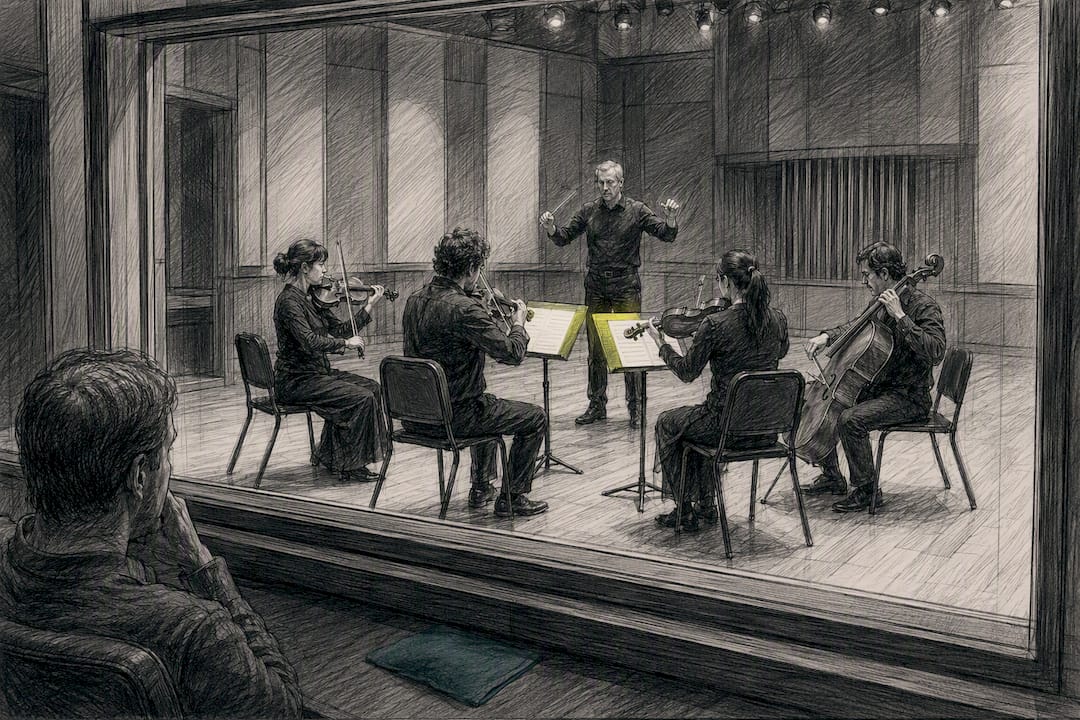
Composer and producer credits matter here too. Robert Emery has led large-scale Abbey Road recording sessions) involving substantial orchestral and choral forces, and his work on Orchestral Meditations projects brings that same scale to meditation-specific composition. Moritz Schneider works alongside Emery on the production side, shaping how the frequency layers sit underneath the orchestral arrangement without fighting it.
The technical proof points back this up. Orchestral Meditations offers:
- 3D surround and binaural mastering built for headphone-based individual practice
- Theta and Solfeggio frequency layering beneath full orchestral arrangements
- Separate stems available for professional users layering voice or sound effects
- Royalty-free licensing structured for classes, therapy, and app integration
Case studies and instructor testimonials from specific studios are still being gathered for future updates to this resource.
How do you build a custom tai chi playlist?
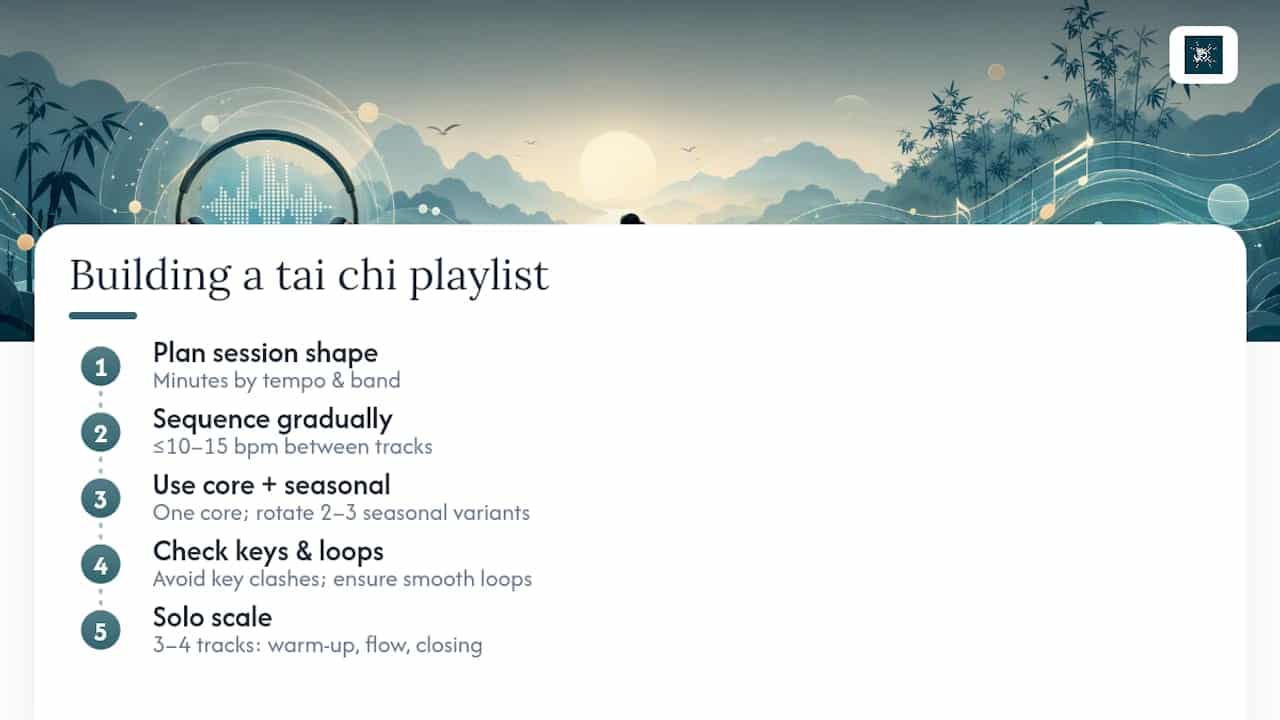
Start with the shape of your session, not a genre. Map out how many minutes you need at each tempo and frequency band before you touch a single track, because a playlist assembled by “songs I like” rarely holds together once bodies start moving through it.
Order matters more than variety. Sequence tracks so tempo drifts gradually rather than jumping, a sudden shift from 65 bpm to 85 bpm mid-flow can visibly disrupt a group’s pacing. Aim for no more than a 10 to 15 bpm change between consecutive tracks.
Keep a “core” and “seasonal” split. Build one reliable core playlist you return to weekly, then rotate two or three seasonal variants so returning students don’t grow numb to the same cues. Repetition helps deepen the association between a track and a movement pattern, but too much repetition breeds tune-out.
If you’re mixing your own combinations from a royalty-free library, watch for key clashes between consecutive tracks almost as much as tempo. Two beautiful pieces in unrelated keys can feel jarring back to back, even at matched tempo. Loop points deserve attention too. A track that loops cleanly at the waveform level but clunks tonally at the seam will eventually announce itself to a room full of people breathing in time with it.
For solo practitioners building a personal playlist rather than a class sequence, the same logic applies at a smaller scale. Three or four tracks covering warm-up, flow, and closing is usually enough. What matters most is that the music actually resonates with you individually, since personalised sound choice consistently outperforms generic “relaxing music” playlists in how people respond to it.
Does the practice environment change the music you should use?
Indoor studio sessions give you the most control, and that control is worth using. A quiet indoor room with decent speakers or headphone access lets binaural mixes work as intended, and lets you run louder dynamic swings in the orchestral arrangement without competing against traffic or wind noise.
Outdoor tai chi, whether in a park or a garden space, changes the calculation substantially. Binaural beats depend on precise stereo separation reaching each ear cleanly, something open-air speaker playback struggles to deliver once ambient noise and wind interference enter the picture. If your practice happens outdoors, individual headphone listening preserves the frequency work far better than a portable speaker ever will.
Volume behaves differently outdoors too. A track mixed for a quiet indoor room can vanish under birdsong and distant traffic, so outdoor sessions often need either headphones per participant or a simpler, speaker-friendly track that doesn’t rely on binaural separation to land. Save theta and beta frequency work for indoor or headphone-based outdoor sessions, and lean on tempo and orchestral dynamics alone when you know playback will be through open-air speakers.
Weather and acoustics also shape track choice in less obvious ways. Reverberant indoor spaces, a studio with hard floors and high ceilings, can make dense orchestral arrangements feel muddy, favouring sparser instrumentation. Soft outdoor spaces with grass and open sky absorb sound quickly, often allowing fuller arrangements to breathe without becoming overwhelming.
What do instructors and practitioners actually notice in sessions?
Instructors who’ve shifted from generic ambient playlists to tempo-matched orchestral tracks consistently report one thing: groups settle into unified pacing faster. When the tempo of the flowing section sits close to the natural pace of the form itself, students stop watching the instructor for timing cues and start following the music instead, freeing the instructor to focus on correcting posture rather than counting beats aloud.
Therapists working one-to-one describe a different but related effect. Clients on headphones during binaural-supported sessions often report losing track of time, a marker some associate with genuine relaxation rather than simply following instructions. That subjective sense of time distortion lines up with what a scoping review of sound interventions found: personalisation and delivery mode consistently moderate how strongly listeners respond, meaning the same track can land completely differently depending on whether it’s heard through headphones or a room speaker.
Content creators building recorded sessions notice something more practical. Viewers and listeners tend to finish longer sessions when the music transitions smoothly between phases rather than cutting abruptly, which is part of why crossfaded, purpose-sequenced tracks outperform shuffled playlists in completion rates, even when the individual tracks themselves are equally well produced.
What instructors get wrong about this music
Most advice on movement soundtracks treats music as decoration, something pleasant playing in the background while the real teaching happens elsewhere. That’s backwards. Tempo and frequency choice actively shape how a group moves, how quickly they settle, and how long they can sustain focused attention. Treating the soundtrack as an afterthought wastes the single easiest lever an instructor has for improving session quality without changing the choreography at all.
The other common mistake is chasing novelty. Instructors rotate playlists constantly, assuming variety keeps students engaged, when the research on repeated sessions suggests the opposite: familiarity with a track’s structure lets the body anticipate transitions, deepening the relaxation response rather than diluting it.
What should come first is matching tempo to phase, properly, before worrying about frequency layering or production polish at all. Get that structural sequencing right and even a modest recording will outperform a beautifully mastered track played at the wrong pace. Production quality, the depth an Abbey Road recording brings, matters most once the sequencing fundamentals are already sound.
— ROBERT
Where to find production-grade tai chi soundtracks
Building a tai chi soundtrack from scratch, chasing licences, checking stereo masters, and hoping a home-recorded string sample doesn’t sound thin under a binaural layer, eats hours most instructors don’t have. Orchestral Meditations removes that entire process: every track is recorded at Abbey Road Studios with the National Philharmonic, mastered in 3D binaural sound, and cleared for professional licensing from the moment you download it.
That matters most for instructors and therapists who need reliable licensing without negotiating separately for every class, app, or client session. The library covers theta and Solfeggio frequency tracks alongside full orchestral pieces, so you can build the tempo-sequenced sessions described above without stitching together audio from several sources of varying quality. Browse the Orchestral Meditations shop to preview tracks and check licensing options for your next session.
Sources
The meta-analysis on music and stress establishes the baseline effect size for music interventions on physiological and psychological stress markers. The 2025 binaural-beat study provides the most direct evidence for combining beta-band binaural tones with movement-relevant motor outcomes. The tempo and relaxation systematic review supports the 60 to 90 bpm guidance used throughout this piece.
For implementation guidance in therapeutic settings, the partner resource on calming sensory interventions offers practical, safety-conscious examples worth reviewing before introducing frequency-based audio to clients.
- The effect of music on the human stress response (meta-analysis)
- Study showing enhanced psychophysiological and motor outcomes with 15 Hz binaural beats combined with preferred music
- Music therapy for stress reduction: a systematic review and meta-analysis
FAQ
What is tai chi meditation music, exactly?
In this context, it refers to orchestral, binaural, and frequency-based soundscapes, live-recorded music layered with theta or Solfeggio frequencies, designed to support tai chi and other mindful movement practice.
What tempo works best for tai chi practice?
Warm-up phases work best near 60 to 70 bpm, flowing movement near 70 to 90 bpm, and cool-down phases benefit from slower tempos. Research links tempo in the 60 to 90 bpm range combined with repeated sessions to strong relaxation effects, see tempo research.
Do I need headphones for binaural beats to work?
Yes. Binaural beats rely on each ear receiving a slightly different frequency, an effect that requires stereo headphones and largely disappears through room speakers.
Are binaural beats safe to use in every session?
Most listeners tolerate binaural beats well at moderate volume, but anyone with photosensitive epilepsy or seizure history should seek medical advice first, and therapeutic settings should always secure informed consent.
Where can instructors licence orchestral tracks for classes?
Royalty-free libraries built for professional use, such as Orchestral Meditations, offer licensing structured for classes, therapy sessions, and app integration, recorded at Abbey Road Studios with the National Philharmonic.