Short verdict: binaural beats can reduce acute anxiety for many people when used correctly, but they work best as a support tool, not a replacement for therapy or medication. Put on stereo headphones, try a 20-minute theta or alpha session in a quiet spot, and judge the effect on your own nervous system. The evidence and the safety details follow below.
TL;DR:
- Binaural beats are most effective in reducing situational anxiety, especially when used in sessions lasting 20 to 36 minutes, with benefits scaling with longer listening times.
- Listening with stereo headphones, at moderate volume, and pairing the sessions with slow breathing or meditation improves both safety and effectiveness.
- Personal responses vary between theta and alpha frequencies, so experimenting with different bands is recommended to find what best calms your nervous system.
- Combining music with binaural beat stimulation and using high-quality, immersive mixes can enhance the listening experience and improve sustained engagement.
- Binaural beats serve as a supportive tool alongside therapy or medication and should not replace professional treatment for anxiety disorders.
What does the evidence say about binaural beats and anxiety?
The strongest data comes from randomised controlled trials, and the results are genuinely encouraging, if modest. One RCT looking at preoperative anxiety found that alpha-range binaural beat stimulation cut self-reported anxiety more than plain relaxation, with a larger relative reduction in state anxiety than the control group managed. That is a clinical setting, real patients waiting for surgery, not a wellness app demo.
A separate trial testing music combined with auditory beat stimulation found the pairing beat pink-noise controls on anxiety reduction, and crucially showed a dose-response relationship: the longer people listened (up to 36 minutes in that study), the bigger the drop in negative affect. That single finding reshapes how you should think about “dosing” a session, more on that shortly.
Physiological markers back this up too. Research on college students found that 20-minute sessions across theta, alpha and beta bands all produced measurable reductions in heart rate and blood pressure, regardless of which frequency was used.
- Preoperative and situational anxiety show the clearest RCT-backed benefit
- Combined music plus auditory beat stimulation tends to outperform beats alone
- Heart rate and blood pressure drops appear across multiple frequency bands
The honest caveat: a rapid review of the wider literature describes the overall evidence as moderate, with real heterogeneity between study designs, sample sizes, and populations. Effect sizes tend to sit in the small-to-moderate range. Nobody serious claims binaural beats cure an anxiety disorder. What they can do, fairly reliably, is nudge your body out of a stress response during a defined listening window.
Which frequencies and session lengths actually help?
Binaural beats work by feeding two slightly different tones into each ear, and your brain perceives the mathematical difference between them as a third, pulsing tone. That perceived pulse sits in a specific frequency band, and each band is associated with a different mental state.
- Theta (roughly 4 to 8 Hz): linked with deep relaxation and the drowsy state just before sleep
- Alpha (roughly 8 to 13 Hz): associated with calm, alert relaxation, the classic “meditative” zone
- Beta (roughly 13 to 30 Hz): tied to normal waking alertness, not typically what you want for anxiety relief
Here is the twist most articles skip: the college-student trial mentioned above tested all three bands and found theta, alpha, and beta sessions reduced heart rate and blood pressure roughly equally, with no consistent winner. That does not mean frequency is irrelevant. It means personal response varies, and a short experimentation phase (a few sessions in theta, a few in alpha) will tell you more than any generic recommendation. For dosage, the clearest signal remains the dose-response study: benefits scaled with listening time, with 20 to 36 minutes producing the largest drops in negative affect.
How do you listen to binaural beats safely and correctly?
Get the mechanics wrong and you get nothing but noise. The binaural effect only registers when each ear receives its own separate tone, which means proper stereo headphones are non-negotiable. Speakers, earbuds worn loosely, or mono playback simply will not create the effect your brain needs.
- Put on stereo headphones and set the volume to a comfortable, moderate level, never loud enough to strain.
- Sit or lie down somewhere you will not be disturbed for the length of the session.
- Never listen while driving, cycling, or operating machinery, the relaxed state you are aiming for is incompatible with alertness tasks.
- Pair the audio with slow breathing or a short guided meditation for a stronger combined effect.
- If you have epilepsy or a history of severe psychiatric symptoms, speak to a clinician before trying regular sessions.
Pro Tip: Do a two minute “sound check” first, just to confirm both earbuds or headphone channels are actually working. A binaural track with one dead channel is just background music, and you will wonder why it “isn’t doing anything.”
Why production quality changes how binaural tracks actually feel
Here is something the clinical papers rarely mention but that matters enormously in practice: a binaural track you actually want to keep listening to will outperform one you tolerate for five minutes then abandon. The dose-response research is unambiguous that longer sessions produce bigger drops in negative affect, so anything that keeps you in your seat for the full 20 minutes is doing real work.
- Live orchestral recordings tend to hold attention longer than looping synthetic tones
- 3D and immersive mixing can deepen the sense of “being inside” the sound
- Careful engineering preserves the underlying binaural frequency difference rather than masking it
This is where the production side earns its place in the conversation. Orchestralmeditations records its meditation library with the National Philharmonic, with sessions produced at Abbey Road Studios, and the composer and producer behind that work, Robert Emery, has spent a career scoring and producing large-scale orchestral projects, work that demands exactly the kind of disciplined mixing needed to keep a binaural layer intact underneath a full orchestra. Fellow composer and producer Moritz Schneider brings a similar background in layering frequency-based composition with live instrumentation.
Getting the binaural effect right inside an orchestral mix is a genuine engineering problem, not a decorative one. Push the balance wrong and you either lose the frequency difference entirely or you get a mix so clinical it defeats the point of using real musicians in the first place.
A ready-to-use listening routine for anxiety relief
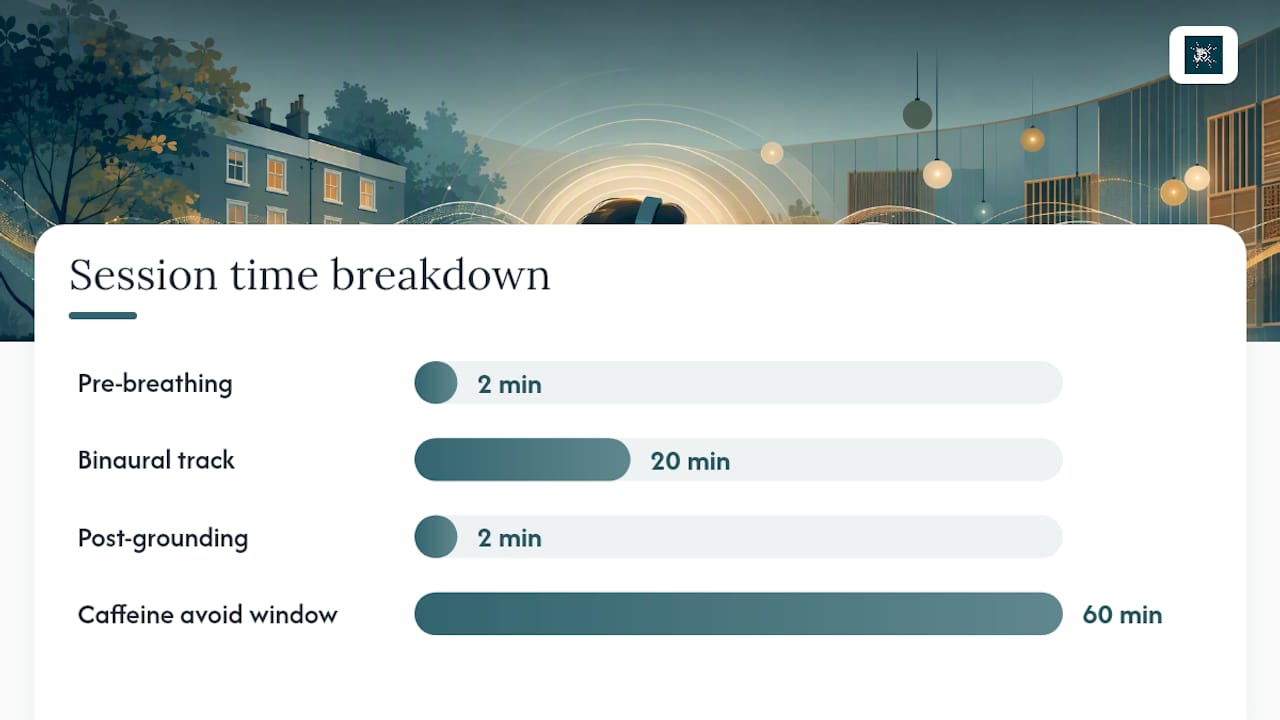
- Spend two minutes on slow, paced breathing before you press play, in for four counts, out for six.
- Listen to a 20-minute theta or alpha binaural track, eyes closed, headphones on, phone on silent.
- Take two minutes afterwards to ground yourself, notice your feet on the floor, take three normal breaths.
- Rate your anxiety from 0 to 10 before and after the session, and jot the number down.
Track that score over a week or two and you will start to see a pattern, maybe alpha works better for you at lunchtime, maybe theta suits you before bed. Skip caffeine in the hour before a session; it works directly against the calming effect you are trying to produce.
Pro Tip: Keep a two-line note after each session, frequency used, and the before/after number. Patterns show up faster than you expect, usually within four or five sessions.
What are the limits, and when should you see a clinician?
Binaural beats are adjunctive support, a genuinely useful tool sitting alongside therapy or medication, never a substitute for either without a clinician’s input. Reported side effects are generally mild, occasional headaches or dizziness, though some listeners note increased negative affect in certain contexts, which is another reason to treat that first few sessions as an experiment, not a commitment.
- Seek urgent help immediately for suicidal thoughts, severe panic, or anxiety that is stopping you functioning day to day
- Keep your prescriber or therapist informed if you are adding binaural listening to an existing treatment plan
- Treat persistent or worsening symptoms as a signal to speak to a GP, not a signal to listen longer
Why I care about how these tracks are actually made
I have spent years around orchestras and recording sessions, and the thing people underestimate is how much the listening experience itself drives whether anyone sticks with a practice long enough to feel a benefit. A binaural layer buried under a poorly balanced mix is wasted science.
That is why the composer and producer collaboration behind our library, working with musicians from the National Philharmonic and sessions at Abbey Road, matters to me as much as the frequency science does. We keep samples openly available so you can hear the difference before you commit to anything.
— ROBERT
Try a binaural meditation track before you commit to anything
If you have read this far, you already know the theory works best when the sound itself is worth returning to. Orchestralmeditations builds its royalty-free library around exactly that idea, binaural and theta frequency tracks recorded with live musicians rather than looped synthetic tones, so a 20-minute session feels like music, not a science experiment.
You can sample tracks before buying, whether you want a single meditation for personal use or a licensed track for a therapy practice, yoga studio, or wellness app. For a technical look at the broader science behind sound-based anxiety relief, our piece on science-backed sound and music for mindfulness goes deeper, and readers curious about related physiological approaches may also find vibroacoustic therapy research useful background reading. When you are ready, browse the binaural and theta collection and start with a short sample session tonight.
This article is general information, not a substitute for advice from a qualified doctor. Consult a qualified healthcare professional about your own circumstances before acting on anything here.
Sources
- Investigating the dose-response relationship between music and anxiety reduction: A randomized clinical trial
- Binaural beat stimulation as a tool to reduce preoperative anxiety in patients undergoing elective surgery and general anesthesia – IOPscience
FAQ
Do binaural beats actually work for anxiety?
Randomised trials show binaural beats can meaningfully reduce self-reported anxiety and physiological stress markers like heart rate, particularly in short guided sessions, though effect sizes are generally small to moderate.
Can binaural beats help with anxiety on their own?
They help most people best as an adjunct to breathing exercises, meditation, or ongoing therapy, rather than as a standalone fix for a diagnosed anxiety disorder.
Is it safe to listen to binaural beats every day?
Daily listening appears low-risk for most healthy adults, though people with epilepsy or severe psychiatric symptoms should check with a clinician first before making it a routine.
What are the side effects of binaural beats?
Reported side effects are mild and infrequent, mainly occasional headaches or dizziness, with a small number of listeners noting increased negative affect in certain contexts.
Which frequency is best for anxiety, theta or alpha?
Trial evidence shows no consistent winner between theta and alpha, so both are worth trying for a few sessions each to see which one settles your own nervous system faster.