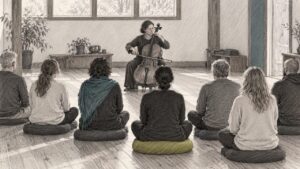
The best music for restorative yoga features a slow tempo or abandons the beat entirely, dissolving into ambient soundscapes that give the nervous system nowhere to rush. Think less “playlist” and more “sonic weather.” The goal is a sound environment so unobtrusive that practitioners forget it is there, yet so carefully chosen that removing it would leave the room feeling oddly exposed.
A few qualities define the ideal sound palette:
- Tempo: slow tempo or completely beatless ambient; anything faster nudges the mind toward activity rather than rest
- Texture: “wet and washy” tones, reverb-heavy electric guitar swells, sustained cello, synth pads modelled on vast spaces like canyons or cathedrals
- Vocals: non-English chanting or wordless vocal textures only; English lyrics pull the mind into narrative and memory
- Dynamics: no sudden changes, no dramatic builds, no drops; the music should feel like it has always been there
- Length:
or continuous soundscapes prevent the subtle “time-counting” that short loops create
Two composers worth knowing immediately are Robert Emery and Moritz Schneider. Emery’s work at Orchestralmeditations integrates high-fidelity orchestral sound with therapeutic frequency techniques, including theta-range entrainment, to facilitate deep physiological relaxation. Schneider, whose atmospheric compositions appear on platforms including Classic FM’s meditation guides, works at what John Tavener famously called the “threshold of audibility”, creating a contemplative stillness that suits restorative yoga perfectly.
Pro Tip: Target the theta brainwave state (4–8 Hz) by choosing music with slow, sustained tones and minimal rhythmic pulse. Theta is the state between waking and sleep, and it is precisely where restorative yoga aims to take practitioners.
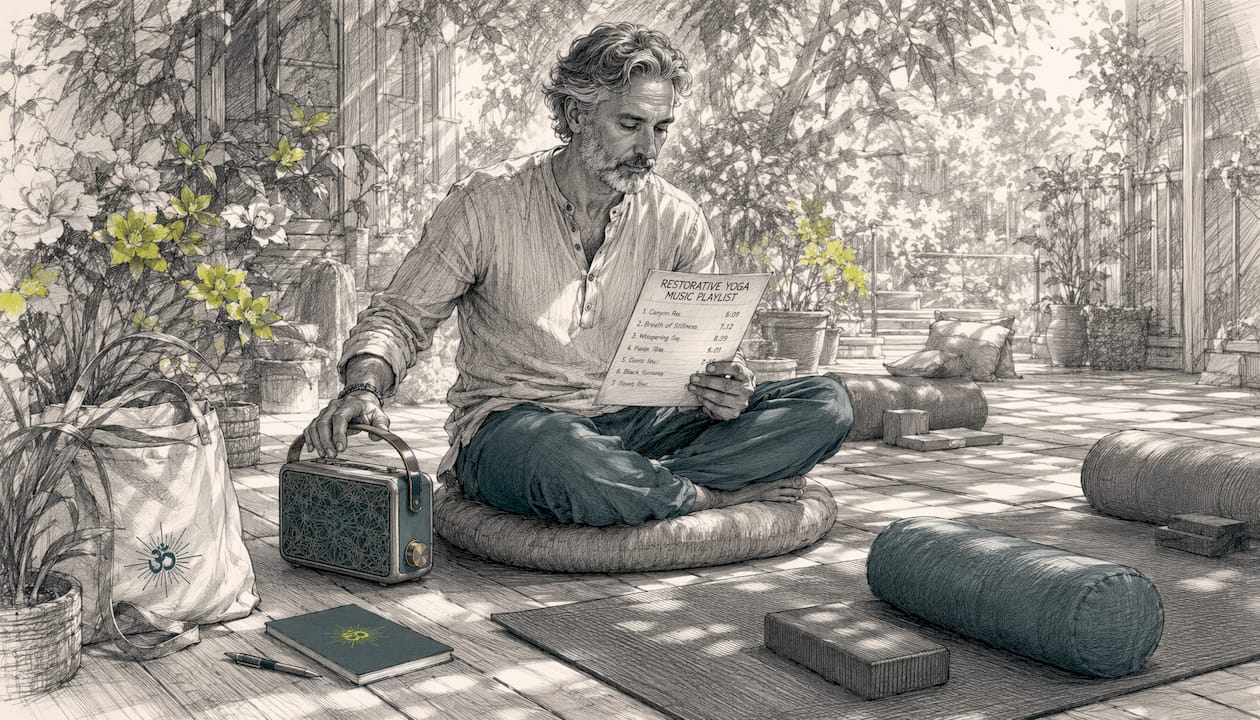

Which artists suit a restorative yoga playlist?
Knowing the theory is one thing. Having actual names to search is another. The artists below consistently produce music that fits the restorative brief, each bringing a slightly different texture to the sonic palette.
- Nala Sinephro: A Caribbean-Belgian composer and producer based in London, her music fuses meditative jazz and field recordings rooted in the study of frequency and geometry. Genuinely unusual and deeply calming.
- Mary Lattimore: A Los Angeles harpist who augments graceful improvisations with electronic effects, emphasising the harp’s ethereal qualities. The result is something that sounds like light through water.
- Ólafur Arnalds: Icelandic modern classical composer whose string arrangements and ambient electronics create a sense of vast, safe space. A reliable anchor for any restorative set.
- Max Richter: His eight-hour work Sleep was literally composed to accompany an entire night’s rest. Even a single track from it can carry a full restorative hold.
- Arvo Pärt: The Estonian composer’s Spiegel im Spiegel (“Mirror in the Mirror”) is, as Classic FM notes, a piece designed for reflection. Tintinnabuli style at its most meditative.
- Sigur Rós: Atmospheric Icelandic post-rock that operates more as texture than song. Their wordless vocal style, sung in an invented language called Hopelandic, sidesteps lyrical distraction entirely.
- Erik Satie: The Gymnopédies and Gnossiennes remain among the most effective pieces for sustained floor holds. Simple, melancholic, and utterly non-intrusive.
- Beautiful Chorus: Led by Alexandra Love, described by fans as “high frequency love music,” their harmony-infused soundscapes sit beautifully in the background of a restorative session.
| Instrumentation type | Sonic quality | Best placement in session |
|---|---|---|
| Grand piano (sustained, minimalist) | Spacious, introspective | Opening centering, Savasana |
| Synth pads (ambient, evolving) | Vast, neutral | Deep holds, full session |
| Cello / strings (legato) | Resonant, somatic | Hip-opening floor sequences |
| Harp (with electronic effects) | Ethereal, fluid | Transitions, mid-session |
| Field recordings (rain, ocean) | Grounding, safe | Any phase; especially Savasana |
Five tips for crafting the perfect restorative yoga playlist
-
Match tempo to session phase. Start slightly warmer (perhaps a slow piano piece at 55 BPM) as practitioners settle in, then let the music become progressively more beatless as the session deepens. The music should mirror the body’s descent, not lead it.
-
Avoid English lyrics entirely. Lyrics pull the mind out of the body and into memory, story, or analysis. If you want vocals, choose wordless toning, Sanskrit chanting, or non-English languages where the voice becomes texture rather than narrative.
-
Use long, uninterrupted tracks. Short loops disrupt meditative flow by creating a subtle awareness of time passing. Aim for tracks of 8–15 minutes, or build a single continuous soundscape that runs the length of the session without obvious seams.
-
Normalise loudness and set volume intentionally. Normalise your playlist to around –14 LUFS for studio use, and start slightly louder as students arrive, then fade gradually throughout the session. By the final Savasana, the music should be barely audible or absent altogether.
-
Plan for silence. Silence is not a gap in the playlist; it is the final track. Schedule at least 60–120 seconds of near-silence at the end of Savasana to allow the nervous system to fully integrate the session. Some practitioners find this the most powerful moment of all.
A sample restorative yoga playlist
A 75-minute session needs roughly 80 minutes of music to cover transitions and a quiet fade-out. Use 2–4 second crossfades throughout, and consider a hard cut only where you want students to notice a shift.
| Track | Artist | Duration | Why it works |
|---|---|---|---|
| Spiegel im Spiegel | Arvo Pärt | 8–15 min | Minimalist piano and violin; no surprises |
| Space 1 (from Space series) | Robert Emery / Orchestralmeditations | 8–15 min | Orchestral theta-frequency composition; deep somatic resonance |
| Near Light | Ólafur Arnalds | 8–15 min | Gentle strings and piano; safe, expansive feel |
| Dream 3 | Max Richter | 8–15 min | From Sleep; designed for neurophysiological rest |
| Atmospheric Study No. 2 | Moritz Schneider | 8–15 min | Threshold-of-audibility minimalism; pure contemplative stillness |
| Gymnopédie No. 1 | Erik Satie | 3 min | Brief, melancholic; ideal for a transition between holds |
| Space 3 (from Space series) | Robert Emery / Orchestralmeditations | 14 min | Binaural-enhanced orchestral soundscape; supports theta entrainment |
| Harpist’s Reverie | Mary Lattimore | 8 min | Harp with electronic effects; ethereal and fluid |
| Near-silence fade | (ambient drone or breath) | 2 min | Nervous system integration; let the room breathe |
- Total runtime: approximately 79 minutes, with crossfades bringing it to a clean 75-minute session
- Sequence logic: the playlist moves from structured minimalism toward increasingly beatless, spacious sound, mirroring the body’s deepening relaxation
- Robert Emery’s orchestral compositions appear twice, bookending the deepest phase of the session where theta entrainment is most valuable
What does the science say about music and restorative yoga?
Music activates the parasympathetic nervous system partly through the vagus nerve, the longest nerve in the body, which connects the brain to the heart, lungs, and gastrointestinal organs, as explained in natural solutions for mood stabilisation and stress. As yoga teacher and researcher Libby Nicholaou explains, music stimulates the vagus nerve, which sends relaxation signals from the body to the brain. Slow, sustained tones are particularly effective because they align with the body’s own rhythms rather than competing with them.
Binaural beats and spatial audio add another layer. When two slightly different frequencies are played in each ear, the brain perceives a third frequency equal to the difference between them. Set correctly, this can gently guide brainwave activity toward the theta range (4–8 Hz), supporting the conscious deep rest that distinguishes restorative yoga from simply lying down.
Robert Emery, the composer and producer behind Orchestralmeditations, has built his practice around precisely this intersection of orchestral craft and therapeutic frequency design. His recordings, made at Abbey Road Studios with the National Philharmonic, use 3D surround sound and theta-frequency layering to create what he describes as immersive sonic environments for deep healing. That is not marketing language; it reflects a genuine technical approach to sound spatialisation that most playlist-builders never consider.
Moritz Schneider approaches the same territory from a more classical angle. His minimalist compositions employ careful balance and deliberate sonic space, working at the threshold of audibility to promote contemplative stillness. Where Emery brings orchestral scale, Schneider brings restraint. Both qualities are useful, and a well-designed restorative playlist often benefits from both.
Pro Tip: If you teach restorative yoga, try Orchestralmeditations’ orchestral meditation music as a session anchor. The theta-frequency layering does work that a standard streaming playlist simply cannot replicate.
Research on music’s mental health benefits consistently points to non-lyrical, minimalist compositions as the most effective for introspective states. The reason is cognitive load: lyrics demand language processing, which keeps the prefrontal cortex active and prevents the deeper downshift restorative yoga requires. Ambient soundscapes and relaxation-focused sound design reduce that load to near zero.
Should you include cultural and traditional sounds?
Traditional and cultural musical elements can enrich a restorative yoga session, but they deserve thoughtful handling rather than casual borrowing. Indian classical instruments such as the tambura and sitar carry centuries of meditative tradition; a tambura drone, for instance, creates a continuous harmonic foundation that the mind can rest against without effort. Tibetan singing bowls and Himalayan gong washes serve a similar function, their long decay times naturally filling the silence between holds.
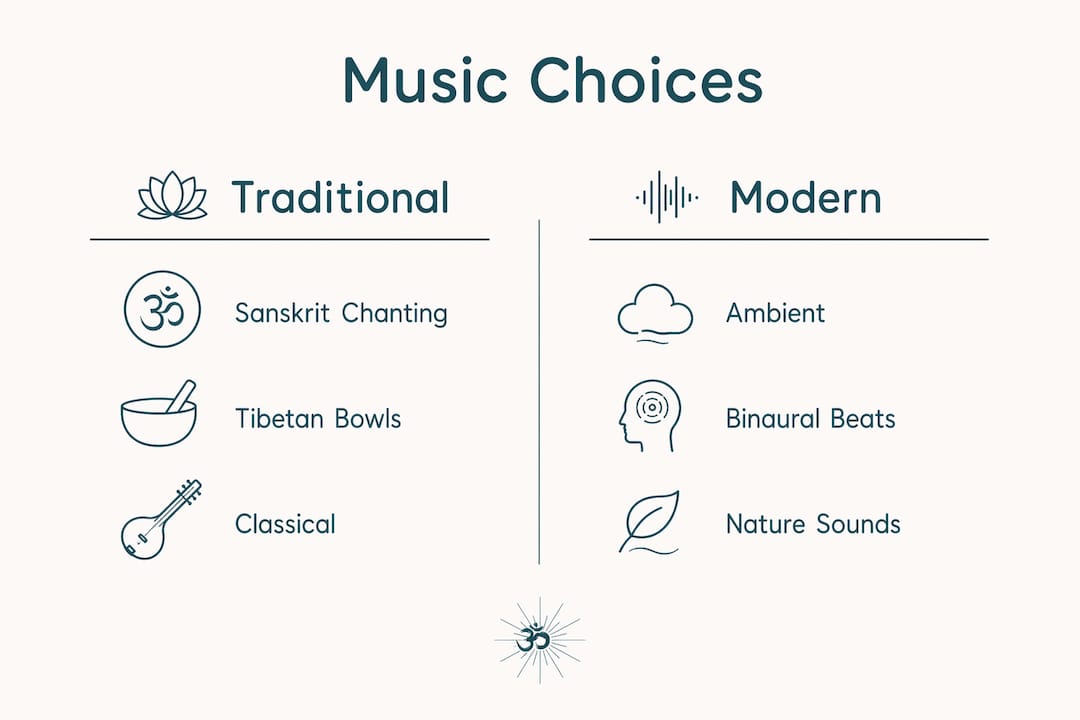
Sanskrit chanting occupies a slightly different category. For practitioners with a background in yoga philosophy, familiar mantras can deepen the sense of sacred space. For a mixed studio class, however, unfamiliar chanting can become a cognitive puzzle rather than a sonic anchor. The practical solution is to use chanting sparingly and at low volume, so the voice becomes texture rather than text. Kirtan-inspired tracks, where the chant is woven into an ambient arrangement, often strike this balance well.
Field recordings of natural environments, while not “traditional” in a cultural sense, tap into something deeply wired in the human nervous system. Our brains recognise rain, ocean waves, and forest sounds as signals of safety, which is precisely why they work so well in restorative contexts. Pairing a natural soundscape with a slow orchestral piece can create a layered environment that feels both grounded and expansive.
The key principle is respect and intentionality. Using a Tibetan bowl recording because it sounds “exotic” is different from understanding its function as a frequency tool. If you are incorporating cultural elements, take a moment to understand what they mean and why they work. Your students will feel the difference, even if they cannot name it.
Key takeaways
The most effective restorative yoga music sits at 40–60 BPM or abandons the beat entirely, using sustained tones, spatial soundscapes, and theta-frequency layering to support deep parasympathetic activation.
| Point | Details |
|---|---|
| Tempo and texture | Choose 40–60 BPM or beatless ambient; prioritise “wet and washy” sustained tones over rhythmic tracks. |
| Avoid English lyrics | Lyrics activate language processing and prevent the deep downshift restorative yoga requires. |
| Track length matters | Use 8–15 minute tracks or continuous soundscapes to prevent time-counting during long holds. |
| Volume management | Start slightly louder as students arrive, fade gradually, and plan 60–120 seconds of near-silence at Savasana. |
| Composer expertise | Robert Emery and Moritz Schneider both create music specifically suited to theta-state and contemplative stillness. |
FAQ
What BPM is best for restorative yoga music?
Restorative yoga music works best at 40–60 BPM or with no discernible beat at all. Anything faster risks stimulating the nervous system rather than calming it.
Should restorative yoga music have lyrics?
No. Lyrics disrupt meditative focus by activating language processing in the brain. If vocals are used, choose non-English chanting or wordless toning so the voice functions as texture rather than narrative.
How long should tracks be in a restorative yoga playlist?
Tracks of 8–15 minutes are ideal. Shorter tracks create a subtle awareness of time passing during long holds, which undermines the meditative state the practice aims to cultivate.
What are binaural beats and do they help?
Binaural beats occur when two slightly different frequencies play in each ear, prompting the brain to perceive a third frequency equal to the difference. Used in the theta range (4–8 Hz), they can gently support the deep, dream-like relaxation that restorative yoga targets.
Where can I find professionally produced restorative yoga music?
Orchestralmeditations offers high-quality orchestral meditation music recorded at Abbey Road Studios, with theta-frequency layering and 3D sound design specifically built for deep meditative states.