Binaural beats online are audio tracks that deliver two slightly different tones, one to each ear via headphones, creating an auditory illusion that encourages your brain to produce specific brainwaves linked to relaxation, sleep, focus, or meditation. The technique is formally known as auditory beat stimulation, and the brainwave entrainment effect it triggers is called the frequency following response (FFR). You cannot achieve this effect through speakers. Headphones are non-negotiable. Composers like Robert Emery and Moritz Schneider have taken this science further, weaving binaural frequencies into full orchestral arrangements to create something that feels far less like a lab experiment and far more like a genuine musical experience.
How do binaural beats work to influence brainwave states?
Binaural beats work by exploiting a quirk in the way your brain processes sound. When your left ear hears a tone at 200 Hz and your right ear hears a tone at 210 Hz, your brain perceives a third “phantom” frequency of 10 Hz. That phantom frequency is the binaural beat. Your brain then tends to synchronise its own electrical activity toward that frequency, a process called the frequency following response.
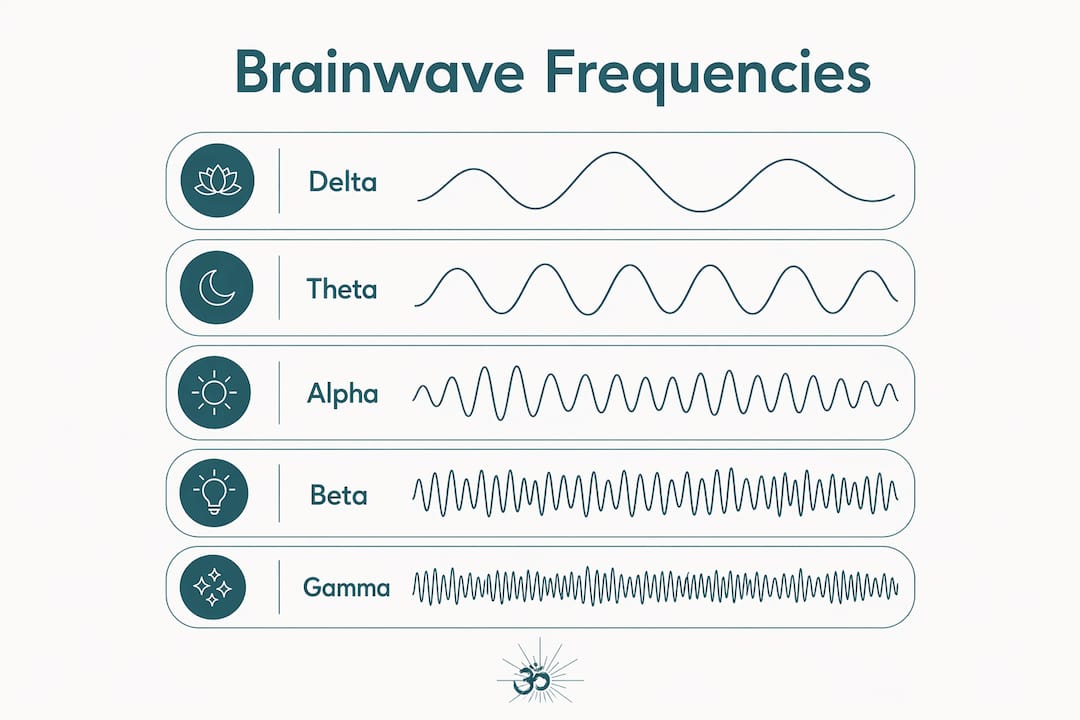
Brainwave entrainment through binaural beats targets five distinct frequency bands, each associated with a different mental state:
- Delta (0.5–4 Hz): Deep, dreamless sleep and physical restoration.
- Theta (4–8 Hz): Light sleep, deep meditation, and creative insight.
- Alpha (8–13 Hz): Calm, relaxed alertness and stress reduction.
- Beta (13–30 Hz): Active concentration, problem-solving, and alertness.
- Gamma (30–50 Hz): Peak cognitive performance and heightened perception.
These frequency bands are classified according to EEG research, and binaural beats aim to nudge your brain toward whichever band you target. The effect is subtle, not a sledgehammer. Think of it less like flicking a switch and more like gently steering a boat.
One critical technical point: binaural beats require stereo panning, with each tone sent fully to one ear. If the two tones mix before reaching your ears, whether through speakers or a mono audio file, the binaural effect is lost entirely. This is why the quality of your headphones matters as much as the quality of the recording itself.
Pro Tip: Use over-ear headphones rather than earbuds if you can. The better seal and phase isolation make a genuine difference to how cleanly each tone reaches each ear.

What brainwave frequencies can you target, and what do they do?
Each brainwave band serves a different purpose, and matching the right frequency to your goal is the single most important decision you make before pressing play. Theta waves, sitting in the 4–8 Hz range, are particularly popular for deep meditation and relaxation because they mirror the brain states associated with hypnagogia, that dreamy half-awake state just before sleep.
Session duration matters too. Recommended session lengths vary by frequency band, and benefits tend to plateau after 30–45 minutes. Pushing beyond that without a break rarely adds value and can cause listening fatigue.
| Frequency band | Hz range | Primary use | Recommended session length |
|---|---|---|---|
| Delta | 0.5–4 Hz | Deep sleep, healing | 30–60 minutes |
| Theta | 4–8 Hz | Meditation, creativity | 20–45 minutes |
| Alpha | 8–13 Hz | Relaxation, calm focus | 20–30 minutes |
| Beta | 13–30 Hz | Concentration, alertness | 15–30 minutes |
| Gamma | 30–50 Hz | Cognitive performance | 15–20 minutes |
Delta sessions run longest because they are designed to accompany sleep, where the brain naturally spends extended periods in slow-wave activity. Gamma sessions are the shortest because sustained high-frequency stimulation can feel mentally taxing. The table above reflects current guidance from Tembrica’s 2026 binaural beats resource, and it is a sensible starting framework for anyone new to the practice.
Alpha waves deserve a special mention for anyone using binaural beats for relaxation. The 8–13 Hz range is the brain’s natural “idle” state, the frequency it settles into when you close your eyes and breathe slowly. Nudging your brain toward alpha through audio is arguably the most accessible entry point into binaural beats therapy, requiring no prior meditation experience whatsoever.
How to find and use binaural beats online safely and effectively
Finding quality binaural beats online is easier than it was a decade ago, but the gap between a well-produced track and a poorly made one is enormous. A badly encoded file, a mono mix, or a track played through laptop speakers will produce nothing but a mild headache and a sense of disappointment.
Follow these steps to get the most from every session:
- Use stereo over-ear headphones. High-quality over-ear headphones are preferred over earbuds for the best seal and phase isolation. This is the single most important piece of equipment you own for this practice.
- Set volume to a moderate, comfortable level. Loud audio causes ear fatigue rather than effective entrainment. Binaural beat entrainment relies on subtle phase perception, not volume power. If it feels loud, turn it down.
- Choose the right track format. Real-time frequency-generating tools offer more precise control over binaural beats than pre-recorded tracks. Real-time software suits those who want to experiment with exact frequencies, while pre-recorded orchestral tracks suit those who want ease and musical richness.
- Add ambient sound if pure tones feel monotonous. Layering binaural beats with ambient sounds such as pink noise or rain improves listening comfort during long sessions. Pure sine-wave tones can grate after twenty minutes; ambient masking softens the experience considerably.
- Keep sessions within the recommended duration. Take a break every 1–2 hours. Benefits plateau after 30–45 minutes, and longer sessions without breaks do not accelerate results.
- Verify true stereo panning before committing to a track. If you cannot hear a clear difference between your left and right ear, the track is not properly formatted for binaural use.
Pro Tip: Before your first session, play a simple stereo test tone through your headphones to confirm left and right channels are correctly assigned. It takes thirty seconds and saves you from a wasted session.
One underappreciated distinction is the difference between a real-time generator and a pre-recorded track. A real-time generator lets you dial in 6 Hz theta precisely, which is useful if you are experimenting. A pre-recorded orchestral track, by contrast, wraps the binaural frequency inside a full musical arrangement, making the experience far more pleasant for regular daily use. Neither is objectively superior. Your preference depends entirely on whether you want a laboratory or a living room.
What does current science say about binaural beats therapy?
The scientific consensus on binaural beats is genuinely mixed, and anyone who tells you otherwise is either overselling or underselling the evidence. Positive EEG changes and subjective relaxation have been observed in studies, but the placebo effect cannot be ruled out. That is not a reason to dismiss the practice. It is a reason to hold your expectations at a sensible level.
“Binaural beats are best understood as a non-invasive wellness support tool, not a replacement for professional medical treatment.” — Biopreneur, 2026
This framing is the most honest one available. Current research suggests binaural beats can support relaxation and meditation practice, particularly when used consistently and with proper technique. They are not a cure for anxiety disorders, insomnia, or depression. Treating them as such would be both inaccurate and potentially harmful if it delays someone from seeking proper clinical support.
What the evidence does support is this: correct implementation is key. Studies showing weak or null effects often involve poor audio quality, speaker playback, or sessions that are too short to produce measurable EEG changes. When the technical conditions are right, the subjective experience of calm and focus is reported consistently across participants. That is not nothing. It is simply not magic either.
For anyone using binaural beats as part of a broader wellness routine, the binaural healing beats guide from Orchestralmeditations offers a grounded overview of the research alongside practical guidance. The key takeaway from the science is this: use binaural beats as a complement to good sleep hygiene, mindfulness practice, and professional support where needed, not as a substitute for any of them.
How do Robert Emery and Moritz Schneider shape binaural beats music?
Robert Emery and Moritz Schneider are the composers and producers behind Orchestralmeditations, and their approach to binaural beats music is genuinely different from what you find on most free streaming platforms. Rather than layering a sine-wave tone under a generic ambient pad, they build full orchestral arrangements around the binaural frequency, recorded with live musicians at Abbey Road Studios with the National Philharmonic.
Their contributions to the field include:
- Orchestral depth: Emery’s compositions use strings, woodwind, and brass to create emotional resonance that pure electronic tones simply cannot replicate. The music works on two levels simultaneously, as a binaural entrainment tool and as a genuinely beautiful listening experience.
- Frequency precision: Schneider’s production expertise ensures that the binaural frequencies are embedded correctly within the stereo field, with true left-right panning preserved throughout the mix. This is not a given in the wider market.
- 3D surround sound techniques: Both composers use spatial audio recording methods that enhance the immersive quality of each track, making the listener feel enveloped rather than merely accompanied.
- Therapeutic intent: Their work incorporates theta frequencies, Solfeggio-based tones, and delta wave compositions designed specifically for deep meditation, sleep, and relaxation, each track built around a defined wellness outcome.
The result is binaural beats music that does not feel like a science experiment. It feels like sitting in the stalls at a concert hall with your eyes closed, which is rather the point.
Key takeaways
Binaural beats online work best when you use stereo headphones, match the frequency band to your goal, and treat the practice as a complement to wider wellness habits rather than a standalone solution.
| Point | Details |
|---|---|
| Headphones are non-negotiable | Speakers cancel the binaural effect; over-ear stereo headphones are the minimum requirement. |
| Match frequency to your goal | Delta suits sleep, theta suits meditation, alpha suits relaxation, beta suits focus, gamma suits cognition. |
| Keep volume moderate | Entrainment depends on subtle phase perception, not loudness; loud audio causes fatigue. |
| Session length has a ceiling | Benefits plateau after 30–45 minutes; breaks every 1–2 hours are advised. |
| Science supports, not guarantees | Binaural beats are a wellness support tool, not a medical treatment or a substitute for professional care. |
Why I think most people use binaural beats wrong
I have been working with meditation music for long enough to notice a pattern. People discover binaural beats online, press play through their phone speaker while washing up, feel nothing, and conclude the whole thing is nonsense. That is a bit like trying to appreciate a Beethoven symphony through a tin can and a piece of string and deciding classical music is overrated.
The technology is genuinely interesting. The frequency following response is a real neurological phenomenon, documented in EEG research. But it requires the right conditions to work, and most casual listeners never bother to create those conditions. Proper headphones, a quiet room, a comfortable position, and a session length that actually gives your brain time to respond. That is not a demanding list. It is just a list that requires a small amount of intention.
What I find most compelling about the work Robert Emery and Moritz Schneider do at Orchestralmeditations is that they have solved the monotony problem. Pure sine-wave tones are effective in a laboratory. They are also, frankly, rather dull to sit with for forty minutes. Wrapping the binaural frequency inside a full orchestral arrangement gives your conscious mind something beautiful to rest on while the entrainment does its work underneath. That is a genuinely elegant solution.
My honest advice: start with alpha or theta, use the binaural beat for meditation guide to orient yourself, and give it at least two weeks of consistent daily sessions before forming an opinion. The brain is not a light switch. It is more like a garden. You have to show up regularly before anything grows.
— ROBERT
Orchestralmeditations: meditation music built for real listening
Orchestralmeditations produces meditation music recorded at Abbey Road Studios with the National Philharmonic, composed by Robert Emery and Moritz Schneider. Every track is built around a specific wellness outcome, whether that is deep sleep, focused meditation, or simple relaxation at the end of a long day.
The library includes binaural beat-enhanced orchestral compositions, theta frequency tracks, and 3D surround sound recordings designed for proper headphone listening. These are not background tracks thrown together in an afternoon. They are professionally produced pieces that work as both binaural entrainment tools and genuinely beautiful music. Browse the full meditation music library to find tracks suited to your practice, or explore the best meditation music collection for a curated starting point.
FAQ
What are binaural beats and how do they work?
Binaural beats are an auditory illusion created when two slightly different frequencies are delivered separately to each ear via headphones. The brain perceives a third “phantom” frequency equal to the difference between the two tones, and tends to synchronise its own electrical activity toward that frequency through a process called the frequency following response.
Do I need headphones for binaural beats to work?
Yes. Headphones are essential because binaural beats require each tone to reach only one ear. Speaker playback mixes the two tones before they reach your ears, cancelling the binaural effect entirely.
Are binaural beats safe to use?
Binaural beats are considered a non-invasive wellness tool and are generally safe for healthy adults. They are not a replacement for medical treatment, and anyone with epilepsy, a heart condition, or a serious mental health condition should consult a doctor before use.
How long should a binaural beats session last?
Session length depends on the target frequency. Delta sessions for sleep run 30–60 minutes, while gamma sessions for cognitive performance run 15–20 minutes. Benefits plateau after 30–45 minutes for most frequency bands, and breaks every 1–2 hours are advised for longer listening periods.
What is the difference between binaural beats for sleep and binaural beats for meditation?
Binaural beats for sleep target delta frequencies in the 0.5–4 Hz range, designed to accompany the brain’s natural slow-wave sleep activity. Binaural beats for meditation typically target theta frequencies in the 4–8 Hz range, which mirror the brain states associated with deep meditative awareness and creative insight.