
For UK clinics, the answer is straightforward: licensed, instrumental orchestral meditation tracks from Orchestralmeditations, played at low volume and scheduled by zone. Recorded at Abbey Road Studios with the National Philharmonic and produced to professional standards, these recordings are designed specifically to reduce patient anxiety and support staff workflow — and they come with commercial licensing that keeps your clinic on the right side of PRS/PPL requirements.
That is the short version. The longer version involves tempo ranges, zone mapping, pilot metrics, and a few licensing pitfalls that catch even experienced clinic administrators off guard. Let us get into it.
Key takeaways
Licensed orchestral meditation music, scheduled by zone and verified for UK public-performance rights, is the most practical and clinically defensible approach to improving patient comfort in UK clinics.
| Point | Details |
|---|---|
| Verify licensing before playing | Consumer streaming services are not licensed for UK public performance; confirm PRS/PPL coverage in writing from your supplier. |
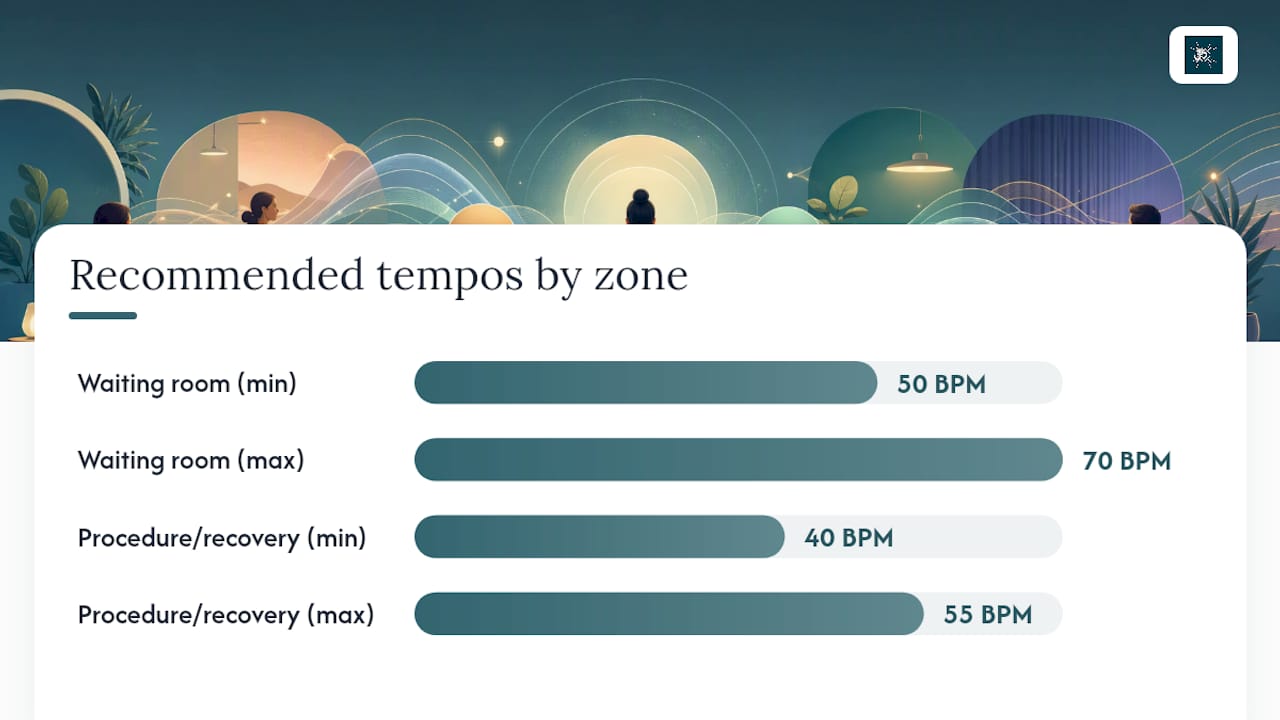
| Match tempo to zone | Use 50–70 BPM for waiting rooms and 40–55 BPM for procedure or recovery areas to support physiological calm. |
| Clinical evidence supports use | An RCT at Ramathibodi Hospital found music therapy reduced anxiety by a mean of 1.87 points and pain by 1.52 points versus control. |
| Run a structured pilot | A 2–4 week zone-specific pilot with pre/post anxiety scores (0–10) gives you defensible data for ongoing spend. |
| Orchestralmeditations for clinics | Offers professionally produced, commercially licensable orchestral tracks (Abbey Road, National Philharmonic) with composer credits from Robert Emery and Moritz Schneider, suitable for UK clinical procurement. |
What meditation music for clinics should you play right now?
Three zones, three approaches. Here is what to put on today:
- Waiting room: Slow instrumental strings or piano at tempos that support calm. Think long, looping orchestral pieces with no recognisable melody hooks and no lyrics. The goal is sonic wallpaper that signals calm without demanding attention.
- Consultation room: Neutral ambient pads or soft chamber music at a gentle tempo. Lower volume than the waiting room. Patients are listening to their clinician here, so the music should be almost imperceptible.
- Procedure or recovery area: Ultra-low ambient or binaural-based tracks with minimal dynamic variation. Nothing that builds to a crescendo or drops suddenly.
Pro Tip: Set your waiting room volume so that two people speaking at a normal conversational level cannot hear the music over their own voices. Then drop it another notch for consultation rooms. Use a simple dayparting schedule: slightly warmer, slightly more present music during morning intake when patients are alert; quieter, more recessive tracks during peak diagnostic hours when concentration matters most.
Why does calming music reduce anxiety and improve patient experience?
Calming music reduces self-reported anxiety and can lower physiological stress markers including heart rate and blood pressure. That is not marketing copy — it is a consistent finding across clinical settings from emergency departments to perioperative suites.
The mechanisms are reasonably well understood. Music engages the auditory cortex and competes with the brain’s threat-detection loop, effectively giving anxious patients something benign to process instead of the ambient sounds of a clinic (trolleys, alarms, hushed clinical conversations — none of which are reassuring). There is also evidence of endorphin release and parasympathetic activation in response to slow, consonant music, which is why the tempo and harmonic content of what you play actually matters rather than just the presence of sound.
Statistic callout: A randomised controlled trial at Ramathibodi Hospital found that music therapy added to standard analgesia reduced patient-reported pain by a mean of 1.52 points and anxiety by a mean of 1.87 points compared with the control group, with statistically significant results (p = 0.002 and p = 0.026 respectively). The study also recorded improved perceived service quality in the music therapy group.
That is a meaningful effect for a zero-cost-per-session intervention. The caveat worth noting: the benefit was most pronounced in non-trauma pain presentations. For acute procedures requiring precise verbal communication, silence or very low ambient sound is often the better clinical call. Music is an adjunct, not a protocol. You can read more about the science of healing with meditation music if you want the fuller mechanistic picture.
What should you look for when choosing relaxation music for healthcare?
The single-sentence answer: pick instrumental, low-lyric, low-tempo tracks with consistent dynamics, loop-friendly lengths, and a commercial licence that explicitly covers public performance in UK healthcare settings.
Musical attributes
- Tempo: Slower tempos suitable for waiting and consultation zones, with even slower tempos recommended for recovery areas. Faster tempos tend to increase arousal rather than reduce it.
- Instrumentation: Soft strings, solo piano, ambient pads, light woodwind. Avoid percussion-heavy arrangements, brass fanfares, or anything with a strong rhythmic pulse.
- Lyrics: None, or so minimal and indistinct that they register as texture rather than language. Recognisable words pull cognitive attention.
- Dynamic range: Narrow. A track that swells dramatically or drops to near-silence creates micro-startle responses — the opposite of what you want.
- Track length and loopability: Tracks of 20–60 minutes that loop without an audible join are ideal for multi-hour clinic sessions. Short pop-length tracks create jarring transitions.
Operational attributes
- Licensing: The supplier must provide explicit written confirmation of PRS/PPL coverage or a direct professional licence for UK public performance. Consumer streaming services do not cover this — more on that below.
- Zone scheduling: Look for suppliers offering multi-zone scheduling or at minimum separate playlist management per room type.
- File formats and bitrates: Lossless or high-bitrate MP3 (320 kbps minimum) for in-room playback. Compressed audio at low bitrates sounds thin through clinical speaker systems.
- Stream reliability: If you are streaming rather than playing downloaded files, confirm uptime guarantees. A buffering track in a procedure room is not a good look.
The relaxation music selection checklist on Orchestralmeditations covers these criteria in more detail if you want a procurement-ready reference.
Pro Tip: Before committing to a supplier, play three tracks to a small group of representative staff or patients and ask one question: “Did you notice the music?” If more than one person says yes and describes it as distracting, the tracks are too prominent. The best therapeutic music for clinics is the kind nobody consciously registers until it stops.
What are the UK licensing rules for playing music in clinics?
Clinics must use commercially licenced music or a supplier that explicitly covers PRS for Music and PPL performance rights. Consumer subscriptions — Spotify, Apple Music, YouTube — are not licensed for public or commercial use, and playing them in a waiting room is a copyright infringement regardless of how quietly you do it.
This trips up a surprising number of well-intentioned clinic managers. The logic of “we pay for a subscription, so we can play it” is understandable but legally wrong. Commercial suppliers confirm that consumer streaming platforms are not an appropriate legal solution for public clinic use, and that fully licenced B2B catalogues reduce administrative risk for NHS and private clinics alike.
Here is what to verify before you press play:
- Ask the supplier directly: Does your licence cover PRS for Music and PPL for UK public performance in a healthcare setting?
- Request written licence terms: A verbal assurance is not enough for procurement records. Get it in writing.
- Confirm territory coverage: Some licences are US-only or EU-only. UK clinics need explicit UK territory coverage.
- Check whether background-music licences are included: Some suppliers charge separately for background-music rights versus on-hold or broadcast use.
- Look for healthcare-specific client case studies: A supplier that lists NHS trusts or private clinic groups as clients has already navigated this compliance landscape.
Music licences for public performance in UK commercial premises are governed by PRS for Music (covering composers and publishers) and PPL (covering recording rights). Clinics that use a supplier with bundled PRO coverage avoid the administrative burden of obtaining separate licences — but they must confirm that coverage in writing before use.
The cleanest procurement approach is to include music licensing costs in your annual operating budget as a line item, either as a subscription fee to a B2B supplier or as a one-time purchase of commercially licenced tracks with explicit professional-use rights. Royalty-free catalogues with professional licences — like those available from Orchestralmeditations — are worth checking for royalty-free therapeutic options that remove the ongoing PRO administration entirely.
Pro Tip: When reviewing supplier licence documents, search specifically for the words “public performance”, “commercial use”, and “healthcare”. If those terms do not appear, ask the supplier to confirm in writing that the licence covers your use case before signing anything.
How do you implement ambient music for therapy across different clinic spaces?
Map music modes to clinic zones first: slow instrumental for waiting areas, neutral low-level ambient for reception and consultation, ultra-low ambient for procedure and recovery spaces where verbal communication is critical.
Step-by-step launch guide
- Zone audit: Walk every patient-facing space and note the acoustic characteristics (hard floors, high ceilings, background HVAC noise). This determines speaker placement and volume baselines.
- Hardware checklist: Ceiling or wall-mounted speakers with independent volume controls per zone; a central scheduler or media player (a dedicated device per zone is fine for smaller clinics); amplifiers rated for the room size.
- Schedule templates: Morning intake (8 AM–10 AM): slightly warmer, more present orchestral tracks. Peak diagnostics (10 AM–2 PM): quieter, more recessive ambient. Afternoon appointments (2 PM–5 PM): return to moderate presence. Evening close: minimal, very slow ambient.
- Staff briefing: Explain the purpose and give staff authority to adjust volume within a defined range (typically ±3 dB from the set point). They are the best real-time monitors you have.
- Signage policy: Some clinics add a small notice near the reception desk noting that relaxation music is playing. Patients with sensory sensitivities appreciate the heads-up.
- Emergency tone protocol: Confirm that your PA system or emergency tone overrides the music system automatically. This is non-negotiable.
Volume guidance: music in a waiting room should sit at roughly 50–55 dB, which is quieter than a normal conversation (60–65 dB). In a consultation room, aim for 40–45 dB or lower. The practical test: if a patient has to raise their voice slightly to be heard by the clinician, the music is too loud.
The C.A.R.E. Channel, adopted across more than 1,000 healthcare sites, uses a 24-hour format with evening programming specifically designed to support patient sleep and circadian rhythm — a useful model for inpatient or extended-care settings where music scheduling needs to run continuously.
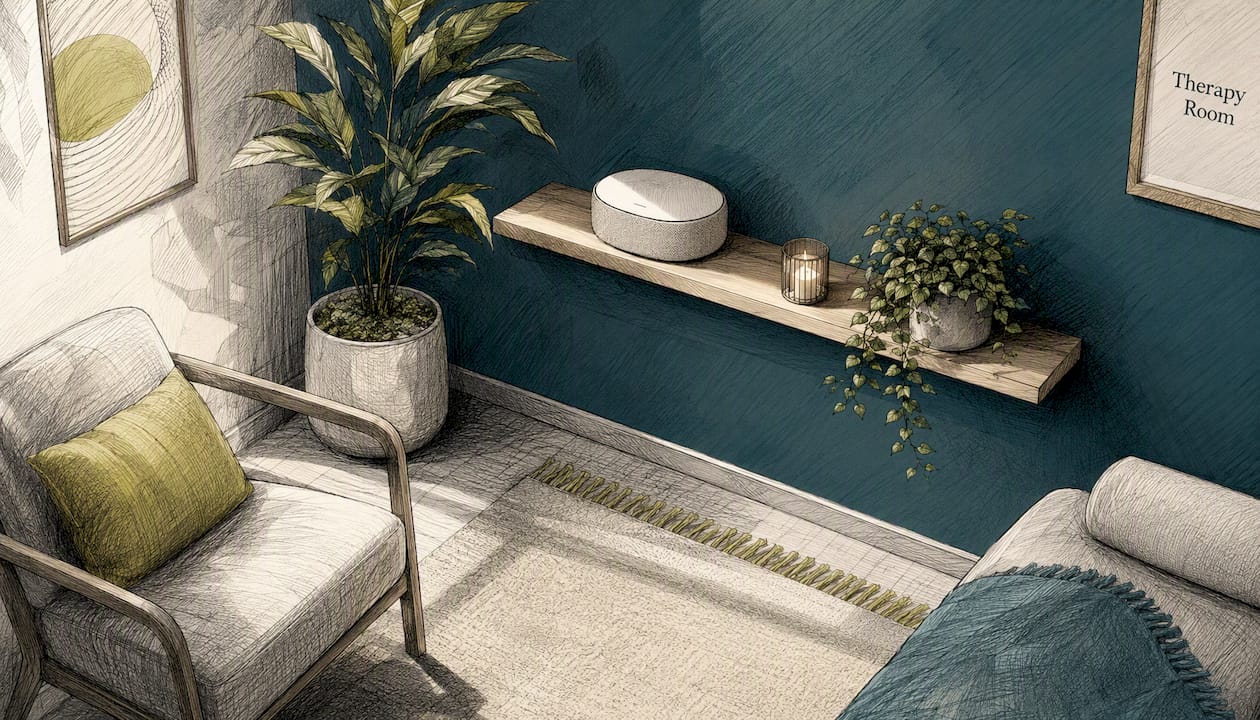
Pro Tip: Use zone-based scheduling to create “quiet hours” around any procedure or consultation that requires sustained verbal instruction. A simple rule: if the clinician needs to repeat themselves, the music goes off.
What does the clinical evidence actually say about therapeutic music?
RCTs show modest-to-moderate reductions in self-reported anxiety and pain when music is integrated with standard care — and the evidence is consistent enough across settings to justify routine implementation, even if the effect sizes are not dramatic.
The strongest evidence comes from perioperative and emergency department settings. The Ramathibodi Hospital RCT (63 participants, 30–40 minute music therapy sessions) demonstrated statistically significant reductions in both pain and anxiety scores, with improved perceived service quality — a finding that matters for clinic reputation as much as patient comfort.
Statistic callout: In the Ramathibodi trial, the music therapy group showed a mean pain reduction of 1.52 points versus 0.09 in the control group (p = 0.002), and a mean anxiety reduction of 1.87 points (p = 0.026). Both results were statistically significant.
Waiting room and outpatient evidence is less rigorous but directionally consistent: industry guidance summarises that slow, low-lyric calming music reduces stress markers and supports practical scheduling in clinical waiting environments. The caveats are real: study methods are heterogeneous, cultural music preferences vary considerably, and live music produces different effects from recorded music. No single track or genre works universally.
The clinical implication is clear: music is an adjunct to standard care, not a substitute for medical analgesia or consented clinical intervention. Use it to reduce background anxiety and improve perceived wait time. Do not use it as a reason to delay pharmacological pain management. For clinicians wanting a structured approach, the step-by-step music therapy session guide offers a practical framework for integrating music into clinical workflows.
Why Orchestralmeditations is a strong fit for UK clinics
Orchestralmeditations provides commercially licensable orchestral meditation recordings produced to professional standards, with explicit options for professional and commercial use that UK clinics can verify before purchase.
The product features most relevant to clinical procurement:
- Professional licensing: Tracks are available with professional-use licences, removing the PRS/PPL administration burden for clinics that purchase directly. Verify current licence wording on the Orchestralmeditations clinic pages before finalising procurement.
- Long-form loopable albums: Extended orchestral pieces designed for continuous playback without jarring transitions — exactly what a four-hour morning clinic session requires.
- 3D surround and binaural mixes: Advanced recording techniques including 3D surround sound and binaural mixes create an immersive, enveloping quality that standard background music catalogues rarely match. In a clinical context, this translates to a more convincing sense of calm rather than the thin, tinny ambient loops that patients tune out (or find irritating).
- Live musicians and orchestral arrangements: Recorded with the National Philharmonic at Abbey Road Studios, the catalogue has a warmth and acoustic depth that digitally produced ambient music cannot replicate. Live strings in a well-recorded space simply sound different — and patients notice, even if they cannot articulate why.
- High-quality file formats: Suitable for professional speaker systems rather than compressed for earbuds.
On the creative side, the catalogue features the work of composer and producer Robert Emery, whose orchestral compositions form the backbone of the Orchestralmeditations library. Emery’s background in orchestral writing gives the recordings a structural coherence that purely ambient productions often lack: there is genuine compositional craft in how tension and release are managed across a long-form track, which matters enormously for clinical use where you need music that sustains calm over hours rather than minutes. Moritz Schneider contributes as a producer and creative collaborator, with production credits that include the Abbey Road sessions. Schneider’s production approach prioritises acoustic space and dynamic restraint — two qualities that are particularly valuable in clinical environments where sonic density needs to stay low. Procurement teams should verify both composers’ credits on the Orchestralmeditations supplier pages and liner notes when building their clinical music policy documentation.
Orchestralmeditations positions its catalogue as suitable for deep relaxation and therapeutic use, with production standards — Abbey Road Studios, National Philharmonic, 3D surround and binaural recording techniques — that support clinical credibility in procurement conversations.
Pro Tip: When requesting a trial from Orchestralmeditations, ask specifically for the long-form loopable versions of tracks rather than the standard-length edits. The extended versions are what make the difference in a four-hour clinic session.
How do you run a pilot and measure whether it is working?
Run a 2–4 week, zone-specific pilot comparing a baseline period (no music or existing audio) with an intervention period (new tracks, scheduled by zone) using simple pre/post patient anxiety surveys and staff feedback forms.
- Define objectives: Are you primarily targeting patient anxiety, perceived wait time, or staff wellbeing? Pick one primary metric per zone.
- Choose zones: Start with the waiting room. It is the easiest to control and the zone with the most patient exposure time.
- Choose tracks: Select 3–5 long-form instrumental tracks per zone from your chosen supplier. Keep them consistent across the pilot period so you are not introducing a variable.
- Set the schedule: Use the dayparting template from the implementation section above.
- Collect baseline metrics: One week before the intervention, ask patients to rate their anxiety on a 0–10 scale as they leave the waiting room. Record average perceived wait time and any staff observations.
- Run the intervention: Two to four weeks of scheduled music. Keep everything else constant.
- Analyse results: Compare pre/post anxiety scores, satisfaction ratings, and staff feedback. Note any adverse events (patients requesting music be turned off, complaints about volume).
For anxiety management more broadly, combining music with other non-pharmacological strategies — breathing exercises, clear signage, comfortable seating — produces better outcomes than music alone. The practical anxiety strategies guide from Prism Counseling is a useful reference for building a fuller patient comfort programme alongside your music pilot.
The music therapy checklist on Orchestralmeditations offers a structured framework for tracking these outcomes across a clinical programme if you want a ready-made template.
Why we design orchestral meditations specifically for clinical settings
We build and licence orchestral meditation recordings with clinical contexts in mind — not as an afterthought, but as a design principle. Patient comfort and staff workflow are not the same as personal meditation at home, and the music needs to reflect that: longer forms, narrower dynamics, professional licensing, and production standards that hold up on clinical speaker systems rather than consumer earbuds.
The recordings in the Orchestralmeditations catalogue carry professional production credentials — Abbey Road Studios, National Philharmonic, the compositional work of Robert Emery and the production craft of Moritz Schneider — that give procurement teams something concrete to point to when justifying a music programme to clinical governance committees. “We use professionally produced, commercially licenced orchestral recordings” is a very different conversation from “we play Spotify in the waiting room.”
If you are building a clinical music policy from scratch, we would genuinely welcome the chance to walk you through a zone demo or a tailored trial. Procurement teams can request composer and production notes, licence documentation, and suggested pilot playlists directly through the Orchestralmeditations clinic pages.
Orchestralmeditations: a risk-free starting point for your clinic
The sharpest argument for starting with Orchestralmeditations rather than a generic background music service is this: you get professionally produced, commercially licenced orchestral recordings with explicit professional-use rights, composer and producer credits you can cite in procurement documentation, and long-form loopable tracks designed for sustained clinical use — without the ongoing PRO administration that comes with most B2B streaming subscriptions.
For UK clinics, the practical next step is to visit the Orchestralmeditations professional pages, request licence confirmation for your specific use case (waiting room, consultation, procedure), and ask for the long-form loopable versions of the catalogue for your pilot. When you make contact, ask specifically about Robert Emery’s compositional credits and Moritz Schneider’s production notes — both are worth including in your clinical music policy documentation. Billing, territory coverage, and file delivery formats are all worth confirming at the same time. The catalogue is available for individual track purchase or subscription, so you can start with a single zone and scale from there.
Sources
The sources below informed this article and are worth bookmarking for your own clinical music policy work. Check each supplier’s licence statement carefully before purchase — what is covered in one territory may not apply in the UK.
- Effects of music therapy on pain and anxiety among patients presenting to the emergency department with pain: a randomised controlled trial — Ramathibodi Hospital
- The business value of calming music in clinics — SoundMachine
- Music for Clinics | Soundsuit
FAQ
What is the best background music for a clinic waiting room?
Instrumental, low-tempo orchestral or ambient tracks at 50–70 BPM with no lyrics and narrow dynamic range. Commercially licenced catalogues from professional suppliers — such as Orchestralmeditations — are the appropriate choice for UK public-performance compliance.
Are there scientifically proven calming tracks for clinical settings?
Clinical trials, including a Ramathibodi Hospital RCT, show that slow, instrumental music reduces self-reported anxiety and pain in healthcare settings. No single track is universally proven, but slow-tempo, low-lyric orchestral music consistently outperforms silence or no intervention.
Can clinics use Spotify or Apple Music in their waiting rooms?
No. Consumer streaming licences do not cover public or commercial performance in UK premises. Clinics must use a B2B supplier with explicit PRS/PPL coverage or purchase commercially licenced tracks with professional-use rights.
What is good meditation music for a therapy or counselling practice?
Slow instrumental pieces — soft strings, piano, or ambient pads at 50–65 BPM — work well in therapy settings. Combining music with other non-pharmacological anxiety strategies, as outlined in practical anxiety management guidance, tends to produce better patient outcomes than music alone.
How do you measure whether clinic music is actually helping patients?
Run a 2–4 week pilot using a simple 0–10 self-reported anxiety scale administered as patients leave the waiting room, alongside perceived wait time and satisfaction scores. Compare baseline and intervention periods with a minimum of 20 patients per period for a meaningful signal.
A note on what the evidence actually demands of us
There is a version of this conversation that goes: “We played some nice music and patients seemed happier.” That is fine as far as it goes, but it is not good enough for a clinical environment where every environmental intervention should be justifiable.
The honest picture is that the evidence for recorded background music in clinics is promising but not overwhelming. The Ramathibodi RCT is a solid data point; the broader literature is heterogeneous. What that means in practice is not “don’t bother” — it means “bother properly.” Run the pilot. Collect the metrics. Use commercially licenced, professionally produced music rather than whatever happens to be on someone’s phone. And choose a supplier whose production credentials — Abbey Road, live orchestral musicians, named composers like Robert Emery — give you something concrete to stand behind in a clinical governance conversation.
The clinics that get the most out of therapeutic music are the ones that treat it as a designed environmental intervention rather than an afterthought. That is a higher bar than most guides set. It is also the bar that actually makes a difference to patients.