Frequency 528 is a musical pitch widely used in sound healing and meditation for its reported calming and restorative effects on the mind and body. Known informally as the “love frequency” or “miracle tone,” it sits just above the C5 note in standard 440 Hz tuning and forms part of the ancient Solfeggio scale, a set of tones historically associated with spiritual and physical transformation. Research published in peer-reviewed journals suggests that 528 Hz reduces cortisol and self-reported anxiety more effectively than standard tuning. Composers like Robert Emery and producers like Moritz Schneider have built entire catalogues around this frequency, crafting music that puts nervous system regulation at the centre of the listening experience.
What does frequency 528 actually do to your body and mind?
The short answer is that 528 Hz calms the nervous system through tonal stability and subjective resonance, not through any mystical property unique to the number itself. A 2018 study measured participants exposed to 528 Hz music and found measurable reductions in both cortisol levels and self-reported anxiety compared to a control group. That is a meaningful result. It means the frequency is not just pleasant background noise; it produces a physiological response you can actually measure.

What it does not do is physically repair your DNA. This claim circulates widely in wellness communities, but DNA repair claims are poetic descriptions rooted in older Solfeggio traditions rather than clinical science. Treating them as literal fact does the frequency a disservice. The real story is interesting enough without the mythology.
Therapists working in sound healing describe the therapeutic value of 528 Hz as lying in two places: nervous system regulation and the listener’s own subjective resonance with the tone. That second point matters more than most people realise. Your brain does not respond identically to every frequency. Personal resonance is a genuine variable.
“The therapeutic effects of 528 Hz are explained more by music therapy principles than by any unique properties of the frequency itself.” — Sound therapy research consensus
Here is what the current evidence actually supports:
- Cortisol reduction: Measurable decreases in the stress hormone cortisol following exposure to 528 Hz music.
- Anxiety relief: Self-reported anxiety drops more with 528 Hz than with standard 440 Hz music in controlled settings.
- Mood enhancement: Studies suggest 528 Hz enhances mood and shows potential as an adjunctive tool in neurorehabilitation for anxiety and stroke recovery.
- Nervous system modulation: The frequency supports parasympathetic activation, the body’s rest-and-digest mode.
- No clinical cure: No peer-reviewed evidence supports 528 Hz as a standalone treatment for any medical condition.
The honest picture is one of genuine promise within realistic limits. That is actually a more useful place to start than miracle claims.
How is frequency 528 used in meditation and sound therapy?
The practical applications of 528 Hz sound are broader than most people expect, and they go well beyond simply pressing play on a YouTube track. Composers and producers working in this space treat the frequency as a structural element of the music itself, not a filter applied afterwards.
Robert Emery, the composer behind several of Orchestralmeditations’ most celebrated recordings, approaches 528 Hz as a tonal foundation. His compositions are built from the ground up at this tuning, meaning every melodic line and harmonic layer sits in natural relationship with the frequency rather than fighting against it. Moritz Schneider, who produces and engineers these recordings, focuses on maintaining tonal stability across the full listening duration. His production work ensures that the immersive quality of the sound does not degrade as a track progresses, which matters enormously when you are trying to hold a meditative state for twenty or thirty minutes. You can explore the benefits of 528 Hz music in detail to understand how this approach translates into the listening experience.
In therapy sessions, practitioners typically integrate 528 Hz in one of three ways. First, as a standalone ambient track during breathwork or body scan meditations. Second, layered with binaural beats to compound the relaxation effect. Third, combined with guided visualisation, where the frequency acts as an emotional anchor rather than the primary focus.
Here is a practical sequence for getting the most from a 528 Hz listening session:
- Choose a quiet space. External noise disrupts the tonal stability that makes the frequency effective. Even moderate background sound reduces the parasympathetic response.
- Use headphones or quality speakers. Cheap earbuds compress the frequency range and strip out the harmonic overtones that carry much of the calming effect.
- Set a duration before you begin. Twenty minutes is a reasonable starting point. Shorter sessions can feel rushed; longer ones require experience to sustain focus.
- Pair with a simple breath practice. Four counts in, four counts out. The rhythm synchronises with the tonal pulse of most 528 Hz compositions and deepens the relaxation response.
- Avoid multitasking. This is not background music for emails. Treat it as a practice, not a supplement.
Many practitioners also combine 528 Hz with other Solfeggio frequencies in sequence. A common pairing is 396 Hz (associated with releasing fear) followed by 528 Hz, which creates a progression from emotional release into restoration.
Pro Tip: If you find your mind wandering during a 528 Hz session, try focusing attention on the lowest audible tone in the track rather than the melody. This grounds attention in the body rather than the thinking mind.
How does 528 Hz compare with other healing frequencies?
This is where things get genuinely interesting, and where a lot of wellness content gets muddled. The comparison between 528 Hz and other popular frequencies is not really a competition. Each serves a different function in the nervous system.
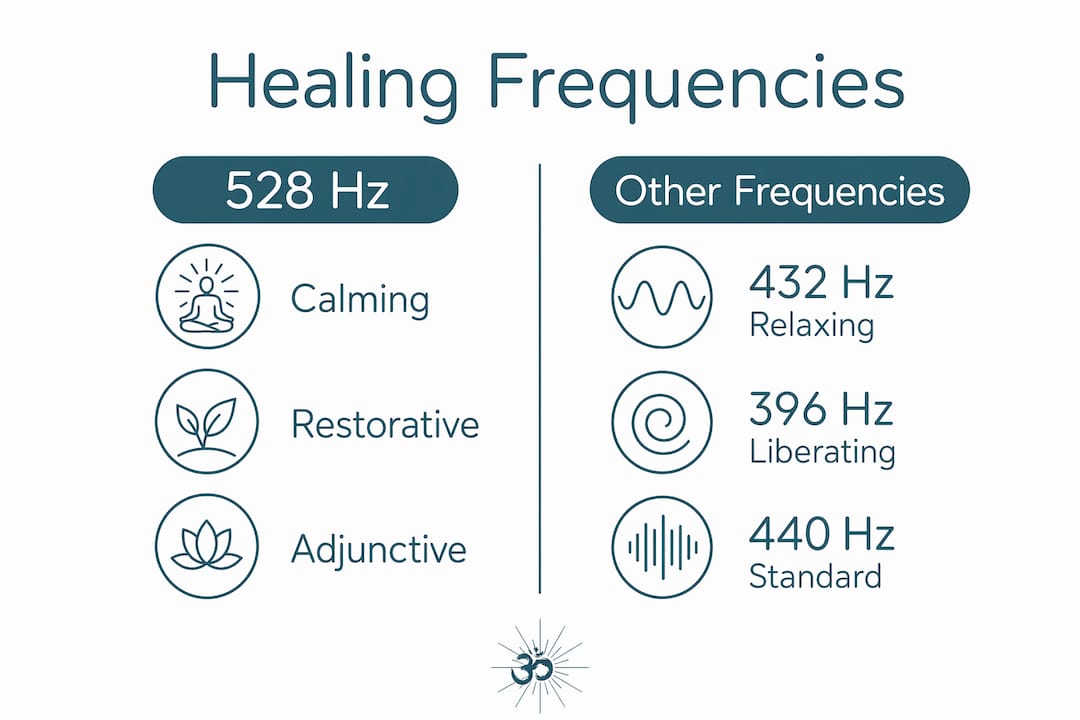
The most common comparison is 432 Hz versus 528 Hz. Both are alternatives to standard 440 Hz concert tuning, but they work differently. 432 Hz is a tuning standard, meaning it shifts the entire musical scale down slightly, producing a warmer, more grounded sound that many listeners find less fatiguing over long sessions. 528 Hz is a specific pitch, not a tuning standard. It targets a single note and its harmonics rather than retuning the whole instrument.
Standard 440 Hz tuning, adopted internationally in 1939, is neither harmful nor healing. It is simply a convention. The argument that 440 Hz is inherently stressful has no strong scientific backing. What the research does support is that music tuned to 528 Hz produces measurably different physiological responses than the same music at 440 Hz.
| Frequency | Type | Primary reported effect | Common use |
|---|---|---|---|
| 440 Hz | International tuning standard | Neutral; conventional listening | All mainstream music |
| 432 Hz | Alternative tuning standard | Warmer tone; reduced listening fatigue | Long meditation sessions |
| 528 Hz | Specific Solfeggio pitch | Cortisol reduction; anxiety relief | Focused meditation; sound therapy |
| 396 Hz | Solfeggio frequency | Emotional release; fear reduction | Preparatory meditation |
| 639 Hz | Solfeggio frequency | Connection; relationship harmony | Group or relational practices |
One technical reality worth knowing: instruments must be retuned or Solfeggio-tuned software synthesisers used to produce 528 Hz accurately. Playing a standard piano alongside a 528 Hz track creates discordance because the two tuning systems do not align. This is why professionally produced recordings, like those from Orchestralmeditations, matter. The engineering precision behind them is not incidental; it is the whole point.
Pro Tip: When choosing between 432 Hz and 528 Hz for a session, ask yourself what you need. If you want to unwind after a long day, 432 Hz’s warmer tone often feels more immediately soothing. If you are working through anxiety or emotional tension, 528 Hz’s specific cortisol-reducing effect may serve you better.
What are the risks and misconceptions around frequency 528?
The biggest risk with 528 Hz is not the frequency itself. It is the claims made about it. Overclaiming does two kinds of damage: it sets unrealistic expectations that lead to disappointment, and it discourages people from using a genuinely useful tool because it feels too “woo-woo” to take seriously.
Experts consistently advise thoughtful scepticism about healing frequency claims. That does not mean dismissing the evidence. It means holding the evidence accurately. Here is what to watch for:
- “528 Hz cures disease.” No peer-reviewed study supports this. The frequency is an adjunctive tool, not a treatment.
- “DNA repair is scientifically proven.” The DNA repair narrative is metaphorical, drawn from older Solfeggio traditions. It has no clinical basis.
- “More exposure equals more benefit.” Listening for eight hours a day will not produce eight times the cortisol reduction. The nervous system does not work that way.
- “All 528 Hz tracks are equivalent.” Production quality matters enormously. A poorly engineered track at 528 Hz may not maintain tonal stability, reducing or eliminating the therapeutic effect.
- “528 Hz replaces professional mental health support.” Sound therapy is a complement to evidence-based care, not a substitute for it.
The best approach to 528 Hz is to treat it as one tool in a broader wellness practice. Combine it with breathwork, movement, sleep hygiene, and where relevant, professional therapeutic support. Personal resonance matters too. If a particular track or composition does not feel right to you, try another. The subjective experience of the frequency is a real variable, not a sign that you are doing it wrong.
Sound therapy works best as a non-invasive adjunctive tool integrated into broader wellness plans. That framing keeps expectations honest and the practice sustainable.
Key takeaways
Frequency 528 is a specific Solfeggio pitch with measurable effects on cortisol and anxiety, best used as an adjunctive tool within a broader, evidence-informed wellness practice.
| Point | Details |
|---|---|
| Defined pitch, not magic | 528 Hz is a specific musical frequency near C5, part of the Solfeggio scale, not a mystical cure. |
| Measurable stress reduction | A 2018 study found 528 Hz music reduces cortisol and anxiety more than standard 440 Hz music. |
| DNA repair is metaphor | No clinical evidence supports physical DNA repair; this claim is poetic, not scientific. |
| Production quality matters | Instruments must be retuned or Solfeggio software used; poorly engineered tracks lose the therapeutic effect. |
| Use it as one tool | 528 Hz works best alongside breathwork, mindfulness, and professional support, not as a standalone treatment. |
Why I think 528 Hz deserves more honest attention than it gets
I have spent a fair amount of time sitting with 528 Hz music, and I will admit my first reaction was scepticism of the eye-rolling variety. The “love frequency” branding does not exactly scream rigorous science. But then I actually listened, properly, with decent headphones and no distractions, to a recording built from the ground up at this tuning. Something shifted. Not dramatically. Not in a cartoon-lightning-bolt way. But the quality of my attention changed, and the tension I carry in my shoulders without noticing loosened a little.
What changed my thinking more than the personal experience was understanding the craft behind the recordings. Robert Emery’s compositional approach is not about slapping a frequency label on a piece of music. He builds harmonic structures that allow the 528 Hz pitch to resonate through the full orchestral texture, so the frequency is not a feature of the track; it is the architecture. Moritz Schneider’s production work then preserves that architecture across the listening duration, which is technically demanding in ways most listeners never consider. The result is music that holds you rather than music you have to hold onto.
The research landscape is still developing. We have solid evidence for cortisol reduction and anxiety relief. We do not yet have large-scale clinical trials. That gap is real, and I think it is worth being honest about it rather than papering over it with testimonials. What I do know is that the subjective experience of a well-produced 528 Hz recording is qualitatively different from generic ambient music, and that difference is worth investigating on your own terms. Start with one session. Use quality headphones. Give it twenty minutes. Then decide.
— ROBERT
Orchestralmeditations’ 528 Hz music: where craft meets calm
If you have read this far and want to actually experience what a professionally produced 528 Hz recording feels like, Orchestralmeditations is the place to start.
The platform’s meditation music library includes compositions by Robert Emery and productions by Moritz Schneider, recorded with live musicians at Abbey Road Studios. Every track is built at the correct tuning from the ground up, not retrofitted. The 3D surround sound engineering means the frequency reaches you the way it is supposed to. Whether you are new to sound therapy or deepening an existing practice, the catalogue offers a range of session lengths and compositional styles. You can also explore the best meditation music to find recordings matched to specific wellness goals, from anxiety relief to deep sleep support.
FAQ
What is frequency 528 in simple terms?
Frequency 528 is a specific musical pitch, slightly above the C5 note in standard tuning, and part of the ancient Solfeggio scale. It is often called the “love frequency” due to its traditional association with healing and transformation.
Is 528 Hz actually healing?
Research shows 528 Hz reduces cortisol and self-reported anxiety compared to standard 440 Hz music, making it a genuinely useful tool for stress relief. It is not a medical treatment, but its calming effects on the nervous system are measurable.
Does 528 Hz repair DNA?
No. The DNA repair claim is a poetic description from older Solfeggio traditions, not a clinical finding. No peer-reviewed study has demonstrated that sound frequencies physically alter or repair DNA.
How long should I listen to 528 Hz music?
Twenty minutes is a practical starting point for most people. Longer sessions are possible, but the nervous system benefits do not scale linearly with duration, so quality of attention matters more than total listening time.
How does 528 Hz differ from 432 Hz?
432 Hz is an alternative tuning standard that shifts the entire musical scale, producing a warmer overall sound. 528 Hz is a specific pitch within the Solfeggio system. You can read a detailed 432 Hz vs 528 Hz comparison to decide which suits your practice better.