Looping meditation music is a track built or edited so that its end flows back into its start without a gap, a click or a sudden change, which lets it run for as long as your practice does. Pick a slow, predictable piece, make sure the loop point is clean, set your player to repeat, and, if you teach or publish, check the licence before it goes anywhere public.
That sounds simple. It is, until the track you love suddenly lurches into a new key at minute four, or your phone inserts a half-second of silence that lands on the exhale like a dropped plate. We have spent a lot of hours in recording studios listening for exactly those moments, so this guide is about what we have learned: what makes a loop work, how to set one up, and what to check in Germany if you plan to use it with other people.
TL;DR
- A good meditation loop is slow (roughly 60 to 80 BPM is what sleep research favours), soft, instrumental and predictable, with no sudden drums or key changes.
- Seamless looping depends on the file as much as the player: MP3 and AAC add tiny silences at the edges, so gapless playback or a lossless file matters.
- Most players can repeat a single track, and some can repeat a selected section, so you rarely need special software.
- In Germany, music played publicly or combined with video usually needs rights cleared, and GEMA presumes its repertoire is in use unless you can show otherwise.
- Our music is recorded with live musicians at Abbey Road Studios, and we offer personal and professional licensing, so you can loop it for yourself or for your clients.
What looping meditation music actually is
A loop is a piece of audio that repeats. That is the whole definition, but there are three quite different things hiding under it.
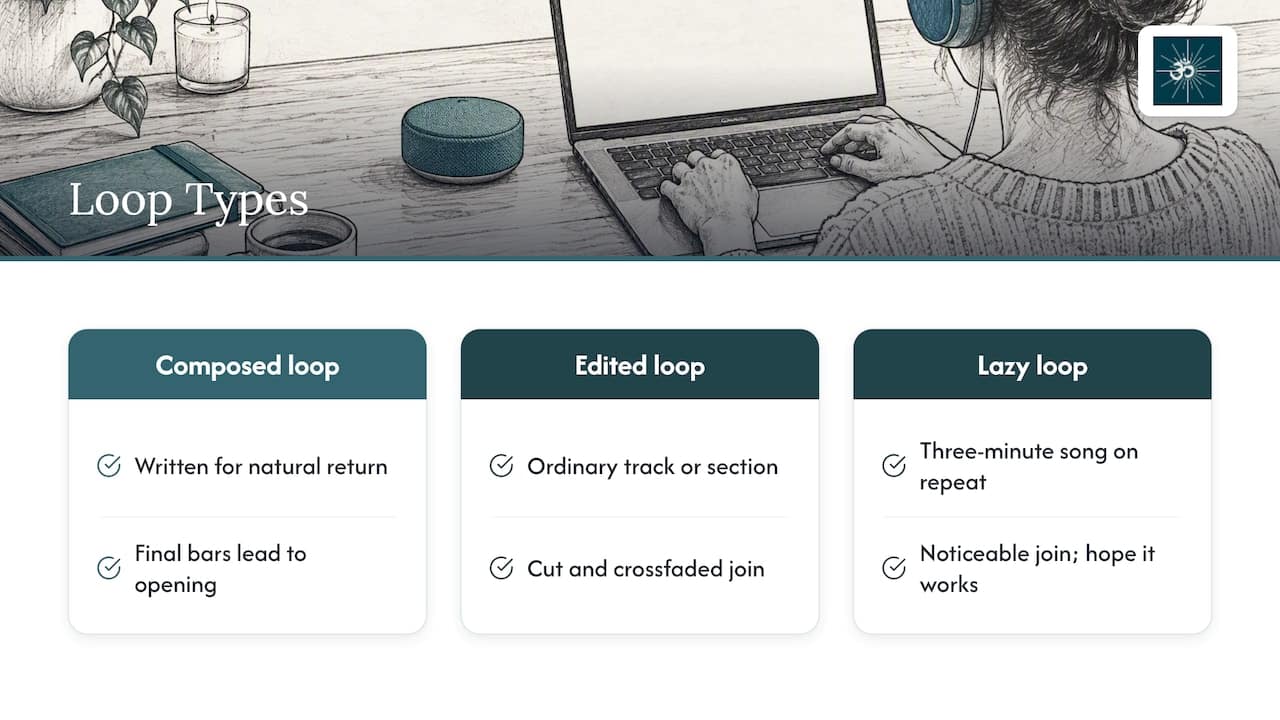
The first is a composed loop: a piece written so that the final bars lead naturally back to the opening. Think of a slow drone that swells and settles, then swells again. The second is an edited loop: an ordinary track, or a section of one, cut and crossfaded so the join is hidden. The third is the lazy loop: you press repeat on a three-minute song and hope. We have all done the third one. It works about as well as sleeping on a folded deckchair.
Why would you want a loop at all? Because meditation does not come in neat track lengths. A breathing practice might run for twelve minutes, a body scan for forty, a yoga nidra session for an hour. If the music stops before you do, the silence pulls you out of the state you worked to reach. If it keeps going and changes character, it pulls you out in a different way. A loop gives the practice a floor to stand on.
We go deeper on the practical side in our own article on loopable meditation music and how to loop it well. This page is the wider picture, with a particular eye on what matters if you live or work in Germany.
What makes a track loop well
Not every beautiful piece of music is a good loop. Some of the most moving music ever written is moving precisely because it goes somewhere: it builds, breaks, resolves. For meditation that is a problem, because a destination implies you were not already there.
Tempo and pulse
A narrative review of the elements of music that help sleep found that the most effective pieces were slow, at about 60 to 80 beats per minute, soft and smooth, instrumental and simple. The authors note that this range is thought to help relaxation by echoing the body’s own rhythms, and the sessions studied typically lasted 30 to 45 minutes, with one study using 60. That is a useful rule of thumb when you choose a loop, whether for sleep or for a seated practice.
Notice the word “believed”. Nobody has proved that your heartbeat politely falls into step with a cello. But as a starting point, a pulse near a resting heart rate is a sensible thing to look for.
Predictability beats cleverness
Music producers who write for meditation tend to agree that structure should be predictable. A guide on making meditation music advises avoiding sudden changes such as unexpected drums or key shifts, because they break the meditative state. The same guide stresses that the music should suit the practice, whether that is yoga nidra or breathwork, rather than following verse and chorus logic.
In practice this means:
- Sustained harmonies rather than melodic hooks you will catch yourself humming.
- Slow dynamics: gentle swells, not crescendos.
- No percussion surprises: a soft pulse is fine, a timpani strike is not.
- A stable key for the length of the loop.
- A beginning and end that resemble each other, so the join is invisible.
If you want to see how this plays out in a guided session, our piece on step-by-step guided meditation techniques shows where music sits underneath a voice.
Live instruments and the loop point
There is a technical reason acoustic recordings can loop beautifully, and a human one. The technical one: a sustained string chord has a natural decay and a slightly shifting texture, so when the loop returns it feels like another breath rather than a photocopy. The human one: our composer Robert Emery has said he truly believes in the power of humans creating music with acoustic instruments, and that digital instruments do not resonate with the body in the same way. We cannot prove the physiology of that, and we will not pretend to. What we can say is that it is how we choose to make our music.
How to make a loop seamless
This is the part that trips people up. You find a lovely track, put it on repeat, and every few minutes there is a tiny stumble. Where does it come from?
The file format
Lossy formats such as MP3 and AAC naturally add silence at the start and end of files through encoder delay and padding, and that silence has to be trimmed for sample-accurate, gapless playback. So if your loop has a faint hiccup, the file itself may be the culprit, not your phone. Where you can, use a lossless version (WAV or FLAC), or a player that reads gapless information properly.
The composition
A format cannot fix a badly written join. Producers who supply music for meditation and wellness apps point out that clean loops need careful composition and editing at the start and end of each track so no transition is audible. If the last chord fades to nothing and the first chord starts with a hard attack, no player on earth will hide that.
What a good loop does at its edges:
- The final seconds hold the same harmony as the opening.
- Reverb tails are allowed to ring into the start, not chopped off.
- Volume at both ends matches.
- There is no solo entrance or rhythmic marker right at the join.
A quick test
Before you rely on a loop for a whole session, play the last twenty seconds and the first twenty seconds back to back with your eyes closed. If you cannot tell where one ends and the other begins, you are done. If you can, the loop needs either a crossfade or a different track.
How to set meditation music to repeat
The good news is that you probably already own everything you need. The exact buttons differ, but the ideas are the same across devices.
- Repeat one: loops a single track. This is the simplest option for a loop built to be a loop.
- Repeat all or repeat folder: cycles through a playlist. Useful if you want three pieces in the same key and mood to rotate.
- Section repeat: some hardware and software players let you mark a start and end point inside a track. One media-player manual describes a repeat control that can repeat the current track, all tracks in a folder, or all tracks, plus an A>B function for repeating a selected section. That is handy if you want to loop the calmest ninety seconds of a longer piece.
- Crossfade: if your player offers it, a short crossfade softens any join that is not perfectly composed.
One warning from experience: check that your phone will not sleep, switch to a notification sound, or dip volume for an email halfway through. Airplane mode and a do-not-disturb setting are the cheapest meditation accessories there are.
Looping music for sleep, relaxation and meditation
The same loop does not suit every purpose, and this is where length and sound choices matter.
| Purpose | Tempo and feel | Loop length to aim for | What to avoid |
|---|---|---|---|
| Falling asleep | Very slow, soft, smooth, instrumental | 30 to 60 minutes of continuous audio, then a fade or a timer | Bright high notes, any rhythmic pulse that draws attention |
| Seated meditation | Slow, sustained, warm harmonies | As long as your practice, often 10 to 30 minutes | Melodic hooks, sudden dynamic changes |
| Breathwork | Gentle swells that can match an inhale and exhale | Match the session, with a loop that has an audible but soft rhythm | Fast pulses that push your breathing |
| Yoga nidra or body scan | Spacious, low, little movement | Often 30 to 60 minutes | Anything that will startle at a loop point |
| Massage and treatment rooms | Consistent, unobtrusive | Hours, so a gapless loop or playlist is useful | Content ID-style surprises, jarring track changes |
The sleep figures come from the narrative review above. The rest is our own working practice, not a research finding: treat it as a place to start and adjust to your own ears.
Does the sound itself make a difference?
People often ask whether binaural beats, theta frequencies or Solfeggio tones do something special. We make music using these ideas, so we are interested, but we want to be straight with you about what the research shows and does not show.
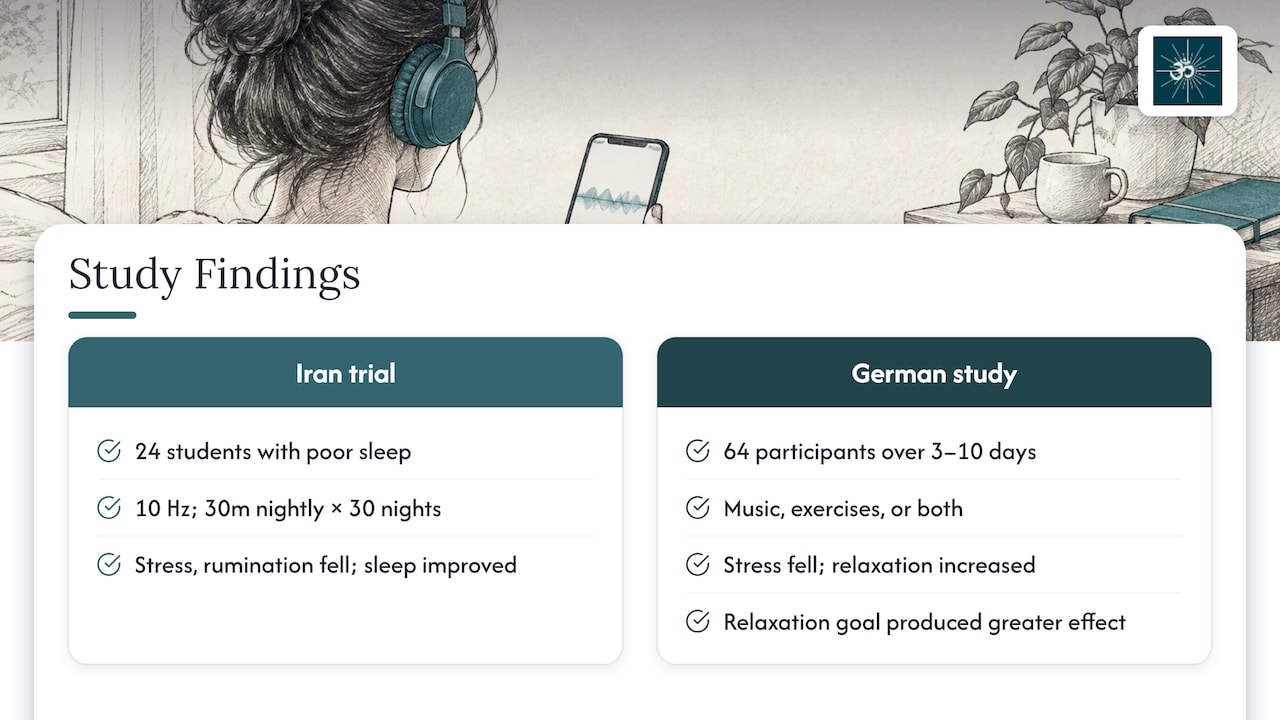
A small randomised trial in Iran with 24 university students who had poor sleep quality found that 10 Hz alpha binaural beats for 30 minutes a night over 30 nights reduced perceived stress and rumination and improved sleep quality. It is a small study, in a specific group, and one result should not be stretched into a universal promise. If you are curious about other non-musical sleep technologies and how their trials are designed, there is a related discussion of PEMF devices and sleep that shows how short trials are structured.
A German study is also worth knowing about. Kappert, Wuttke-Linnemann, Schlotz and Nater followed 64 participants over 3 to 10 days and found that music, language-based exercises and their combination reduced perceived stress and increased relaxation. The detail we find most useful is that choosing relaxation as your stated goal produced a greater effect. In other words, the intention you bring matters, and music is not automatically relaxing in every context. If you press play while mentally rehearsing your inbox, even a perfect loop has a hard job.
So our advice is plain. Choose a loop you find calming, listen with intent, and do not treat any frequency as a medicine. If you have a medical condition, a sleep disorder, epilepsy or a history of seizures, or you are pregnant, speak with your doctor before adding binaural beats to your routine, and keep the volume at a comfortable level.
Perspective: why we record live and why it suits loops
When we started Orchestral Meditations, we kept asking one question: what would a piece of music have to do to stay out of your way for an hour, and still feel alive?
Our answer was live musicians. We record at Abbey Road Studios with the National Philharmonic, because a real string section breathes. Every bow change is slightly different, every chord decays in a room that was built for sound. When a loop returns to its opening, your ear hears a new breath rather than a copy. Synthetic pads can be lovely, but we find they tend to feel flat over a long session.
The second thing is intent. Moritz Schneider, who composes and produces with me, has been writing for film, albums and musicals for over 20 years, and a few years ago found a real passion for meditation music, what he calls music for inner films. I have spent my career conducting orchestras and producing, and what I learned is that restraint is the hardest skill. A meditation track has to resist every instinct to be impressive.
That is why we design our pieces with predictable arcs, soft dynamics and, where it suits the piece, binaural, theta and Solfeggio elements and 3D surround sound for a more immersive listen. These are our own design choices and our own belief in the work, not medical claims. What we hear from listeners is deep relaxation, and we think loops built this way are the easiest to live inside.
ROBERT
Who is behind the music
You are entitled to know who made what you are about to loop for an hour. Orchestral Meditations is the work of a composing and producing duo, Robert Emery and Moritz Schneider, who by their own account have worked together for around thirteen years.
Robert Emery started piano at seven, studied at the Royal College of Music and is a conductor who has worked with orchestras including the London Philharmonic and Royal Philharmonic. He is Music Director of the National Philharmonic Orchestra of Great Britain, the orchestra heard on our recordings. During the pandemic he also set up a charity to support struggling musicians. We mention that not to boast on his behalf (he would hate it), but because it explains the approach: musicians first, then the music.
Moritz Schneider is a composer and producer who has written for feature films, albums and musicals, and has had several UK Classical Chart number ones. He came to meditation music after working with channelling mediums, noticing that for him music arrives in a similar way. It is a slightly unusual origin story, and we think that is part of what gives the pieces their character.
Together they are credited on every track we license, which matters for the next section.
Using looped music in Germany: GEMA and licences
If you only listen at home, you can skip ahead to the next section. If you teach, treat clients, run a studio, publish videos or build an app, read on, because rights are where a pleasant afternoon of looping can turn into a letter.
None of this is legal advice, and if your situation is complicated, a lawyer who specialises in copyright, or GEMA itself, is the right person to ask.
What the law covers
The German Copyright Act (UrhG) protects musical works and gives authors exclusive rights of reproduction and public communication. A communication is public when it is intended for a plurality of people, and making a work available online covers access by individuals at a time and place of their choosing. So a class in a studio, a waiting room playlist and a streamed video each fall under rules that private listening does not.
What GEMA presumes
GEMA is the German collecting society for music rights. For public performances of dance and light music and for mechanical reproductions, its presumption is that GEMA repertoire is being used unless detailed programme or track lists show that only works by authors it does not represent were used. That is why people search for “GEMA-free” music, and why keeping documentation of where your tracks come from is a good habit.
GEMA’s German guidance also says music use should be registered whenever music is used publicly, including background music, music on the internet and recordings, and that registration should happen before playback. If you run a yoga studio or treatment room, check with GEMA how that applies to you and which music you play.
Video is its own case
Many meditation teachers put a loop under a video. GEMA states that combining music with video generally requires rightsholder consent, including synchronisation permission for the composition and permission for the original recording, and that publishing or presenting the video can need further reproduction and performing rights. “Royalty-free” does not automatically mean “covers every use”, so read what your licence actually allows.
A checklist before you loop for others
- Do you know who composed and recorded the track, and can you show it?
- Does the licence cover your use: classes, treatments, video, app, commercial content?
- Is a credit required, and in what wording?
- Is the music registered with a collecting society, and does that change what you owe?
- Have you kept the licence and purchase record somewhere you can find in a year?
That last point sounds dull. It is also the one that saves you.
Looping our music: personal and professional options
If you want to try this with music made for the purpose, we offer both routes. The personal subscription costs €21 per month and suits individuals who want a library for their own practice and sleep. The professional subscription costs €150 per month and is for practitioners, instructors, therapists and creators who need professional licensing for their work.
If you are after specific tracks to use in classes, apps, guided audio or video, our royalty-free meditation music page explains the library and licence options. Our recordings feature live musicians, with binaural, theta and Solfeggio-based pieces and 3D surround sound in the range.
If you would rather browse first, start from our homepage and listen to the samples with headphones, eyes closed, ideally on repeat.
A simple setup you can try tonight
Here is a routine that takes five minutes to build and costs nothing.
- Pick one piece that is slow, soft and instrumental. Play it once all the way through and ask whether anything made you open your eyes.
- Check the join. Play the last and first twenty seconds back to back.
- Use the best file you have. Lossless if possible, otherwise a player with gapless playback.
- Set repeat one, switch on do-not-disturb, and lower the volume until the music is just present.
- Set a timer if it is for sleep. Studies on sleep music mostly used sessions of 30 to 60 minutes, and there is no need for it to run all night.
- Say your intention before you begin: “this is for relaxing.” The German study above suggests that stating the goal helps.
If it works, keep the track. If it does not, change one thing and try again. The perfect loop is a bit like the perfect cup of tea, and everyone argues about it.
FAQ
How long should a meditation loop be?
It should match your practice. For sleep, research reviewed in the narrative review above mostly used sessions of 30 to 45 minutes, with one using 60. For seated meditation, the length of your session is the right answer, and a timer is better than a track that runs on for hours.
Why does my looped track have a tiny gap?
Most often the file is to blame. MP3 and AAC files carry small amounts of silence at the start and end, so a player that is not gapless will stumble at the join. Try a lossless file, a gapless-capable player or a short crossfade. If the music itself ends abruptly, the loop was not composed for repeating.
Is royalty-free music the same as GEMA-free music in Germany?
No. Royalty-free describes how a licence is priced and used, while GEMA-free means the works are not in GEMA’s repertoire. GEMA presumes its repertoire is used unless documentation shows otherwise, so keep your licence and track records. If in doubt, ask GEMA directly.
Do binaural beats work better in a loop?
A loop simply keeps the sound steady for longer. One small trial found that 10 Hz alpha binaural beats over 30 nights improved sleep quality and reduced stress in university students with poor sleep. It is one small study, so treat the result as encouraging rather than conclusive, and see a doctor about persistent sleep problems.
Can I use your music in my yoga classes or videos?
That is what our professional licensing is for. Check the terms on the royalty-free meditation music and professional subscription pages for the exact uses covered, and keep your licence on file. For video, remember that rights for both the composition and the recording have to be clear.
Sources
- Elements of music that work to improve sleep, a narrative review
- How to Make Meditation Music: Drones, Breath and Session Arcs
- oximedia_audio gapless documentation
- Music for Meditation and Wellness Apps
- MP1 media player user manual
- The Effectiveness of Alpha Binaural Beats in Reducing Stress and Rumination
- The Aim Justifies the Means: Differences Among Musical and Language-Based Relaxation
- PEMF for Sleep: Can Your Device Match the 4-Week Trial?
- What is the GEMA presumption?
- So melden Sie Musik bei der GEMA an
- Buy a licence for music in videos (GEMA)