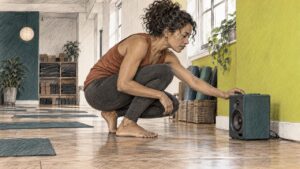
Good orchestral meditation music comes down to three things: a calm, legato, medium-tempo composition, a recording that is clear and spacious rather than murky or squashed, and a listening setup that lets you hear both. Get those right and the music does half your job for you. Get them wrong and you will spend twenty minutes of your sitting quietly annoyed at a hissing cymbal.
This guide walks through what the research says, what “recording quality” actually means once you strip out the marketing, and how to test any track in about five minutes with a pair of headphones and a healthy dose of suspicion.
TL;DR
- Relaxing orchestral music tends to be legato, soft and unhurried. A 2023 listening study linked perceived relaxation to medium tempo (80 to 100 bpm), smooth phrasing and clear recordings.
- Recording quality is about clarity, natural space and low distortion. You can judge it yourself with a short listening test.
- Immersive 3D formats are more likely to create a sense of immersion than stereo, but headphones and individual ear shape change what you hear.
- Binaural and theta beats have mixed evidence. Treat them as an optional layer, never as the reason a track works.
- For sleep, research points to roughly 30 to 45 minutes of listening before bed.
Why orchestral music suits meditation in the first place
Let me confess something. The first time I was asked to sit still and listen to “relaxing music”, it was a synthesiser pad that sounded like a fridge humming in B flat. I did not feel transported. I felt like checking the milk.
Live orchestral instruments are a different animal. A string section is made of dozens of real bowed strings, each slightly different, which gives sustained chords a living, breathing quality that a single sampled note rarely matches. That is not mysticism, it is just physics and people.
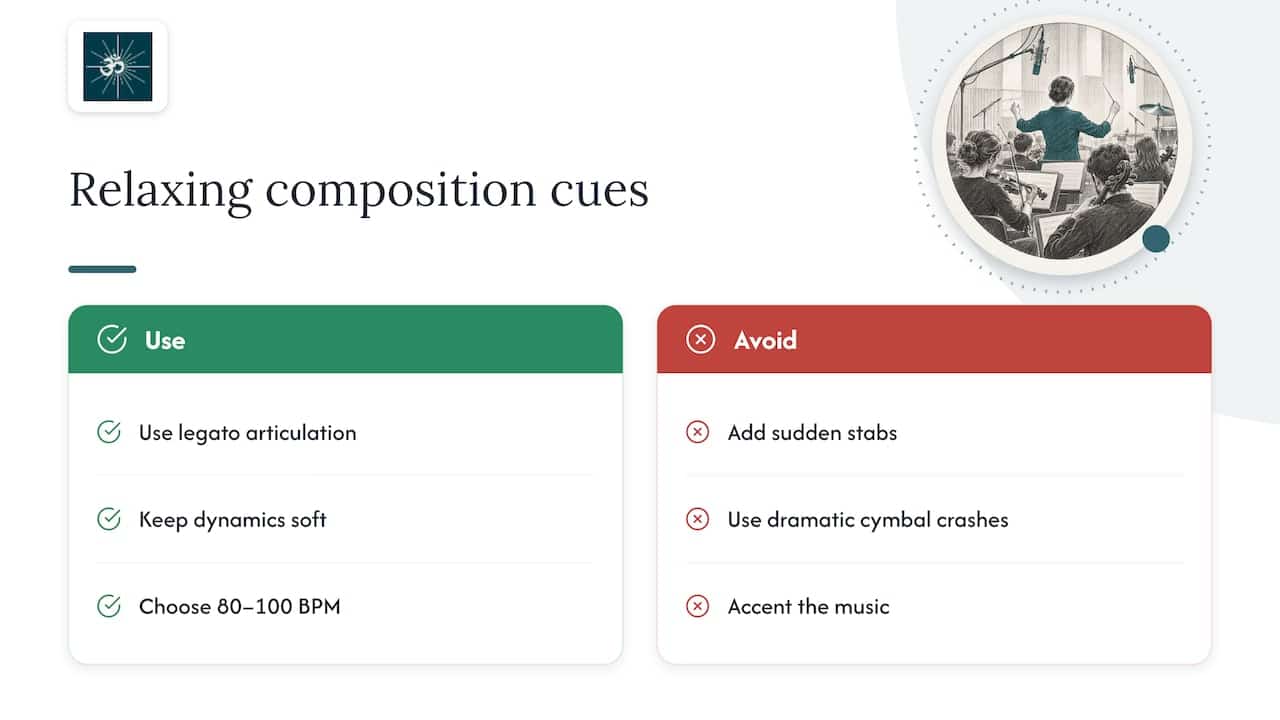
There is also data on what makes classical music feel relaxing. A 2023 web-based listening study identified 16 compositional elements of relaxation in Western classical music. Legato articulation, a soft dynamic range and a medium tempo of 80 to 100 beats per minute were associated with perceived relaxation, as was a lack of accentuation. In plain English: no sudden stabs, no dramatic cymbal crashes, nothing that makes you jump. (It is a preprint, so read it as a strong pointer rather than the last word.)
What this means when you choose a track
If a piece builds slowly, breathes in long phrases and avoids sharp attacks, it is working with your nervous system rather than against it. A good meditation score can still have emotional peaks. It simply arrives at them the way a tide arrives, not the way a door slams.
The same study associated high-clarity recordings with perceived relaxation, which brings us neatly to the part most listeners never think about.
What “recording quality” really means for meditation
People use the phrase loosely. In practice, it covers five things you can actually hear.
1. Clarity
Clarity means you can pick out individual lines: the second violins separate from the violas, the harp does not dissolve into the strings. Professional orchestral engineers often pair a main microphone array such as the Decca Tree with additional spot microphones, which add clarity and focus to what the main array captures. Done well, you get depth and detail together. Done badly, you get a wash of mush or a spotlight on one nervous oboe.
2. Natural space
An orchestra recorded in a good room carries the room with it: the gentle tail of reverb as a chord ends, the sense that the sound has somewhere to go. That tail is what lets your mind relax into the music. Artificial reverb poured over a dry recording can imitate it, but the ear often notices the join.
3. Resolution and the highest frequencies
Here the science gets curious. A 2017 study from Japan found that high-resolution audio at 192 kHz, which keeps inaudible components above 20 kHz, could induce a relaxed attentional state in listeners. You cannot hear those frequencies directly, yet the study suggests they may still matter. It is a single study, so I would not throw out your whole library over it, but it is a fair argument for starting from a clean, high-quality master rather than a heavily compressed copy of a copy.
4. Dynamics that have not been flattened
A lot of streaming-friendly music is compressed until the quiet bits are nearly as loud as the loud bits. For meditation, that is the opposite of what you want. The soft passages should be genuinely soft, so that you lean into them, and the swells should have room to grow.
5. Absence of distraction
Hiss, clicks, a stray page turn, a harsh sibilant choir consonant. Individually tiny. Together, they pull your attention outward at exactly the moment you are trying to point it inwards.
A note on physical measurements
Engineers do measure spatial qualities. An AES Japan study of orchestra recordings looked at factors such as lateral fraction (LFC) and interaural cross-correlation (IACC) in relation to spatial impressions. Their correlation with listeners’ ratings varied by piece of music. The lesson is a humbling one: no single number tells you whether a recording will feel good. Your ears remain the final instrument.
Stereo, headphones and 3D sound: what changes
The same recording can feel like a different piece depending on how it reaches you.
Immersive formats and your living room
Research on immersive 3D reproduction of orchestral music, published through the Audio Engineering Society, indicates that immersive formats can reduce the influence of your own listening room compared with stereo. That helps preserve spatial detail and the sense of being enveloped by the sound. If your flat has bare walls and a flat-pack echo, that matters.
Germany has a notable place in this field. In a 2019 field test with the Gewandhausorchester Leipzig, researchers showed that MPEG-H 3D Audio workflows could realistically depict concert hall acoustics, including sources placed above the listener.
Does 3D actually feel more immersive?
A 2022 study by Hanover University and other German institutions developed the Immersive Music Experience Inventory and confirmed that 3D audio formats are more likely to trigger a strong sense of immersion than stereo or mono. For meditation, immersion is not a gimmick. The more fully the sound occupies your attention, the less room your to-do list has to wander in.
The headphone catch
Headphones are the practical way most of us get a spatial or binaural effect, but there is a snag. Everyone’s ears and head are shaped differently, and the same 2022 research notes that a mismatch between the recording’s assumed head-related transfer function (HRTF) and yours can reduce the spatial impression. Individualised HRTFs improve localisation, externalisation and realism. Most people will never have theirs measured, so the pragmatic answer is to try a track on your own headphones and trust what you hear. Some sounds will sit convincingly outside your head. Others will stubbornly sit between your ears. Both are normal.
If you enjoy the idea of sound as something you feel as well as hear, the research on vibroacoustic therapy shows how physical vibration is studied alongside listening. It is a useful reminder that low frequencies reach the body, not only the ears.
Binaural beats, theta and Solfeggio: what the evidence says
This is where I would be doing you a disservice if I only waved a magic wand.
A review of music and sleep reported that theta binaural beats did not significantly improve sleep quality compared with pure music. Separately, a 2025 paper on altered states notes that studies suggest delta binaural beats may improve subjective sleep quality, but no research has confirmed a causal role for the beats themselves.
So what should a sensible listener do? Three things.
- Judge the music first. If the composition and recording are lovely, the track works even with the beats switched off in your imagination.
- Use headphones for binaural tracks. The effect depends on a different tone in each ear, so speakers defeat the point.
- Treat frequency work as an optional layer. Plenty of people find a track with a theta or Solfeggio focus a helpful ritual cue, a bit like lighting the same candle each evening. That is a perfectly good reason to use it. Just do not expect a lab-grade guarantee.
What works reliably, according to the sleep research, is slower instrumental music. A review of 27 studies found that music therapy significantly improved subjective sleep quality, largely by easing anxiety and regulating mood, and that most studies used slower instrumental or pure music. If you want a family-oriented read on the same idea, this guide to instrumental music for sleep covers how calm, wordless music is used at bedtime.
Our perspective: why we record with live musicians
We make orchestral meditation music, so you should know where we stand, and that we are biased. We would simply argue that the bias comes from listening, not the other way round.
Our recordings feature live musicians, including sessions recorded at Abbey Road Studios with the National Philharmonic. That is not a name-dropping exercise. A room with that kind of acoustic character and players at that level are the raw ingredients for the clarity and natural space we described above. No plug-in can invent them from nothing.
The team behind the music matters too. Robert Emery, composer and conductor, started on the piano at seven, studied at the Royal College of Music and is now Music Director of the National Philharmonic Orchestra of Great Britain. He has conducted orchestras including the London Philharmonic, the Royal Philharmonic and Sinfonieorchester Basel, and worked as musical supervisor on productions that include the Berlin staging of Tanz der Vampire. A conductor spends his life asking one question: does this phrase breathe? That is exactly the question a meditation track needs answered.
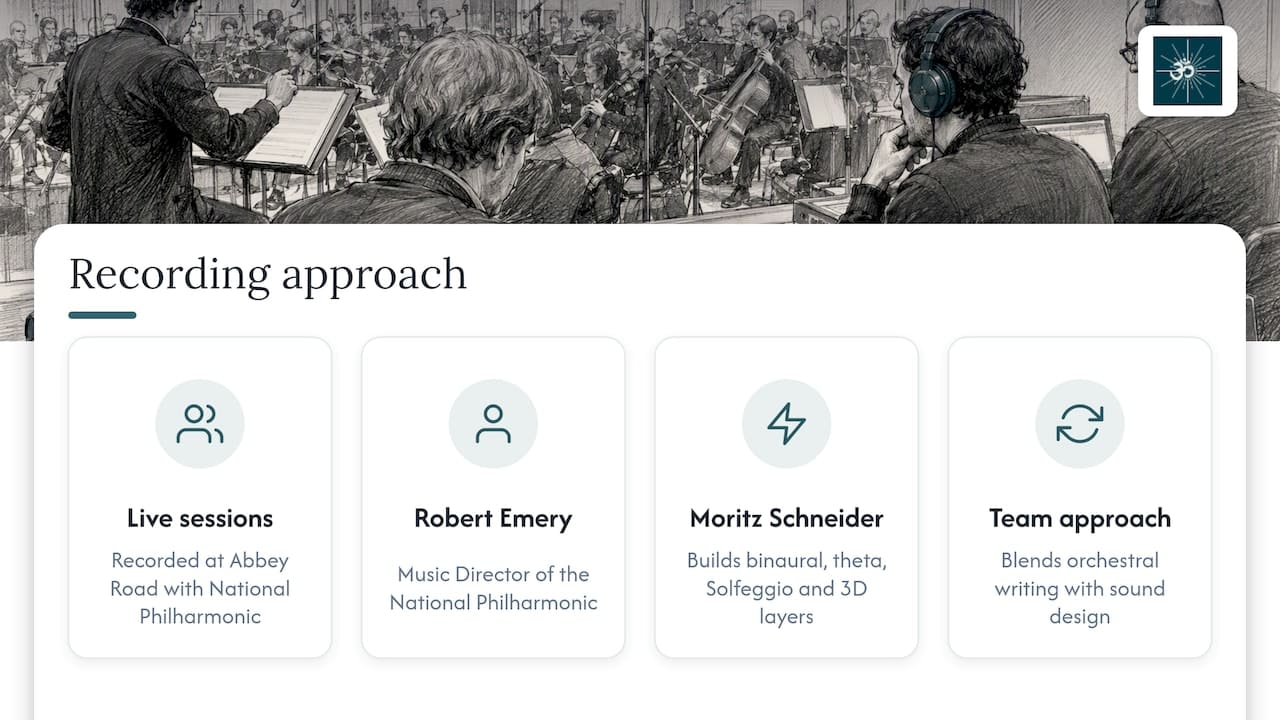
Moritz Schneider, composer and producer, brings the sound design and the technical architecture behind our frequency-based work, the binaural, theta and Solfeggio layers, and the 3D surround mixes. He and Robert have worked together for around thirteen years. Their approach is to blend orchestral writing with carefully considered sound design, rather than to churn out thirty meditations a week.
Our honest position on frequencies matches the research above. We build them in because many listeners value them, and we are happy for the orchestra to carry the experience on its own merits. We believe that bodies respond to real acoustic instruments in a way that sampled ones struggle to match. We would say that, of course. Test it yourself, and let your own ears vote.
— ROBERT
A five-minute test for any meditation recording
You do not need a studio or a spectrum analyser. Try this with any track, ours or anyone else’s.
- Use decent headphones in a quiet room. Closed-back or open-back, it matters less than being consistent.
- Play the quietest passage at a comfortable level. Listen for hiss, hum or digital grit. A clean noise floor is the first sign of a careful recording.
- Follow one instrument. Can you track the cellos from start to finish without them vanishing into a blur? That is clarity.
- Listen to the end of a chord. Does the sound decay naturally into the room, or does it cut off or smear unnaturally?
- Check the swell. At the loudest moment, does the music open up, or does it get harsh and fatiguing?
- Notice your attention. Did you drift into the music, or keep noticing the production? If you spotted the production, something is off.
- Compare formats if you can. If a track is offered in both stereo and a spatial mix, listen to both back to back with your eyes closed.
Three strikes (hiss, harshness, mushy detail) and you can move on without guilt.
Setting up your listening routine
Small details beat expensive gear.
- Volume: lower than you think. Meditation music should sit just above the room’s background noise.
- Duration: for sleep, the 2025 narrative review suggests 30 to 45 minutes of daily listening before bedtime is a sensible dose. For daytime sitting, simply match the track to your practice.
- Same time, same place: repetition teaches your brain that this sound means “slow down”.
- Sleep with care: if you fall asleep in headphones, choose comfortable, low-profile ones or use a speaker instead.
- If you teach or work with clients: check the licence before using any track in a class, an app or a recorded session. Personal listening and commercial use are different things.
Hear it for yourself
If you would like to compare what we have been describing, our library is built around live orchestral recordings with 3D surround, binaural, theta and Solfeggio options. For personal listening, our personal subscription costs €21 per month. If you teach, run a studio or build content, the professional subscription is €150 per month, and our royalty-free meditation music page explains the licensing options.
You can also browse our full meditation music library and start with a track that matches how you want to feel.
FAQ
Does the quality of the recording really change how relaxing music is?
It can. A 2023 listening study associated high-clarity recordings with perceived relaxation, and a 2017 study linked high-resolution audio to a relaxed attentional state. Neither proves that a better recording will relax every listener, but both support choosing clean, uncompressed sound over harsh or muddy audio.
Do I need 3D or spatial audio to meditate?
No. Good stereo on decent headphones is enough for most people. Research shows that 3D formats are more likely to create a sense of immersion, and can reduce the effect of your room, so they are a pleasant upgrade rather than a requirement.
Do binaural beats work?
The evidence is mixed. A review found theta binaural beats did not significantly improve sleep quality compared with pure music, and for delta beats no causal role has been confirmed. If you enjoy them as part of a ritual, they do no harm for most people, but choose the music first.
What tempo is best for meditation music?
The 2023 listening study associated medium tempo, 80 to 100 bpm, with perceived relaxation, along with legato phrasing and soft dynamics. Slower pieces can work beautifully too, so use the range as a guide and trust your own response.
How long should I listen before bed?
A 2025 narrative review suggests 30 to 45 minutes of daily listening before bedtime as an optimal dose for music interventions. If you have persistent sleep problems, speak to your GP, as music is a support and not a treatment for a sleep disorder.
Sources
- Identification and Multivariate Analysis of 16 Compositional Elements of Relaxation (medRxiv, 2023)
- High-Resolution Audio with Inaudible High-Frequency Components (Frontiers in Psychology, 2017)
- Evaluation Tests Report Part 2 (AES Japan)
- Ten Minute Master: Orchestral Recording (MusicTech)
- Influence of the Listening Environment on Immersive 3D Audio (Audio Engineering Society)
- Wrapped into sound: Development of the Immersive Music Experience Inventory (Frontiers in Psychology, 2022)
- Elements of music that work to improve sleep: a narrative review (2025)
- The neurobiology of altered states of consciousness induced by sound (2025)
- Meta-narrative review: the impact of music therapy on sleep (2025)