
Let me start with a confession: the first time someone told me music could lift a low mood, I rolled my eyes so hard I nearly sprained something. I was a professional musician, I had spent years inside orchestras, and I knew perfectly well that Mahler had never cured anyone’s Monday. Then I watched what a good piece of slow, live-played music did to a room full of tense people, and I stopped rolling.
Here is the honest, useful answer. Music you listen to by yourself, on purpose, can be a gentle daily companion when you are feeling low. The research on it is encouraging, and the people who benefit most use it as a regular ritual next to proper care, not instead of it. Below you will find what the studies actually found, how to choose a track, how long and how loud to listen, and when it is time to call a doctor. We make orchestral meditation music, so we will also show you where our own recordings fit.
TL;DR
- Listening to music is the best-studied form of “meditation music”: a 2020 meta-analysis of 55 trials found that listening to pre-recorded music reduced depressive symptoms noticeably.
- Music therapy with a qualified therapist is a separate thing, and in Germany it is generally paid for out of your own pocket. Self-guided listening is the easy daily complement.
- Choose slow, spacious, wordless music you personally find calming, keep the volume moderate, and stop any piece that stirs up distress.
- If low mood lasts more than two weeks, if you lose interest in things you used to enjoy, or if thoughts of death appear, see your GP (Hausarzt) or a psychotherapist. Music then sits alongside treatment.
- Our personal subscription costs €21 per month and gives you a whole library of live-orchestra meditations to build a routine around.
What “depression meditation music” actually means
The phrase is a search-engine hybrid, so let us untangle it. When people type it, they usually mean calm, mostly instrumental music they can put on while sitting, lying down or breathing slowly, with the hope that it eases a heavy mood. Nobody is promising a cure. They want a better hour.
Researchers draw a line that is worth knowing, because it explains almost every headline you will read. In their 2017 review of music interventions for depression, Leubner and Hinterberger separate two things:
- Music therapy is a structured process led by a board-certified music therapist, with goals set for you individually and a therapeutic relationship at its centre. It can involve listening, but also playing, composing and improvising.
- Music medicine is listening to pre-recorded music, whether chosen by a professional who is not a music therapist or simply your own favourite pieces.
Meditation music that you download and press play on belongs to the second group. That is not a lesser category. It is the one you can do tonight, at home, without a waiting list.
What the research says about music and low mood
I promised myself I would not drown you in statistics, so here is the short tour. Effect sizes below are given as “SMD” (standardised mean difference), a way of comparing results across studies. Roughly speaking, 0.2 is small, 0.5 medium and 0.8 large.
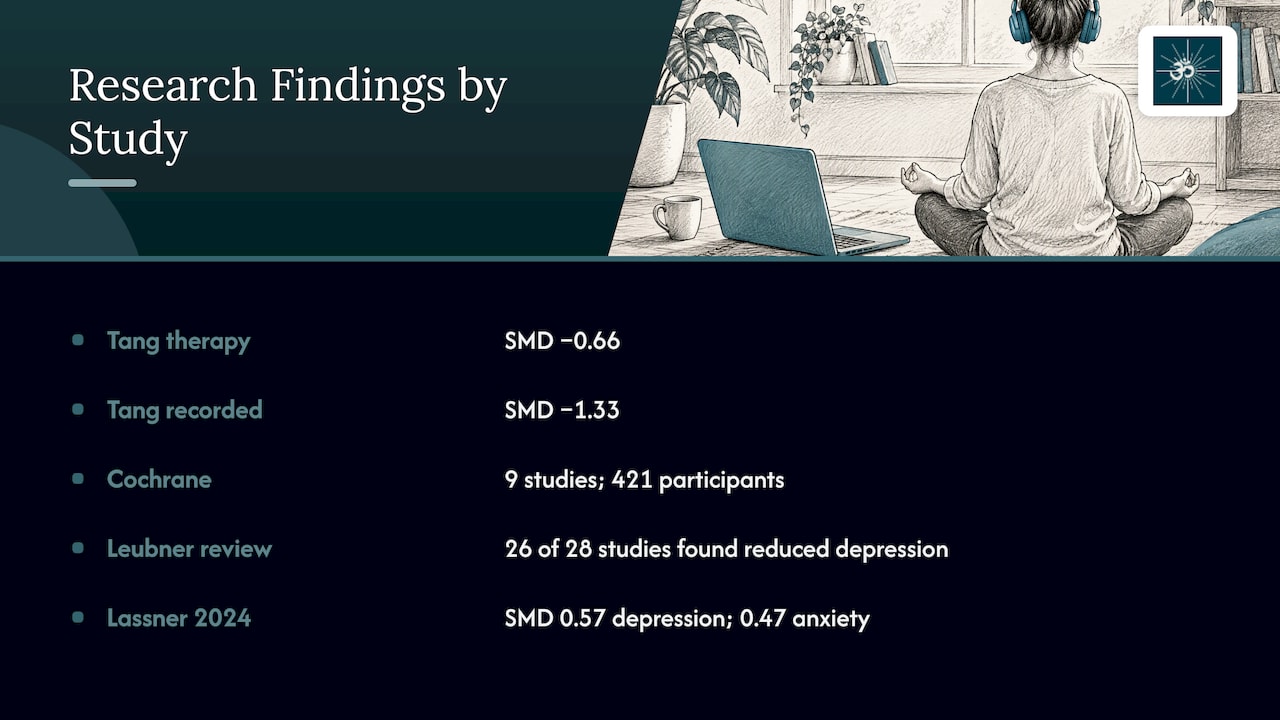
Listening to recorded music. A 2020 meta-analysis of 55 randomised trials by Tang and colleagues looked at music therapy and music medicine side by side. Music therapy reduced depressive symptoms (SMD −0.66). Music medicine, meaning listening to pre-recorded music without a therapist in the room, showed an even larger effect (SMD −1.33). Surprising, and rather cheering for anyone with a pair of headphones.
Music alongside usual treatment. The Cochrane review by Aalbers and colleagues covered 9 studies and 421 participants. It found moderate-quality evidence of large short-term benefits when music therapy was added to treatment as usual, compared with treatment as usual alone, on both clinician-rated and patient-reported symptoms. It also found no more or fewer adverse events than usual treatment alone. The same review found benefits for anxiety and for day-to-day functioning, as summarised in BJPsych Advances.
A broader sweep. Leubner and Hinterberger’s review of 28 studies with 1,810 participants found a statistically significant drop in depression levels in the music group in 26 of them. A 2024 meta-review by Lassner and colleagues found that music-based interventions improved depressive symptoms (SMD 0.57, 27 studies, 1,249 participants) and anxiety (SMD 0.47) by the end of treatment.
Sleep and quality of life. Low mood and bad sleep are tangled up like headphone cables in a coat pocket. A 2025 meta-analysis by Lee and colleagues found music therapy improved depressive symptoms, quality of life and sleep quality compared with controls. In the 2024 meta-review, daily listening sessions of 25 to 60 minutes improved sleep quality (SMD 0.69).
What does it all add up to? The US National Center for Complementary and Integrative Health explains that listening to or making music activates brain areas involved in emotion, memory and movement, and prompts the release of neurotransmitters and hormones linked to feelings and social bonding. That is the plausible mechanism. The practical takeaway is a modest, repeatable one: a regular listening habit is a sensible, low-risk thing to add to your day, particularly when it sits beside care from your doctor or therapist.
Where the German picture differs
If you live in Germany, a few local facts help you plan.
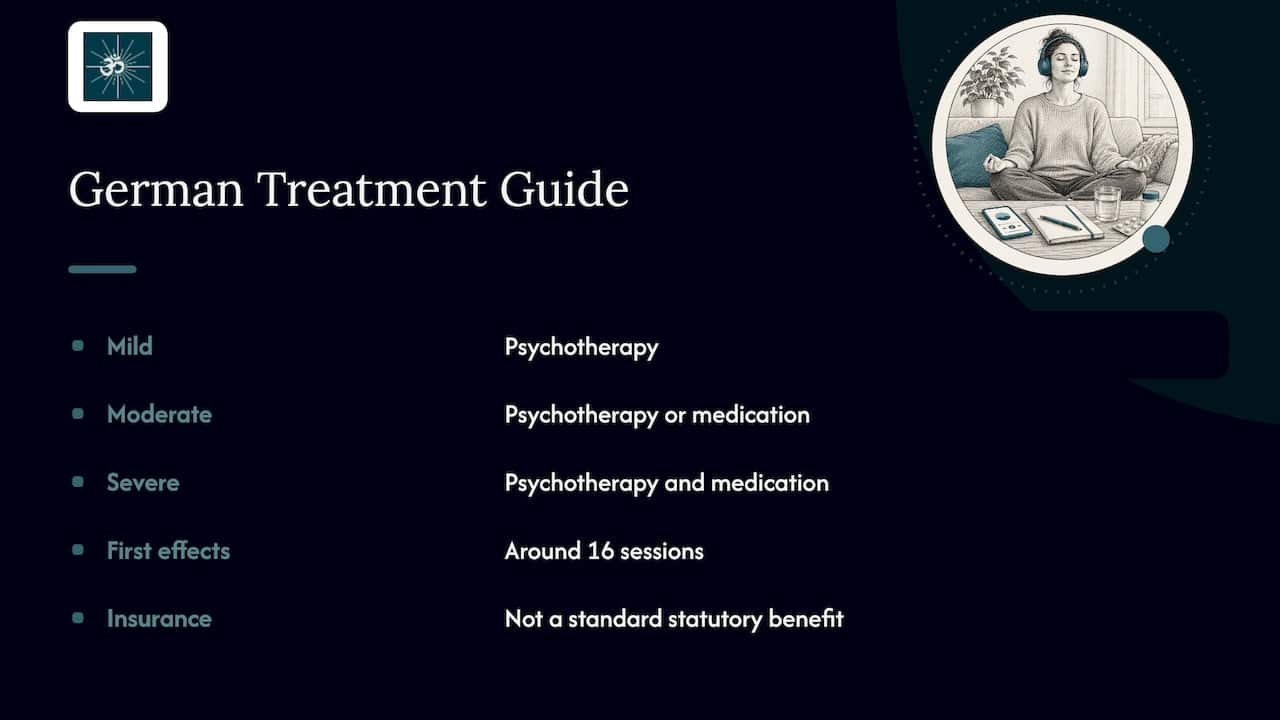
The national guideline for depression, the Nationale VersorgungsLeitlinie Unipolare Depression (version 3.0, 2022, valid until 2027), recommends that people with a moderate depressive episode be offered psychotherapy or medication as equivalent options. It adds supportive measures such as psychoeducation, light therapy and exercise. It does not give music a specific recommendation for unipolar depression. That is simply where the formal guidance stands: music is a companion to those pillars, and a pleasant one.
The German Society for Music Therapy (Deutsche Musiktherapeutische Gesellschaft) describes music therapy in its 2017 position paper as something that improves quality of life and eases psychological suffering, including in depression, and that complements standard therapies in inpatient and outpatient care. It points to first effects after a cycle of around 16 sessions.
On money: a 2025 CME article for GPs notes that music therapy is not a standard benefit of the statutory health insurance funds, so patients currently pay for it themselves. A self-guided listening routine, by contrast, costs you a subscription or a download and a quiet corner.
The Bundespsychotherapeutenkammer’s patient brochure, Wege zur Psychotherapie, spells out the guideline’s stepwise logic: psychotherapy for mild depression, psychotherapy or medication for moderate, and both for severe. Keep that map in mind. Your playlist belongs on it as a daily companion, and your doctor holds the rest of the map.
How to choose meditation music when you feel low
Most of what ranks for this search is an endless stream of videos with titles promising to “remove negative energy” in forty-five minutes. Fine for background, but you deserve a more deliberate approach. Here is what I would look for.
Pick sound you can trust your body with
Slow tempo, no sudden loud entries, no lyrics that drag your mind into a story. Live instruments tend to have a natural, slightly imperfect warmth that synthetic loops struggle to copy. If you have ever felt your shoulders drop when a cello held a long note, you know what I mean. Our own library is built that way: recordings made with the National Philharmonic at Abbey Road Studios, not stitched together from presets.
Decide what you want the session to do
Different moments need different music:
- Morning, to get moving gently: brighter, warm orchestral textures with a soft pulse.
- Midday reset: ten to fifteen minutes of spacious, slow music with your eyes closed.
- Evening wind-down and sleep: very slow, low, steady pieces. Binaural beats and theta-range tracks are designed for this kind of settling. Binaural beats are two slightly different tones played in each ear, and your brain perceives the difference as a gentle pulse. Theta refers to the slow brainwave range, roughly 4 to 8 Hz, that is associated with drowsy, dreamy states. You need stereo headphones for binaural tracks to work as intended.
- Rituals and energy-work settings: some listeners enjoy the soft, drifting style typical of reiki-style music, and the same gentle, unhurried approach applies.
Your own reaction is the final judge
The NCCIH points out that because music is tied to strong memories and emotions, some people may be distressed by particular pieces or types of music. If a track brings back something painful, stop it and choose another. There is no medal for sitting through a piece that makes you feel worse. Wordless, unfamiliar orchestral music has a practical advantage here: it is less likely to be tied to a particular year of your life.
How to use it: a simple routine
With low mood, the hardest part is rarely the music. It is starting. So make the routine small enough that it survives a bad day.
- Choose a fixed anchor. Attach listening to something you already do: after brushing your teeth, with the first coffee, or when you get into bed. Anchors beat willpower.
- Start with ten minutes. Studies on sleep used daily sessions of 25 to 60 minutes, but you can build up. Ten minutes done daily beats an hour done once.
- Set the volume low. The NCCIH warns that listening at too high a volume can contribute to noise-induced hearing loss. Meditation music should sit comfortably below conversation level, particularly with in-ear headphones.
- Do one thing while it plays, or nothing. Sit by a window, breathe slowly, stretch, or lie down. Scrolling your phone works against you.
- Note how you feel afterwards. One line in a notebook is plenty: “a bit lighter”, “still flat”, “slept better”. After two or three weeks, the pattern tells you something real, and it is useful to show your doctor or therapist.
- Keep the same piece for a while. Familiarity is part of the point. Your nervous system learns “this sound means we slow down”, a bit like Pavlov’s dogs, but with fewer bells and more strings.
Music is a companion to care, and here is when to call a doctor
This part matters more than any playlist. Low mood and depression are not the same thing, and depression is a medical condition that responds well to proper treatment. Meditation music can make your days feel gentler. It sits next to treatment, in the way a good walk or a regular bedtime does.
See your GP (Hausarzt) or a psychotherapist if any of these apply, as the BpTK patient brochure advises:
- your low mood has lasted more than two weeks,
- you have lost interest in activities you used to enjoy,
- thoughts of death appear.
If you are in immediate danger or thinking about ending your life, contact the emergency services or go to the nearest hospital emergency department straight away. Do not wait for a routine appointment.
If you are already in treatment, tell your therapist or doctor that you are building a listening routine. Many therapists welcome it, and it gives you something concrete to discuss. If you are interested in music therapy with a trained therapist, ask them about it, bearing in mind that, as noted above, you will usually be paying for it yourself.
Perspective: why we record with a full orchestra
Moritz Schneider and I have spent a lot of years in rooms with large orchestras, and one thing never stops surprising me: how quickly a group of people playing together in real time changes the air. Nobody has to explain it to you. You feel it before you can describe it.
That is why we record meditation music the way we do. Our tracks are made with the National Philharmonic at Abbey Road Studios, with live musicians and with composers who care about every held note. Moritz and I write and produce them with one aim: to give you something you can sink into, without a sudden jolt, without a gimmick, and without feeling as though you are listening to a ringtone with ambitions.
We also use sound design that we believe in. Theta-range tracks, binaural beats, Solfeggio frequencies and 3D surround sound are woven into the orchestration, not stuck on top of it. Our recordings are designed to support deep relaxation and a settled, mindful state, and many of our listeners tell us about the calm and the sense of release they find in them.
What we hope you take from this article is simple. If your days feel heavy, a daily listening ritual is a kind thing to do for yourself. Pair it with the care your doctor or therapist recommends, give it a few weeks, and let good music do what it has done for people for thousands of years: keep you company.
ROBERT
Build your routine with our library
If you would like a deep, varied catalogue to rotate through, our personal meditation music subscription costs €21 per month. It gives you access to our orchestral meditations, including binaural, theta and Solfeggio-frequency tracks, so your morning, midday and evening sessions never have to be the same piece on loop.

If you work with other people, as a therapist, a yoga or meditation teacher, a coach or an app developer, our professional subscription is €150 per month and comes with professional licensing. You can also look through our royalty-free meditation music for use in sessions, guided audio and wellness content.
FAQ
Can meditation music help with depression?
Studies on music interventions report lower depressive symptoms, and a 2020 meta-analysis found a notable effect for listening to pre-recorded music. It works best as a daily companion to the treatment your doctor or therapist recommends. Think of it as supporting your wellbeing, not as treatment in its own right.
How long should I listen each day?
Start with ten minutes and build up. In the studies on sleep, daily sessions lasted between 25 and 60 minutes. Choose a time you can keep every day, keep the volume moderate, and stop if a piece makes you feel worse.
Is meditation music the same as music therapy?
No. Music therapy is a structured process led by a qualified music therapist with goals set for you individually. Meditation music is something you listen to by yourself, which researchers call music medicine. In Germany, music therapy is not a standard benefit of the statutory health insurance funds, so you would usually pay for it yourself.
Do I need headphones for binaural beats?
Yes. Binaural beats rely on a slightly different tone reaching each ear, so stereo headphones are needed for them to work as designed. Keep the volume low, since loud listening can contribute to hearing damage.
When should I see a doctor instead of just listening to music?
See your GP or a psychotherapist if low mood lasts more than two weeks, if you lose interest in things you enjoy, or if thoughts of death appear. In an emergency, call the emergency services. Music can keep you company while you get that care.
Sources
- Reviewing the Effectiveness of Music Interventions in Treating Depression (Leubner & Hinterberger, 2017)
- Effects of music therapy on depression: a meta-analysis (Tang et al., 2020)
- Music therapy for depression, Cochrane review (Aalbers et al., 2017)
- Music therapy for depression: a Cochrane Review, BJPsych Advances
- Evidence for music therapy and music medicine in mental disorders (Lassner et al., 2024)
- Music therapy for patients with depression: systematic review (Lee et al., 2025)
- Music and Health: What You Need To Know, NCCIH
- Nationale VersorgungsLeitlinie Unipolare Depression, version 3.0 (2022)
- Musiktherapie im Gesundheitswesen, Deutsche Musiktherapeutische Gesellschaft (2017)
- Depressionen – Hausärztliche Praxis (2025)
- Wege zur Psychotherapie, Bundespsychotherapeutenkammer
- What reiki music is like and its main characteristics