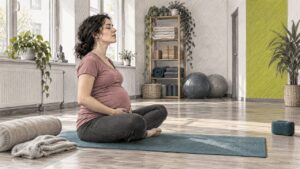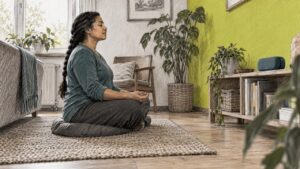
Good savasana music is slow, unhurried and free of surprises. It has no strong beat, no vocal you feel obliged to follow, and no sudden entrance that makes a room full of relaxed people twitch. It runs a little longer than the pose itself, and it fades out rather than stopping. We write and record meditation music for a living, so we have strong views here. The short version: the best savasana track is the one nobody notices until it is gone.
This guide is for yoga teachers, meditators, massage therapists and anyone building a calm playlist at home. It covers what to look for, how long to plan for, how to handle volume and the final fade, when silence is the better choice, and how the same thinking applies to massage and spa sessions.
TL;DR
-
Choose slow, spacious, mostly instrumental music with no strong pulse, no sharp attacks and no lyrics that pull the mind into language.
-
Plan for 5 to 10 minutes of music for a typical class savasana, and 20 to 30 for a long restorative practice. Build in a gentle fade at the end rather than a hard stop.
-
Keep the volume low enough that you can speak over it softly. Start the track before you cue the pose, so nothing begins on top of the silence.
-
Massage and spa sessions follow the same rules, with one addition: the track needs to run for the full treatment so nobody has to touch a phone mid-session.
-
If you teach professionally, use music with a licence made for professional use rather than a personal playlist.
What savasana asks of music
Savasana (Sanskrit for “corpse pose”, usually shortened in English to “final relaxation”) is the closing pose of most yoga classes. You lie on your back, arms and legs loose, and do nothing at all. It sounds like the easy bit. Anyone who has tried to do nothing for seven minutes knows otherwise.
Music has two jobs here. First, it gives the mind something soft to rest on, so the to-do list has less room to shout. Second, it covers the small noises of a room: the radiator, a cough, someone’s mat creaking, the street outside. In a German city studio with a window onto a tram line, that second job is not trivial.
Notice what music should not do. It should not tell a story, build to a climax or ask for attention. A track with a dramatic crescendo is lovely in a concert hall and wrong for savasana, where the whole point is that nothing needs to happen. If you catch yourself thinking “ooh, this is a good bit”, the track is working against you.
What to listen for in a savasana track
We have a checklist we run through whenever we mix a piece meant for deep rest. You can use the same one when you audition tracks.
Tempo and pulse
Look for music that is slow or has no obvious pulse at all. A steady beat invites the body to count along, and counting is the opposite of letting go. Long, sustained notes from strings, pads or soft winds do this best.
Dynamics
The loudest moment in the track should not be much louder than the quietest. Play the whole piece once, start to finish, before you ever use it in a class. A single bright cymbal swell at minute six has ruined more savasanas than any ringing phone.
Voice and language
Instrumental music is the safe default, because words, even in a language you do not speak, pull attention towards meaning. If you like a vocal, choose wordless singing that works as another instrument. Guided scripts belong in their own category: if you want to talk people through the body, keep the music underneath simple enough to sit behind your voice.
Timbre
Timbre is the colour of a sound. Warm, rounded sounds (strings, low flute, soft piano, gentle synth pads) suit deep rest. Thin, piercing or metallic sounds tend to keep people alert. Live musicians help, because a real bow on a real string has tiny natural variations that make the sound feel alive without drawing attention to itself. That is one reason we record with live players, in our case the National Philharmonic at Abbey Road Studios.
Space
Good savasana music leaves air between the notes. Silence inside the music is a feature, not a gap to be filled. Spatial recording, such as the 3D surround sound we use, can make a piece feel wider and less like a sound coming from a speaker in the corner. Headphones show this most clearly, but a decent pair of room speakers will carry some of it too.
Music or silence? How to decide
Silence is a perfectly respectable choice, and many teachers use it. The question is what your particular room needs on a particular day.
Music tends to help when:
-
the room is noisy or the building has plenty of background sound,
-
the class is full of beginners who find stillness unsettling,
-
the group arrived wired, after work or after a dynamic flow,
-
you want a clear emotional shape to the end of the class.
Silence tends to help when:
-
the group is experienced and likes the stillness of a quiet room,
-
the class was already gentle and the music has been playing throughout,
-
you are leading a longer, more inward practice where you speak rather than play.
A middle path works well too: start the savasana with music for the first few minutes, let it fade to nothing, and leave a minute or two of quiet before you bring people back. The fade-out becomes a quiet hand-off from sound to stillness. If you want to read more on how sound and mindfulness fit together, our article on science-backed sound and music for mindfulness goes into the reasoning.
How long should savasana music run?
There is no official number. A common rule of thumb among teachers is that final relaxation should take up roughly a tenth of the class, which makes 5 to 10 minutes typical in a 60 to 90 minute session. Restorative and yin classes often give it far longer. Treat the table below as a starting plan rather than a rule.
| Class type | Savasana length | Music plan |
|---|---|---|
| Short flow (45 minutes) | 4 to 5 minutes | One track, gentle fade in the last 30 seconds |
| Standard class (60 to 75 minutes) | 5 to 8 minutes | One track of about 8 to 10 minutes, so it outlasts the pose |
| Long class (90 minutes) | 8 to 10 minutes | One track of 10 to 12 minutes, or two that share a key |
| Restorative or yin | 15 to 30 minutes | Continuous long-form track or a short playlist with soft transitions |
| Yoga nidra or guided relaxation | 20 to 40 minutes | Quiet underlay beneath the voice, fading as you finish speaking |
The principle is the same everywhere: the music should be longer than you need. If it ends at the exact moment you wanted to ring a bell, you will hear the silence arrive and the mood will crack. A longer track lets you decide when the class ends rather than the file deciding for you.
Volume, transitions and the end of the track
This is the part teachers learn by embarrassing experience, so here are the lessons without the embarrassment.
Set the volume before the class
Test the level at floor height, lying on a mat, not standing at the speaker. What sounds right standing up is usually too loud when your ears are near the floor. A good test is that you could speak in a calm, low voice over the music without raising it. Remember that people’s ears are more sensitive to sudden changes than to steady sound, so keep the level constant rather than turning things up and down mid-pose.
Start the music before the pose
Bring the track in softly while students are still moving into position, so the sound is already in the room when they lie down. Starting music into a hush feels abrupt, however quiet the first note is.
Avoid gaps and auto-play surprises
Turn off auto-play and any “suggested next track” feature. Disable notifications, and put the phone in flight mode. If you use a streaming service on a laptop, an advert or an automatic jump to something upbeat is a real risk. A downloaded file you own avoids the problem completely.
Plan the way out
A gentle fade over the last 20 to 30 seconds suits almost any track. Then give it a beat of quiet before you speak. When you do bring people back, use a low, slow voice, ask them to deepen the breath, wiggle fingers and toes and roll to one side. Switching the main lights on at full brightness is the usual way to undo all the good work, so raise them slowly or not at all.
One more practical point: the fade is easiest if the track itself ends with a long natural decay. Pieces built to loop or end on a held chord are much easier to blend than ones that finish with a flourish.
Frequencies, binaural beats and theta: what they add
Meditation music often mentions Solfeggio frequencies (a set of tones such as 528 Hz that are used in sound-healing circles), theta (the slower brainwave range associated with drowsy, dreamy states) and binaural beats (two slightly different tones, one in each ear, which the brain blends into a third rhythm). These are part of what we use when designing deep-rest pieces, and our library includes tracks built around them.
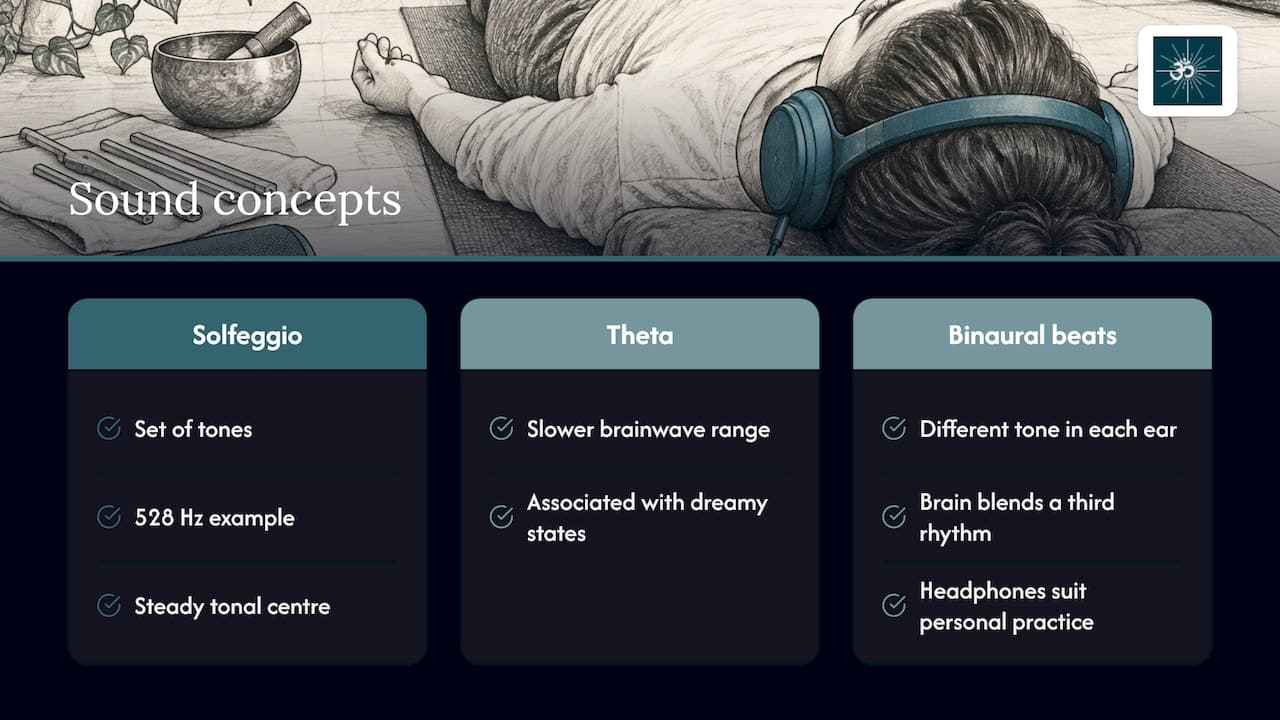
Two practical notes for savasana. Binaural beats work through headphones, so they suit personal practice and one-to-one sessions more than a room with speakers. Tracks built on a single tuning, such as our 528Hz meditations, tend to hold a very steady tonal centre, which is exactly what you want when the goal is to let go. If you would like a plain overview of tones people associate with sleep and calm, this list of frequencies for sleep, calm and focus is a convenient reference.
Savasana music for yoga classes: choosing by style
Here is how different styles of yoga tend to shape the music.
-
Hatha and gentle flow: a single warm instrumental track, strings or soft pads, with a clear fade.
-
Vinyasa and Ashtanga: the class has been dynamic, so the shift needs to be noticeable. Start with something very quiet and spacious, a clear contrast to the playlist before it.
-
Yin and restorative: long, slow pieces with very little movement. Here you can let a single track run for 15 minutes or more.
-
Yoga nidra: keep the music beneath the voice, with no melody that competes for attention.
-
Hot yoga: keep it simple and steady. Plenty of people cool down during savasana and a gentle, warm sound helps the room feel safe rather than exposed.
If you are torn between using music or something like a singing bowl, our comparison of singing bowls versus music for meditation walks through how each shapes a session.
Meditation music for massage and spa sessions
Massage therapists and spa hosts ask almost the same questions as yoga teachers, with a few twists. The client is lying down, often face-down, often with their eyes closed for an hour or more. The music has to stay the same quality from the first minute to the last.
Building a spa or massage playlist
The simplest approach is to choose a few long tracks rather than a long list of short ones. Each change of track is a small interruption, and your client will notice a change in key or instrumentation even while half asleep. A rough structure for a 60-minute treatment looks like this:
| Phase | Time | What the music does |
|---|---|---|
| Arrival and settling | First 5 to 10 minutes | Soft, spacious, minimal movement |
| Main treatment | Middle 40 to 45 minutes | Warm, steady and consistent, no strong peaks |
| Closing | Last 5 to 10 minutes | Slightly lighter and brighter, fading very gradually |
Keep tracks in the same or related keys, so the transitions pass almost unnoticed. If you use a playlist, set a short crossfade of a few seconds so there is never a gap. Better still, use one long piece that covers the whole treatment.
What to avoid
-
Anything with a clear lyric or a catchy hook. Clients start humming along, and humming is not relaxing.
-
Sudden changes in loudness, nature sounds with unpredictable sharp events (a bird shriek, a crash of thunder) and abrupt starts.
-
Streaming services with adverts or automatic suggestions.
-
Volume that competes with conversation. If the therapist and client need to speak, the music should allow it at a soft level.
Licensing for treatment rooms
If you play music in a business such as a studio, spa or practice, that counts as professional use, and a personal listening licence is not designed for it. Our professional licensing covers use in meditation, therapy, yoga, massage and wellness content, so you can choose tracks for your treatments and classes with the permissions already sorted. Our royalty-free meditation music is offered with both personal and professional licences, and the Royalty Free Meditation Music page is the place to start for professional use.
What research says about sound, relaxation and massage
We try to be honest about what is known. A 2022 study by Nike Walter and Thilo Hinterberger in the journal Medicina looked at 34 participants during a professional singing bowl massage, using 64-channel EEG (a recording of brain activity) and ECG (a recording of the heart). The study on the neurophysiological effects of a singing bowl massage found that EEG power fell during the sound session and fell further afterwards, with beta-2 and gamma activity going down. Heart rate dropped from 75.5 to 71.5 beats per minute, 97.1% of participants said they felt more balanced, and 91.2% said they felt more relaxed. The researchers read this as a possible shift towards a more mindful, meditative state.
That study used singing bowls rather than orchestral music, so it is not a verdict on any one kind of sound. What it does show is that a calm, structured sound environment during bodywork is something researchers can measure, and that people report feeling both more settled and more relaxed afterwards. It is a good reason to treat your music choice as part of the treatment rather than an afterthought.
Choosing music in practice: a quick routine
Here is a routine you can run in about ten minutes before your next class or session.
-
Listen all the way through. Lie down and play the track from start to finish at the volume you plan to use. Mark any moment that made you open your eyes.
-
Check the length. Does it comfortably outlast the pose? If not, pick a longer piece or plan the overlap.
-
Check the ending. Does it fade naturally or stop with a bang? You want the first.
-
Test the volume at floor level. Speak softly over it. You should be heard without strain.
-
Take away the surprises. Switch off auto-play, notifications and anything that could cut in.
-
Keep a short list. Three or four tracks you trust beat a hundred you half-know. Rotate them so regulars do not tune out.
Our article on step-by-step guided meditation is a handy companion if you also lead the relaxation with your voice.
Our perspective
I have spent a lot of my working life in rooms where people are trying to make something sound effortless, which is a funny kind of effort. When a hundred musicians are in the room at Abbey Road and the red light goes on, the quietest passages are the hardest to play. A single held note on a violin, with nothing to hide behind, will tell you everything about the player. That is the sound I want underneath a savasana.
At Orchestral Meditations we record live musicians, including sessions with the National Philharmonic at Abbey Road Studios, because we believe a real instrument breathes in a way a loop never quite does. Our composers write exclusive pieces for deep rest, and our sound design draws on binaural beats, theta and Solfeggio frequencies, with 3D surround sound to give the music space around the listener. We would rather make fewer pieces that earn their place than a mountain of background filler.
The point is not to impress anyone. It is that the person lying on the mat, or on the massage table, should forget there is music at all, and simply feel that the room has become a kinder place. If you teach or treat for a living, that is what we hope our work can give you. Robert Emery, composer and producer, Orchestral Meditations.
ROBERT
Savasana music from Orchestral Meditations
If you want savasana music made for exactly this job, our library is built around orchestral meditation recordings by live musicians, with tracks you can buy individually or reach through a subscription. A personal subscription is €21 per month and suits your own practice. A professional subscription is €150 per month and is meant for teachers, therapists and others who use the music with clients or in their content. Single tracks such as Samsara, a 528Hz meditation are available with personal or professional licences, and the personal subscription is the easiest way to explore the library.

Teachers and practitioners who need broader rights can look at the professional subscription, and everything else is on the Orchestral Meditations home page.
FAQ
What is the best music for savasana?
Slow, spacious instrumental music with no strong beat and no sudden loud moments. Strings, soft pads, low flute and gentle piano all work well. Choose a track that runs longer than the pose, so that you decide when the class ends rather than the file.
How long should savasana music be?
For a standard 60 to 75 minute class, savasana usually lasts 5 to 8 minutes, so a track of 8 to 10 minutes gives you a comfortable margin. Restorative and yin classes may need 15 to 30 minutes. Whatever the length, fade the music out gently over the last half minute.
Should savasana have music at all?
Both work. Music helps in noisy rooms, with beginners and after energetic classes, while silence suits experienced groups and quiet, inward practices. Many teachers start with music, fade to silence for a minute or two, and then bring the class back.
What is the best meditation music for massage?
Long, warm, steady instrumental pieces with no lyrics and little change in volume. One continuous track, or a few in related keys with short crossfades, avoids the interruptions that break a client’s relaxation. Use music licensed for professional use if you play it in a treatment room.
How do I build a spa meditation playlist?
Start with a quiet, spacious opening, keep the middle section warm and even, and finish with a slightly lighter track that fades gradually. For a 60-minute treatment, two or three long tracks are usually better than a dozen short ones.