
Theta focus music is calm, slow-moving music built around the theta range of brain activity, roughly 4 to 8 Hz. Often it carries a binaural beat in that range, played through headphones. You use it for meditation, quiet concentration and creative work, and the sensible way to use it is as a steady, low-distraction backdrop that helps you settle in, not as a switch that forces your brain into a state. The research on brainwave effects is mixed, so we will tell you what is known, what is not, and how to pick a track that is actually pleasant to spend forty minutes with.
TL;DR
- Theta is usually defined as about 4–8 Hz. Theta focus music aims at that band, most often through binaural beats that need stereo headphones.
- The evidence is honest but mixed: some studies report calmer stress responses, while EEG studies disagree about whether the brain truly “follows” the beat.
- Choose a track by sound quality, length and how it feels to you. No ideal frequency or schedule has been established.
- Keep the volume modest (below 85 dB), and speak to a doctor first if you have epilepsy.
- Live orchestral recording and careful sound design make long listening sessions easier on the ear than thin synthetic loops.
What theta focus music actually is
Let us start with the slightly embarrassing admission: the phrase “theta focus music” is a bit of a hybrid. Theta is a band of brain activity. Focus is a mental state. Music is, well, music. Search for it and you will find hours-long videos of humming drones, soft pads and pulsing tones, all promising that your mind will drift into something wonderful.
The technical part is simple. Researchers describe theta as approximately 4–8 Hz, and that is the range this music aims for. One review describes theta-band beats (4–7 Hz) as being associated with meditation, creativity, REM sleep and mild anxiety. The Sleep Foundation adds that theta activity is generally linked with light sleep, drowsiness and meditation.
That is why “focus” here rarely means the sharp, caffeinated, spreadsheet kind. It means a quiet, inward, absorbed attention: the sort you have when you are sketching, journaling, doing a body scan or sitting in a deep meditation. If you want to crunch numbers, a gentler, faster-paced track will probably serve you better. If you want to sink into one thing and stay there, theta territory is the right neighbourhood.
Why “theta” and not alpha or beta
Brain activity is sorted into bands: delta (slowest, deep sleep), theta, alpha (relaxed wakefulness), beta (active thinking) and gamma. Theta sits between drowsy and calm-awake. That is the appeal: it is associated with the half-dreamy, idea-wandering state many people recognise from the minutes before sleep or from a good meditation. Music producers aim at it because the association is intuitive, even if the science of causing that state with sound is still being argued over.
How binaural beats work inside theta music
Most theta tracks rely on binaural beats, and the mechanism is neat. A systematic review defines a binaural beat as the perception of a third tone when slightly different frequencies are played separately to each ear. The beat you perceive equals the difference between the two tones.
A worked example from a 2021 EEG study: researchers used a 500 Hz carrier tone in one ear and 495.33 Hz in the other. The difference, 4.67 Hz, sits inside the theta band. Another study used a 6 Hz beat on a 250 Hz carrier for 30 minutes, choosing 6 Hz because it is the middle of the theta range and has been linked in the literature with meditation-related activity.
Notice what you do not hear in those examples: a 4.67 Hz tone. That would be far below the range of human hearing. What you perceive is a slow, wobbling pulse created by two ordinary-pitched tones. Sound designers then hide that pulse under pads, strings and ambient textures so the result sounds like music rather than a lab experiment.
Do you need headphones?
Yes. Both ears must receive their own tone. The Sleep Foundation notes that headphones or earbuds are suitable, but removing one earbud eliminates the binaural beat. Speakers blend the two tones in the air before they reach you, and the effect disappears.
Binaural, monaural and isochronic: a quick map
You will see three terms around theta music:
- Binaural beats: two different tones, one per ear. The beat is created in your perception. Headphones required.
- Monaural beats: the tones are combined before playback, so the pulse is in the audio itself and works on speakers too.
- Isochronic tones: single tones switched on and off at regular intervals. Also no headphones needed, but the pulsing is more obvious to the ear, which some people find tiring.
If you plan to listen for a long stretch, the less abrasive the pulse, the better. That is where musical craft makes a real difference.
What the research says (and does not say)
Here is where we should be straight with you, because a page about theta music that only repeats marketing lines is not much use.
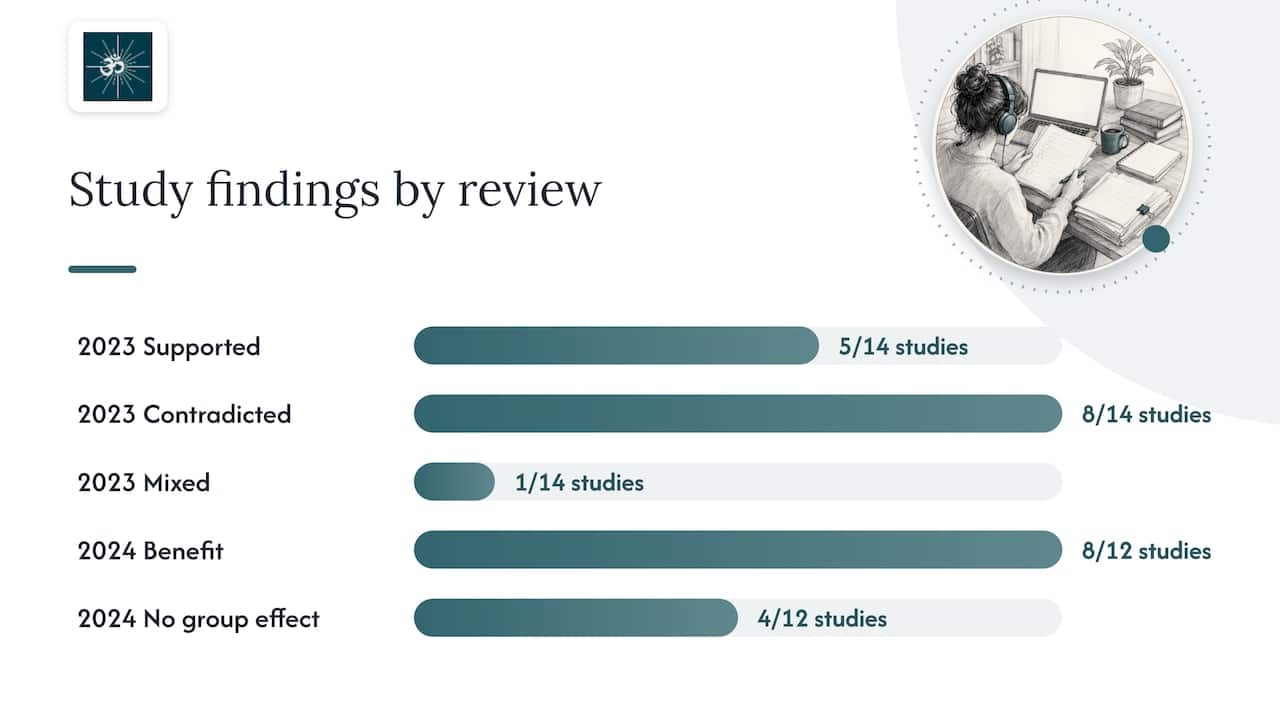
The picture is mixed. A 2023 systematic review of EEG studies found 14 eligible papers: five supported brainwave entrainment, eight contradicted it and one was mixed, with methods varying so much that comparison was hard. Austria’s public health portal says that commercial claims of reliably changing brainwaves are not scientifically established.
On the experience side there are more encouraging signs. A 2024 review of 12 randomised controlled studies on non-clinical binaural-beat listening for stress found that eight reported at least one significant benefit over control, while four found no group effect. The same authors concluded that the evidence is not strong enough for widespread recommendation, and that no optimal frequency or listening schedule has been established.
A subtler finding comes from the 2021 personalised-beat study: theta and beta stimulation did change EEG power relative to rest, yet the sessions did not produce clearly distinct mental states. A measurable change in how the brain handles sound is not the same as arriving at the state you were hoping for.
So what is a sensible reader to do with all that? Treat theta focus music as a conditions tool. A consistent, calming sound, a set time, headphones on, phone away: those things help you start a practice. Whether the beat itself adds something on top is a fair open question, and your own experience is a decent judge. If you feel steadier and more absorbed with it, that is useful. If you do not, the music is still music, and good music is a pleasant companion either way.
A note on the wider science of sound
Beyond headphones, researchers are looking at other ways sound and vibration might support wellbeing. If that interests you, this overview of vibroacoustic therapy benefits walks through clinical research on stress and wellbeing, including the mixed findings and the limits of the current evidence, which is exactly the spirit in which we suggest approaching theta music too.
How to choose a theta focus track
Because no ideal frequency has been established, picking by a magic number is a bit like choosing a wine by its alcohol percentage. Use these criteria instead.
- Sound quality. Theta tracks are long, and thin, buzzy synthesisers wear on you. Acoustic instruments and real room acoustics are kinder over 30 minutes or more. Our own composer Robert Emery puts it plainly: he believes in the power of people making music with acoustic instruments, because digital instruments do not resonate with the body in the same way.
- Where the beat sits. A beat in the 4–8 Hz band is what makes it “theta”. Anything in that range matches the usual definition, and studies have used values from about 4.6 Hz to 6 Hz. Do not agonise over a tenth of a hertz.
- How audible the pulse is. If the throbbing is the first thing you notice, the track is fighting you. A good binaural track tucks the effect under the music.
- Length and structure. Meditation of twenty to forty minutes needs a piece that does not suddenly change character. Look for gentle evolution, not dramatic crescendos.
- Licence, if you teach or publish. Using a track in a class, app, video or client session is a different matter from listening at home. Check the licence before you press play for others.
A quick comparison by type
| Type of theta audio | Typical sound | Headphones needed | Best for |
|---|---|---|---|
| Synthetic drone with binaural beat | Steady hum, little variation | Yes | Short, simple sessions |
| Ambient pads with binaural beat | Soft layers, slow change | Yes | Reading, journaling, meditation |
| Live orchestral recording with theta beat | Strings, winds and room warmth | Yes | Longer meditation, therapy and teaching |
| Isochronic tone tracks | Clear on-off pulsing | No | Those who dislike headphones, short sessions |
How to use theta focus music well
Here is a routine that stays honest about the science while making the most of the practical side.
- Put on stereo headphones or earbuds, with both on. Over-ear headphones are more comfortable for a long session.
- Set the volume low to moderate. The 2024 review by Mirmohamadi, Norozpour and Zarrabian recommends keeping listening below 85 dB, as prolonged exposure above that level can damage hearing. If you can hold a conversation over the track, you are in a good place.
- Choose one task. Meditation, a creative session or a gentle reading hour. Theta music is happiest with one thing at a time.
- Give it ten minutes. Settling takes a while. Judging the track after sixty seconds is like judging a cup of tea before the bag has steeped.
- Keep it regular, not obsessive. In the protocols one review examined, exposures within a week of each other were associated with maintained stress-buffering effects, which suggests you do not need to listen every single day. Think of it as a few reliable sessions a week.
- Notice how you feel afterwards. Your own notes beat any claim on a video title.
Safety: who should be careful
Studies in the 2024 stress-management review generally reported no harms attributed to the listening, though adverse effects were often poorly monitored. Repetitive binaural sounds can make some listeners uncomfortable, so if a track makes you tense, dizzy or irritable, stop and choose something else. If you have epilepsy, consult your doctor before trying binaural beats. And never listen while driving or operating machinery, because the whole point is to drift inwards.
Our perspective
We make theta music for a living, so you might expect us to promise you the moon. We will not. What we can say is this: the beat is only one ingredient, and probably not the most important one.
When Moritz Schneider and I sit down to build a theta piece, the first question is never “which hertz?” It is “would a person want to hear this for half an hour?” Moritz, who handles much of the sound design and the technical architecture of the frequency work, spends a great deal of time making sure the beat sits underneath the orchestration rather than on top of it. I conduct and compose, and I started piano at seven and studied at the Royal College of Music, so I am rather biased towards the sound of real strings in a real room.
That is why we record with live musicians, including sessions with the National Philharmonic at Abbey Road Studios, and why we mix in 3D surround sound. The goal is a recording that your body responds to, not a hum that your ears tolerate. The science of binaural beats is still being debated, and we are comfortable saying so. What we believe, and design for, is that beautiful, unhurried acoustic music makes it easier to sit down, breathe, and stay with your practice.
If you try one of our theta pieces and it helps you sink in, wonderful. If it simply makes your Tuesday evening a little more civilised, we will take that too.
ROBERT
Using theta music in your own practice or work
If you teach meditation or yoga, run massage or therapy sessions, or build a wellness app, theta music raises a practical question: what are you allowed to play? Personal listening and professional use are not the same thing. A track bought for your own headphones does not automatically cover a group class, a client recording or a published audio guide, so you need a licence that matches the use.
This is the gap we built our library to fill. Our royalty-free meditation music is recorded with live musicians, and it includes binaural, theta and Solfeggio-frequency tracks. For listeners it is available through a subscription; for practitioners and creators there are professional licensing options covering uses such as meditation, therapy, yoga, apps, guided audio and massage.
One more thing worth knowing: if you want to understand how sound and mindfulness fit together beyond theta, our article on science-backed sound and music for mindfulness is a good next step.
Try theta music recorded with live musicians
If you would like to hear what live orchestral theta music sounds like, our personal subscription costs €21 per month and gives you access to our meditation music for your own practice. If you teach, treat clients or publish, the professional subscription is €150 per month, and our royalty-free meditation music page explains the professional licensing. Check the pages for the current terms.
You can also start at Orchestral Meditations and browse the library at your own pace.
Common mistakes with theta focus music
- Playing it through speakers and expecting a binaural effect. Without headphones the beat vanishes.
- Turning the volume up to “feel it”. Louder is not deeper, and it can harm your hearing.
- Hunting for the perfect frequency. Nothing in the studies suggests a single best number.
- Using it for tasks that need fast, sharp attention. Theta is for absorbed, inward work.
- Expecting an instant result. A calm, routine-based approach tends to serve better than a dramatic one-off.
FAQ
What frequency is theta focus music?
Theta is usually defined as about 4–8 Hz. Studies have used values such as 4.6 Hz and 6 Hz. In music, the audible tones are ordinary pitches, and the theta figure is the difference between the two ears’ tones.
Does theta music really improve focus?
The evidence is mixed. Some randomised studies report stress benefits, but EEG studies disagree on whether the brain follows the beat, and reviewers say the evidence is not strong enough for a general recommendation. Many people still find it a helpful, calming background for inward, absorbed tasks.
Can I listen to theta music without headphones?
Binaural theta tracks need headphones, because each ear must receive its own tone. If you prefer speakers, look for monaural or isochronic tracks, where the pulse is built into the audio itself.
How long and how often should I listen?
No optimal duration or schedule has been established. Studies have used sessions such as 30 minutes, and a review suggests regular exposure within a week may maintain effects, so a few sessions weekly is a reasonable starting point. Adjust to how you feel.
Is theta music safe?
Studies generally report no harm attributed to listening, though monitoring was often limited. Keep the volume below 85 dB, stop if you feel uncomfortable, and talk to your doctor first if you have epilepsy.
Sources
- Personalized Theta and Beta Binaural Beats for Brain Entrainment (2021)
- Brain Responses to a 6-Hz Binaural Beat (2017)
- Binaural beats to entrain the brain? A systematic review (2023)
- Is non-clinical, personal use of binaural beats effective for stress management? (2024)
- A Review of Binaural Beats and the Brain (2024)
- Binaurale Beats, Gesundheitsportal Österreich
- Binaural Beats for Sleep, Sleep Foundation
- Binaural Beats benefits, dosage, and side effects, Examine
- Vibroacoustic therapy benefits backed by clinical research