Music-based mindfulness works in the classroom when you keep it short, repeatable and specific, not when you treat it as a cure-all. The simplest next step is a four-minute mindful listening ritual, run daily with a short prompt, similar to the protocol used by Greater Good in Education. Pair it with a curated library like Orchestral Meditations when you want reliably calm, high-fidelity tracks without trawling streaming playlists mid-lesson.
TL;DR:
- Short, guided listening routines of four to six minutes can effectively support classroom mindfulness and emotional regulation in children.
- Focusing on a single attention target, such as a pulse or specific instrument, prevents exercises from becoming background noise.
- Practices work best with familiar, repetitive routines for young children and require flexibility and adaptation for neurodiverse pupils.
- Implementation quality, including teacher familiarity and fidelity to the protocol, influences the program’s impact more than the specific activity chosen.
- Using dedicated, high-quality orchestral music libraries like Orchestral Meditations helps maintain distraction-free listening sessions and consistent practice.
Why music supports mindfulness in classrooms
Silent breath work asks a lot of an eight-year-old. Sitting still, eyes closed, attending to nothing but your own inhale: for plenty of pupils, that is a genuinely hard task, not a restful one. Music gives the brain something concrete to hold onto instead, which is exactly why it works as a mindfulness vehicle rather than a mere mood softener.
Three mechanisms do the heavy lifting. Pulse and rhythm anchor attention the way a breath count does, but with far less effort involved. Melodic and timbral change give pupils something to actually notice, converting passive listening into an active exercise. And group listening or singing builds a shared emotional register in the room, which is a quieter way of saying it gets everyone on the same wavelength before a lesson starts.
This matters for classroom climate as much as for any individual pupil’s focus:
- Music offers an accessible entry point for children who find silent stillness uncomfortable or unfamiliar.
- Shared listening builds a sense of social synchrony that supports social and emotional learning goals.
- A clear attention target (rhythm, timbre, a single instrument) turns background sound into genuine practice rather than wallpaper.
Quick classroom protocols you can run tomorrow
You do not need a training day to start. These five activities are ready to copy, and each one earns its place for a different reason.
- Four-minute mindful listening protocol. Play a short orchestral excerpt (Dvořák’s Symphony No. 9 is the example Greater Good in Education built its five-day version around), give one prompt such as “notice when the strings get louder”, then ask for thirty seconds of quiet reflection.
- Guided breathing with a solo instrument. Six to eight minutes of solo cello or piano, breathing paced loosely to the phrasing, works well as a pre-assessment routine or transition activity.
- Singing or chant rituals for transitions. A thirty-second call-and-response chant at the start or end of a lesson does the synchrony work of a longer session in a fraction of the time.
- Student-created mood playlists. Let pupils choose three tracks for “calm” or “focus”, then discuss why those choices work, which turns a listening task into a reflection task.
- Movement and improvisation. For classes that struggle to sit still, a short body-scan-to-rhythm or simple call-and-response drumming pattern achieves a similar settling effect without demanding stillness at all.
Pro Tip: Give every listening task one single attention target, pulse, timbre or a specific instrument, because a vague “just relax” instruction turns the exercise into background noise rather than practice.
Age adaptations and where these activities fit in the day
Early Years and Key Stage 1 pupils need very short, highly repeated routines, the same piece and the same prompt for several days running, because familiarity is what builds comfort, not novelty. Older pupils can handle longer sessions and benefit from adding a written reflection or journal line afterwards.
- Keep it to around four minutes daily for younger children, repeating the same track across a week rather than varying it.
- Move to six to eight minutes, two or three times a week, once pupils reach upper primary or secondary age, adding brief written reflection.
- Morning registration, the slot straight after break, and the few minutes before an assessment are the three placements that tend to work best.
- For neurodiverse pupils, build in flexibility around eye contact, stillness and participation; this practical guide to emotional regulation for SEN children is a useful reference when adapting expectations.
- Choose repertoire that reflects the pupils in the room rather than defaulting to a single cultural tradition of calm.
What the evidence actually shows
The evidence base is real but modest, and it rewards precision over enthusiasm. A 2024 systematic evidence review covering 24 interventions across 41 studies rated Learning to BREATHE, the Mindfulness in Schools Project and MBSR as having high evidence among school mindfulness programmes, which tells you these particular curricula have a track record, not that any mindfulness activity automatically works.
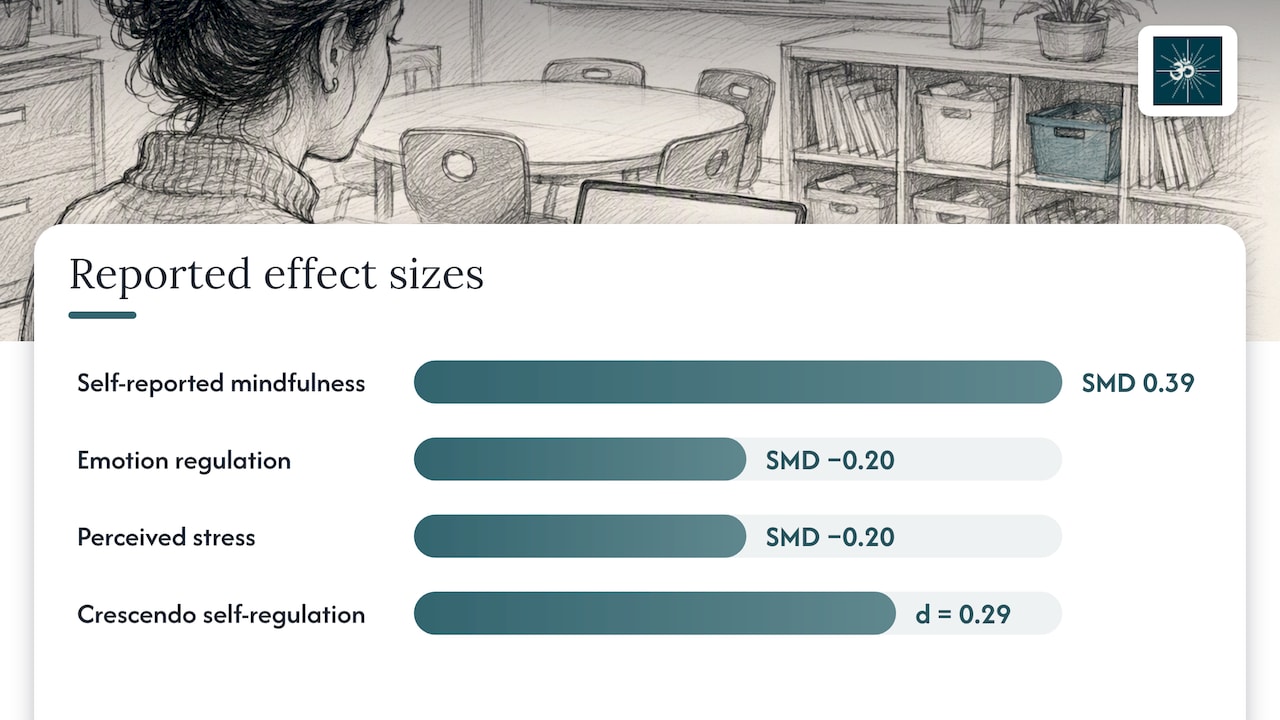
A 2025 systematic review and meta-analysis found small but statistically significant effects for self-reported mindfulness (SMD 0.39) and small improvements in emotion regulation and perceived stress (both SMD −0.20), with no significant effect on anxiety. That is a meaningful finding: these programmes shift how pupils regulate day to day, but they are not an anxiety treatment.
On the music-specific side, a 2026 quasi-experimental evaluation of the Crescendo programme, involving 559 children aged 5 to 6, found a self-regulation effect of Cohen’s d = 0.29 compared with matched control schools. That is a modest gain, consistent with the wider literature rather than an outlier. Across both strands, implementation quality (who delivers it, how faithfully, how often) explains more variance than the specific technique chosen.
Teacher readiness, safety and facilitation tips
Your own comfort with the practice shapes whether pupils buy in. Trial the audio yourself before playing it to a class, because a track that sounds calming through headphones can sound thin through a classroom speaker.
- Run a short staff taster session so colleagues experience the protocol before rolling it out, which builds consistency across year groups.
- Model the practice yourself rather than only instructing it, and set a non-judgemental tone for reflection (“there’s no wrong answer here”).
- Know your safeguarding signposts: a mindfulness moment can occasionally surface distress, and staff should know the standard referral route rather than trying to counsel in the moment.
- Use a simple observation prompt afterwards, did attention visibly settle, did more pupils than usual join the reflection, to judge whether the activity is earning its slot.
Pro Tip: Treat the first two weeks as a trial, not a commitment: if a routine isn’t landing, change the prompt before you abandon the whole idea.
Resources, sample scripts and templates you can copy
A five-day mini-plan removes the guesswork. Day one: play a 90-second excerpt, prompt “notice the loudest moment”. Day two: same piece, prompt “notice when an instrument drops out”. Day three: introduce a new piece, same prompt structure. Day four: add ten seconds of silent reflection after listening. Day five: ask pupils to describe one sensation they noticed, in one sentence.
- A four-minute whole-class script: “Sit comfortably. I’m going to play a short piece of music. Your only job is to notice [attention target]. When it finishes, we’ll have thirty seconds of quiet before anyone speaks.”
- Playlist themes: calm (slow tempo, sustained strings), focus (steady pulse, minimal melodic surprise), reflection (solo instrument, wide dynamic range).
- Selection criteria: favour clear tempo and timbre over lyrical complexity, and draw repertoire from more than one cultural tradition across the term.
Free classroom-ready packs and audio examples are available through Greater Good in Education’s practitioner guidance, which is worth bookmarking alongside any licensed library you use.
Using high-quality recorded music in the classroom: where Orchestral Meditations fits
Streaming platforms are not built for repeatable, distraction-free classroom listening, adverts and algorithmic shuffling undo the whole point of a mindful listening protocol. A dedicated library sidesteps that.
- Short orchestral tracks work well for the four-minute listening ritual and as a bed for solo-instrument breathing exercises.
- Orchestral Meditations’ personal subscription suits an individual teacher building a private collection, while its professional subscription is built for broader, institutional licensing.
- The recordings were made at Abbey Road Studios, the same building linked to decades of orchestral and film scoring work, using 3D surround techniques aimed at immersive rather than flat listening.
- Composer and producer Moritz Schneider contributes to the platform’s scored material, giving the catalogue a consistency of musical language that a randomly assembled playlist rarely offers.
Check the licence tier before playing anything to a class, since personal and professional subscriptions cover different use cases.
Strategies for involving parents and community in mindfulness music programs
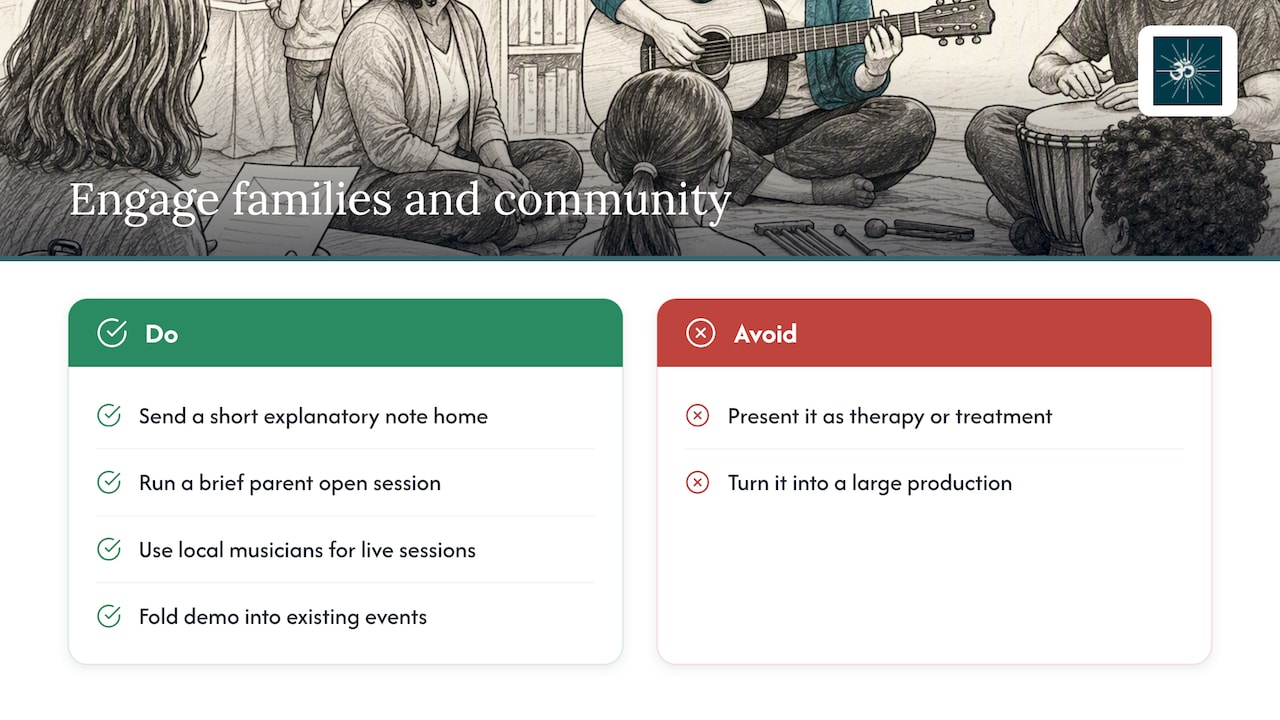
A four-minute classroom ritual has a much longer shelf life when parents understand what it is and why it is happening. Start with a short note home explaining the routine in plain terms, what the pupils listen to, what the prompt asks of them, and what you are hoping to see (steadier attention, a calmer transition into lessons).
Invite parents to a short open session, even fifteen minutes at a parents’ evening, where they experience the same listening exercise their children do. It demystifies the practice far more effectively than a written explanation, and it tends to convert sceptical parents faster than any policy document.
Community musicians, local choirs or secondary school music students can be brought in for occasional live sessions, which gives the practice a sense of occasion without turning it into a big production. Where a school already runs a family music evening or a wellbeing week, folding a mindful listening demonstration into that existing event costs nothing extra in staff time.
Keep messaging consistent across newsletters and any school app updates: mindfulness music sits alongside existing pastoral work rather than replacing it, which avoids the impression that it is a therapy substitute rather than a classroom habit.
Assessment methods to measure impact of mindfulness music in schools
You do not need a formal trial to know whether a routine is working, but a light evaluation structure stops you relying on impressions alone. Before and after a half-term of daily practice, a short pupil self-report, three or four simple statements rated on a scale, can track shifts in self-reported calm or focus without adding significant workload.
Teacher observation logs are the most practical tool for most schools: a thirty-second note after each session on whether the class settled faster than usual, whether more pupils engaged with the reflection prompt, and whether behaviour incidents in the following lesson dropped. Over a term, these logs build a picture that is more useful than a single survey.
Where a school wants a firmer evidence trail, comparing a class running the protocol against a similar class that is not, rather than assuming uniform impact, mirrors the logic used in the Crescendo evaluation and gives a more honest read on what the practice is actually doing. Evidence-based approaches to stress management generally favour this kind of comparison over anecdote, and it keeps expectations realistic rather than inflated.
Author’s perspective: modest aims and practical next steps
Keep the goal narrow: better attention, steadier transitions, a shared classroom habit, not a cure for anxiety, because the evidence simply does not stretch that far. The most useful thing a school can do is treat each routine as a small experiment, tweak the prompt, swap the track, watch what actually lands with this particular class.
Share what works across staff rather than each teacher reinventing the wheel alone, and ask pupils directly what they noticed. Their answers are usually more honest than any survey.
— ROBERT
A brief, honest look at Orchestral Meditations as a classroom resource
Building your own calm, reliable playlist from scratch takes longer than most teachers have spare on a Sunday evening. Orchestral Meditations offers a royalty-free library of orchestral tracks, recorded with live musicians, alongside a personal subscription at €21 per month and a professional subscription at €150 per month for school-level or institutional licensing.
Try a single short track from the royalty-free meditation music range first, in your next mindful listening session, before committing to a subscription. If it fits your routine, the personal subscription is the simplest way for an individual teacher to build a small, dependable library without licensing headaches.
Sources
- Mindful Music Moments | Greater Good in Education
- Systematic evidence review (school mindfulness interventions) — PubMed entry
- Crescendo evaluation — MDPI
This article is general information, not a substitute for advice from a qualified doctor. Consult a qualified healthcare professional about your own circumstances before acting on anything here.
FAQ
What are the 5 R’s of mindfulness?
Definitions vary by framework. One education-focused model lists Relationships, Recognition of Distress, Regulation, Reflection and Resilience, while other versions use different terms entirely, so it is worth checking which framework a specific programme or trainer is referring to.
How can music be used to practice mindfulness?
Music works best as a mindfulness anchor when it gives pupils one clear thing to notice, a pulse, a change in timbre, a single instrument entering or dropping out. Short, repeated listening sessions, guided breathing paired with a solo instrument, and simple call-and-response singing are the most classroom-tested approaches.
What are some effective mindfulness programs for schools?
A 2024 systematic evidence review rated Learning to BREATHE, the Mindfulness in Schools Project and MBSR as having high evidence among school-based programmes. For a music-specific example, the Crescendo programme showed a modest positive effect on self-regulation in young children in a quasi-experimental evaluation.
Are there any negative effects of teaching mindfulness in schools?
Large-scale reviews generally report small, positive or neutral effects rather than harm, though anxiety outcomes specifically show no significant improvement across studies. Implementation quality matters: poorly modelled or rushed sessions are more likely to disengage pupils than to cause measurable harm, which is why teacher readiness and pacing are worth getting right from the start.