
Can binaural beats genuinely ease a migraine? The honest answer is: maybe, for some people, as a relaxation aid rather than a cure. A 2024 systematic review found the evidence thin and inconsistent, and the German Migraine and Headache Society doesn’t list binaural beats among its proven treatments. If your pain, nausea or sound sensitivity gets worse while listening, stop. If attacks are frequent or severe, see a clinician before experimenting.
TL;DR:
- Binaural beats are unlikely to significantly treat migraines and should be used as a relaxation aid rather than a primary therapy.
- The scientific evidence supporting their effectiveness for migraine relief is low quality and inconsistent, with no established optimal frequency.
- Listening to binaural beats during severe attacks or if symptoms worsen can be counterproductive and should be avoided.
- Personal trials with low volume and session lengths of 10 to 30 minutes, combined with symptom tracking, are recommended to assess individual response.
- These audio techniques should complement medical treatment, not replace it, especially for frequent or severe migraines.
What binaural beats are and how they might affect the brain
Here’s the basic trick: play a slightly different tone in each ear, say 200 Hz in the left and 210 Hz in the right, and your brain perceives a phantom third tone pulsing at the 10 Hz difference. That illusion is a binaural beat. It only works through headphones, because your two ears need to receive genuinely separate signals for your brain to do the blending.
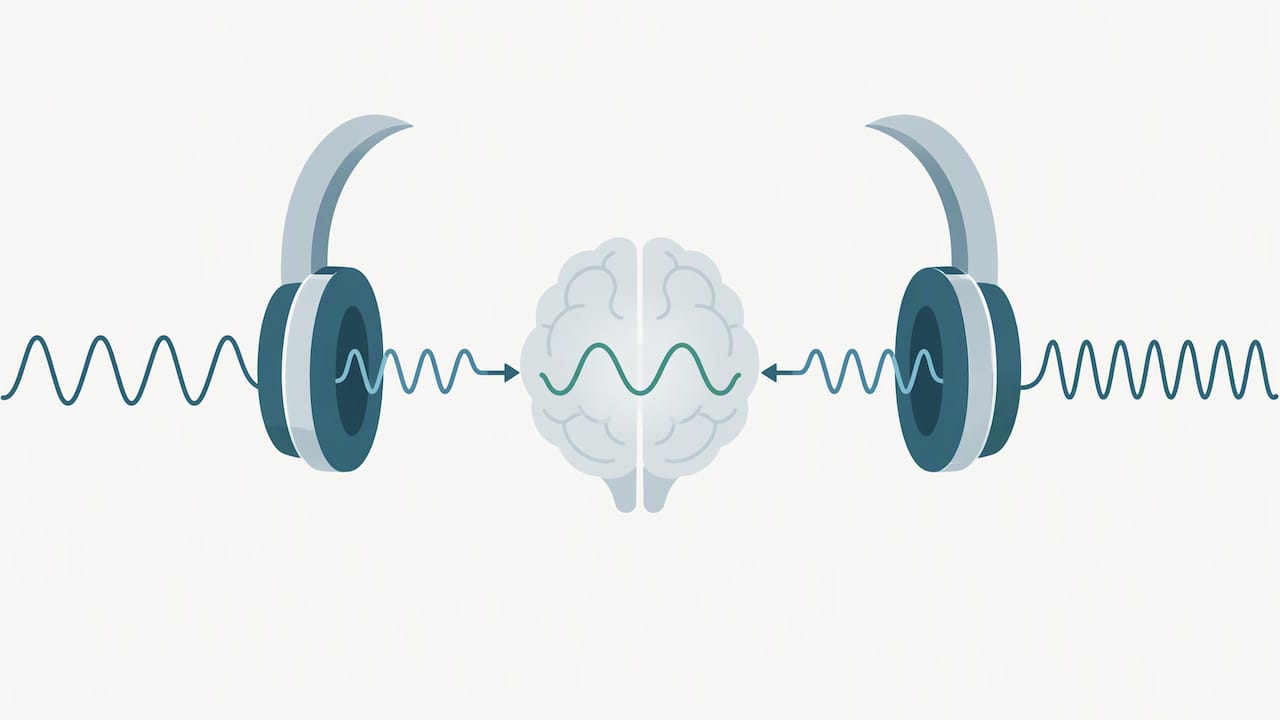
The theory, loosely called “entrainment,” is that your brainwaves might start following that pulse, nudging your EEG activity towards whichever frequency band the beat sits in: alpha, theta or delta. It’s a tidy idea. The evidence for it reliably changing pain or mood is far less tidy, which we’ll get into shortly.
A few distinctions worth keeping straight:
- Binaural beats need two ears and headphones; monaural beats mix both tones before they reach you, so they work through speakers too and entrain the brain by a different route.
- General music therapy relies on melody, rhythm and emotional association, while binaural beats are built purely on the frequency gap between two tones.
- Neither is a drug, and neither carries the same quality of clinical testing as standard migraine medication.
What the research shows: systematic review and key trials
This is where enthusiasm needs tempering. The 2024 systematic review pulled together 16 randomised controlled trials covering both acute and chronic pain, and the authors couldn’t even pool the results because the studies were too different in design, dosing and outcome measures. Their verdict: evidence quality ranges from low to very low. That’s not a condemnation, but it is a reason to keep expectations modest. Within that mixed bag, alpha and delta-alpha combinations appeared more promising for acute pain than other frequency pairings, though “potentially useful” is doing a lot of hedging there.
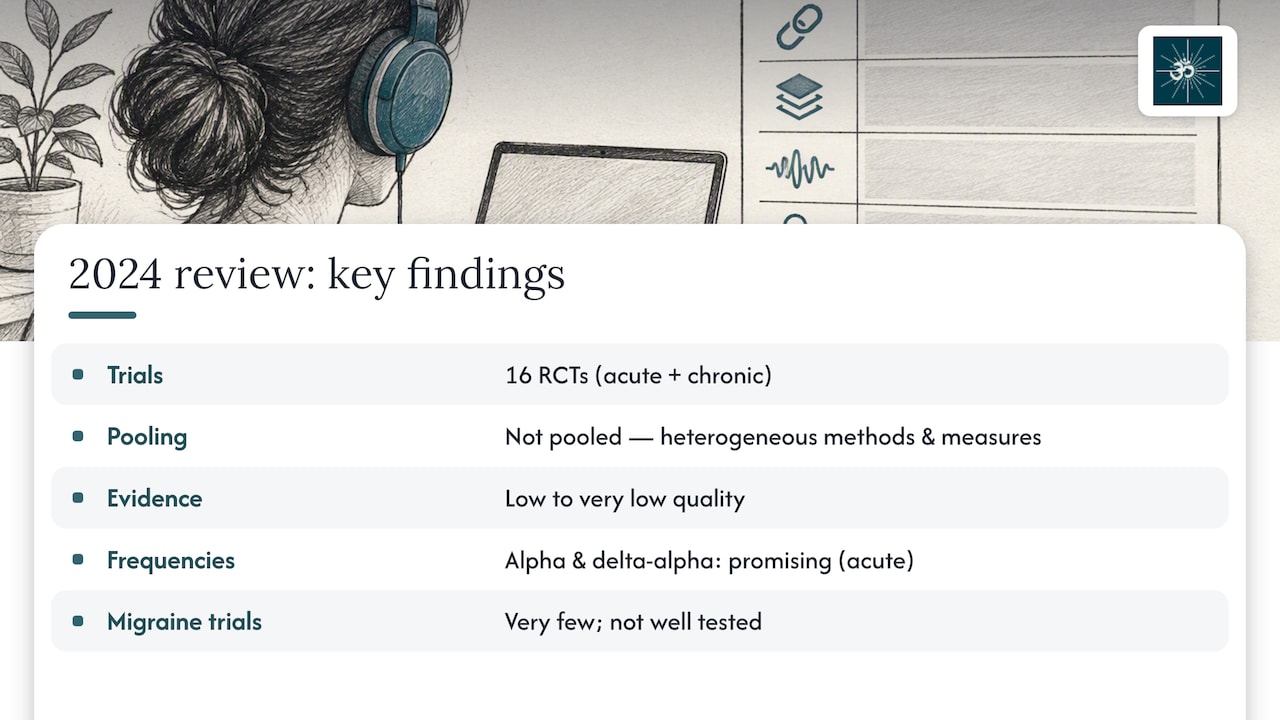
A 2024 systematic review found 16 trials on binaural beats for pain, but judged the overall evidence low to very low in quality largely due to heterogeneity and bias risk. That single sentence probably tells you more than most marketing copy on this subject ever will.
One trial worth naming on its own: a 2020 double-blind, randomised crossover study gave chronic pain patients 30 minutes of 5 Hz theta binaural beats against a sham tone. Pain scores dropped significantly during the first session, and weekly analgesic use fell too. Encouraging, but it wasn’t a migraine trial. It tested general chronic pain, and migraine has its own particular mechanisms, triggers and sensory quirks that don’t necessarily behave the same way.
Put the two together and you get a reasonable, not dramatic, picture: binaural beats show some promise for pain generally, almost nothing has been tested specifically on migraine, and the German guideline’s silence on the subject reflects that gap rather than any rejection of the idea.
Frequencies, carrier tones and setting up a session properly
If you’ve gone looking for “the best Hz for migraine,” I’ll save you the scrolling: there isn’t one, not yet. Trials have used alpha beats around 10 Hz, theta around 4 to 5 Hz, and combined delta-alpha patterns, with no consistent winner across studies.
A few practical notes before you press play:
- The “carrier frequency,” the actual pitch you hear in each ear (often somewhere between 100 and 400 Hz), affects comfort as much as the beat itself does.
- Masking the beat with music or white noise can change the experience. Some trials found unmasked, pure-tone beats produced a clearer entrainment signal, though they’re also less pleasant to sit through.
- Session lengths in the research mostly ran from 10 minutes at the low end to 20 or 30 minutes, which is a sensible target if you’re testing this yourself.
Pro Tip: Start at a low, comfortable volume on over-ear headphones rather than earbuds. Loud or tightly sealed in-ear listening can itself provoke tension around the ears and jaw.
Rather than hunting for a single magic frequency, treat this as a personal calibration exercise. Your nervous system isn’t identical to the trial participants’, so give yourself a few honest attempts before deciding anything.
Who should be cautious, and when to stop
Migraine and sound have a complicated relationship. Phonophobia, that heightened sensitivity to noise during an attack, means an intervention built entirely from sound could backfire for some people.
- Stop immediately if pain, nausea, dizziness, aura intensity or sound sensitivity increases during or after a session.
- Keep the volume low and the session short, especially on your first few attempts, and favour comfortable over-ear headphones over anything that presses into the ear canal.
- Avoid trying binaural beats during a severe acute attack if sound of any kind already makes things worse.
- Treat this as one piece of a broader management plan, not a substitute for medical care, and get a clinical assessment if attacks are frequent or disabling.
A simple trial protocol to test whether it helps you
Rather than guessing, run your own small experiment. It costs nothing but a few days of patience, and it hands your doctor something more useful than “I think it helped.”
- Spend several days keeping a plain headache diary before you introduce any audio, noting attack timing, pain intensity, nausea and phonophobia.
- Alternate listening days with matched “control” days where you rest quietly without any binaural track, so you can see what’s genuinely attributable to the sound.
- On listening days, use sessions of 10 to 30 minutes, at low volume, and log the same measures: pain, nausea, phonophobia and whether you needed rescue medication.
- After a couple of weeks, compare the two sets of days. A consistent dip in pain intensity, a shorter attack, or less reliance on medication on listening days is a genuine signal. No difference, or symptoms that worsen, is useful information too.
Pro Tip: Pair your listening sessions with a simple breathing or body-scan routine, similar to the techniques in our guided meditation guide, so you’re not relying on the audio alone to do the relaxing.
If the diary shows a real pattern, bring it to your clinician. If it doesn’t, you’ve lost nothing but a little time, and you can rule the approach out with confidence rather than lingering doubt.
Why Orchestral Meditations takes this seriously
Orchestral Meditations offers a library of meditation music featuring orchestral performances and sound design to provide layered listening experiences. Composer and producer Robert Emery has shaped tracks that treat frequency work as a craft rather than an afterthought bolted onto stock audio. That matters, because a well-built masking layer can change how tolerable, and arguably how effective, a session feels, as the research into masked versus unmasked beats suggests. These are framed as practice-focused tools for regular relaxation, not a clinical treatment.
— ROBERT
Where to find these tracks if you want to try them properly
If you’ve read this far and decided a structured trial is worth your time, the quality of the recording genuinely matters, both for comfort and for whether you’ll actually stick with it past day three.

Orchestral Meditations offers a few ways in, depending on how often you plan to listen:
- A Personal subscription at 21 EUR per month, suited to anyone building a regular relaxation habit around their diary.
- A Professional subscription at 150 EUR per month, aimed at therapists, yoga instructors and clinicians who want to use tracks in sessions with clients.
- Individually licensed tracks from the Royalty Free Meditation Music range, for content creators who need cleared audio for apps or guided recordings.
Whichever option fits, keep running your own trial and safety checks alongside it. Good production doesn’t override your own tolerance, and the diary method above still applies regardless of which track you choose.
FAQ
Are binaural beats good for migraines?
They may help some people relax, but the evidence is specific to general pain rather than migraine, and the 2024 systematic review rated it low to very low in quality. Treat them as a complementary option alongside medical care, not a replacement for it.
What is the dark side of binaural beats?
For people with migraine, the main risk is that sound itself, including a constant tone through headphones, can worsen phonophobia or intensify an attack for some individuals, as noted in a consumer health overview. Stop listening if symptoms increase rather than pushing through.
Which frequency is best for migraine?
No single frequency has been established as best; trials have tested alpha tones around 10 Hz, theta around 4 to 5 Hz and delta-alpha combinations with mixed results, including in a chronic pain crossover trial that used 5 Hz theta. Personal testing with a diary is more reliable than chasing a specific number.
What is the 5 4 3 2 1 rule for migraines?
This isn’t a frequency protocol; it’s a grounding technique some people use during anxiety or sensory overload, naming five things you see, four you feel and so on, unrelated to binaural beats research. It isn’t part of the German guideline’s recommended migraine management and audio-based approaches sit separately from it.
Can binaural beats replace migraine medication? Non-drug measures like relaxation are recommended as a complement to care, not a substitute, and German guideline authors recommend behavioural approaches alongside standard treatment rather than instead of it.
No. Non-drug measures like relaxation are recommended as a complement to care, not a substitute, and German guideline authors recommend behavioural approaches alongside standard treatment rather than instead of it. Frequent or severe attacks still warrant clinical assessment.
Sources
- Does brain entrainment using binaural auditory beats affect pain perception in acute and chronic pain?: a systematic review
- Reduced pain and analgesic use after acoustic binaural beats therapy in chronic pain ‐ A double‐blind randomized control cross‐over trial
- Music for migraine: Music therapy, binaural beats, and more
- Treatment of migraine attacks and prevention of migraine: Guidelines by the German Migraine and Headache Society and the German Society of Neurology