Recording meditation audio, in the sense that matters for professional use, means orchestral music captured with live musicians in a proper studio, often layered with binaural or 3D sound and specific frequency work, then licensed with clear commercial terms.
The sensible route is to licence tracks from a producer who can show studio and composer credits rather than assemble something from stock loops. Providers like Orchestral Meditations, built around producer Robert Emery and composer Moritz Schneider, give you exactly that paper trail, and it is worth knowing what to check before you buy.
TL;DR:
- Professional meditation recordings should feature live orchestra and choir credits, recognized studios, and clear production details to ensure quality and authenticity.
- High-resolution master files, separated stems, and full metadata are essential for remixing, licensing verification, and maintaining professional standards in distribution.
- Theta and delta binaural beats show the most consistent evidence for supporting relaxation, but effects vary between individuals and depend on repeated, structured listening.
- UK professionals need a separate public performance license from PPL PRS when playing music publicly, even if tracks are licensed as royalty-free for embedding in products.
- For maximum credibility, purchase studio-recorded orchestral tracks with verified credits and match production quality to the setting’s expectations, especially for retreats, therapy, or paid apps.
What professional orchestral meditation recordings actually include
A properly produced meditation track carries fingerprints you can verify. Live orchestra and choir credits, a named conductor or producer, and a recognisable studio (Abbey Road being the obvious benchmark) all signal that real musicians, not a synthesiser preset, made the recording. That matters because the texture of bowed strings or a breathing choir section does something a sample library simply cannot replicate.
Sound design is the second layer. Look for binaural mixing, 3D surround treatment, theta or delta-leaning frequency content, Solfeggio tones, and vocal textures woven in rather than bolted on as an afterthought.
Then there’s the paperwork you never think about until you need it:
- High-resolution master files, not just a compressed streaming rip
- Stems separated by instrument or frequency layer, useful if you want to remix or duck under narration
- Full metadata: composer, producer, recording date, key and tempo
- Composer and producer credits stated plainly, not buried in a footer
- Licence documentation you can actually produce if a client or platform ever asks
Skip any of these and you’re buying background noise dressed up as therapeutic audio.
What does the research say about binaural beats and orchestral music?
Theta-frequency binaural beats show the most consistent evidence for supporting relaxation and stress reduction, though the size of the effect depends heavily on exposure length and which frequency band you use. A systematic review in Acta Neuropsychiatrica found theta-band beats linked repeatedly to physiological stress reduction across the studies it examined, even as methods and exposure times varied widely between trials.
The evidence in brief: binaural beats can entrain brain oscillations with effects that shift by frequency band. Theta and delta ranges tend to favour relaxation and sleep; alpha and beta lean towards focus and alertness, according to a review of binaural beats and brain function.
Three things follow from that for anyone using this material professionally:
- Treat these tracks as stress-regulation aids that support a session, not medical treatments that replace one
- Expect variability between listeners; what settles one client might do little for another
- Favour consistent, repeated use in structured sessions over a single one-off exposure, since the research base is built on repeated or sustained listening, not isolated dips
None of that undermines the tool. It just means you sell it honestly.
Licensing and legal essentials for UK professionals
Buying a royalty-free track is not the same as being cleared to play it anywhere. A royalty-free commercial licence lets you embed a recording into your product, an app, a class recording, or a course, without paying per-use royalties to the composer each time. A public-performance licence is a separate matter entirely, and you need it the moment music plays live in a class, studio, or any space where the public can hear it.
In the UK, that generally means holding TheMusicLicence from PPL PRS if you play music in a business or public setting; royalty-free clearance for your product does not substitute for it. Skipping this isn’t a grey area either, it counts as copyright infringement under the Copyright, Designs and Patents Act.
Work through this before you launch anything commercial:
- Read the licence terms line by line for app, streaming and sublicensing rights, not just “commercial use”
- Confirm territory coverage, since some licences are UK-only or exclude certain platforms
- Check whether the licence permits sublicensing if you’re embedding tracks inside a third-party app or platform
- Budget for TheMusicLicence or the relevant collecting society fee if music will be played in a physical venue or live class
- Verify licensing bodies directly through gov.uk’s guidance on collective management organisations rather than taking a vendor’s word for it
Pro Tip: Keep a folder of every licence PDF you buy, dated and labelled by track. If a client, app store reviewer, or PRS auditor ever asks, “prove it,” you want that answer in thirty seconds, not thirty emails.
How do you choose the right tracks for sessions, apps or therapy?
Start with provenance, because it tells you what you’re actually buying. Look for named studios, live-musician credits, and producers or composers you can verify independently, such as Robert Emery, whose Abbey Road meditation recordings feature well over a hundred musicians and singers, according to his own recorded credits).
From there, the checklist splits into two practical categories:
- Licence checks: confirm permitted uses, commercial and professional clauses, whether sublicensing is allowed for apps or third-party platforms, and any attribution requirements buried in the small print
- Fit-for-purpose checks: session length against your class format, tempo and dynamic range against your voice-over pacing, whether binaural elements are present, and whether stems or headphone-optimised mixes are actually available
Composer Moritz Schneider talks about his meditation pieces as “inner films”, cinematic works built to accompany a narrative rather than loop quietly in the background. That distinction is worth paying attention to. A track designed as a scored journey behaves very differently from a generic ambient loop once you drop a guided script over it.
Pro Tip: Test any track with your actual script before buying the full catalogue. A beautiful piece that swells at the wrong moment will fight your voice, not support it.
Technical and session-integration guidance
Ask for 24 bit WAV or FLAC masters at 48kHz as a baseline; anything less loses detail your listeners will feel even if they can’t name why. Good providers offer both stereo and binaural masters, plus stems so you can mix voice separately from music.
When you layer narration over an orchestral bed, keep three things in mind:
- Set music levels so your voice sits clearly above the bed, then use gentle compression and ducking so the orchestral swell doesn’t fight your cues
- Handle fades carefully at the start and end of a class or app session, since an abrupt cut breaks the mood you’ve spent forty minutes building
- Label binaural tracks clearly as headphone-required content, because stereo speakers cannot reproduce the interaural effect the mix depends on, and offer a non-binaural alternative for anyone who can’t use headphones
That last point isn’t a footnote. Play a binaural track through a room speaker and you’ve simply handed your client a pleasant piece of orchestral music with none of the frequency benefit you promised.
Orchestral Meditations, Robert Emery and Moritz Schneider: a studio-recorded option
Orchestral Meditations positions itself around a specific promise: studio-recorded, royalty-free orchestral meditation music with high-resolution masters and licensing built for professional use, not only personal listening.
Two names anchor the catalogue’s credibility. Robert Emery has produced and conducted large-scale meditation recordings at Abbey Road Studios, work that has involved well over a hundred musicians and singers on a single session. Moritz Schneider composes with a stated focus on binaural, three-dimensional listening and describes his pieces as purposeful “inner films” rather than passive background loops.
What that translates to for a buyer:
- A library built from live orchestral sessions rather than sample packs
- Composer and producer credits you can look up and verify independently
- Personal and professional subscription tiers, plus individual track purchases with licence documentation attached
Best practices and equipment for recording high-quality meditation audio
Room acoustics and microphone choice decide more of your final sound than almost anything you do afterwards. A large-diaphragm condenser microphone, positioned close but not so close it captures every breath, suits a calm, spoken narration far better than a cheap dynamic mic built for stage vocals.
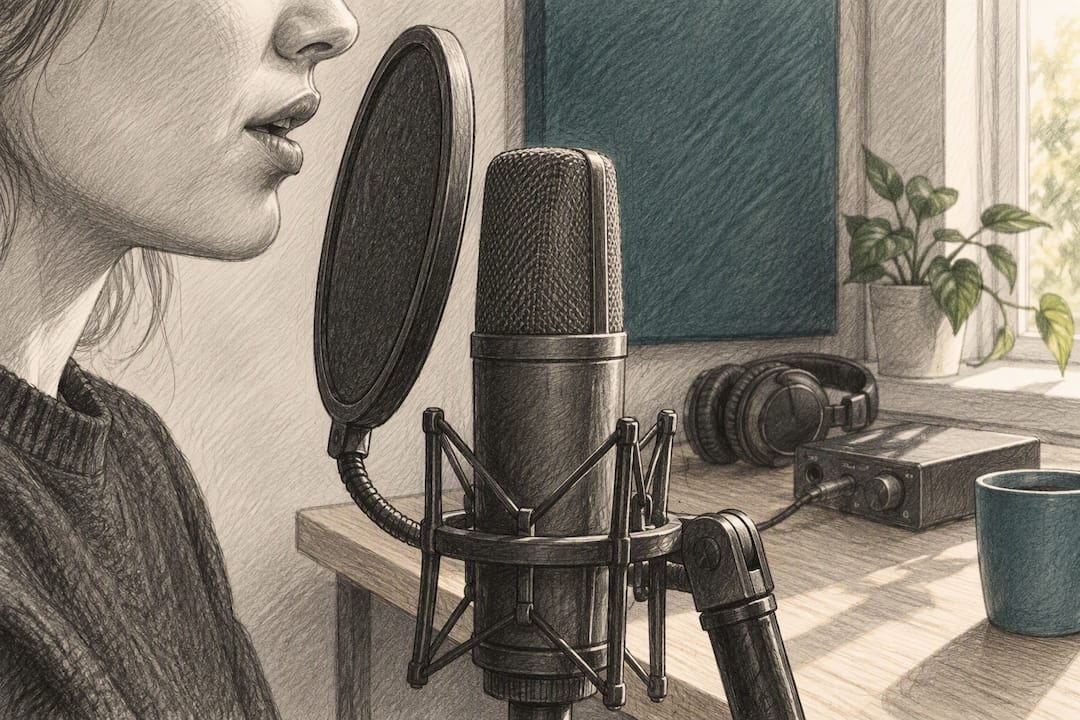
Pair it with an audio interface that offers clean, low-noise preamps; the difference between a budget interface and a mid-range one shows up as hiss the moment you push the gain to catch a soft voice. Closed-back headphones let you monitor without bleed into the microphone, which matters more than people expect once you start layering a music bed underneath.
Beyond gear, discipline matters just as much. Record a few seconds of room tone before every session so you have something to fill gaps in editing without an obvious silence cut. Warm up your voice for a couple of minutes before pressing record, since a cold voice reads flatter and more strained than you’d guess from listening back.
If you’re licensing orchestral beds rather than recording your own, none of this changes the fact that your spoken layer still needs the same care. A polished Abbey Road recording under a poorly recorded voice will always sound like two different projects stitched together, and listeners notice that mismatch even when they can’t explain why.
How do you actually produce a meditation session from script to finished file?
Start with the script, and write it to be spoken, not read. Short sentences, deliberate pauses marked directly in the text, and a pace roughly a third slower than normal conversation all help once you’re in front of a microphone and nerves speed you up without you noticing.
Set up your recording space before you touch record. A small room with soft furnishings (a bedroom with a wardrobe full of clothes works better than most people expect) absorbs reflections that a bare office bounces straight back into your microphone.
The production sequence generally runs like this:
- Record your narration dry, without any music playing, so you retain full control over timing later
- Edit out breaths, mouth clicks and long pauses first, before you touch tone or effects
- Apply light compression to even out your vocal dynamics, then EQ to remove low-end rumble and any harshness above 4kHz
- Layer your licensed orchestral bed underneath, matching its swells and quiet passages to your script’s natural pauses
- Master the combined file to a consistent loudness level so it doesn’t jump in volume compared with other tracks in your library
Rushing straight from recording to “done” is the single most common mistake. The gap between an amateur file and a professional one lives almost entirely in that editing and layering stage.
Techniques for voice recording and sound layering
A calm, steady voice reads as trustworthy far more than a technically perfect one. Speak slightly lower and slower than your natural conversational register; it signals calm to a listener’s nervous system before they’ve even processed the words.
Positioning your microphone off axis, angled slightly away from a direct line into your mouth, softens sibilance and plosives without needing heavy processing afterwards. Combine that with a pop filter and you’ll cut most harsh consonant sounds at the source rather than fighting them in the mix.
Layering is where an average recording becomes a genuinely immersive one. Build from the bottom up: a low, sustained orchestral pad or drone first, then your voice sitting clearly above it, then any higher frequency textures such as strings, choir or ambient tones layered on top, kept quiet enough that they support rather than compete.
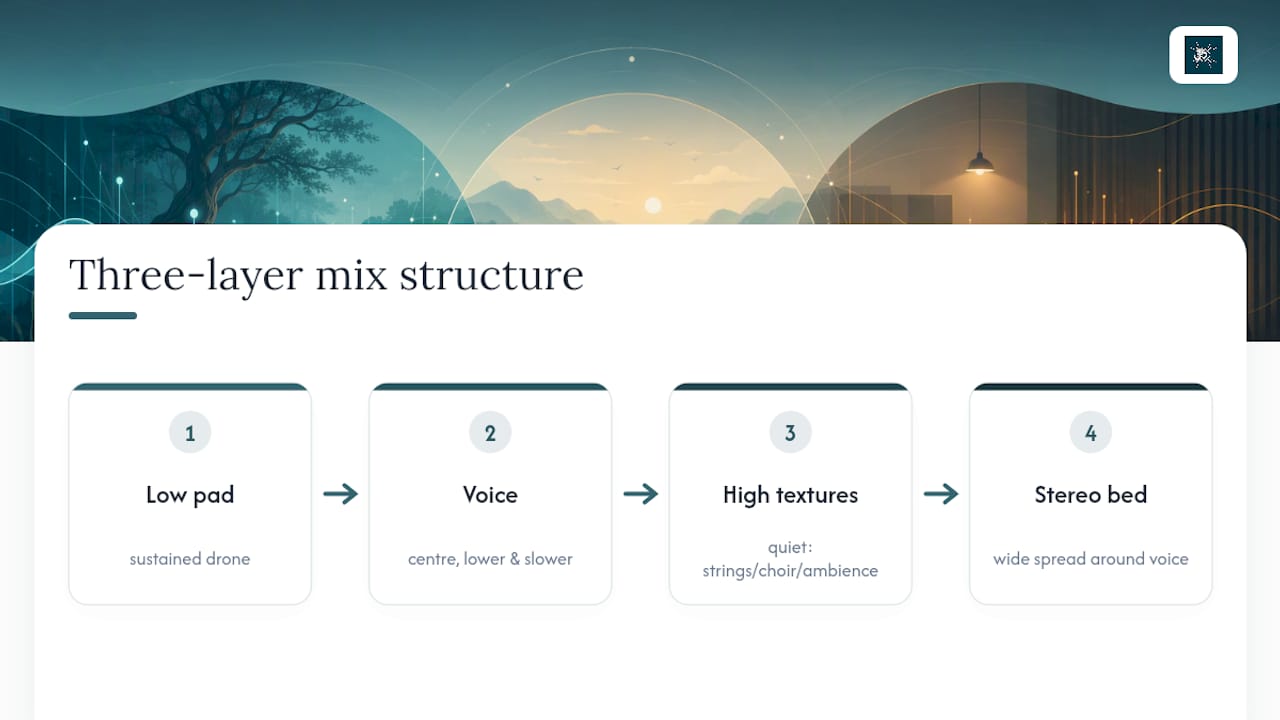
Panning matters more than most beginners realise. A wide stereo spread on the music bed with your voice locked dead centre creates a sense of space, almost as though the listener sits inside the orchestra while your voice speaks directly to them. If you’re working with a binaural mix, that spatial effect intensifies further, which is exactly why it depends on headphone playback to work as intended.
Automate small volume swells rather than leaving levels static throughout. A slight lift during an emotional cue in your script, followed by a gentle pull back down, keeps a fifteen-minute session from ever feeling flat.
Acoustic treatment and noise control during recording
Untreated rooms are the most common reason home-recorded meditation audio sounds thin or harsh, long before the microphone or interface gets blamed. Hard, parallel walls create flutter echo and reflections that stack onto your voice, and no amount of post-production EQ removes that cleanly once it’s baked into the recording.
Basic treatment doesn’t require a professional studio budget. Thick curtains, a rug, a duvet pinned across a wall, or purpose-made acoustic foam panels placed at first reflection points (roughly where a mirror held against the wall would show your microphone) all cut reflections noticeably.

Noise control runs alongside acoustic treatment, not instead of it. Record at a time of day when traffic, appliances and neighbours are quietest, switch off anything with a fan or compressor (fridges are the classic culprit nobody remembers until playback), and check your interface’s noise floor by recording thirty seconds of silence before every session.
A cardioid or hypercardioid microphone pattern rejects sound from the sides and rear, which helps enormously in an imperfect room, whereas an omnidirectional pattern picks up everything equally and will punish poor treatment far more harshly. If you can hear a hum, hiss or rumble on playback that you didn’t notice while recording, address it at source next time rather than relying on noise reduction plugins, which tend to soften your voice along with the noise they remove.
Marketing and distribution channels for meditation audio recordings
Meditation audio finds its audience through a narrower set of channels than most content, and spreading effort thin across all of them rarely beats focusing on two or three that fit your actual practice.
Your own website and email list remain the highest-value channel for a wellness practitioner, because listeners who sign up have already shown intent rather than stumbling across a track algorithmically. Podcast platforms and dedicated meditation apps come next, particularly if you can offer a free sample session that showcases production quality, since listeners judge a fifteen-second clip far more harshly for audio quality than they judge the script.
Social platforms work best for short excerpts rather than full sessions; a ninety-second clip with a striking visual and a snippet of orchestral swell tends to outperform a full-length upload buried in a feed nobody scrolls slowly through. YouTube remains genuinely useful for long-form meditation content specifically because its search behaviour favours evergreen, sleep-and-relaxation-style queries that keep bringing traffic months after upload.
Partnerships with yoga studios, therapy practices and corporate wellness programmes offer a distribution route many practitioners overlook, since a licensed, professionally produced track lends your offering credibility that a client can sense even if they can’t articulate the studio credits behind it. Whichever channels you choose, keep your licensing documentation ready. Distribution partners increasingly ask for proof of clearance before they’ll feature third-party audio on their own platforms.
Practitioner perspective: when studio-recorded orchestral music earns its price
Pay for orchestral, studio-recorded material when your setting demands it: a retreat, a paid app, a therapy practice where sonic quality signals credibility. For a casual social clip or a free taster session, a lighter ambient track does the job fine. The difference is audience expectation, not audio snobbery, so match production value to what your clients are actually paying for.
— ROBERT
Explore Orchestral Meditations subscriptions and licences
Licensing here means you skip the studio hire, the musician fees, and the months of production time, and start from a finished, credited recording instead. Orchestral Meditations offers a personal subscription at $24 per month for individual practice, and a professional subscription at $179 per month for practitioners who need commercial rights across classes, apps and therapy sessions.
[Image: Call to action banner]
If you’d rather buy tracks outright, the royalty-free meditation music catalogue covers individual purchases with professional licensing terms attached, no subscription required. Listen through a few Abbey Road-recorded samples, check the licence wording against your specific use case (app embedding, class playback, therapy sessions), and if your rollout needs sublicensing across a platform or enterprise product, reach out before you commit. That single check now saves a far more awkward conversation with a rights holder later.
Sources
- Gov
- Music and binaural beat interventions for young adults: A systematic review of effects on anxiety, sleep, and cognition — Acta Neuropsychiatrica
- A review of binaural beats and the brain — PMC
FAQ
Is a royalty-free licence enough to play meditation music in classes?
No. A royalty-free licence covers embedding a track in your product, but playing music in a public or business space in the UK generally requires TheMusicLicence from PPL PRS as well.
Does binaural meditation audio actually work?
Research shows theta-frequency binaural beats consistently support relaxation and stress reduction, though effects vary by frequency band and exposure time. Treat it as a stress-regulation aid rather than a guaranteed clinical outcome.
Who are Robert Emery and Moritz Schneider?
Robert Emery is a producer and conductor who has recorded large-scale meditation projects at Abbey Road Studios with over a hundred musicians and singers. Moritz Schneider is a composer known for describing his binaural meditation pieces as cinematic “inner films”.
Do binaural tracks need headphones to work?
Yes. Binaural mixes rely on separate audio delivered to each ear, so stereo speakers cannot reproduce the intended effect. Label headphone-required tracks clearly and offer a non-binaural alternative for participants who can’t use headphones.