
For masking traffic, snoring, and low rumbling household noise, brown noise tends to feel warmer and more soothing. For broad-spectrum masking of unpredictable sounds like chatter or clattering pipes, white noise is still the classic pick. Neither wins outright. The real answer depends on what’s keeping you awake, your personal comfort with hiss versus rumble, and testing both at a sensible volume before committing to one.
TL;DR:
- Brown noise is more effective for masking low-frequency household sounds like traffic, snoring, or HVAC vibrations than white noise.
- White noise provides broader sound coverage, making it better for sudden, high-pitched noises such as door slams or footsteps.
- Most sleep studies show that steady background noise reduces arousals, but evidence does not clearly favor brown noise over white noise.
- Testing both noise types over five nights at a consistent, comfortable volume helps identify which suits personal sleep disruptions best.
- High-quality, well-produced soundscapes are less fatiguing for long-term listening and may improve masking effectiveness.
White noise vs brown noise: what you’re actually hearing
White noise contains equal energy across every audible frequency, which is why it sounds like television static, a box fan, or a radio tuned between stations. It’s flat, hissy, and relentless in a way that some people find comforting and others find grating within minutes.
Pink noise sits in the middle. It carries more energy at lower frequencies than white noise but less than brown, producing a softer, steadier texture, closer to falling rain or wind moving through leaves. It’s worth knowing about even if brown noise is your main comparison point, because several sleep studies group pink noise separately, and it often performs differently.
Brown noise (sometimes called red noise in older literature) weights its energy even more heavily toward the low end. Named after Brownian motion rather than any actual colour, it sounds like a distant waterfall, rolling thunder, or the low cabin hum on a long-haul flight. There’s no sharp hiss here, just a deep, steady rumble.
Run this quick listening check tonight before deciding anything:
- Play a white noise clip for two minutes. Notice whether the hiss feels calming or irritating by the one-minute mark.
- Switch to brown noise for two minutes. Notice whether the rumble feels grounding or simply duller.
- Try pink noise briefly too. It often reads as a “compromise” between the two.
- Do this at low volume in the room you actually sleep in, since acoustics change everything.
Why the sound differs so sharply: spectral shape explained
The reason white and brown noise sound nothing alike comes down to how their energy is distributed across frequencies, not just their volume.
White noise has equal energy per frequency, which our ears perceive as heavily weighted towards the high end, because we’re naturally more sensitive to higher pitches. That’s the hiss. Pink noise follows a 1/f slope, losing energy gradually as frequency rises, giving it a smoother, more natural texture. Brown noise follows a much steeper slope again, losing energy roughly twice as fast as pink noise does per octave, which strips out almost all the high-frequency content and leaves that deep, rolling rumble behind.
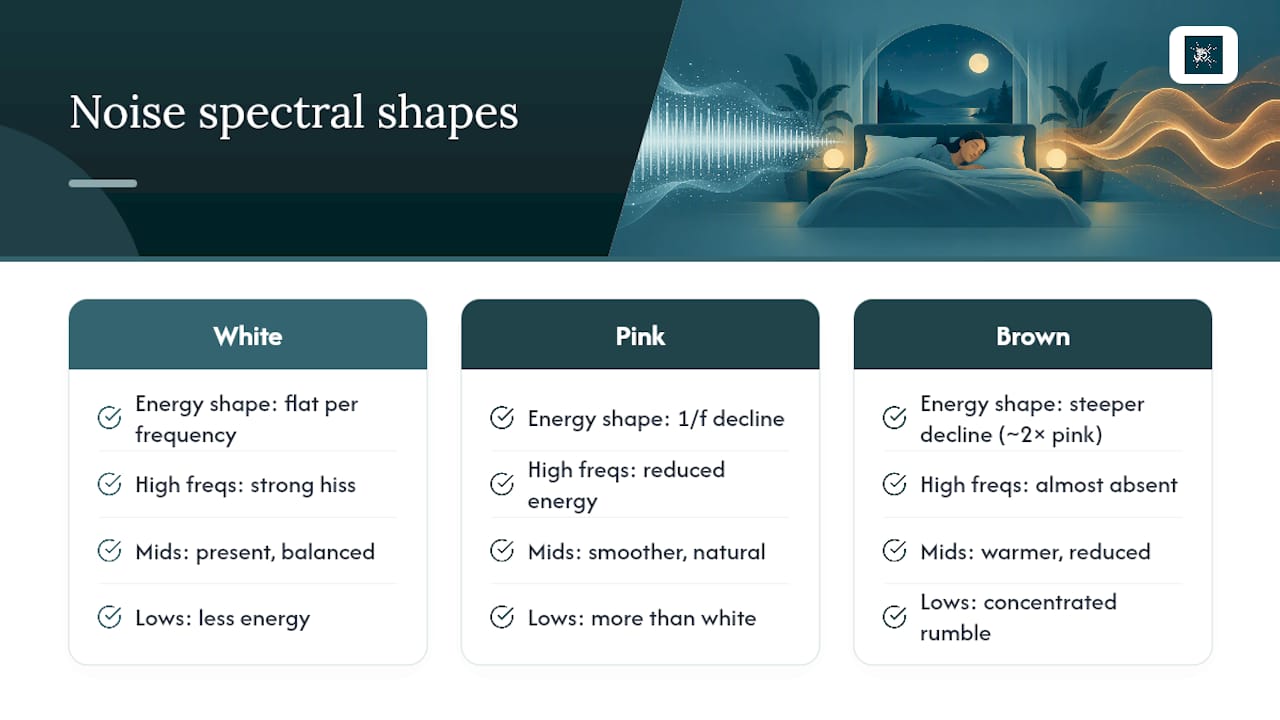
This matters practically because nocturnal disturbances aren’t all the same shape. Traffic rumble, snoring, and HVAC vibration sit mostly in the low-frequency range, which is exactly where brown noise concentrates its energy, giving it a natural overlap advantage for those specific sounds. Sudden, sharp noises, a door closing, footsteps, a partner’s phone buzzing, span a wider frequency range, and that’s where white noise’s broader coverage tends to do more work. Northwestern Medicine puts it plainly: white noise gives broad masking, while brown noise offers deeper relief for people sensitive to high pitches.
What the research actually says about sleep and masking
Masking, quite simply, is the part of this story with the strongest evidence behind it. Steady background sound raises the ambient noise floor, which makes intermittent disruptive sounds less likely to trigger an arousal. Several sleep studies have shown that overlaying steady noise reduces the rate of arousals caused by recorded hospital and household sounds, and that effect holds regardless of exactly which colour of noise you’re using.
A systematic review of 34 studies covering 1,103 participants found genuinely mixed results across the board. White noise studies produced fewer positive outcomes than pink or multiaudio interventions, and multiaudio approaches (curated, layered soundscapes) showed the highest proportion of positive sleep outcomes, though the review itself flagged inconsistent study quality across the pool. Direct head-to-head trials of white against brown noise specifically remain thin on the ground, so a lot of the “brown noise is better” chatter online is preference-driven rather than trial-proven.
Who tends to benefit most from adding steady noise at night?
- People in genuinely noisy homes, near roads, shared walls, or a snoring partner, tend to notice the biggest improvement from masking.
- Tinnitus sufferers often use brown or white noise specifically to reduce the contrast between silence and the ringing they perceive.
- People with ADHD-related focus difficulties sometimes report calmer attention with steady background sound, though this is more commonly studied for daytime concentration than sleep.
- Anxious sleepers occasionally find the predictability of steady noise reassuring, though this varies enormously by individual.
If disrupted sleep persists for weeks despite trying this, that’s worth raising with a GP rather than solving with a louder fan.
How to actually test white noise against brown noise
Don’t just play both once and guess. Run a proper trial.
- Pick a testing window. Give each colour five to seven nights if you can, or three to four if you need a faster read. Keep bedtime, room, and device volume identical across both trial periods.
- Track three things each morning. Roughly how long it took to fall asleep, how many times you woke, and how rested you felt on waking. A simple notes app or sleep diary works fine.
- Set volume before you start, not during. Play the sound at a level where you can still hold a normal conversation without raising your voice. If you have to speak louder to be heard over it, it’s too loud.
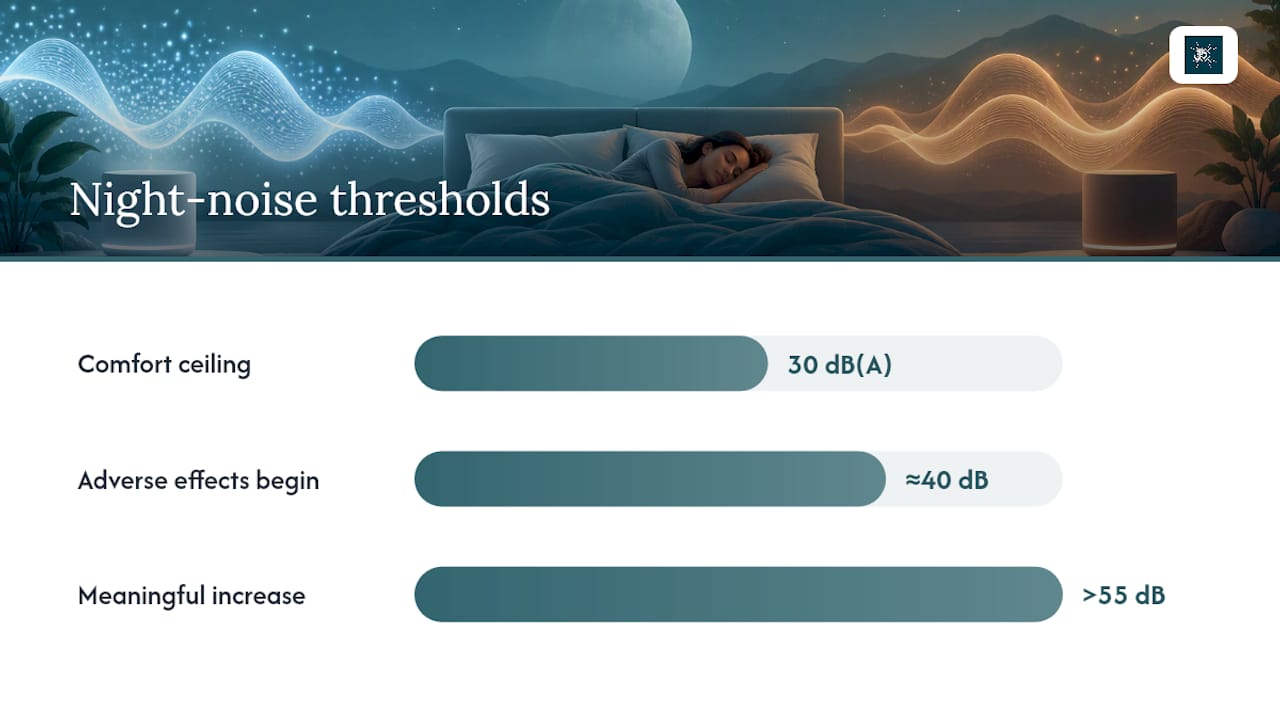
- Check the WHO benchmark. WHO night-noise guidance identifies roughly 30 dB(A) indoors as the level with no observed sleep disruption, with adverse effects becoming measurable above about 40 dB and increasing meaningfully past 55 dB. Treat 30 dB as your rough ceiling for comfortable, safe background sound.
- Compare your notes after both trials. One colour will usually pull ahead clearly. If neither does, alternate based on what’s disturbing you that particular night, traffic calls for brown, an unpredictable household calls for white.
Pro Tip: Keep a phone or tablet plugged in and out of reach if you’re prone to fiddling with volume mid-trial. Consistency is what makes the comparison meaningful.
Harvard Health notes that continuous sound played too loud may interfere with sleep stages rather than protect them, so all-night use isn’t automatically the safest default. If you suspect existing hearing damage, or you’re setting this up for a young child, check with a clinician before running any of the above.
Why production quality changes how noise actually feels
Not all “brown noise” is equal. A cheap, looping generator track often has an audible seam where the loop restarts, a jarring moment that can pull you straight out of a drowsy state. Higher-fidelity recordings, mastered properly and mixed with genuine low-frequency depth rather than a crude filter over static, tend to feel less fatiguing over hours of listening.
This is exactly the territory expert producers work in. High-quality recordings with orchestral texture, binaural mastering, and 3D surround techniques elevate soundscapes beyond a flat loop. Skilled composers and producers apply arrangement discipline, careful low-frequency emphasis, controlled high-frequency roll-off, and avoid jarring loop points to create genuinely restful tracks distinct from generic tone generators. If you’re using sound for hours every night, particularly for tinnitus masking, that difference in mindful, science-backed production is worth the upgrade over a free app loop.
What I’d actually try first
There’s no universal winner here, and anyone who tells you otherwise is guessing. If low rumbling noise is your problem, snoring, traffic, HVAC, start with brown. If it’s unpredictable sharper sounds, start with white. Run the five-night trial properly, keep volume at conversational level, and trust your own notes over anyone’s strong opinion, including mine.
— ROBERT
Sources
For the primary evidence behind this comparison, see the WHO night-noise guidelines, the PMC systematic review, and Harvard Health’s explainer.
If you’d rather skip the trial-and-error entirely, Orchestralmeditations’ Personal subscription gives you access to professionally recorded, high-fidelity soundscapes built for exactly this kind of extended night-time listening.
- Noise interventions for sleep (systematic review) — PMC
- WHO night-noise guidelines (European Region) — WHO
- Can white noise really help you sleep better? — Harvard Health
- What noise color is best for sleep? — Northwestern Medicine
FAQ
Is brown noise better than white noise?
Neither is objectively better; large-scale review evidence shows mixed results across noise colours, with multiaudio approaches often outperforming both. Brown noise tends to suit low rumbling disturbances like traffic or snoring, while white noise masks a broader range of sudden sounds.
Which noise colour is best for sleep?
There’s no single best colour. Northwestern Medicine recommends testing white, pink, and brown noise individually, since comfort and masking needs vary significantly from person to person.
What colour noise is best for ADHD?
Steady background noise, white or brown, is sometimes used to support daytime focus in people with ADHD, though most available research centres on general concentration rather than sleep specifically. Personal testing remains the most reliable way to find what helps.
Is it okay to listen to brown noise all night?
It can be, provided the volume stays low enough that you wouldn’t need to raise your voice over it, ideally around the 30 dB(A) indoor level the WHO identifies as having no observed sleep disruption. Harvard Health notes that louder, continuous sound may interfere with sleep stages, so keep it comfortable rather than maximised.