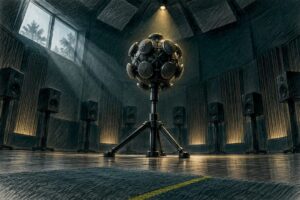
Binaural audio is a two-channel, headphone-focused method that encodes ear-specific timing and level cues, following the ITU’s own definition of the term. 3D audio is the bigger idea: the perceptual goal of sound that surrounds and locates you convincingly, which binaural, ambisonics, and object-based systems can all deliver. Pick binaural for portable, headphone-first listening and smaller projects. Pick a broader 3D or object-based workflow when you need multiple playback targets, height channels, interactivity, or head tracking.
TL;DR:
- Binaural audio is primarily designed for two-channel headphone delivery with fixed perspective, whereas 3D audio supports multiple playback formats and interactivity.
- Dummy-head recordings capture cues directly but are perspective-locked; ambisonics and object-based systems store a full sound field or metadata for adaptable rendering.
- Most headphone-based binaural mixes should be tested on multiple models to ensure the spatial cues remain convincing across different devices.
- Mixing binaural or spatial audio early in production saves time, especially when most of the audience will listen through headphones, unlike formats needing multi-target rendering.
- Claims of binaural beats reliably altering brain activity lack consistent scientific support, so approach such therapeutic promises with skepticism.
Binaural vs 3D audio: where the two genuinely diverge
Confusing binaural with 3D audio is a bit like confusing a violin with an orchestra. One is a specific instrument, one is the whole ensemble, and the second can absolutely include the first. Here’s where the practical gap opens up.
Delivery format is the clearest split. Binaural output is almost always two channels, encoded for a specific listening scenario: headphones, full stop. A broader 3D pipeline might carry ambisonic B-format, discrete object streams with metadata, or a 7.1.4 speaker bed, none of which behave the same way binaural does.
Workflow shape differs too. Binaural recording, done properly, uses a dummy head rig with microphones sitting where your eardrums would be, capturing a fixed perspective baked in at the moment of recording. Object-based authoring works the opposite way round: you place sounds in a virtual space with metadata describing where they sit, and the renderer decides how to translate that for whatever system is playing it back, whether that’s headphones, a soundbar, or a cinema rig.
Playback reality is where a lot of otherwise good productions fall apart. Headphones are non-negotiable for binaural, since a render intended for two ears becomes flat and unconvincing over stereo speakers. Speaker-based 3D formats need proper channel mapping or a renderer that understands the room. Head tracking, when it’s present, updates the whole scene as the listener moves, which is a separate feature from the binaural render itself, not a given part of it.
- Binaural: two channels, headphone-only, fixed perspective baked in at capture.
- 3D/object/ambisonic: multichannel or metadata-driven, renders to many playback types, supports interactivity.
- HRTFs (head-related transfer functions) vary from person to person, so a binaural mix that sounds razor-sharp on one listener can sound merely decent on another.
- Production cost climbs with complexity: a binaural stereo bounce is quick and cheap; an object-based ambisonics pipeline with metadata authoring takes longer and needs more specialist tooling.
Pro Tip: Always test a binaural mix on at least two or three different headphone models before calling it finished. The spatial illusion lives in fine spectral detail, and cheap earbuds can flatten cues that sounded three-dimensional on your studio pair.
How is spatial sound actually built? HRTFs, ambisonics and objects
Every spatial audio technique is trying to fake, or genuinely capture, the tiny cues your brain uses to locate sound in real life. Those cues are timing differences between your ears, level differences, and the way your outer ear and head filter frequencies depending on direction. Engineers call this filtering the head-related transfer function, or HRTF, and it’s the mathematical fingerprint that makes a sound seem to come from behind you rather than from a pair of headphones sitting on your head.
Dummy-head binaural recording captures these cues directly, using microphones positioned inside a model head shaped roughly like a human skull, complete with silicone ears. It’s elegantly simple and remarkably convincing, but the perspective is locked at the moment of recording. Turn your head and nothing moves with you, because nothing was ever tracking your head in the first place.

Ambisonics takes a different route entirely, storing a full sound field using spherical harmonics rather than discrete channels tied to speaker positions. Higher-order ambisonics adds more harmonics and finer spatial resolution, and crucially, the format can be decoded to almost any playback system after the fact, including a binaural headphone mix.
Object-based systems go further still. MPEG-H 3D Audio treats each sound as a separate object carried with metadata describing its position, and the renderer decides at playback time how to map that onto whatever system is listening, whether that’s a 5.1 living room setup or a pair of AirPods.
- HRTF filtering: encodes direction through spectral shape, not just volume and timing.
- Dummy-head capture: authentic cues, but the listening angle is fixed forever.
- Ambisonics: a full sound field stored independently of any one speaker layout.
- Object-based metadata (MPEG-H, ADM): renders on demand, including a binaural downmix for headphones.
One figure worth holding onto: systematic reviews of binaural beats (the low-frequency tones layered under music, not spatial binaural recording generally) report genuinely mixed results across studies, some showing an effect on brainwave activity and others showing none at all. Treat any strong claim about guaranteed brainwave entrainment with a healthy dose of scepticism.
Which format suits your project: music, VR, film or wellness?
Matching the technique to the project saves you weeks of rework later.
- Music. Live binaural capture, or a binaural render of a finished mix, works beautifully for headphone-first releases. The catch: it’s headphone-only, so anyone listening on speakers gets a flatter, ordinary stereo image.
- VR and games. Object-based audio or ambisonics with head tracking is close to essential here, since these formats support the interactivity and multi-target rendering that a static binaural file simply cannot offer.
- Film and broadcast. Hybrid systems are common, blending channel beds with object metadata so the same master can serve a cinema, a soundbar, and a phone.
- Meditation and wellness audio. Binaural, headphone-first mixes are usually the simplest reliable path, since most listeners reach for headphones or earbuds anyway and the format needs no renderer on the listener’s end.
Pro Tip: Before committing to a format, ask one question: will most of my audience be wearing headphones? If the honest answer is yes, binaural saves you production time without costing you immersion.
How Orchestral Meditations puts these techniques into practice
A typical production sequence for a meditation track starts with a live orchestral session, carefully staged microphones capturing depth and width the way a concert hall genuinely sounds, then a decision point: render the mix to binaural for headphone delivery, or author it as a multichannel or ADM-based asset for wider distribution. These sessions are recorded at Abbey Road Studios with the National Philharmonic, resulting in a catalogue that suits headphone-first meditation work well, as the source material has genuine acoustic depth rather than synthetic reverb.
Named production leads matter more than most listeners realise. Composer and producer Robert Emery, known for large-scale orchestral projects and his work bringing classical performance to broader audiences, and producer Moritz Schneider both make the arrangement and mic-placement calls that shape how convincingly a binaural or spatial render will translate. Someone has to decide where the strings sit in the stereo field, how close the mics get to the section, and how much room tone to keep, and those choices happen well before any binaural encoding takes place.
- Live orchestral capture at Abbey Road Studios with the National Philharmonic.
- A choice point between binaural headphone render and multichannel authoring.
- Arrangement and mic-placement decisions led by named production staff, not automated defaults.
- Specific therapeutic outcome claims still need independent, high-quality trials before they can be stated as settled science.
Choosing between binaural and 3D: a practitioner’s shortcut
Author for your most constrained listener first. If headphones are the near-certain playback device, go binaural and stop overthinking it. If you genuinely need multiple playback targets, height, or interactivity, build in objects or ambisonics from day one, because retrofitting spatial metadata onto a finished stereo mix rarely works well.
The pitfall I see most often: people assume “3D audio” and “binaural beats” are the same conversation. They are not, and conflating the two muddies both the engineering and the wellness claims. Test on the actual target device too. Assumptions about HRTFs sink more good mixes than any plugin ever will.
— ROBERT
Ready-made spatial meditation audio without building it yourself
If you’d rather license finished, headphone-ready tracks than build a binaural pipeline from scratch, there are options offering real acoustic depth from live orchestral sessions rather than sample libraries. The Personal subscription suits individual listeners who want ready-made meditations at $24 per month, while the Professional subscription at $179 per month covers practitioners, therapists, and app developers who need commercial licensing.

For a one-off need rather than an ongoing subscription, the royalty-free catalogue lets you audition individual tracks recorded with the same Abbey Road sessions and spatial techniques discussed throughout this piece. Browse the catalogue and pick the licence that matches how you plan to use the music.
Standards and studies worth reading next
For the definitions, formats, and evidence referenced above, go straight to the primary documents rather than a secondhand summary.
- ITU-R BS.2094-1: common definitions for the audio definition model
- ITU-R BS.2076-3: immersive audio description and formats
- ITU-R BS.2159-9: multichannel sound technology report
- Systematic review on binaural beats
Sources
- Recommendation ITU-R BS.2094-1 (06/2017) Common definitions for the audio definition model
- Listen to a binaural Logic Pro spatial audio mix on iPhone and other devices – Apple Support
- Recommendation ITU-R BS.2076-3 (2025) Immersive audio description and formats
- Systematic review on binaural beats (PubMed)
FAQ
Is 3D audio better than binaural audio?
Neither is objectively better; they solve different problems. Binaural is simpler and cheaper for headphone-only delivery, while 3D formats like ambisonics and object-based audio suit projects requiring multiple playback systems or interactivity.
What is 3D binaural audio?
The phrase usually refers to a binaural render, meaning a two-channel headphone mix built to sound three-dimensional through timing, level, and spectral cues. It’s still fundamentally a headphone format, not a multi-speaker one.
What is the dark side of binaural beats?
The main concern isn’t safety, it’s overclaiming. Systematic reviews show mixed and inconsistent evidence for binaural beats reliably producing specific brainwave or mood effects, so treat strong therapeutic promises with caution.
Is binaural audio better than standard stereo?
For headphone listening, binaural typically creates a far more immersive, directional sense of space than flat stereo. That advantage disappears on speakers, since binaural cues are built specifically for two ears in headphones.
How much do Orchestral Meditations’ spatial tracks cost?
Orchestral Meditations offers a Personal subscription at $24 per month and a Professional subscription at $179 per month for commercial licensing. Individual royalty-free tracks are also available, with pricing listed on the catalogue page.