Yes, you can use meditation music commercially in the UK, but only once you have cleared the right permissions, and those permissions are rarely as simple as “I bought the track.” Composition rights and recording rights are separate, so before you publish anything, stop relying on a personal streaming account, check whether the track came with a written licence naming its permitted uses, and pause any public or commercial use until that paperwork actually exists.
TL;DR:
- You must obtain a written license covering composition, recording, and territory rights before commercial use of meditation music in the UK.
- Licensing fees from PRS, PPL, and the need for sync and master licenses depend on the specific use case, such as videos, apps, or classes.
- Ownership rights are separate: composition rights belong to the composer, sound-recording rights to the producer, and performers have their own rights that require clear licensing.
- “Royalty-free” does not guarantee the absence of public performance or sync rights restrictions; always verify the license scope and territory.
- Proper documentation and licensing are crucial to avoid costly legal disputes, especially when using third-party or commercially marketed tracks.
Meditation music copyright UK: a quick compliance checklist
Before you press play in a class, a video, or an app, run through this sequence. It takes ten minutes and saves you a very awkward email from a rights agency later.
- Decide your use-case. Public playback in a studio, syncing to a video, distributing inside a paid course, and embedding in an app are four different legal situations, not one.
- Check the metadata. Ask whoever supplied the track for a licence certificate naming permitted uses, territory (UK specifically), and duration.
- Cover the room. If you play music in a paid class or on business premises, you need TheMusicLicence cover from PRS and PPL, or a direct performance licence from the rights holder.
- Cover the video. Using a recording in a podcast or video needs both a sync licence (for the composition) and a master licence (for that specific recording).
- Keep the paper trail. Store every permission, certificate, and receipt somewhere you can find it in thirty seconds, because that’s usually how long you get before an infringement claim escalates.
Pro Tip: Screenshot or PDF every licence confirmation the moment you receive it. Composers change management, labels get sold, and email threads vanish. A saved certificate is worth more than a promise from three years ago.
Who actually owns a meditation track’s rights
A single meditation recording usually carries at least three separate layers of ownership, and mixing them up is the single most common mistake creators make.
- Composition rights belong to the composer and their publisher. These cover the melody, harmony, and arrangement, regardless of who eventually records it.
- Sound-recording (master) rights usually sit with the producer, label, or whoever commissioned the session. These protect that specific recorded performance, not the underlying tune.
- Performers’ rights, administered in the UK largely through PPL, give the musicians on the recording a separate claim, which affects how licensing income gets split and who needs to sign off on certain uses.
Here’s the part that trips up a lot of well-meaning creators: a composition can be entirely public domain (Debussy, say, or a folk melody with no living composer) while the specific recording of it is still fully protected. You can hum “Clair de Lune” freely. You cannot lift a particular orchestra’s recorded performance of it without clearing the master rights, because musical works are protected for 70 years after the composer’s death, while sound recordings get their own 70-year term from first publication. Those two clocks run independently.
This is exactly why commissioning agreements matter so much. If you’re paying a composer to write something bespoke, the contract needs to state, in plain terms, who owns what afterwards, and what you’re licensed to do with it. A verbal “yeah, use it however” is not a licence; it’s a liability waiting for a disagreement.
The licences you’ll actually need in the UK
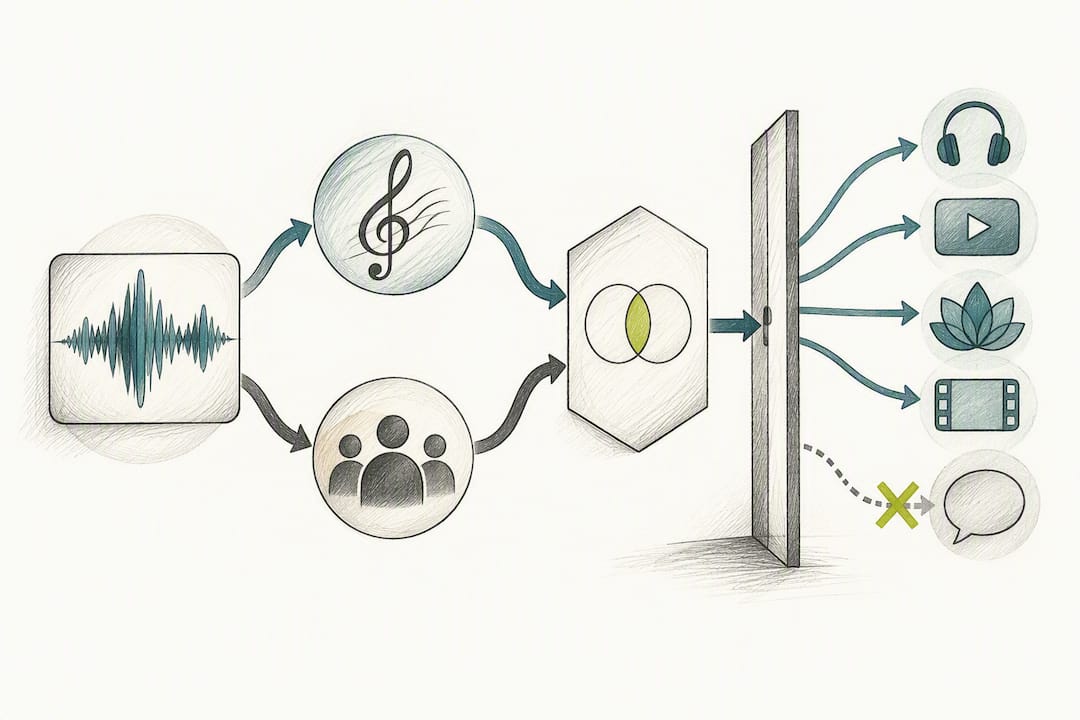
Four licence types cover most meditation music use-cases, and it helps enormously to know which one you’re dealing with before you email anyone.
- PRS for Music collects on behalf of composers and publishers for the public performance and broadcast of the composition itself. If you’re playing music where the public can hear it, PRS is usually part of the equation.
- PPL and TheMusicLicence work as a joint product covering the recording side of public and business playback. Tariffs vary by premises type and size, and sector pricing guidance suggests many small studios sit within a modest, predictable tariff band once they contact PRS and PPL directly for a quote, rather than guessing.
- Sync licences are needed whenever you’re pairing music with moving images, whether that’s a YouTube guided meditation, a course video, or an advert. The composer or publisher typically issues this.
- Master licences grant permission to use the actual recording alongside that sync clearance. Miss this one and you can have a perfectly legal composition licence while still infringing the recording.
A studio running paid classes with background music needs TheMusicLicence. A YouTube channel monetising guided meditations needs both sync and master clearance before publishing, not after. A podcast intro built from a “free download” needs the same scrutiny, because free-to-stream is not the same as free-to-broadcast.
Common scenarios and the correct route to legal use
Match your situation to one of these, because the paperwork genuinely differs.
- Paid class or treatment room. You need a public-performance licence (TheMusicLicence) unless the catalogue you’re using is explicitly cleared for public performance and comes with a certificate saying so.
- YouTube and monetised video. Secure sync and master licences before you publish. Skip this step and expect an automated Content ID claim, which can mute your audio, redirect your revenue, or take the video down entirely.
- Paid courses and apps. You’ll need sync and master licences that name your specific territory and distribution channel, and you should check whether the licence is perpetual or time-limited before you build a whole course around one track.
- Free demos and listening samples. Being free to stream does not mean cleared for commercial use. Read the terms every single time, even for a track you’ve used before.
- Third-party playlists in a business setting. A personal Spotify or Apple Music subscription is licensed for private, non-commercial listening. Playing it in your studio or embedding it in your product breaches those terms regardless of how quiet the volume is.
What ‘royalty-free’ actually means (and the red flags to watch)
“Royalty-free” is one of the most misunderstood phrases in music licensing, and meditation creators fall for the misunderstanding constantly. It typically means you pay once rather than a royalty per play, not that every possible restriction disappears. Public-performance rights, sync permissions, and territory limits can still apply on top of a royalty-free label.
Watch for these red flags before you commit:
- No licence certificate offered, only a download link.
- Language written for consumer listening rather than commercial use.
- No stated territory or duration.
- No named rights-holder you could actually contact if a question arose.
A genuine commercial-use licence should give you a signed certificate, explicit wording on public performance and sync rights where relevant, a territory covering the UK (or worldwide), and ideally an indemnity clause protecting you if the seller’s own claim to the rights turns out to be wrong.
Pro Tip: If a licence document doesn’t name a specific person or company you could sue if things went wrong, that’s usually a sign it wasn’t drafted properly in the first place.
How to clear rights step by step
Clearing rights isn’t glamorous, but it’s a short, repeatable process once you’ve done it twice.
- Map your uses. List every right you actually need: composition, master, public performance, sync, or some combination.
- Contact the credited composer or producer directly. Ask them to confirm ownership and provide a written licence or certificate rather than a verbal assurance.
- Ask the right questions. “Who owns the composition and the master recording?” “Is the track registered with PRS or PPL?” “Does this licence cover UK public performance and sync rights?” “What territory and duration does this cover?”
- Get it in writing. A licence naming your permitted uses, kept alongside proof of payment, is your defence if anyone ever queries your right to use the track.
- Build it into commissions from day one. If you’re paying someone to compose original meditation music, the contract should assign or licence the rights you need explicitly, not leave it implied.
| Step | What you’re securing | Who to ask |
|---|---|---|
| Map uses | Clarity on which rights apply | Yourself, before contacting anyone |
| Confirm ownership | Proof the seller can actually licence the track | Composer, producer, or publisher |
| Request certificate | Written licence naming uses, territory, duration | Rights-holder or licensing platform |
| Store documentation | Evidence if ownership is ever disputed | Your own records |
Client E-E-A-T: how Orchestral Meditations and credited composers fit this workflow
A reputable meditation-music catalogue makes this entire process faster, because the hard part of rights clearance is usually finding out who actually owns the track. Orchestral Meditations records with live musicians and supplies composer and producer credits alongside its licensing options, which removes a lot of the guesswork that trips up smaller catalogues.
Named credits matter more than most creators realise. When a track carries a producer credit for someone like Robert Emery, whose conducting and production work spans major orchestral recordings and large-scale live performances broadcast internationally, or Moritz Schneider, known for composing and producing immersive orchestral and frequency-based work, you have an identifiable person to contact if a licensing question ever arises. That provenance is exactly what a licence-seeker needs.
A reliable supplier should hand over:
- A signed licence naming permitted uses and territory.
- Composer and producer credits.
- Studio or session notes confirming where and how the recording was made.
- Proof of ownership or a clear assignment of rights.
When a track’s paperwork already answers “who owns this and what am I allowed to do with it,” clearance stops being a legal research project and becomes a five-minute formality.
A practitioner’s note on cheap music versus proper clearance
Free meditation tracks are everywhere, and the temptation to grab one for a course or a class is completely understandable when you’re running a small wellness business on a tight margin. But the maths rarely works in your favour once you account for the risk. A Content ID strike on a monetised YouTube channel, or a cease-and-desist letter over background music in a paid studio class, costs far more in time, stress, and lost income than a properly licensed track ever would.
If your content generates revenue or touches paying clients in any way, budget for clearance the same way you’d budget for insurance. It’s not exciting, and it doesn’t show up in a highlight reel, but it’s the difference between building something sustainable and building something one complaint away from disappearing.
— ROBERT
Where to find rights-cleared meditation music for UK use
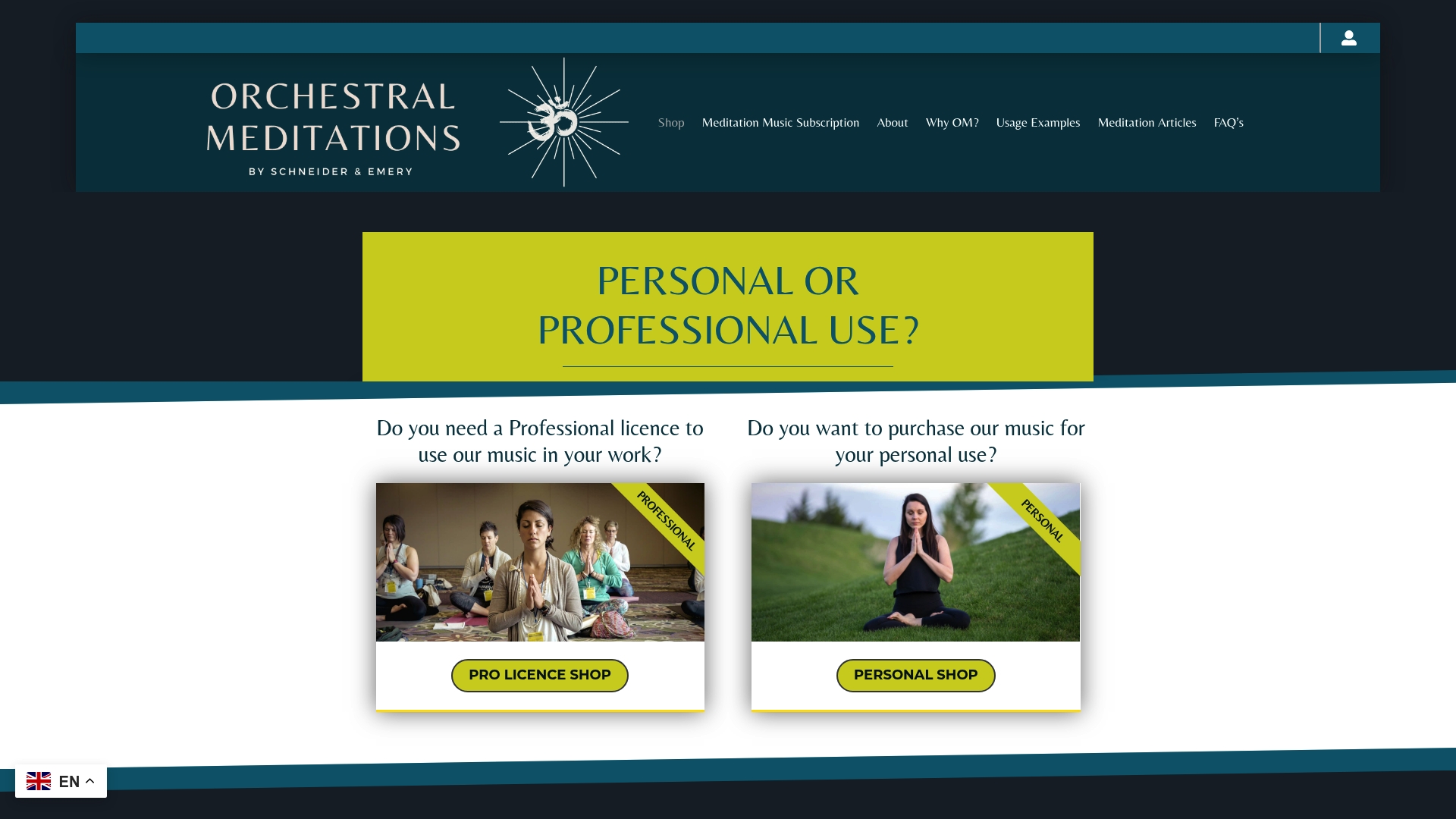
Orchestral Meditations offers exactly the kind of documented, credited catalogue this whole clearance process depends on. The Personal subscription suits individual practice and non-commercial listening, while the Professional subscription is built for practitioners, therapists, yoga teachers, and app developers who need licensing that actually covers commercial and professional use.
Before you buy anything from any provider, check two things on the product page: the licence scope (does it name public performance, sync, or app embedding specifically?) and whether a certificate is available on request. For tracks you plan to use across classes, videos, or a paid app, the Royalty Free Meditation Music range lays out licensing details for professional purchasers so you’re not left guessing after the fact. If you’re building a business around meditation content, that documentation is worth checking before you commit to a single track.
Sources
This article is general information, not a substitute for advice from a qualified lawyer. Consult a qualified legal professional about your own circumstances before acting on anything here.
FAQ
What music is out of copyright in the UK?
A musical composition falls out of copyright once 70 years have passed since the composer’s death, at which point the underlying composition enters the public domain. The specific recording of that piece can still be protected separately for 70 years from first publication, so a public-domain melody performed on a recent recording isn’t automatically free to use.
Is there a copyright law for music in the UK?
Yes, UK copyright law is set out in primary legislation and supporting statutory instruments, which define how composition rights, recording rights, and performers’ rights are created and enforced. These laws apply automatically the moment an original work is created, with no registration required.
How many seconds of music can I use without copyright?
There is no fixed number of seconds that automatically avoids infringement in UK law; that idea is a myth that circulates widely online. Even a short clip can require a licence if it’s recognisable and used without permission, so the safer approach is always to clear the rights rather than guess at a “safe” duration.
What is the 2039 rule in UK copyright law?
There isn’t a standard rule recognised in UK copyright legislation with that name, and definitions of similar phrases vary widely depending on context. If you’ve seen such a term referenced for a specific work, it likely relates to a particular contractual or licensing arrangement rather than a general statutory rule, so check the primary source before relying on it.
Do I need a licence to play meditation music in my studio?
If your studio hosts paid classes or is a business premises, you generally need TheMusicLicence from PRS and PPL to cover public performance and playback of recordings. Some rights-cleared catalogues supply a certificate covering their own tracks for public performance, but playing music from other sources in the same space still typically triggers the standard licensing requirement.