Start with trauma-informed orchestral meditations for grounding, binaural or theta tracks for winding down before sleep, and treat any of it as a companion to therapy rather than a replacement. Go gently, notice how your body responds, and bring a therapist into the conversation if symptoms sit at the moderate to severe end. Orchestral Meditations, with recordings from composer and producer Robert Emery and theta specialist Moritz Schneider, is one place to find this kind of trauma-sensitive, professionally recorded music.
TL;DR:
- Use live orchestral recordings made at reputable studios because their predictable, human-played sound reduces unexpected sonic surprises that could worsen overreactive states.
- Opt for theta-range compositions, especially for hypervigilance, insomnia, or sleep support, and employ gentle, consistent volume during sessions.
- Incorporate guided meditations with calm voices for processing intrusive memories and unguided orchestral tracks for grounding during daily routines.
- Build personalized playlists gradually, monitoring your body’s responses each week, and involve your therapist to tailor music use to your trauma profile.
- Choose trauma-sensitive music from sources with proven provenance, such as Abbey Road recordings, and avoid tracks with unverified marketing claims or sudden dynamic shifts.
Types of PTSD meditation music and when to use each one
Not all calming music does the same job, which matters enormously once you’re dealing with a nervous system that’s easily tipped into overdrive. PTSD meditation music generally falls into a few camps, and knowing which is which saves you from picking the wrong tool for the moment.
Binaural beats play two slightly different frequencies in each ear, and your brain perceives a third “beat” between them. People use these for focus or sleep, though the evidence base is thinner than for orchestral or therapist-led approaches, so treat them as an experiment rather than a guarantee.
Solfeggio and frequency-based music is marketed heavily on streaming platforms and YouTube for “trauma healing,” often with bold claims attached. Much of it isn’t clinician-vetted, and tracks like these circulate widely on consumer platforms without any oversight, so treat marketing language sceptically and favour tracks with real provenance.
Theta and orchestral meditations sit in the 4 to 8 Hz theta range, associated with the drowsy space between wakefulness and sleep. Moritz Schneider, who composes in this territory, describes theta music as built specifically to support that in-between state, using live instrumentation rather than looped generative sound.
Guided versus unguided is the final fork. Guided tracks work well for beginners or for processing intrusive memories, since a voice gives you an anchor. Unguided orchestral pieces suit grounding work or background calm during daily tasks.
Quick matching guide:
- Hypervigilance or racing thoughts: slow orchestral or theta pieces, played quietly through speakers rather than headphones
- Insomnia: theta-range tracks in a consistent bedtime routine, low volume, no sudden dynamic shifts
- Intrusive memories: guided meditation with a calm, present voice to interrupt the spiral
- General grounding: live orchestral recordings with predictable, non-jarring instrumentation
Pro Tip: Build a personalised playlist gradually. Add one new track a week and note how your body reacts before adding the next, rather than loading up twenty unfamiliar pieces and hoping for the best.
What does the research say about music and PTSD?
A 2017 theoretical review of music therapy for posttraumatic stress in adults concluded that music therapy may usefully reduce PTSD symptoms and improve day-to-day functioning. That’s a real, peer-reviewed signal, not marketing copy.
The same review flags real limits. Studies in this field vary hugely in the interventions tested, the populations studied, and the outcome measures used, and many trials are small. That heterogeneity means music therapy sits firmly in the “promising complementary tool” category rather than a stand-alone cure, and the review’s authors treat it that way themselves.
PTSD UK, the charity offering guidance in this space, states plainly that music can help people relax, meditate, and sleep more easily. Crucially, they add that trained music therapists can structure interventions around individual needs, which is a different thing from pressing play on a random playlist and hoping.
For readers who want to go deeper than any single review, PubMed’s psychomusicology literature is active and growing, covering how music affects emotion regulation and brain states more broadly.
What this means in practice:
- Music therapy is a complementary approach, best used alongside established PTSD treatments, not instead of them
- Small trial sizes mean individual results vary considerably from person to person
- A trained music therapist can tailor pacing, instrumentation, and session length to your specific trauma profile
- General relaxation music and clinically structured music therapy are not interchangeable, even when they sound similar
How to use meditation music safely for trauma recovery
Trauma-sensitive listening isn’t complicated, but it does reward a bit of structure. Here’s a workable approach:
- Start with a two-minute grounding check. Before you press play, notice your breathing and where tension sits in your body. This baseline helps you spot changes once the music starts.
- Run a 15 to 25 minute session. That’s long enough to settle into a theta or orchestral piece without your attention wandering into distraction or discomfort.
- Keep volume low, especially with binaural beats. These rely on precise frequency differences between ears, so headphones need to sit comfortably and never blast. Loud, prolonged headphone use can itself become a stressor.
- For sleep sessions, fade rather than stop abruptly. A track that ends suddenly can jolt you awake; choose recordings designed to taper.
- Watch for red flags. Increased panic, intrusive imagery, or a sense of dissociation mid-session are signals to stop immediately, ground yourself with slow breathing or naming objects in the room, and reach out to a therapist if the reaction repeats.
- Share your playlist with your therapist. If you’re already in treatment, bring specific tracks to a session and talk through what worked and what didn’t. This turns your listening into useful clinical data rather than a private guessing game.
Pro Tip: Keep a one-line note after each session, just “calmer” or “restless,” so patterns emerge over a few weeks instead of relying on memory alone.
Why the recording quality behind the music matters
Orchestral Meditations builds its library around large-scale recordings made at Abbey Road Studios, using live musicians rather than synthesised loops. Robert Emery, the conductor, composer, and producer behind much of this work, has recorded meditation productions at Abbey Road involving more than 128 musicians and singers), a scale that’s unusual in the wellness-music space and closer to what you’d expect from a film score session.
That matters for trauma-sensitive listening because live orchestral recordings tend to behave predictably. There are no jarring algorithmic transitions or generative surprises, just carefully mixed, human-played sound designed to hold a mood without lurching.
Moritz Schneider, who composes specifically in the theta range, describes his approach as crafting music for the space between wakefulness and sleep, favouring live instrumentation over loops precisely so the listening experience stays consistent from one session to the next.
- Live orchestral timbre reduces unexpected sonic surprises that could jolt a hypervigilant nervous system
- Recordings made at a known studio with named musicians offer a level of provenance most royalty-free libraries don’t disclose
- Industry coverage of Emery’s Abbey Road projects documents the scale and seriousness of the production process
If you’re weighing up trauma-informed yoga music or meditation soundtracks generally, provenance like this is worth checking before you commit to a library.
Choosing music for your specific trauma profile
There’s no single track that works for everyone, because PTSD itself doesn’t present the same way twice. Someone dealing with combat-related hypervigilance needs something different from someone processing a single traumatic event or complex, prolonged childhood trauma.
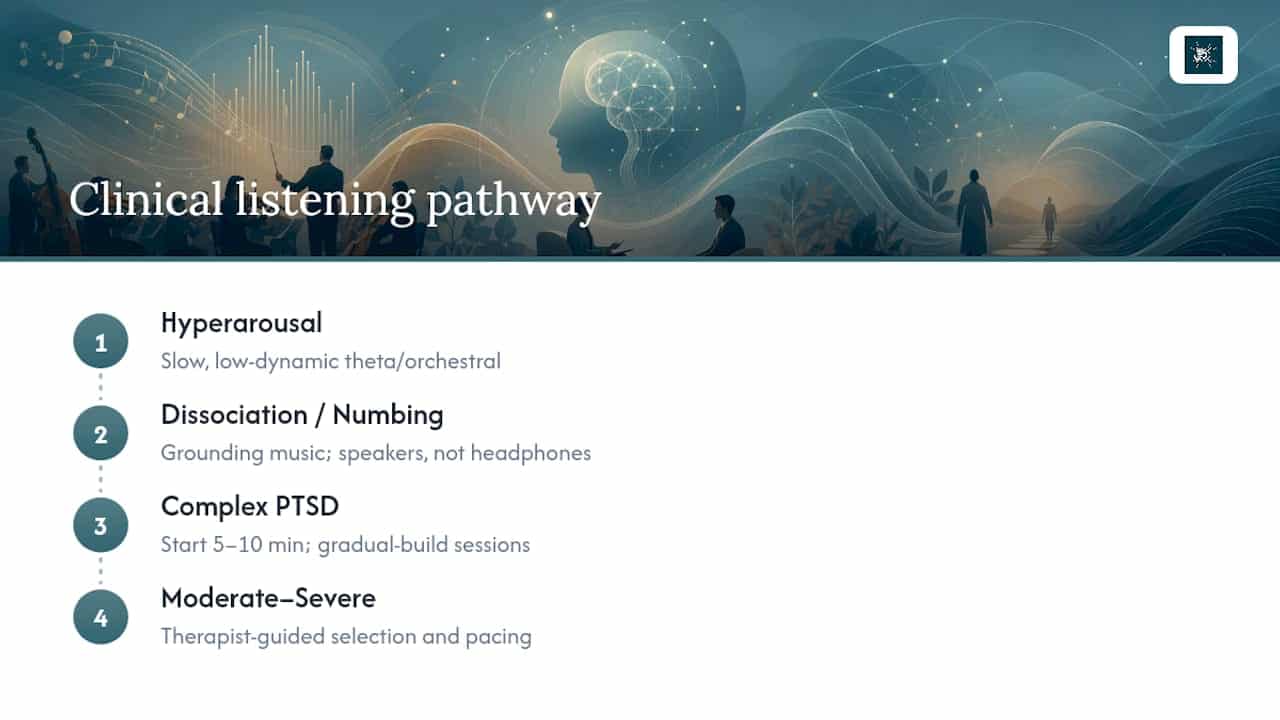
If your symptoms lean towards hyperarousal, jumpiness, a racing heart, sleep that won’t come, slower orchestral pieces with minimal dynamic range tend to work better than anything with sudden swells or percussion. Theta-range compositions fit naturally here, since they’re built to ease you towards a drowsy, settled state rather than stimulate.
If your trauma profile involves dissociation or numbing, be more cautious with anything designed to induce altered states, including binaural beats. Grounding-focused orchestral music, played at moderate volume through speakers rather than headphones, keeps you anchored in the room rather than floating away from it.
For complex PTSD, where symptoms often include shame, emotional flooding, and difficulty trusting safety, shorter sessions with a gradual build tend to be more tolerable than long immersive pieces. Five to ten minutes to start, extending only once you know how your body responds.
Severity matters too. Mild, situational symptoms often respond well to self-directed listening. Moderate to severe presentations, particularly with flashbacks or dissociation, benefit from a therapist helping select and pace the music, rather than trial and error alone.
Fitting meditation music around CBT and EMDR
Music doesn’t compete with structured trauma therapies, it sits alongside them. If you’re doing CBT, meditation music can support the relaxation and exposure components between sessions, giving you a consistent, low-stakes way to practise the calm-body-first approach that CBT often teaches.
For EMDR, timing matters more. EMDR sessions typically involve bilateral stimulation and processing that needs a clear, undistracted headspace, so most practitioners wouldn’t recommend layering music during the processing phase itself. Where meditation music fits naturally is before and after, use a grounding orchestral track to settle before a session, and a gentle piece afterwards to help regulate before you re-enter your day.
Always mention your music practice to whoever’s running your therapy. A CBT therapist or EMDR-trained clinician can tell you whether a particular listening habit is reinforcing the work or accidentally creating an avoidance pattern, something you can’t always judge from the inside. This is exactly the kind of tailoring PTSD UK highlights when it talks about trained therapists structuring interventions around individual needs rather than generic playlists.
Combining music with breathing and mindfulness for PTSD
Music on its own helps. Music paired with a breathing technique tends to help more, because it gives your attention somewhere specific to land instead of drifting towards trauma-related thoughts.
A simple pairing: box breathing (four counts in, four held, four out, four held) layered under a slow orchestral piece. The steady musical pulse gives your breath count something external to sync with, which is often easier than counting in silence.
For grounding, try the classic five-senses technique while a calming track plays quietly in the background, naming what you can see, hear, touch, smell, and taste. The music provides a stable backdrop rather than the main focus, useful when intrusive thoughts are loud and you need your attention split across multiple anchors rather than one.
Body scans work well with longer, unguided theta pieces, since there’s no voice competing with your internal attention as you move awareness from head to toe. Keep sessions short at first, five minutes is plenty, and extend only as it feels tolerable.
Music helps, but it isn’t the whole answer
Music can genuinely shift how your body holds tension, and the research backing that is real, if still developing. What worries me is how often “calming music for trauma” gets marketed as a fix rather than a support, especially on platforms where nobody involved has clinical training.
Use it to widen what already works for you. Bring it into sessions with your therapist rather than around them. And if a track ever leaves you shakier than before you pressed play, that’s information, not failure, so tell someone and adjust.
— ROBERT
Finding the right Orchestral Meditations subscription for your practice
If you’ve read this far, you already know that not all meditation music is built the same, and that’s exactly the gap Orchestral Meditations was built to close. Rather than generic royalty-free loops, the library draws on live orchestral recordings and named composers, so what you hear has real provenance behind it, not just a marketing label.
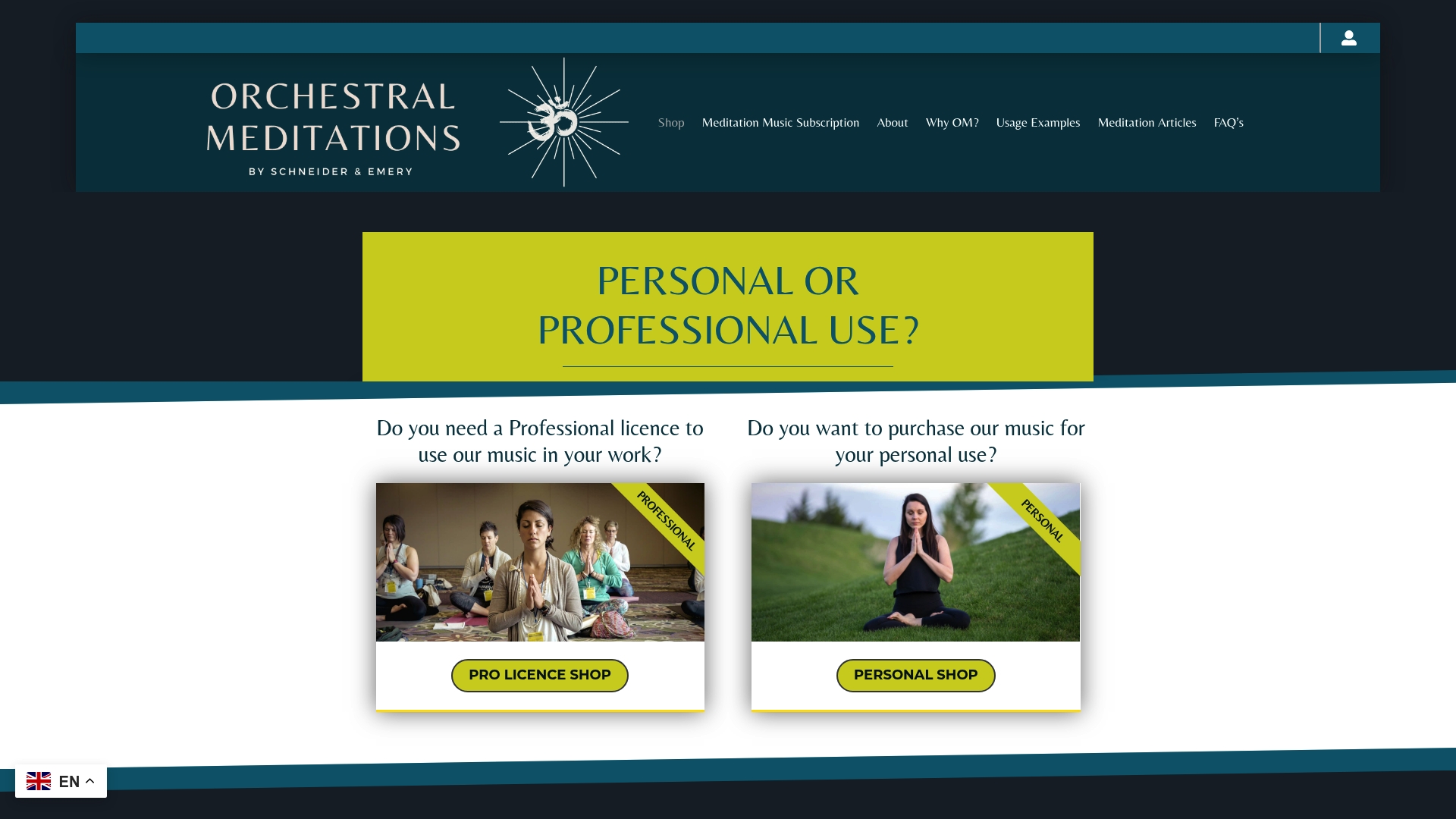
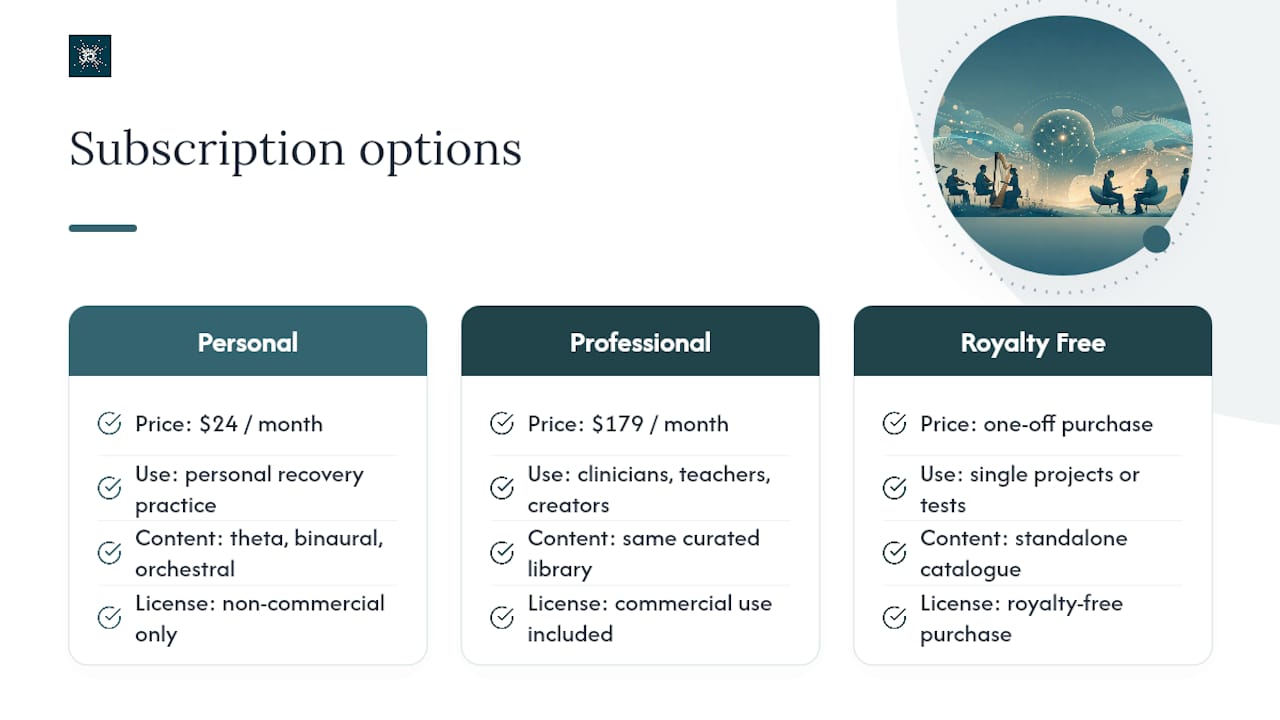
For personal recovery use, the Personal subscription at €21 per month gives you ongoing access to the curated theta, binaural, and orchestral library, ideal if you’re building a regular self-practice around the session structure covered above. If you’re a therapist, yoga instructor, or content creator who needs to use tracks commercially, whether in client sessions, an app, or guided audio you produce yourself, the Professional subscription at €150 per month covers that licensing. For a one-off purchase instead of an ongoing subscription, the Royalty Free Meditation Music catalogue is worth a browse.
Trial a handful of tracks first, notice what settles you and what doesn’t, and loop your therapist in in if you’re managing moderate to severe symptoms. Start with a short session tonight and see how your body responds.
This article is general information, not a substitute for advice from a qualified doctor. Consult a qualified healthcare professional about your own circumstances before acting on anything here.
Sources
- Music therapy for posttraumatic stress in adults: a theoretical review
- Music Therapy for PTSD — PTSD UK
FAQ
What is the best meditation for PTSD?
There’s no single “best” meditation, but trauma-informed approaches combining grounding techniques with slow, predictable orchestral or theta music tend to work well for hyperarousal and sleep difficulties. PTSD UK notes that music helps people relax and sleep more easily, though a therapist can tailor the approach to your specific symptoms.
What are the stages of complex PTSD recovery?
Complex PTSD recovery generally moves through establishing safety and stability, processing traumatic memories, and reconnecting with everyday life and relationships, though the pace and order varies enormously between individuals. Meditation music tends to be most useful in the safety and stability stage, offering a low-risk way to practise self-regulation before deeper processing work begins.
What kind of music can help calm PTSD symptoms?
Slow, live-instrumented orchestral pieces and theta-range compositions, roughly 4 to 8 Hz, are commonly used for calming and sleep support, according to composer Moritz Schneider’s work in this area. Guided meditation with a calm voice can help specifically with intrusive memories, while unguided orchestral tracks suit general grounding.
What are some common triggers for PTSD?
Common triggers include sounds, smells, or situations that resemble the original traumatic event, along with anniversaries, certain places, or even specific types of physical sensation. If a piece of meditation music triggers a strong reaction rather than calm, that’s a signal to stop, ground yourself, and mention it to a therapist rather than pushing through.
Does Orchestral Meditations offer music suitable for PTSD recovery?
Yes, Orchestral Meditations produces trauma-sensitive orchestral and theta recordings made with live musicians, including work from composer and producer Robert Emery and theta specialist Moritz Schneider. Personal use starts through the Personal subscription at €21 per month, while therapists and practitioners can access commercial licensing via the Professional subscription.