
Yes, you can buy a proper licence for this. Orchestral Meditations sells a royalty-free commercial licence that lets UK yoga teachers play its orchestral meditation tracks in classes, workshops and recorded sessions. The recordings come from sessions at Abbey Road Studios with the National Philharmonic, produced by Robert Emery and composed by Moritz Schneider. In practice, that means in-class playback and, where the licence terms allow it, inclusion in your own guided recordings.
TL;DR:
- A professional yoga music license from Orchestral Meditations covers in-class playback and inclusion in recorded sessions but does not permit reselling or sharing audio files without specific tier approval.
- The Pro bundle is suitable for regular classes and commercial use, offering a one-time fee with no ongoing charges, whereas subscriptions grant ongoing access to a growing library for a recurring cost.
- When using binaural tracks, headphones are essential to preserve the intended effects, as room speakers can cancel out subtle phase differences.
- Licensing terms are typically not restricted by country, but teachers should verify their specific license scope when streaming internationally or selling courses abroad.
- It is important to keep original invoices and licensing documents, as changing or cancelling a license depends on the purchase type and requires reviewing the specific terms.
What does a yoga class music license actually cover?
A yoga class music license, in the sense that matters to you, is a permission slip from the music’s owner rather than a public-performance formality. It tells you exactly what you can do with a specific track once you have paid for it, and Orchestral Meditations spells this out at the point of purchase rather than burying it in small print you need a solicitor to translate.
Here is what a professional licence from Orchestral Meditations typically permits and where teachers tend to trip up:
- Live playback in classes: you can play the track during studio sessions, retreats, or one-to-one work without asking permission each time.
- Inclusion in your own recordings: many licences allow the track to sit underneath a guided meditation you record and sell or distribute to students, provided the specific licence tier covers that use.
- Royalty-free means no ongoing usage fee: once bought, you are not charged again every time you press play, which is the whole point of the Pro licence bundle.
What it does not cover, unless you have specifically bought the tier that allows it, is reselling the raw audio file itself, bundling it wholesale into a third-party app, or redistributing it to other instructors as if it were yours to share. A personal licence, bought for your own practice, is a different product entirely from a professional one, and mixing the two up is the single most common licensing mistake teachers make.
How much does a yoga music licence cost?
Orchestral Meditations packages its licences around how often and how widely you plan to use the music, rather than charging one flat number for everyone.
A single-track licence suits a teacher who has found one perfect piece for savasana and wants it cleared for that specific use. It is the cheapest entry point, but it locks you to that one recording, so if your sequencing changes week to week you will find yourself buying again.
The Pro bundle is built for teachers running regular classes, selling recorded products, or working across multiple instructors under one studio banner. Shop copy is explicit that this tier is royalty-free for commercial use, and that Orchestral Meditations does not charge additional fees or require further permission once you have bought it, a detail worth confirming with the Pro licence page before you commit.
A subscription suits studios that rotate music often and want ongoing access to a growing library rather than repeat one-off purchases. It costs more over a year than a single bundle but removes the need to keep buying track by track.
- Single track: lowest upfront cost, narrowest use.
- Pro bundle: one-off cost, no ongoing usage fees, ideal for regular commercial use.
- Subscription: recurring cost, broadest and most flexible access.
How do I buy and set up licensed tracks for class?
Buying the licence is the easy part. Getting the files working properly in your studio is where a bit of planning pays off.
- Visit the shop landing page and browse by track, collection, or licence type rather than starting from a search bar, since the Orchestral Meditations shop groups tracks by intended use.
- Choose your licence tier at checkout, single track, Pro bundle, or subscription, matching it to how often you actually teach.
- Complete checkout and you will receive digital files (typically WAV for quality, MP3 for convenience) along with a licence invoice.
- Set up playback according to the file type: standard stereo mixes work fine through room speakers, but binaural tracks need headphones to deliver their intended effect properly.
- Keep the invoice as your proof of purchase and licence terms, both for your own records and for any VAT paperwork your accountant needs at year end.
Pro Tip: Before you play a binaural track through studio speakers, check the file description. A true binaural mix relies on subtle left/right phase differences that only register correctly through headphones, so playing it in a room can quietly cancel out the exact effect you paid for.
What does the science say about binaural beats in class?
Some of the tracks in the Orchestral Meditations library layer binaural beats and theta frequencies underneath the orchestral recording, and there is genuine research behind why that combination shows up so often in meditation music.
A PLOS One study found that brief, self-administered 6 Hz binaural-beat exposures increased calmness and focus across two separate trials, and participants generally preferred the beats when they were embedded in pink noise rather than played in isolation. Separately, a Frontiers in Neuroscience study recorded theta brainwave activity resembling a meditative state within ten minutes of exposure to a 6 Hz binaural beat on a 250 Hz carrier tone, using QEEG measurements.
For your class, that translates to a few practical points:
- Short segments work: a few minutes of theta content at the start or end of class is enough to draw on the calming effect, without needing a 40-minute binaural soundscape.
- Headphones matter for binaural files specifically; room speakers are fine for standard stereo mixes.
- Layering theta content in a warmer soundscape, rather than isolated tones, tends to land better with a group.
The research signal: theta-range binaural beats have shown measurable calming effects in controlled studies within roughly 10 minutes of exposure, which is well within a typical savasana window.
How should I cue and sequence tracks in a class?
Where you place a track in your sequence matters almost as much as which track you choose.
- Warm-up (5 to 10 minutes): a lighter orchestral piece, low volume, mostly there to settle the room rather than dominate it.
- Guided relaxation or pranayama (10 to 15 minutes): this is where theta or binaural tracks earn their keep, assuming you have headphone playback available or a room-friendly stereo mix if you do not.
- Savasana (5 to 10 minutes): fade in gently over the first thirty seconds and fade out well before you speak again, so the silence itself becomes part of the cue to return.
A simple script helps: “As the music settles, let your breath settle with it,” said quietly as the track fades in, then “Start to notice sound in the room again,” as it fades out, gives students a bridge back rather than a jolt. Keep volume low enough that your voice never has to compete with it, and for mixed-ability or hearing-sensitive groups, always offer a verbal heads-up before anything with a strong bass or binaural element begins.
Do I need extra permission to play licensed music publicly?
A yoga class is generally treated as a business activity rather than a purely private one, which is why using properly licensed, royalty-free tracks matters more than many teachers realise. When you buy a professional licence from Orchestral Meditations, the point of that purchase is to clear the specific permission you need directly with the rights holder, meaning you are not relying on a separate blanket scheme to cover that particular recording.
Shop terms for the Pro licence state plainly that once you hold the licence, Orchestral Meditations does not charge additional fees and you do not need further permission from them to use the tracks in your professional setting. That clarity is precisely why buying a dedicated commercial licence, rather than assuming a personal-use track is fine for class, protects you.
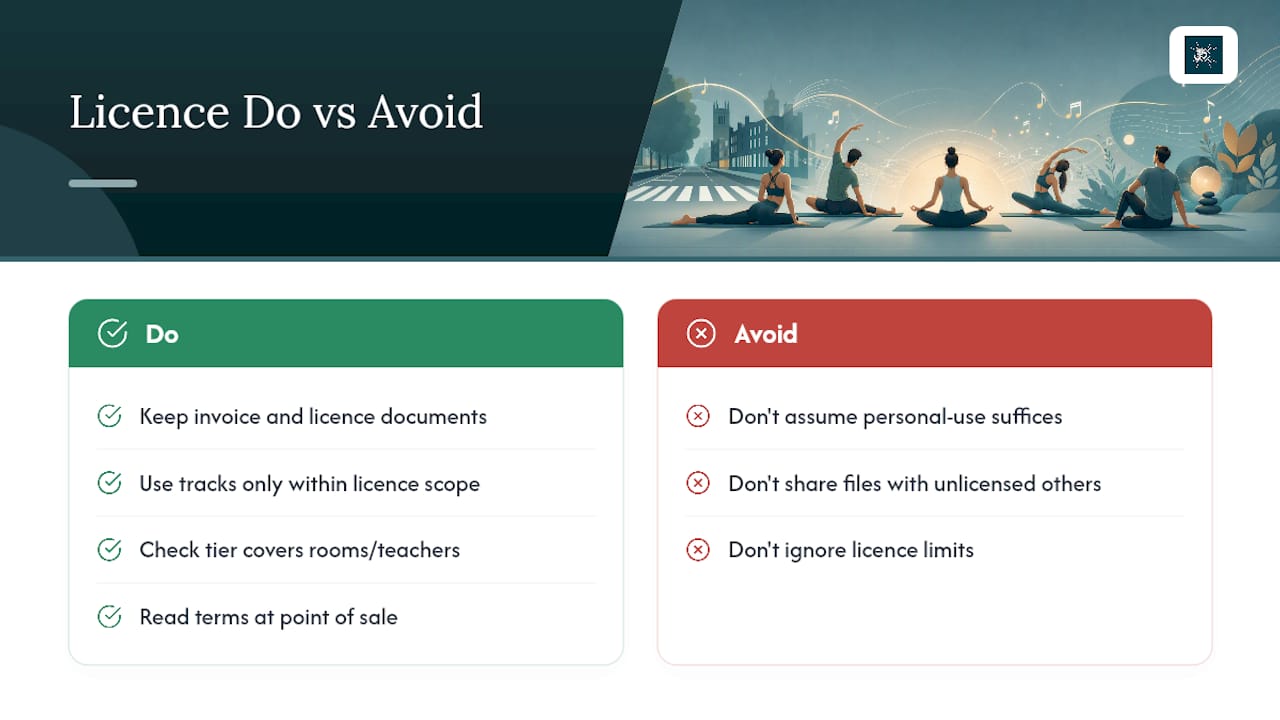
Your obligations as the licence holder are straightforward but worth taking seriously: keep your invoice and licence documentation on file, use the track only within the scope the licence describes (in-class playback, or inclusion in recordings if your tier permits it), and avoid passing the file to other instructors or venues who have not bought their own licence. If your studio runs classes across multiple rooms or multiple teachers simultaneously, check whether your licence tier covers that scale or whether each instructor needs their own.
None of this requires a legal background to get right. It requires reading the specific terms attached to the tier you bought, which Orchestral Meditations sets out at the point of sale rather than leaving to assumption.
Does the licence cover use outside the UK?
Orchestral Meditations licenses are sold and used internationally, and the licence terms themselves are not typically restricted to a single country’s borders in the way a broadcast rights deal might be.
For a UK-based teacher, this matters in two practical scenarios. First, if you teach retreats abroad, or run online classes streamed to students outside the UK, a licence bought through the Orchestral Meditations shop generally travels with the use rather than the location, though you should always check the specific wording on your invoice for that track. Second, if you are building a course or app intended for international sale, confirm whether your licence tier explicitly covers distribution beyond your home market, since a single-track licence bought for one studio’s in-person classes is a narrower product than a Pro bundle intended for wider commercial distribution.
The safest approach is simple: read the licence text attached to your specific purchase rather than assuming a general royalty-free label means unlimited global rights for every possible use. If your teaching genuinely spans multiple countries or platforms, it is worth contacting Orchestral Meditations directly before you scale up, just to confirm your tier matches your actual footprint. That five-minute email is cheaper than a licensing dispute later.
Are there limits on class size or attendee numbers?
Most teachers assume a music licence must scale with headcount, the way a room hire fee might, but that is not typically how a royalty-free professional licence works.
A Pro-tier licence from Orchestral Meditations is generally structured around your right to use the track commercially, not metered by how many students are in the room on a given Tuesday evening. That is a meaningful difference from some public-performance schemes, which do factor in audience size and venue capacity. Buying the Pro bundle rather than a personal-use track is precisely what lets you play the same piece to a class of eight or a workshop of eighty without needing a separate calculation each time.
Where size genuinely does matter is at the level of instructors and locations, not attendees. If your studio has five teachers each running their own timetable, or you operate across three separate venues, that is the point at which you should check whether your existing licence tier covers that spread or whether it was designed around a single teacher, single-location use case. This is different from asking “how many yoga mats can I have in the room,” and conflating the two is an easy mistake.
If you are ever unsure whether your growing studio has outgrown the scope of the licence you originally bought, the sensible move is the same as with territorial questions: check the licence text on your invoice, and if it is ambiguous for your setup, ask before you assume.
How long does the licence last, and does it renew automatically?
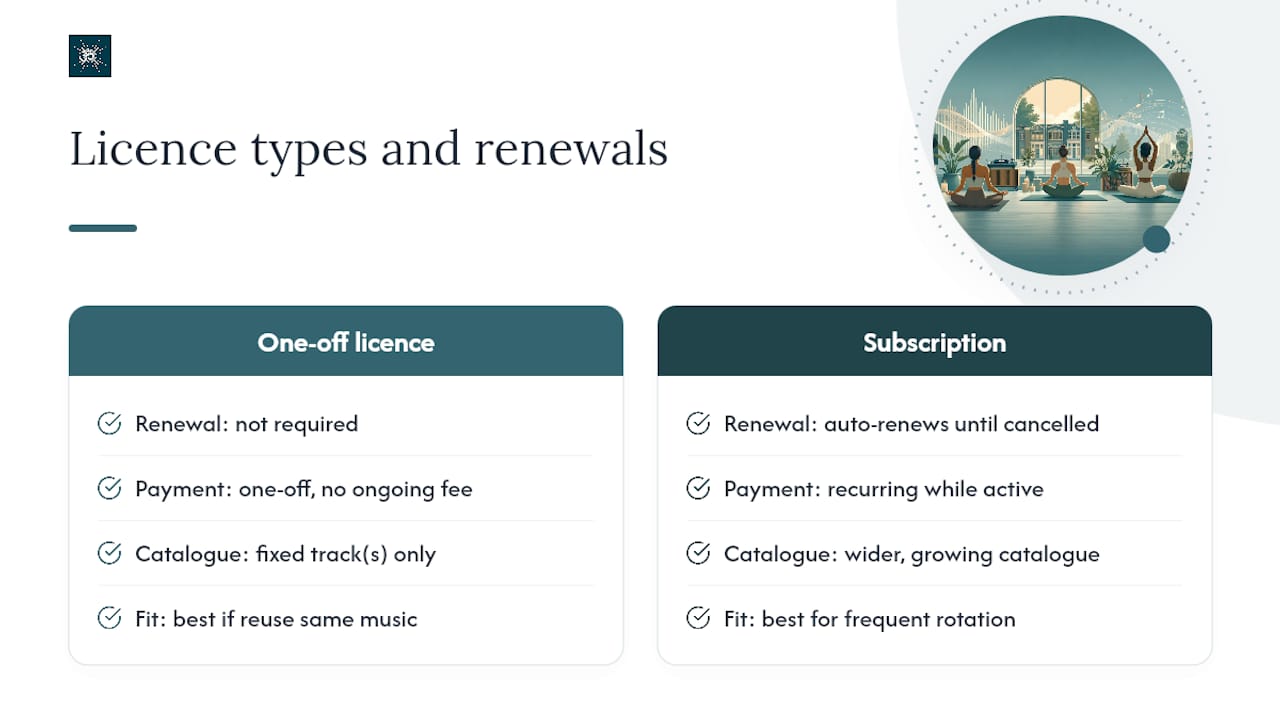
A one-off Pro licence purchase from Orchestral Meditations is designed to cover your use of that track going forward, rather than expiring after a fixed number of months the way some stock-music subscriptions do. That is one of the clearer advantages of buying the bundle outright: you are not on a clock.
The subscription option works differently by design. It is a recurring arrangement, giving you ongoing access to a wider and growing catalogue for as long as you keep paying, and like most subscriptions it will typically renew automatically until you cancel it. That trade-off, is worth weighing honestly against your teaching pattern: if you rotate music constantly across a large class timetable, the subscription’s breadth may suit you better than repeatedly buying single bundles.
For a single-track licence, the same logic as the Pro bundle generally applies. Once bought and paid for, the licence document confirms your rights to that recording, and there is no separate renewal fee attached to that specific transaction.
The practical takeaway is to know which product you actually hold. A one-off Pro or single-track purchase does not need renewing. A subscription does, automatically, and it is worth marking that renewal date in your own diary rather than being surprised by it, especially if your teaching load changes and you decide the recurring cost no longer makes sense.
Can I cancel or change my licence, and how?
Cancelling or amending a licence depends entirely on which product you bought, so the first step is always identifying whether you hold a one-off purchase or a subscription.
For a one-off Pro bundle or single-track licence, there is nothing to actively cancel, since there is no recurring charge attached to the transaction in the first place. If your teaching needs change and you require a different licence tier (moving from a single track to the Pro bundle, for example), the straightforward route is simply to purchase the new tier that matches your current use, rather than trying to modify the original invoice.
For a subscription, cancellation typically follows the standard process for any recurring digital purchase: you manage or cancel it through your account on the Orchestral Meditations site, and the cancellation takes effect at the end of your current billing period rather than instantly, which is standard practice across most subscription services. Keep an eye on your renewal date if you are planning to stop, since cancelling a few days after a renewal charge has already gone through will not usually trigger a refund for that period.
If you are ever uncertain which category your purchase falls into, or you need to change licence details for a growing studio, the most reliable move is to check your original invoice or account dashboard first. It will tell you exactly what you bought and when it was billed, which resolves most confusion faster than guessing.
Who do I contact with licence or usage questions?
If a question comes up that the licence text on your invoice does not answer, the surest source is Orchestral Meditations directly rather than a forum thread or a well-meaning colleague’s guess.
Teachers most often need support in a handful of predictable situations: confirming whether a specific track’s licence covers a new use (say, adding it to a recorded course rather than just live classes), clarifying whether a growing studio’s multi-instructor setup needs an upgraded tier, or resolving a billing question on a subscription renewal. All of these are far easier to sort out before you scale a use than after a dispute arises.
Every purchase comes with a licence invoice, and that document is your first reference point since it states the specific terms attached to your transaction. Beyond that, Orchestral Meditations can be reached through the contact channels listed on its site for anything the invoice does not cover, whether that is a licensing edge case, a technical file issue, or a billing query on a subscription.
Keep your invoices somewhere you can actually find them, ideally a dedicated folder rather than scattered across email searches, so that if a question or dispute ever comes up months later, you can answer it in minutes rather than digging through your inbox under pressure.
Why we recommend Orchestral Meditations for professional yoga classes
There is a genuine difference in a room when the music underneath a savasana was recorded with a full orchestra rather than programmed on a laptop, and I think most teachers feel it before they can explain why. Sessions recorded at Abbey Road Studios) with the National Philharmonic carry a warmth and dynamic range that a synthesised pad simply cannot replicate, and that matters more in a quiet, attentive class than almost anywhere else music gets used.
Robert Emery’s production work on these sessions and Moritz Schneider’s compositional background in meditative orchestral writing are not incidental details. They are the reason the theta and binaural elements sit inside something musical rather than clinical. For a busy UK studio owner, the licensing clarity matters just as much as the sound: you know what you are allowed to do with the track, and support is there if a question comes up.
— ROBERT
Get your class music sorted this week
Orchestral Meditations gives you something a generic royalty-free library cannot: orchestral recordings made at Abbey Road with the National Philharmonic, cleared for professional use, without the guesswork over whether a track is actually safe to play commercially.
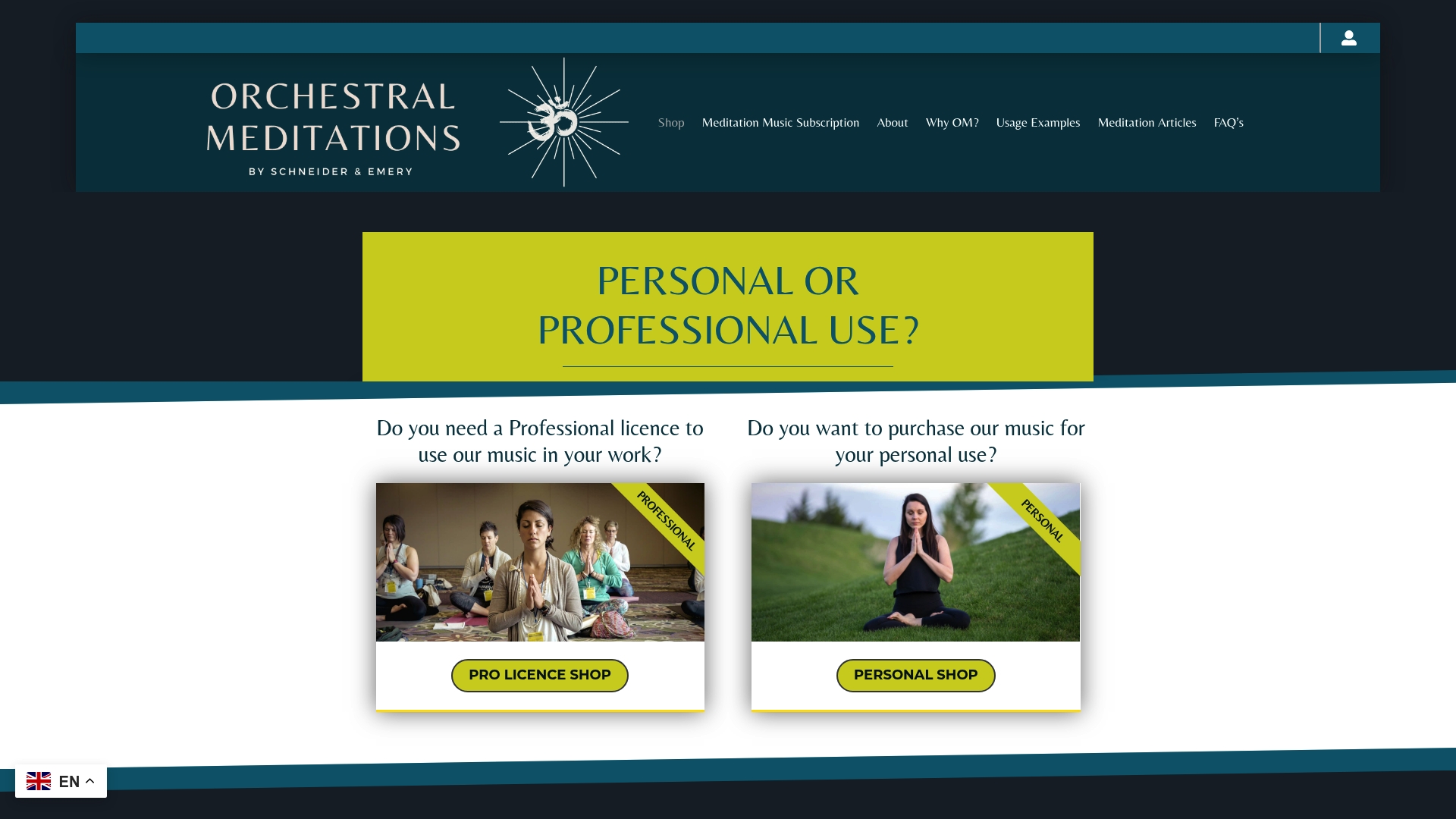
If you are ready to stop second-guessing your playlist, head to the Orchestral Meditations shop and compare single tracks against the Pro bundle. Both are royalty-free for professional use, and the Pro tier is built specifically for teachers running regular classes or selling recorded sessions, with no extra fees once you have bought it. Pick the tier that matches how often you teach, complete checkout, and you will have your licence invoice and files ready before your next class.
Sources
- Effects of self-administered binaural beats on meditative and introspective states | PLOS One
- Brain responses to a 6‑Hz binaural beat: effects on general theta rhythm and frontal midline theta activity | Frontiers
FAQ
Do I need a separate licence for online yoga classes?
Check the specific licence text on your invoice, since coverage for streamed or online sessions can differ from in-person, single-location licences.
Can I use the same track for multiple studio locations?
A Pro bundle is generally built for broader commercial use, but if you run several venues or several instructors, confirm your tier covers that spread before assuming it does.
What file format will I receive after purchase?
Orchestral Meditations typically supplies WAV files for full quality and MP3 files for convenience, alongside your licence invoice.
Do binaural tracks work through normal speakers?
No, binaural tracks are designed for headphone listening; for room playback, choose a standard stereo mix instead so you do not lose the intended effect.
Does the Pro licence charge ongoing usage fees?
No, shop terms confirm that Pro licence holders do not pay additional fees or need further permission once the licence is bought.