There’s no single “podcast licence” waiting for you at GOV.UK, but that doesn’t mean you’re free to bung any track under your intro. You need to clear two separate things: the composition (via PRS for Music) and the recording itself, usually through a synchronisation licence from the label. The safest, cheapest route for most independent shows is properly licensed royalty-free music, because it’s pre-cleared for exactly this use. Get the licence wrong and you’re looking at takedowns, claims, or worse.
TL;DR:
- Most independent podcasters should use royalty-free or pre-cleared music libraries that explicitly include synchronization rights to avoid legal risks.
- Licensing requirements involve separate permissions from PRS for music, PPL for recorded tracks, and direct sync clearances from publishers and labels for specific recordings.
- Costs depend on the licensing route: subscription services, one-off track purchases, or custom clearance, with larger shows incurring higher fees or negotiations.
- Platform hosting does not usually cover music rights, making it the podcaster’s responsibility to verify and manage licensing for each episode.
- Global distribution means licensors must confirm that the license covers international use, as UK licenses may not extend worldwide without explicit clearance.
Which rights and licences apply to podcasts in the UK: PRS, PPL and synchronisation explained
Here’s where most podcasters trip up: they think “music licensing” is one thing. It isn’t. It’s at least three things wearing a trench coat.
PRS for Music collects royalties for the composer, songwriter, and publisher. It covers the composition, the actual notes and lyrics, and the right to communicate that work to the public. If you’re publishing episodes on your own website, PRS guidance confirms you may need a Digital Music Licence to cover that communication right. This is separate from anything you pay to use a specific recording.
PPL works the other side of the equation. It licenses recorded music on behalf of record labels and performers, the people who made that specific recording exist. PPL’s licensing pages explain that PPL PRS Ltd jointly administers TheMusicLicence, primarily for public playing of recorded music in venues, shops, and businesses. It’s not automatically a podcast licence, and relying on it to cover episode production is a common misreading of what it actually does.
Then there’s the one that catches nearly everyone out: synchronisation. The moment you fix a piece of commercial music into your episode, timed against dialogue, dropped in as a bed, faded under a voiceover, you’re synchronising it to your content. That nearly always requires direct clearance from both the publisher (for the composition) and the label (for the master recording), a point legal commentary on podcast production makes explicit.
To summarise the three:
- PRS for Music: composition and communication-to-the-public rights.
- PPL / TheMusicLicence: recorded-music rights, mainly for public performance settings.
- Synchronisation: the licence you need to actually fix a track into your episode, cleared separately from both.
Platform responsibility varies too. If you self-host, the licensing burden usually sits with you. If a hosting platform holds its own blanket agreements, some of that risk shifts, but you should never assume this without checking their terms directly.
How to legally include music: three practical routes for podcasters
Once you understand the rights involved, the actual decision becomes simpler. You’ve got three realistic paths.
- Professional royalty-free or production music. Check the licence text carefully: does it explicitly grant synchronisation rights, does it cover monetised and commercial shows, is there a time limit or territorial restriction? Royalty-free services typically bundle sync permission into the purchase or subscription, which is precisely why this route dominates indie podcasting.
- Direct sync clearance for commercial recordings. You’ll need to contact the publisher for the composition and the label for the master, sometimes the same conversation, often two entirely separate ones. Ask for sync plus master-use rights, specify whether you want perpetual or limited-term use, and get it in writing. Expect negotiation on fee and scope, particularly if your show is commercially successful.
- Platform or DSP licensing. Some hosting services carry blanket agreements that cover certain uses. This almost never extends fully to sync rights for commercial tracks you’ve chosen yourself, so don’t assume your host has quietly solved this for you.
Before you hit publish, run this quick checklist:
- Confirm the exact wording of your licence, don’t just skim the marketing page.
- Save the invoice, licence certificate, or confirmation email somewhere retrievable.
- Note the scope: personal use, commercial use, which platforms, which territories.
Pro Tip: Keep a simple spreadsheet with one row per track, per episode, listing the licence type, purchase date, and a link to the saved proof. It takes five minutes and could save you weeks if a rights holder ever queries an episode.
Costs and how licences are typically priced in the UK
Budgeting for music rights in podcasting isn’t as simple as “one fee, done.” The pricing shape depends entirely on which route you take.
PRS’s podcast and audiobook licence structure works on a rate per music hour listened, with an annual minimum fee attached, so high-volume platforms and creators with large listener bases will see costs scale with usage. This licence is aimed more at services and platform operators than at a solo creator publishing a weekly show, but the mechanics are worth understanding if you’re building anything beyond a hobby podcast.
For most independent creators, the real comparison is subscription versus one-off:
- Subscription production-music services charge monthly or annually and grant ongoing access to a library, with sync permissions built in for the duration of your membership.
- One-off track purchases typically buy a lifetime licence for that specific track under stated terms, useful if you want a signature theme without an ongoing bill.
- Direct sync clearance for commercial recordings has no fixed price. It depends on the commercial reach of your show, audience size, and territory, and can run into serious money for anything with real distribution.
If your podcast is a personal project with modest listenership, a subscription or one-off royalty-free purchase will almost always be the sensible choice. If you’re building a commercial media product with sponsors and real reach, budget time and possibly legal advice into clearing anything you can’t source through a licensed library.
Lower-cost lawful alternatives: public domain, Creative Commons and production music
Not every safe option costs money, but each comes with strings attached that trip people up.
Public domain music in the UK generally means the composer has been dead for more than 70 years, and even then, a specific recording of that composition can still carry its own separate rights. A 1920s recording of a Beethoven symphony isn’t automatically free just because Beethoven is public domain, the performance and recording rights may still belong to someone.
Creative Commons licences vary wildly in what they permit. The Creative Commons licence chooser sets out the differences clearly, but the short version for podcasters is this:
- Avoid NC (non-commercial) licences unless your show genuinely earns nothing.
- Avoid SA (share-alike) unless you’re prepared for your episode to inherit the same open licence.
- Always attribute exactly as the licence requires, get this wrong and you’ve technically breached the terms.
Production and stock libraries sit in between. Check whether the licence is a one-off lifetime grant or a subscription that lapses if you stop paying, and whether tracks are exclusive to you or shared across thousands of other podcasts.
Practical example for wellness podcasters: Orchestral Meditations, composers and licensing choices
Wellness and meditation podcasts have a specific problem: the music isn’t decoration, it’s half the content. A poorly licensed ambient track undermines the entire therapeutic intent of the episode, both artistically and legally.
Orchestralmeditations builds its library around professionally recorded orchestral compositions, live musicians, binaural and theta-frequency elements, designed from the ground up for exactly this kind of use, with commercial licensing options for podcasts, apps, and guided audio content. That model matters because it removes the guesswork: you’re not trying to work out whether a stock loop technically permits monetised distribution.
The production side matters too. Composer and producer credits carry real weight in orchestral recording, where sourcing permissions, session musician agreements, and studio rights all need managing before a single note reaches a listener. Robert Emery, known for large-scale orchestral production work, represents the calibre of professional judgement that goes into building a track library intended for therapeutic and commercial use simultaneously.
When music is composed and cleared with commercial use built in from the start, the creator’s only job is choosing the right track, not untangling who owns what.
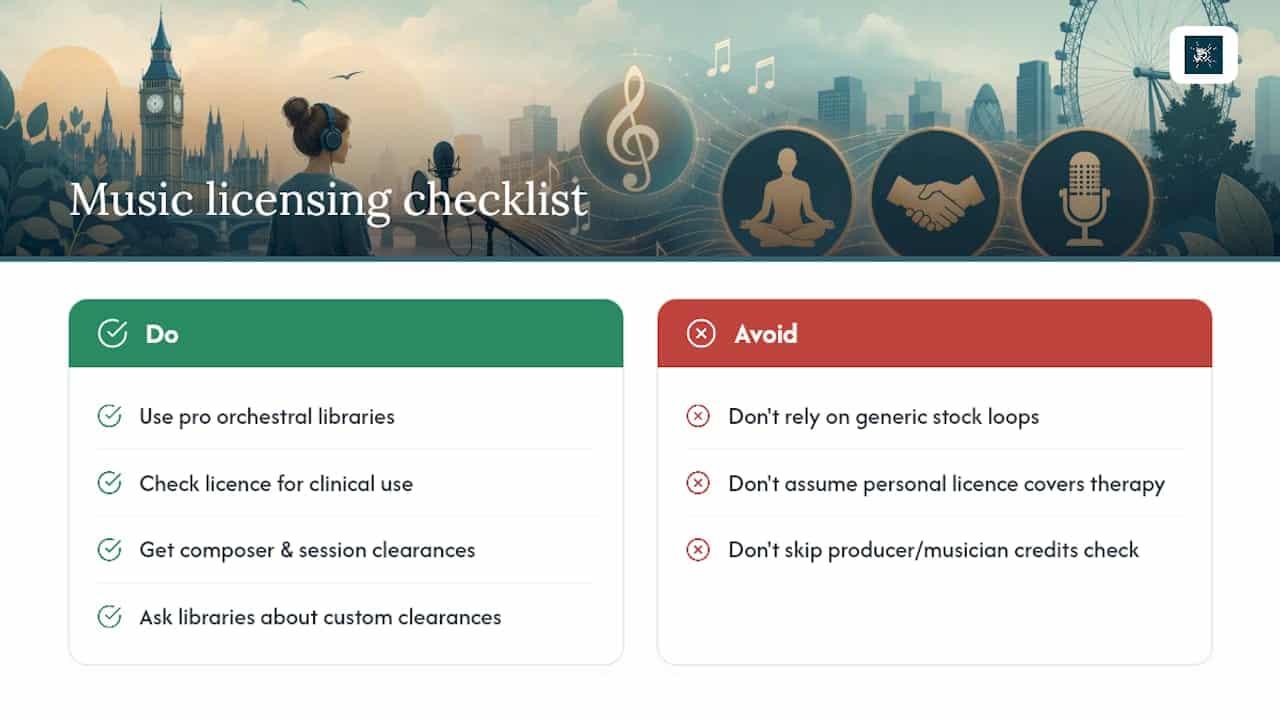
Pro Tip: For therapy or clinical-adjacent content, always check whether your licence explicitly mentions professional or clinical use. Some personal-use licences exclude it entirely.
If you need something bespoke, most professional libraries, Orchestralmeditations included, will discuss custom clearances for larger commercial projects.
Pre-publish checklist and record-keeping every podcaster should follow
Documentation is what separates a minor scare from a genuine legal problem. Before each episode goes live:
- Confirm the exact licence type covering every music element used.
- Save the licence, invoice, or confirmation email in a dedicated folder.
- Record the licence ID, purchase date, and file name against the episode.
- Note the scope: territory, platform, commercial permissions, expiry if any.
- Keep rights-holder contact details on file in case questions arise later.
If challenged, screenshots of licence terms, invoices, and any signed correspondence are your evidence. Should you receive a takedown notice or a rights complaint, respond promptly, locate your saved proof, and contact the platform or rights holder directly before escalating. Legal advisers consistently warn that creators who can’t produce paperwork quickly tend to fare far worse in disputes than those who can.
Who’s actually responsible: you or your hosting platform?
This is the question that causes the most confusion, and the honest answer is: usually you.
Most UK podcast hosting services (the platforms that store your audio files and generate your RSS feed) do not hold blanket music licences covering the content you upload. They provide distribution infrastructure, not rights clearance. Some larger platforms with in-house original content may carry broader agreements, but that coverage typically applies to their own commissioned shows, not to tracks you’ve independently dropped into your episode.
If you self-host on your own website, PRS guidance is clear that you may need a Digital Music Licence to cover the communication-to-the-public element of publishing that content publicly.
The practical takeaway: never assume your hosting provider has quietly sorted your music rights. Read their terms of service specifically for music licensing language, and if it isn’t mentioned, treat it as your responsibility. This is precisely why royalty-free and production-music routes have become the default for independent UK podcasters, the licence travels with the track, not with whichever platform happens to be hosting it that year.
Does it matter if your UK podcast is heard worldwide?
Yes, and this catches out more creators than you’d expect. Producing a podcast in the UK doesn’t confine its legal exposure to UK law once it’s distributed globally through Apple Podcasts, Spotify, or similar platforms.
Music licensing is territorial. A licence cleared under UK terms may not automatically extend rights for use in the US, the EU, or elsewhere, particularly for direct sync clearances negotiated with a specific label or publisher for a defined territory. If you’ve cleared a track “for UK use only” and your show is streamed globally by default (which most podcast distribution does), you may be technically outside your licence terms the moment someone in another country presses play.
The safest approach is to check, before you commit to any direct sync deal, whether the clearance covers worldwide digital distribution. Most reputable royalty-free and production-music licences are written with global use in mind precisely because podcast distribution is inherently international, which is another practical argument for choosing a pre-cleared library over piecing together country-specific permissions yourself.
Summary of differences in licensing for cover versions or remixes used in podcasts
Cover versions and remixes create a layered licensing problem that catches out even careful podcasters.
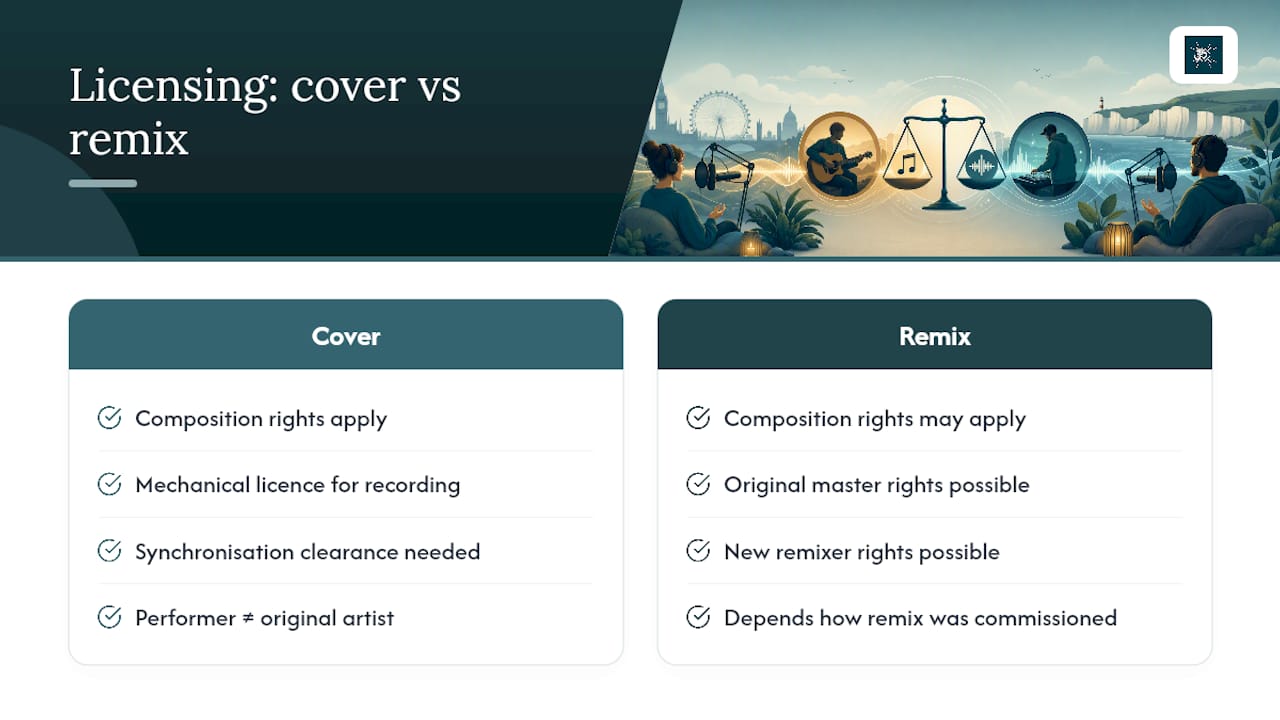
A cover version still uses someone else’s composition, so the underlying songwriter and publisher rights apply exactly as they would to the original recording. You’d typically need a mechanical licence to release the cover as a recording, plus synchronisation clearance to use it in your episode, even though the performer on the cover isn’t the original artist.
A remix is even messier: you’re potentially dealing with the original composition rights, the original master recording rights (if samples or stems are used), and any new creative contribution from the remixer, which may itself carry separate rights depending on how the remix was commissioned.
Neither cover versions nor remixes become “safer” to use simply because they sound different from the original. If anything, they require more diligence, not less, because you may need sign-off from multiple parties rather than one. Unless you’ve secured explicit clearance covering the specific version you intend to use, treat covers and remixes with the same caution as the original commercial recording, and lean towards properly licensed alternative music where the derivative status isn’t a factor at all.
Guidance on how to identify and contact copyright holders for direct sync licences
If you’ve decided direct clearance is worth pursuing, start with the credits. Streaming platforms, official release notes, and databases maintained by PRS for Music and PPL can help identify the publisher and label attached to a specific recording.
For the composition side, PRS’s member search tools can point you towards the publisher representing a songwriter. For the recording itself, the label listed on the release (visible on most streaming platforms or physical packaging) is your starting point. Larger labels typically have dedicated sync licensing teams; smaller independent labels may route requests through the artist’s management directly.
When you make contact, be specific: name the exact track, the intended use (a podcast episode, run time, platform), whether the show is monetised, expected audience reach, and whether you want a limited term or perpetual licence. Vague enquiries get vague, slow responses. Clear ones get quoted faster.
Budget more time than you’d expect. Direct sync negotiations, even for straightforward requests, can take weeks rather than days, which is worth factoring into your production schedule if a specific commercial track is central to an episode.
Advice on handling music licensing for podcasts with interviews or guest contributions involving music use
Guest episodes introduce a licensing wrinkle many podcasters don’t anticipate: what happens when your guest brings their own music into the conversation?
If a guest, say, a musician promoting a new release, wants to play or discuss a specific track during the interview, the same rules apply as if you’d chosen the music yourself. Their permission to use their own composition doesn’t automatically transfer to you using it in your published episode; if it’s a recording controlled by a label, that label’s rights still apply regardless of who’s speaking about it.
The safest practice is to agree in advance, before recording, exactly what music (if any) will feature, and confirm the guest or their representative can grant or facilitate the necessary clearance for your specific use case. Get this in writing, even a simple email exchange, rather than relying on a verbal nod during the session.
If a guest performs live during the episode (an original composition, for instance), you’re on slightly safer ground since it’s their own work, but you should still clarify ownership and get explicit permission to publish, particularly if the show is monetised or likely to be distributed widely.
Robert’s note: artistic choices that respect rights
I’ve spent enough time around orchestral recording to know that the quality of a piece of music and the clarity of its rights aren’t separate conversations, they’re the same conversation. When a track is composed, performed, and cleared properly from the outset, the creator using it can focus entirely on whether it serves the content, not on whether they’re exposed.
For therapeutic and wellness audio especially, the emotional weight of the music matters enormously, but so does the certainty that nobody’s going to challenge its use six months into a series, which is why understanding the types of wellness platforms for practitioners is crucial for your licensing choices. Cost, exclusivity, and emotional impact all pull against each other. Getting that balance right usually means favouring properly licensed, professionally produced music over anything scraped together from uncertain sources. If you’re building something bespoke and need a licence that matches a specific creative brief, it’s always worth asking the question directly rather than guessing.
— ROBERT
A pre-cleared orchestral library built for podcast licensing peace of mind
If you’ve read this far, you’ll know that the fastest way to remove music licensing risk from your podcast isn’t more paperwork, it’s choosing music that’s already cleared for exactly what you’re doing. Orchestralmeditations offers curated orchestral tracks, recorded with live musicians and designed specifically for meditation, therapy, and wellness content, with commercial podcast licences built into the purchase.
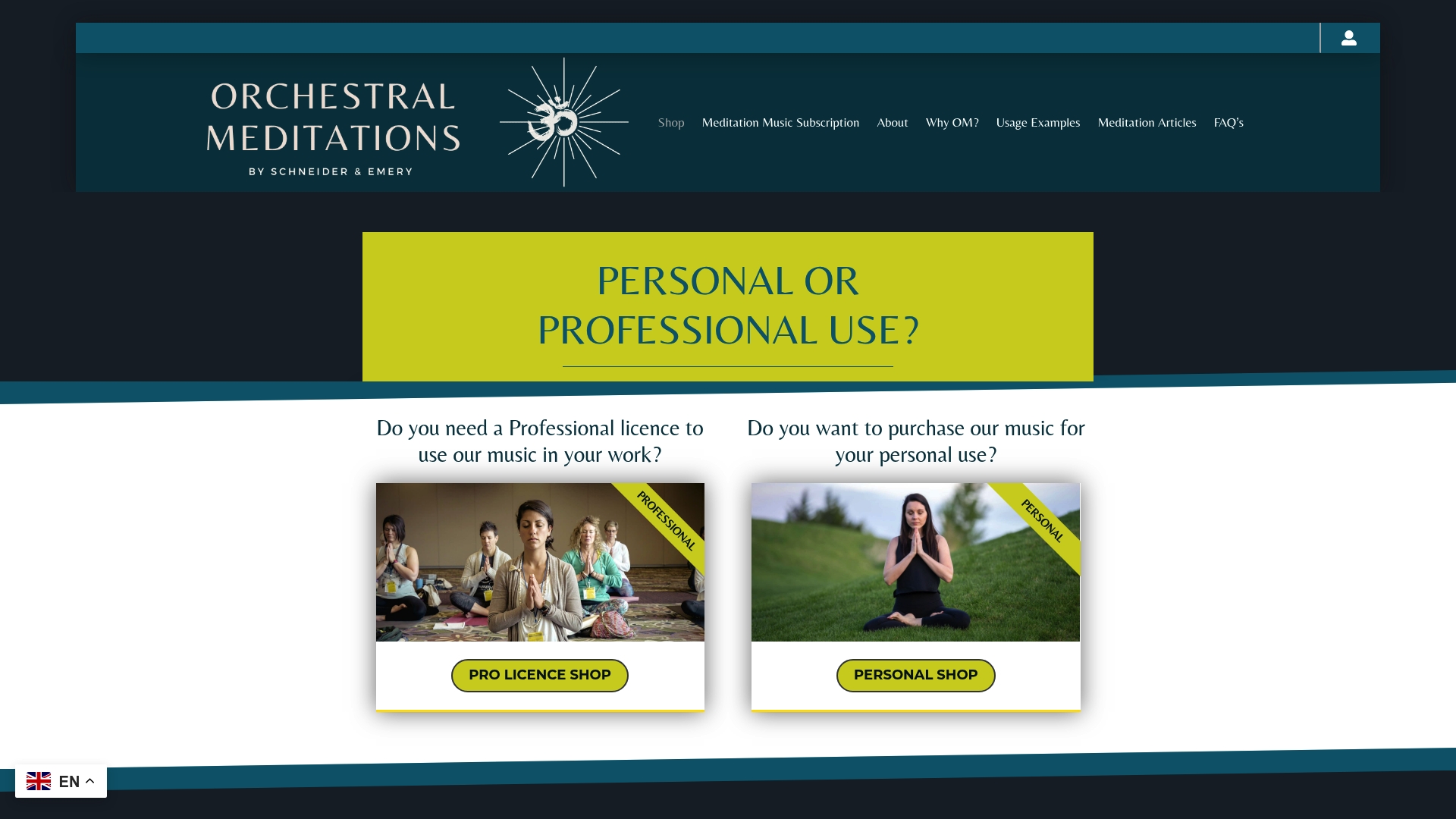
Every track comes with a written licence covering commercial and monetised use, so there’s no ambiguity about whether your episode is covered once it’s published. Whether you need a single track for a signature intro or a broader library for a full wellness series, the licensing terms are stated upfront rather than buried in fine print you have to chase down separately.
Browse the Orchestralmeditations shop to find tracks that fit your show’s tone, check the licence terms against your intended use, and get your next episode covered before you hit publish.
Sources
For authoritative confirmation beyond this guide, consult PRS for Music’s podcasting pages, PPL’s licensing pages, and Gov. These remain the primary, up-to-date sources for anything touching UK music rights compliance.
This article is general information, not a substitute for advice from a qualified lawyer. Consult a qualified legal professional about your own circumstances before acting on anything here.
FAQ
How much does a music licence cost in the UK?
Costs vary widely: royalty-free subscriptions often run to modest monthly fees, one-off track purchases carry a fixed lifetime price, and PRS’s podcast licence uses a rate per music hour listened with an annual minimum. Direct sync clearance for commercial tracks has no fixed price and depends on audience reach and territory.
How much does a PPL and PRS licence cost?
There’s no single combined figure, PPL and PRS licence separate rights (recordings versus compositions) with different fee structures, and PPL’s licensing pages set out specific rates depending on the type of use, so you’ll need to check the relevant licence category for your situation.
Can I avoid paying PPL and PRS fees entirely?
Yes, by using properly licensed royalty-free or production music that already includes sync permissions, rather than commercial recordings that trigger PRS and PPL clearance requirements.
Is there a way to legally avoid a music licence altogether?
Genuine public domain compositions (composer deceased over 70 years) and correctly attributed Creative Commons tracks can sometimes be used without a paid licence, but you must verify the specific recording’s rights status, not just the composition, before assuming it’s free to use.
Does Orchestralmeditations cover commercial podcast use?
Yes, Orchestralmeditations provides commercial licensing options alongside its orchestral track library, designed specifically to support monetised wellness and meditation podcasts without separate sync negotiations.