You can use meditation music on Instagram legally — but only if you have the correct rights or are posting platform-cleared tracks. Get it wrong and you are looking at muted audio, reduced reach, content removal, or account strikes. The good news is that the path to doing this properly is not as tangled as it sounds, once you know which rights you actually need.
One thing many creators miss: most recorded music carries two separate copyrights — the composition (owned by the songwriter or publisher) and the sound recording (owned by the artist, label, or master rights holder). Platform access often covers only non-commercial personal use, which means it does not automatically clear either right for a paid campaign or a branded post.
Key takeaways
Using meditation music legally on Instagram requires both sync and master licence clearance for commercial posts — platform availability alone is never sufficient proof of commercial rights.
| Point | Details |
|---|---|
| Check your account type first | Business accounts are limited to Meta Sound Collection; personal/creator accounts have broader but non-commercial access. |
| Two licences, not one | Sync (composition) and master (recording) licences are both required for commercial video posts. |
| Save all licence documentation | Contracts, receipts, and screenshots form your evidence pack for disputing Content ID claims via Instagram’s Account Status tool. |
| AI fingerprinting catches altered audio | Pitch-shifting and short clips no longer reliably avoid detection; only a proper licence protects you. |
| Orchestralmeditations for commercial use | Named composer credits (Robert Emery, Moritz Schneider) and written licence documentation make it a credible source for Instagram-ready meditation music. |
How does Instagram meditation music copyright actually work?
The phrase “copyright-free” gets thrown around a lot in wellness creator circles, and it causes no end of confusion. So let us be precise. Under UK copyright law, music is protected from the moment it is created — no registration required. For most recorded tracks, that protection lasts for the lifetime of the composer plus 70 years for the composition, and 70 years from the date of publication for the sound recording.

That means a track recorded in the 1990s is almost certainly still protected. Do not assume age equals public domain.
The two rights you must clear for Instagram video posts:
- Sync licence: permission from the composition rights holder (publisher/songwriter) to pair the music with your visual content.
- Master use licence: permission from the recording rights holder (label or artist) to use that specific recorded version.
Both are typically required when you post a video with music. Recorded music carries these two separate copyrights, and Instagram’s in-app library handles the licensing on your behalf only within specific, limited conditions.
There is also a persistent myth worth squashing: the idea that using only 10 or 15 seconds of a track is legally safe. It is not. Copyright infringement turns on whether you have captured the recognisable “heart” of a song, not on clip length alone. A five-second hook from a well-known ambient track can still trigger a claim.
For creators posting guided meditations, yoga sessions, or wellness content with a commercial angle, the stakes are higher than for a personal mindfulness post. The commercial use of in-app tracks without separate sync licences has led to legal action against brands in multiple jurisdictions — a principle that applies squarely to UK creators running paid campaigns.
What Instagram’s music policies mean for your account type
Instagram’s music system is not one-size-fits-all, and the distinction between account types is where most creators come unstuck.
Personal and creator accounts get access to a broad in-app catalogue for non-commercial use. You can add popular tracks to Reels and Stories, and Instagram’s licensing deals with rights holders cover that specific, non-commercial context.
Business accounts are restricted to the Meta Sound Collection, which contains a limited selection of tracks cleared for commercial use on Facebook and Instagram. That is a significantly smaller pool than the main catalogue, which is why many business creators find it limiting and turn to third-party libraries instead.
What the automated system actually does:
- Meta Rights Manager uses audio fingerprinting to scan every upload against a database of reference files submitted by rights holders.
- Detection has been upgraded with AI that can flag short background audio, pitch-shifted versions, and AI-generated audio that resembles a protected track.
- When a match is found, the rights holder can choose to block the content, mute the audio, or monetise the post by running ads against it.
- Retroactive muting can happen if a licensing agreement between Meta and a rights holder changes after you post.
Consequences in practice:
- Muted audio on Reels or Stories (often with no warning before posting)
- Reduced distribution or suppressed reach
- Content removal
- Account strikes that accumulate toward suspension
Pro Tip: Switching your account from business to personal just to access a wider music library is a risky workaround. If your content is commercial in nature — promoting a product, a paid course, or a brand partnership — the account type is not what determines your legal exposure. The commercial intent of the post is. Platform appearance does not equal legal clearance.
Safe options for adding meditation music to Reels, Stories and feed posts
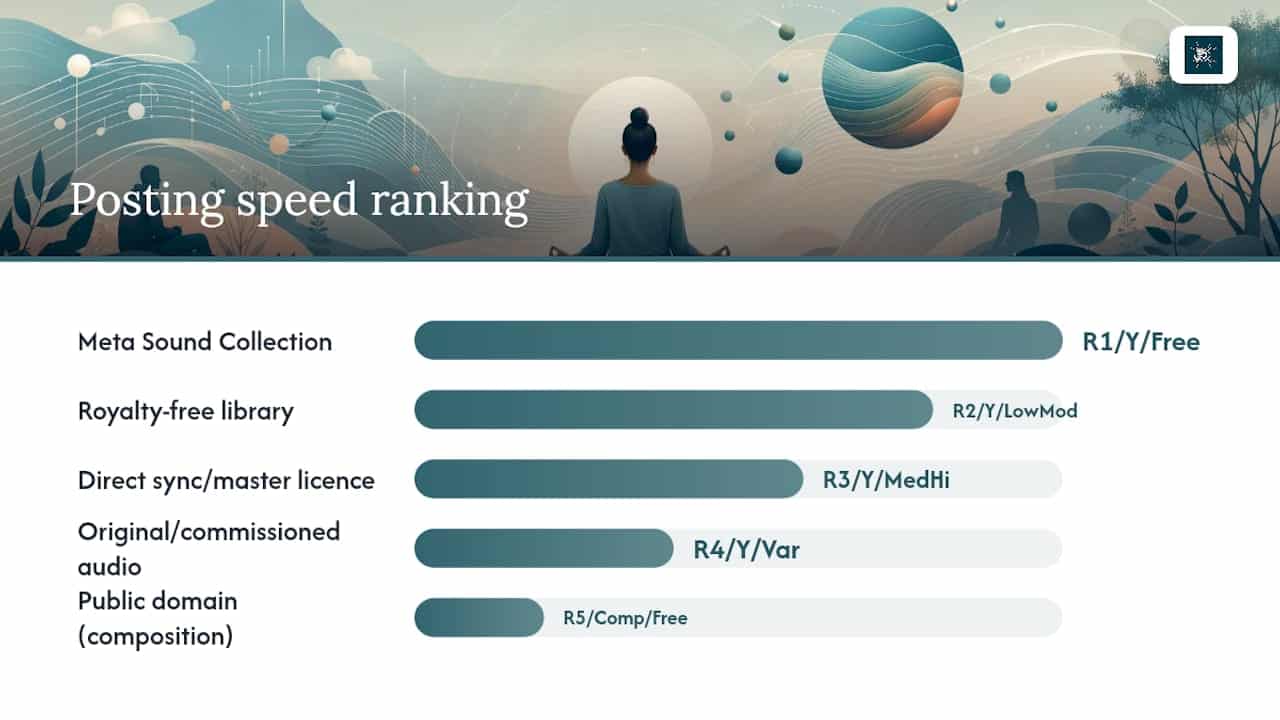
Here is a ranked breakdown from fastest to most legally robust, along with the trade-offs worth knowing.
1. Meta Sound Collection (business accounts)
Fastest for business posts. Pre-cleared for commercial use on Instagram and Facebook. The catalogue leans towards popular and upbeat tracks, so finding suitable meditation music takes patience — but it is the lowest-friction option for branded content.
2. Royalty-free commercial libraries with explicit Instagram rights
This is where most serious creators land. A subscription or per-track purchase from a library that explicitly grants commercial social media rights, handles Content ID registration, and provides written licence documentation covers you far better than the in-app picker. Subscription commercial libraries reduce administrative overhead by bundling platform-friendly licences and Content ID handling into a single purchase.
3. Direct sync and master licences
The gold standard for recognisable tracks or high-profile campaigns. You contact the publisher and label separately, negotiate terms, and receive written contracts. More expensive and slower, but the only route for using a specific well-known piece of music commercially.
4. Original audio
If you compose or commission music yourself, you own the rights from creation. Commission agreements should transfer copyright or grant you a full commercial licence in writing.
5. Public domain works
Compositions by composers who died more than 70 years ago are out of copyright in the UK — but the recording of that composition may still be protected. A 2020 recording of a Debussy piece is not public domain just because Debussy is.
Red flags to avoid in any licence:
- No explicit mention of social media or Instagram as a permitted platform
- “Streaming only” licences that exclude synchronisation with video
- No written confirmation of sync rights
- Ambiguous territory clauses that exclude the UK
- No mention of Content ID handling or indemnification
One more thing: a licence cleared for Instagram does not automatically transfer to TikTok, YouTube, or any other platform. Each platform is a separate territory for licensing purposes, and you need explicit permission for each one.
| Option | Simplicity | Commercial coverage | Cost |
|---|---|---|---|
| Meta Sound Collection | High | Yes, for Instagram/Facebook | Free with account |
| Royalty-free library (subscription) | High | Yes, if explicitly stated | Low to moderate |
| Direct sync/master licence | Low | Yes, fully negotiated | Moderate to high |
| Original/commissioned audio | Medium | Yes, if contract is clear | Variable |
| Public domain (composition only) | Medium | Composition only | Free |
How to licence meditation music for Instagram: a step-by-step process
Getting a licence sorted before you post is always easier than disputing a claim after the fact. Here is the practical sequence.
-
Identify both rights holders. For the composition, search the PRS for Music database to find the publisher. For the recording, check PPL UK or the label’s website. Artist pages on streaming platforms can also help trace who owns what.
-
Request a sync licence from the publisher and a master use licence from the label or recording rights holder. Do this in writing, specifying the platform (Instagram), territory (UK, or worldwide if relevant), duration of use, and whether the content is commercial.
-
Confirm the scope in writing. The licence must state: the specific track and recording, the permitted platform(s), the territory, the start and end dates, whether it covers paid promotion, and how Content ID claims will be handled.
-
Get a signed contract with indemnity clauses. You want the rights holder to confirm they own what they are licensing and to indemnify you if a third-party claim arises.
-
Pay the agreed fee and retain proof of payment alongside the signed contract.
-
Document everything for appeals. Save the signed licence, proof of payment, a screenshot of the licence terms, and embed metadata in the audio file before uploading. If a claim arises, this is your evidence pack.
Sample licence clauses to request:
- “This licence grants the licensee the right to synchronise [track name] with video content posted on Instagram (including Reels, Stories, and feed posts) for commercial purposes within the United Kingdom for a period of [X months/years].”
- “The licensor confirms that this licence covers Content ID registration and that no automated claims will be filed against content posted under this agreement.”
- “The licensor warrants that they hold all necessary rights to grant this licence and will indemnify the licensee against third-party claims arising from the licensed use.”
Pre-cleared subscription services are a practical alternative when timelines are tight or budgets are limited, because the licence terms are already negotiated and the documentation is immediate.
How to check whether a meditation track is copyrighted or cleared for Instagram
The short answer: assume it is protected until you can prove otherwise. Here is how to check systematically.
Tools to use:
- Instagram music picker: if a track appears in your account’s library, it is cleared for your account type’s permitted use — but confirm whether that use is commercial or personal only.
- PRS for Music: search the UK’s performing rights database to identify the composition rights holder and publisher.
- PPL UK: the UK’s phonographic performance licensing body, useful for identifying recording rights holders.
- Shazam or ACR Cloud: identify unknown tracks quickly before you start any licensing conversation.
- Content ID dashboards: if you have access through a distributor or rights management service, check whether a track is already registered in Content ID.
Step-by-step evidence collection:
- Screenshot the Instagram music picker showing the track in your available library, with your account type visible.
- Search PRS for Music and PPL UK databases and screenshot the results showing rights ownership.
- Request licence confirmation in writing from the rights holder and save the email thread.
- Save the audio file with embedded metadata (track name, rights holder, licence reference number).
- Keep all receipts, contracts, and screenshots in a named folder for each campaign or post series.
Pro Tip: Save your upload timestamp (screenshot the post immediately after publishing) and export the video’s metadata. If a claim arrives weeks later, you will have a timestamped evidence pack ready to attach to an appeal via Instagram’s Account Status tool — which is considerably faster than starting from scratch.
Meta’s Rights Manager and fingerprinting system has been upgraded with AI detection that can flag short clips and altered audio, so the old tricks of pitch-shifting or trimming to under 30 seconds are no longer reliable. Build your evidence before you post, not after.
Why Orchestralmeditations is worth knowing about for licensable meditation music
If you are a UK creator posting meditation content and you want music that is genuinely cleared for commercial Instagram use, Orchestralmeditations is a catalogue worth knowing.
The library is built around orchestral recordings made with live musicians, including sessions at Abbey Road Studios with the National Philharmonic. The tracks incorporate binaural beats, theta frequencies, Solfeggio-based compositions, and 3D surround sound — the kind of immersive audio that works particularly well for guided meditation Reels and longer wellness content.
What makes the catalogue credible for sync discussions:
- Explicit commercial licence options (personal and professional tiers) with written documentation provided at purchase.
- Royalty-free downloads with clear licence terms designed for creators and wellness professionals.
- Named composer and producer credits, which matter more than most creators realise.
That last point deserves a moment. When you are licensing music for a commercial campaign, named credits are a trust signal — they tell you who actually created the work, who holds the rights, and who to contact if questions arise. Two names worth knowing from the Orchestralmeditations catalogue are Robert Emery and Moritz Schneider.
Robert Emery is a composer and producer whose work spans orchestral and ambient music. His credits include work for film, television, and meditation audio, and his presence in the Orchestralmeditations catalogue reflects a professional production standard that holds up in sync discussions. Moritz Schneider brings a producer’s ear for frequency-based audio design, with a background in therapeutic soundscapes and binaural production — the kind of technical depth that matters when you are creating content for trauma-informed wellness practitioners or clinical settings. You can verify artist presence and catalogue entries through streaming platforms, which also helps when tracing rights ownership for any licensing enquiry.
Orchestralmeditations offers both single-track purchases and subscription plans, with licence documentation provided at the point of purchase. That documentation is what you attach to an Instagram appeal if a Content ID claim ever arises against your post.
For creators working in trauma-informed or therapeutic contexts, it is also worth noting that the right musical framing matters beyond copyright. Resources like meditation for trauma recovery can inform how you select and contextualise music for sensitive wellness content.
A UK meditation creator’s honest take on Instagram music licensing
Look, the licensing side of posting meditation content on Instagram is genuinely one of those things that sounds more complicated than it is — until you get your first muted Reel at 11pm the night before a workshop launch. Then it feels very complicated indeed.
Practical dos and don’ts:
- Do check your account type before every campaign, not just once at setup.
- Do plan licences before a paid campaign, not after you have already edited the video.
- Do prefer commercially cleared tracks for guided sessions — the risk profile is completely different from a personal mindfulness post.
- Do not assume a track is safe because it appears in the Instagram picker on your account.
- Do not rely on pitch-shifting or short clips to avoid detection — AI-powered fingerprinting catches both.
- Do not reuse an Instagram-cleared licence on TikTok or YouTube without checking the terms.
Building a workflow that actually holds up:
Integrate a licence checklist into your production process, not as an afterthought. When you brief a composer or producer — whether that is someone like Robert Emery or Moritz Schneider through a catalogue like Orchestralmeditations, or an independent musician you commission directly — get the licence scope confirmed in writing before you start editing. Build in at least two weeks for any direct sync negotiation, and longer for major label tracks.
A quick scenario: say you are licensing a three-minute orchestral meditation for a paid online workshop. You need a sync licence covering Instagram Reels (commercial use, UK territory, minimum 12-month duration), a master use licence for the specific recording, written confirmation that Content ID claims are waived under the licence, and proof of payment. That is your evidence pack. It takes under an hour to assemble if the rights holder is organised — and it is the difference between a smooth appeal and a very stressful afternoon.
Orchestralmeditations has the licences you need for Instagram
Posting meditation content commercially on Instagram means you need music that comes with proper documentation, not just a vague “royalty-free” label on a download page.
Orchestralmeditations offers a library of professionally recorded orchestral meditation tracks with explicit commercial licence options — personal and professional tiers, single-track purchases, and subscription plans. Every purchase comes with written licence documentation that you can use as evidence if a Content ID claim ever lands on your post. The catalogue includes work by named composers and producers, recorded at Abbey Road Studios with live musicians, and covers binaural, theta frequency, and Solfeggio-based audio suited to guided meditation Reels, wellness Stories, and longer-form content.
For creators who need a track cleared for a specific Instagram campaign or a custom sync query, the Orchestralmeditations team can be contacted directly. Browse the full meditation music library and check the professional licence options to find the right tier for your use case.
Sources
- Instagram Reels Music Copyright: The 2026 Legal Guide – Foxi Blog
- How to Use Licensed Music on Instagram
- Instagram Business Accounts & Music Copyright Lawsuits | SRIPLAW
- How to Fix and Appeal an Instagram Copyright Claim – Creator Tribune
This article is general information, not a substitute for advice from a qualified lawyer. Consult a qualified legal professional about your own circumstances before acting on anything here.
FAQ
Is it legal to use copyrighted music in Instagram posts?
Only if you have the correct licence or are using platform-cleared tracks within their permitted scope. Business accounts must use Meta Sound Collection for commercial posts; personal accounts can access a broader library for non-commercial use only.
How do you avoid copyright issues on Instagram when using meditation music?
Use tracks from Meta Sound Collection for business posts, or purchase a royalty-free commercial licence from a library like Orchestralmeditations that provides written documentation. Keep all licence receipts and contracts in case a Content ID claim arises.
Which Instagram music is copyright-free?
Tracks in the Meta Sound Collection are cleared for commercial use on Instagram and Facebook. Beyond that, “copyright-free” typically means royalty-free with a commercial licence — always check that the licence explicitly covers Instagram and commercial use before posting.
How do I know if a meditation track on Instagram is properly licensed?
Check whether the track appears in your account’s music picker (which reflects your account type’s permitted use), then search PRS for Music and PPL UK to identify the rights holders. For commercial posts, written licence confirmation from the rights holder is the only reliable proof.