The music of Om is defined as the sacred sound current used across Hindu, Buddhist, and yogic traditions to align the mind, body, and breath in meditation. Pronounced as a three-part syllable (A-U-M), it represents the primordial vibration from which all sound is said to arise. Practitioners use Om chanting music to clear mental noise, calm the nervous system, and open a channel to deeper awareness. Contemporary composers like Robert Emery and Moritz Schneider have brought this ancient sound into the modern age, pairing it with orchestral arrangements that honour its spiritual roots while making it accessible to new listeners. Chanting Om 108 times is a longstanding practice in Indian spiritual disciplines, used to purify the mind and structure morning sadhana sessions.
What is the music of Om and why does it matter in meditation?
Om is not a mere chant. It is the foundational cosmic sound in mantric traditions, representing the vibration underlying all of creation. That distinction matters enormously. Treating Om as background noise is a bit like using a Stradivarius to prop open a window. You are missing the point entirely.

In Sanskrit cosmology, Om encodes three states of consciousness. The “A” sound represents the waking state, “U” the dreaming state, and “M” the deep sleep state. The silence after the syllable represents the fourth state, turiya, which is pure awareness itself. When you chant or listen to Om music with this understanding, the sound becomes a map rather than a melody.
Spiritual music of Om also carries a protective quality. Practitioners across Kundalini yoga, Vedic meditation, and Tibetan Buddhist traditions use Om as an invocation, calling the practitioner into alignment with their inner teacher and higher awareness. It is less about the ears and more about what happens in the space behind them.
What is the spiritual significance of Om in mantric traditions?
Om sits at the heart of virtually every major Indian spiritual system. In Kundalini yoga, it functions as an invocation to higher self-awareness, aligning the practitioner with the divine teacher within. Think of it as tuning a radio to the right frequency before you try to pick up a signal.
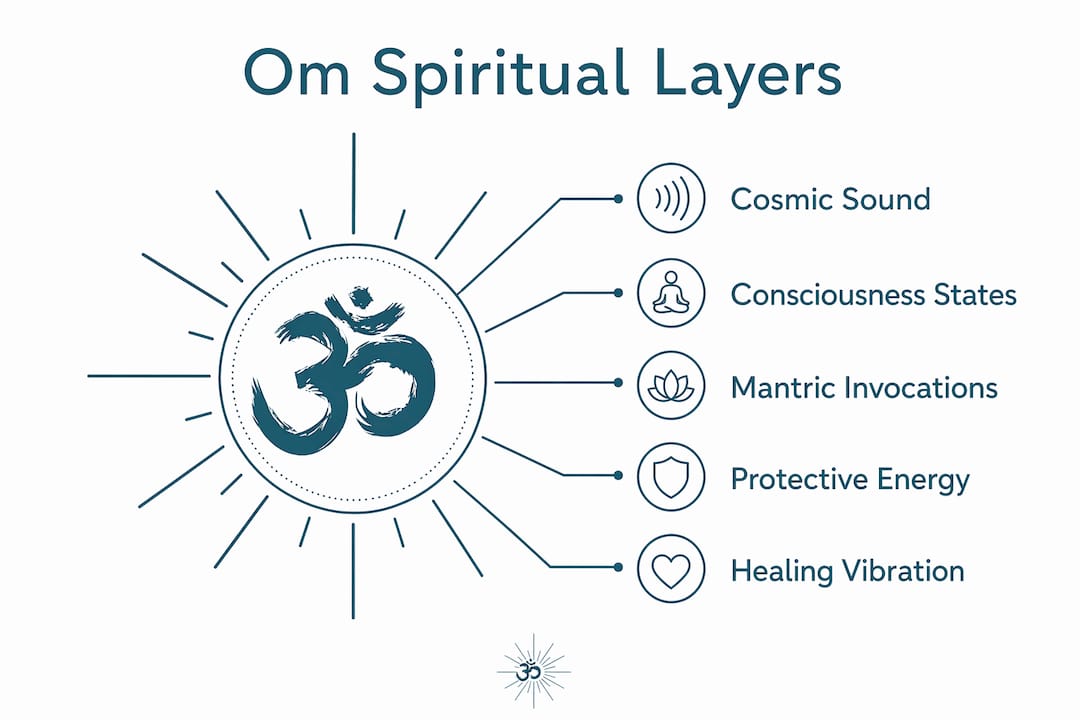
The three qualities Om represents, creation, preservation, and dissolution, mirror the Hindu trinity of Brahma, Vishnu, and Shiva. Chanting Om is therefore not a passive act. It is a conscious participation in the cycle of existence. That is quite a lot to pack into a single syllable, and yet practitioners report feeling it immediately.
The number 108 carries its own significance in this context. Indian cosmology holds that there are 108 sacred sites, 108 Upanishads, and 108 beads on a mala. Completing a 108-count chanting cycle structures the meditation session and creates a container of focused intention. Seed sounds like “Haum” are sometimes paired with Om to dissolve fear and clear emotional heaviness, grounding the practitioner in safety before deeper states are accessed.
“Om is the bow, the self is the arrow, and Brahman is the target.” — Mandukya Upanishad
This ancient teaching captures why Om is treated as a vehicle rather than a destination. The sound carries you somewhere. Where you land depends on the quality of your attention.
How does Om music vary, and what should you look for in recordings?
Not all Om recordings are created equal. This is where things get genuinely interesting, and where a lot of well-meaning practitioners go slightly wrong.
Deep baritone versus synthetic tracks
Traditional Om chanting features deep, resonant baritone voices that physically ground the listener. The low-frequency vibration travels through the body, not just the ears. Synthetic or higher-pitched tracks can sound pleasant, but they lack the nervous system impact of a genuine human voice sustaining a long, full-bodied Om. If your Om recording sounds like it was produced by a keyboard preset from 2003, it probably was.
The 432Hz question
Om music tuned to 432Hz has gained considerable attention in meditation circles. Proponents argue that this tuning dissolves ego and invites pure being beyond thought, functioning as an invitation to what some teachers call infinity consciousness. Whether or not you subscribe to the physics of it, the subjective experience of 432Hz Om recordings tends to feel warmer and less clinical than standard 440Hz tuning. That alone makes it worth exploring.
What to look for when choosing a recording
- Voice quality. Prioritise recordings with a genuine human voice, ideally a trained vocalist with a naturally deep register.
- Duration. Sessions under ten minutes rarely allow the nervous system to fully settle. Look for recordings of at least twenty minutes for serious practice.
- Soundscape support. Minimal orchestral elements or nature sounds can deepen the experience without distracting from the Om itself. Composers like Robert Emery and Moritz Schneider have built careers around getting this balance right. Their work pairs traditional chant integrity with live orchestral arrangements, recorded at Abbey Road Studios with the National Philharmonic, which is rather a different proposition from a laptop and a reverb plug-in.
- Frequency consistency. The Om should sustain evenly without jarring edits or volume spikes that pull you out of the meditative state.
- Production clarity. Muddy or over-compressed audio is fatiguing. High-resolution recordings allow the overtones of the chant to breathe.
Pro Tip: Before committing to a long session, listen to the first sixty seconds of any Om recording with your eyes closed. If your shoulders drop and your jaw unclenches, you have found a good one. If you feel nothing, move on.
| Feature | Traditional chant recordings | Synthetic or digital tracks |
|---|---|---|
| Voice type | Deep human baritone | Synthesised or processed |
| Nervous system effect | Strong grounding response | Mild or inconsistent |
| Frequency options | Often 432Hz or natural tuning | Variable, often 440Hz |
| Soundscape | Minimal or orchestral | Often layered with effects |
| Best for | Serious meditation practice | Casual background listening |
What are the benefits of Om chanting music for relaxation and healing?
The benefits of Om music are well recognised across wellness and clinical meditation contexts. Om chanting music reduces stress, anxiety, and emotional heaviness while creating mental clarity and inner calm. That is not a vague spiritual claim. Practitioners and clinicians working in sound-based therapies report consistent results across a wide range of people.
Here is what regular Om sound healing practice tends to produce:
- Nervous system regulation. The sustained vibration of Om activates the vagus nerve, shifting the body from sympathetic (fight or flight) to parasympathetic (rest and digest) mode.
- Emotional clearing. Om and related seed sounds foster grounded safety and dissolve accumulated emotional tension. Think of it as a reset button for the emotional body.
- Mental clarity. Regular chanting reduces the mental chatter that most meditators describe as their biggest obstacle. The sound gives the mind something specific to anchor to.
- Ego dissolution. Om music tuned to 432Hz is particularly associated with resting in pure being beyond the narrative self. This is the state that advanced meditators spend years trying to access.
- Spiritual protection. Many traditions hold that chanting Om creates an energetic field around the practitioner, making the meditation space feel contained and safe.
The sound healing applications of Om extend into clinical wellness settings. Yoga therapists, integrative health practitioners, and mindfulness coaches increasingly use Om-based audio as part of structured programmes for anxiety, insomnia, and chronic stress. The combination of rhythmic breath, vocal vibration, and focused attention produces measurable shifts in physiological state. Ayurvedic practitioners also recognise Om as a tool for mental wellness, placing it within a broader framework of sound, breath, and lifestyle practices.
How to use Om music in your daily meditation practice
Getting Om music into your daily routine does not require a Himalayan cave or a guru. It requires about twenty minutes and a pair of decent headphones. Here is how to make it work.
-
Choose your session type. Morning sadhana benefits from active chanting, ideally the 108-count cycle that structures breath and intention for the day ahead. Evening sessions suit passive listening, where you simply receive the sound rather than produce it.
-
Set the space. Dim the lights, sit comfortably with your spine upright, and remove distractions. Om creates a protective meditative space when used with intention. Treating it like background music while answering emails rather defeats the purpose.
-
Pair it with breathwork. Inhale fully, then release the Om on the exhale, sustaining the sound for as long as the breath allows. This synchronises the chant with the respiratory cycle and deepens the calming effect considerably.
-
Combine with guided meditation. Works by Robert Emery and Moritz Schneider are designed to sit beneath guided meditation scripts or yoga nidra sessions. The orchestral soundscapes they create support the Om without competing with it. You can explore Om meditation downloads to find recordings that suit your practice style.
-
Use it in yoga sessions. Opening and closing a yoga practice with three rounds of Om is standard in most traditions. Adding a longer Om music track during savasana extends the integration period and allows the body to absorb the session more fully.
-
Night-time calm. A twenty-minute Om recording before sleep reduces cortisol and prepares the nervous system for deep rest. Keep the volume low and let the sound fade naturally rather than stopping it abruptly.
Pro Tip: If you find your mind wandering during Om meditation, do not fight it. Simply return your attention to the physical sensation of the sound vibrating in your chest and throat. The body is a much more reliable anchor than the breath alone.
The meditative soundscapes that work best for Om practice tend to be those with minimal melodic movement. Too much harmonic activity pulls the mind into listening mode rather than resting mode. Emery and Schneider understand this distinction intuitively, which is why their compositions feel spacious rather than busy.
Key takeaways
The music of Om is the most direct sonic path to nervous system regulation, emotional clearing, and meditative depth available to practitioners at any level of experience.
| Point | Details |
|---|---|
| Om is a complete practice | The syllable encodes waking, dreaming, and deep sleep states, making it a full meditative map in one sound. |
| Voice quality determines impact | Deep baritone recordings ground the nervous system more effectively than synthetic or high-pitched alternatives. |
| 108 chants structure the session | Completing a 108-count cycle purifies the mind and creates focused intention for morning or evening practice. |
| 432Hz tuning aids ego dissolution | This frequency invites rest in pure awareness beyond thought, supporting deeper meditative states. |
| Orchestral pairings deepen experience | Composers like Robert Emery and Moritz Schneider blend traditional chant with live orchestral arrangements for immersive practice. |
Why Om music changed how I think about sound entirely
I came to Om music the way most British musicians do: with mild scepticism and a slightly raised eyebrow. I had spent years working with orchestral compositions, and the idea that a single syllable could do what a full score could not struck me as, well, optimistic.
I was wrong. Embarrassingly so.
The first time I sat with a properly recorded Om chant, one with a genuine baritone voice and no synthetic padding, I felt the sound in my sternum before I registered it in my ears. That is not a metaphor. The physical resonance of a well-produced Om recording is genuinely different from anything else in the meditation music world. It reminded me of standing next to a double bass being played fortissimo. You feel it in your bones.
What struck me most about the work of Robert Emery and Moritz Schneider was their restraint. Lesser composers would have buried the Om under strings and swells. Emery and Schneider let the chant breathe. The orchestral elements they add function like a frame around a painting. They define the space without filling it. That is extraordinarily difficult to do well, and they do it consistently.
My honest advice? Resist the urge to treat Om as ambient noise. Sit with it. Let it be the entire point of the session. The relaxation and stress relief that follows is not incidental. It is the direct result of giving the sound your full attention. The syllable rewards presence in a way that very few things in life actually do.
— ROBERT
Orchestralmeditations: Om music crafted for serious practice
Orchestralmeditations produces Om meditation music recorded at Abbey Road Studios with the National Philharmonic, combining traditional chant integrity with live orchestral depth. The result is a listening experience that works for both newcomers and long-term practitioners.

Their library includes binaural beat recordings, theta frequency tracks, and Solfeggio-based compositions that complement Om chanting beautifully. If you have been making do with low-quality recordings, the difference is immediately apparent. You can browse the full meditation music collection to find Om-based tracks suited to your practice, whether that is morning sadhana, yoga, or evening wind-down. For a curated personal selection, the best meditation music page is a good place to begin.
FAQ
What is the music of Om?
The music of Om is sacred sound-based meditation music built around the syllable Om (also written as Aum), used in Hindu, Buddhist, and yogic traditions to align the mind, body, and breath and facilitate deep meditative states.
How many times should you chant Om in meditation?
Chanting Om 108 times is the standard practice in Indian spiritual disciplines. The 108-count cycle structures the session, purifies the mind, and creates focused intention for morning sadhana or evening practice.
What does Om music do for the nervous system?
Om chanting music activates the parasympathetic nervous system, reducing stress and anxiety while creating mental clarity and inner calm. Deep baritone recordings produce the strongest grounding response.
What is 432Hz Om music?
Om music tuned to 432Hz is a frequency-specific recording designed to dissolve ego and invite rest in pure awareness beyond thought. Practitioners report it feels warmer and more immersive than standard 440Hz tuning.
How do I choose a good Om meditation recording?
Prioritise recordings with a genuine deep human voice, a duration of at least twenty minutes, and minimal but supportive soundscaping. Works by composers like Robert Emery and Moritz Schneider, recorded with live orchestras, represent the higher end of what is available for serious practice.