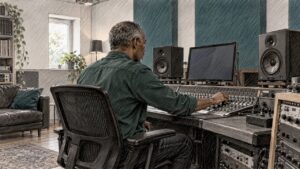
Orchestral mindfulness music is music written and recorded for a live orchestra with one job: to help you settle into the present moment instead of pulling your attention around like a film score does. Strings, woodwind, choir and piano move slowly, the harmony stays open, and nothing jumps out at you. Done well, it gives you the warmth of real musicians in a real room, which is hard to fake. That is why our own meditation recordings were made with live players at Abbey Road Studios, and why we think a live orchestra is the best place to begin if you want music that carries your practice.
I am a musician first and a meditation person second, so allow me one confession. The first time I tried to meditate to “relaxing orchestral music” from a random playlist, a trumpet turned up at minute four and I nearly fell off the cushion. Mindfulness music is not simply orchestral music that is quiet. It is orchestral music that has been designed with the listener’s attention in mind.
TL;DR
- Orchestral mindfulness music uses live acoustic instruments, slow harmonic movement and very few sudden changes, so your attention can rest on it instead of chasing it.
- Research on music and stress is encouraging: a large 2019 meta-analysis of 104 randomised trials found music interventions reduced both psychological and physiological stress.
- Intention matters: in a German field study, listeners who chose “relaxation” as their goal before pressing play got more out of the music than those who did not.
- Match the music to the job: spacious, theta-based pieces for meditation and rest, steadier and gentler material for focus.
- Our personal subscription costs €21 a month and the professional subscription €150 a month, both with licensing built in.
What orchestral mindfulness music actually is
Three things get mixed up under this keyword, so let us separate them.
Orchestral ambient music is a texture. Think long string pads, soft piano, reverb. It can be lovely, and it is usually made to sit in the background of a film, a café or a study video.
Orchestral relaxation music is a mood. It aims to make you feel calm, and it often borrows from classical repertoire or cinematic writing, including the occasional swell that is gorgeous but not exactly neutral.
Orchestral mindfulness music is a tool. It is written so that you can return to it again and again as an anchor for attention. The tempo is slow and steady, the melodies are simple enough not to demand analysis, and the dynamics rarely surprise you. Often it is built around a particular purpose: a body scan, a breath practice, a deeper theta-state meditation or a wind-down before sleep.
The difference sounds subtle on paper and is obvious in practice. After ten minutes of a good mindfulness piece you have not noticed the music at all, which is the point. After ten minutes of a dramatic cinematic playlist you have noticed it constantly.
Why a live orchestra rather than a sample library
A digital string patch plays every note identically. Sixty live players do not. There is a slight wobble in the vibrato, a breath before a phrase, a bloom in the room as the sound reaches the back wall. Those tiny irregularities are what give a long, slow piece its sense of being alive, and they are very hard to program.
This is the reason we record the way we do. The music behind Orchestral Meditations was recorded with the National Philharmonic at Abbey Road Studios, and we use 3D surround sound so that the orchestra seems to sit around you rather than in front of you. If you meditate with headphones, that sense of space matters more than you would expect.
What the research says about music, stress and wellbeing
I am not a scientist, and I will not pretend that a string quartet is a pill. But the research is worth knowing, because it also tells you how to listen.
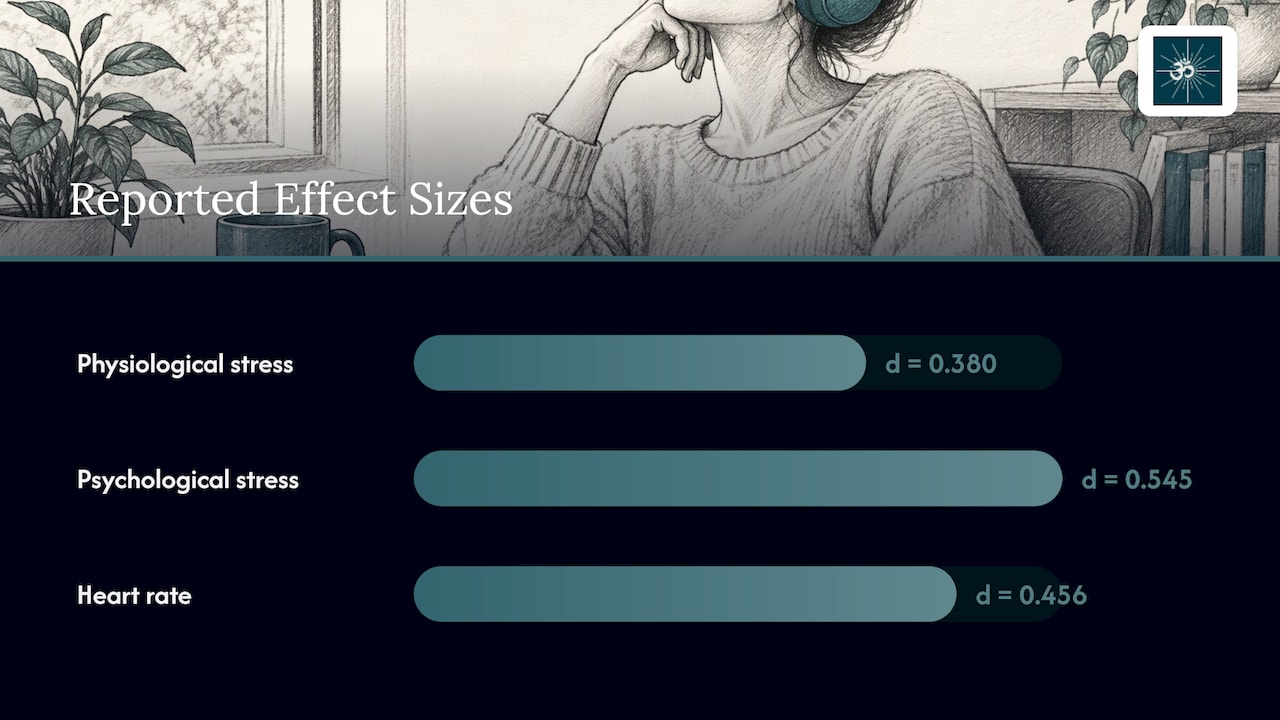
Music lowers stress, measurably. A pair of multilevel meta-analyses by de Witte and colleagues, covering 104 randomised controlled trials and 9,617 participants, found that music interventions reduced stress both physiologically (d = 0.380) and psychologically (d = 0.545). The effect was stronger for heart rate (d = 0.456) than for blood pressure or hormone levels. In plain terms: the largest and most reliable change was the body slowing down.
Music made with a therapeutic purpose works well. A 2020 meta-analysis of 47 studies with 2,747 participants found a medium-to-large effect of music therapy on stress-related outcomes (d = 0.723). Music therapy there means interventions tailored by a trained music therapist, which is a distinct profession from simply listening to a playlist. If you are a music therapy professional, you will know this line well. If you are a yoga or meditation teacher, it is a good reason to choose your music deliberately and to treat it as part of the session’s design.
Wellbeing improves too. A 2025 meta-analysis in Frontiers in Psychology pooled ten studies and found that music-based interventions raised subjective wellbeing (SMD = 0.36). Music listening showed a significant effect in clinical groups (SMD = 0.65).
Classical and self-chosen music stands out. A 2025 scoping review of sound interventions in adults reported that music, especially classical and self-selected pieces, lowered physiological stress markers such as cortisol, heart rate variability and blood pressure, with personal preference playing a big part in the outcome. That second finding is worth a moment. The “best” piece is partly the one you actually like, so give yourself permission to choose.
Orchestral sound and the body. A review of music in intensive care medicine by Trappe noted that vocal and orchestral music produced significantly better correlations between cardiovascular and respiratory signals than the other styles compared. It also reported that calming music before surgery lowered anxiety more than a sedative did in one trial. That is a clinical setting, not your living room, but it shows how seriously researchers take the nervous system’s response to this kind of sound.
If you want a wider view of how sound and other approaches fit into managing stress, this overview of stress management therapy for adults covers the landscape.
The intention trick
Here is my favourite finding, because it costs nothing. In a German field study by Mattes and colleagues (2019, 64 participants over several days in everyday life), music, spoken relaxation and a combination all reduced perceived stress to a similar degree. Music, however, also produced stronger activation, and the goal participants set before listening, relaxation or activation, strengthened the matching effect. The authors recommend listening to music with the explicit aim of relaxing.
So before you press play, say it to yourself: “This is my ten minutes to settle.” It is slightly daft and it seems to help.
Binaural beats, theta and Solfeggio: what they add
Many mindfulness recordings layer something extra under the orchestra, and it helps to know what each one is.
Binaural beats are created when each ear receives a slightly different tone through headphones. Your brain perceives a third, pulsing tone at the difference between the two. A 6 Hz beat, for example, is a gentle pulse at the theta rate. You need stereo headphones for it to work, so use them for these tracks.
Theta refers to brainwave activity at roughly 4 to 7 Hz, associated with drowsy, dreamy, deeply relaxed states. That is the territory many meditators are aiming for, which is why theta-based music is popular for deeper practice.
Solfeggio frequencies are a set of tones, such as 174 Hz or 528 Hz, that many practitioners use as tonal centres for healing and sound work. They are used in sound practice and as an organising idea for composition and listening.
What does the research on binaural beats say? A few studies are worth knowing:
- A 2026 PLOS ONE paper by Amd reported that five minutes of self-administered theta binaural beats at 6 Hz increased both calm and focus in over 200 participants across two studies.
- McConnell and colleagues (2014) found that 20 minutes of theta binaural beats (4 to 7 Hz) after exertion raised parasympathetic activity and subjective relaxation in a double-blind, placebo-controlled study. The parasympathetic system is the part of your nervous system that handles rest and recovery.
- A UK study by Lee-Harris and colleagues compared meditative binaural music with calm and arousing classical music. Younger listeners found the binaural music significantly calmer than low-arousal classical, while older listeners rated calm classical as the most comforting. That is a lovely reminder that taste and age matter.
- A study with 35 older residents of retirement homes in Taiwan used familiar music combined with alpha binaural beats for 30 minutes over five days and recorded lower heart rate and blood pressure and lower depression scores.
The combination of familiar, beautiful music and a subtle binaural layer shows up in more than one of these. That is precisely why we build our theta tracks as real orchestral compositions first and add the sound design underneath, rather than the other way round.
Choosing the right orchestral music for your goal
The other half of the keyword is “best orchestral ambient music”. There is no single best, but there is a best for what you are doing.
| Goal | What to look for | What to avoid |
|---|---|---|
| Seated meditation | Slow tempo, sustained strings, long phrases, theta or binaural layer | Melodies with strong hooks that you will end up humming |
| Body scan or yoga nidra | Soft, spacious texture, gentle low register, very gradual change | Percussion, brass swells |
| Focus and study | Steady pulse, familiar sound world, low variation | Anything with dramatic build-ups |
| Sleep wind-down | Warm tone, quiet dynamics, long tracks that fade naturally | Bright, high-register passages |
| Teaching or therapy sessions | Music you hold a licence for, consistent quality across a library | Streaming playlists with unclear usage rights |
Two more points that matter.
Check the dynamics, not just the title. A track called “Peaceful Strings” can still contain a crescendo that jolts you at minute six. Listen through the whole piece once while doing something else. If you notice a moment of drama, it is not a mindfulness track.
Length and loops. Many free videos online take a three-minute piece and loop it for an hour. Your brain recognises the repetition and starts waiting for it, which is the opposite of letting go. Longer compositions that develop slowly give your attention somewhere to rest without presenting a pattern to track.
How to use orchestral music in your mindfulness practice
Here is a routine I give to students who are new to music-led meditation. It takes about fifteen minutes.
1. Set the intention (one minute)
Sit comfortably, put on headphones if the track uses binaural beats, and say what you want from the session: to relax, to focus, to let the day go. The German field study above suggests this small step strengthens the effect.
2. Breathe before you press play (two minutes)
Take a few slow breaths with longer exhales. If you like to build a stress-relief routine around breathing, breathing exercises for stress relief are a natural companion to a listening session.
3. Start the music at a low volume
The music should sit slightly below the level at which you would follow it as a performance. If you catch yourself analysing the violins, turn it down a touch.
4. Use the music as an anchor
When your mind wanders, and it will, bring your attention back to the sound of the strings, then to the feeling of your breath. You are not trying to listen well. You are using the sound as a handrail.
5. Finish in silence
When the track ends, stay put for a minute or two. Research on silence in music therapy contexts suggests even short periods matter: Pfeifer’s 2022 overview describes studies in which as little as 6.5 minutes of silence influenced relaxation, mood and rumination in healthy students. A calm landing is part of the practice.
For focus rather than meditation
Choose something steady and unobtrusive, keep the volume low, and use the same piece for the same kind of work. After a week, the music becomes a cue: it starts, and your brain knows the job. Our article on science-backed sound and music for mindfulness goes further into how sound supports a practice.
The people behind the music
Music like this does not come from nowhere, and I think it is worth knowing who made it.
Orchestral Meditations was created by the composer, conductor and producer Robert Emery together with the composer and producer Moritz Schneider. Emery is an English pianist, conductor, producer and orchestrator, born in 1983, who came to wide attention performing with artists such as Russell Watson, Meat Loaf and Stewart Copeland. In 2023 he was named music director of the National Philharmonic Orchestra of Great Britain, the orchestra that plays on our recordings. The same source notes that Emery and Schneider have composed, produced and conducted together before, on the 2017 album 4Colors by the Swiss singer SEVEN.
Why does that matter to you as a listener? Because a long working relationship between two composers and a full orchestra shows in the details: the pacing, the way a phrase hands over from one section to another, the patience. Meditation music is difficult to write, since the skill lies in what you leave out.
Our view: why orchestral music suits mindfulness
When Moritz and I started this project, we asked a simple question: what would meditation music sound like if it were composed like a film score, performed by a full orchestra, and then stripped of everything that grabs attention? We wanted the feeling of a great hall without the drama.
That is why we record with live musicians. A real string section breathes. You can hear the bow change, the air in the room, the tiny human differences between players. Those details give a long, slow piece an organic quality that keeps you company without demanding anything from you.
It is also why we build our theta, binaural and Solfeggio-based tracks as proper compositions. The sound design is there to support the music, not to replace it. Recording at Abbey Road with the National Philharmonic, and using 3D surround sound, lets us place the orchestra around the listener so the music feels like an environment rather than a performance.
We are convinced that the best meditation music is made by people who love both music and stillness, and who are willing to spend months getting a four-minute passage exactly as quiet as it should be. That is how we work, and it is what we offer to everyone who meditates, teaches or heals with sound.
ROBERT
Using orchestral meditation music with your clients or students
If you teach yoga, lead meditation groups, work as a therapist or make wellness content, you have a question beyond “does this sound nice”: are you allowed to play it?
Music from a streaming service is licensed for private listening. Playing it in a class, a paid session, a guided audio or an app is a different use, and it needs the right licence. This is the practical reason professionals look for royalty-free libraries with clear terms.

Our catalogue is built around this need. Tracks and subscriptions come with either a personal or a professional licence, for use in meditation, therapy, yoga, apps, guided audio, massage and wellness content. A teacher who builds a class around a particular piece can use it every week without worrying about the rights.
Start listening
For your own practice, the personal subscription is €21 a month and gives you access to the library of orchestral meditation recordings. If you teach, run sessions or create content, the professional subscription is €150 a month and carries the professional licence. You can also browse our royalty-free meditation music collection track by track.
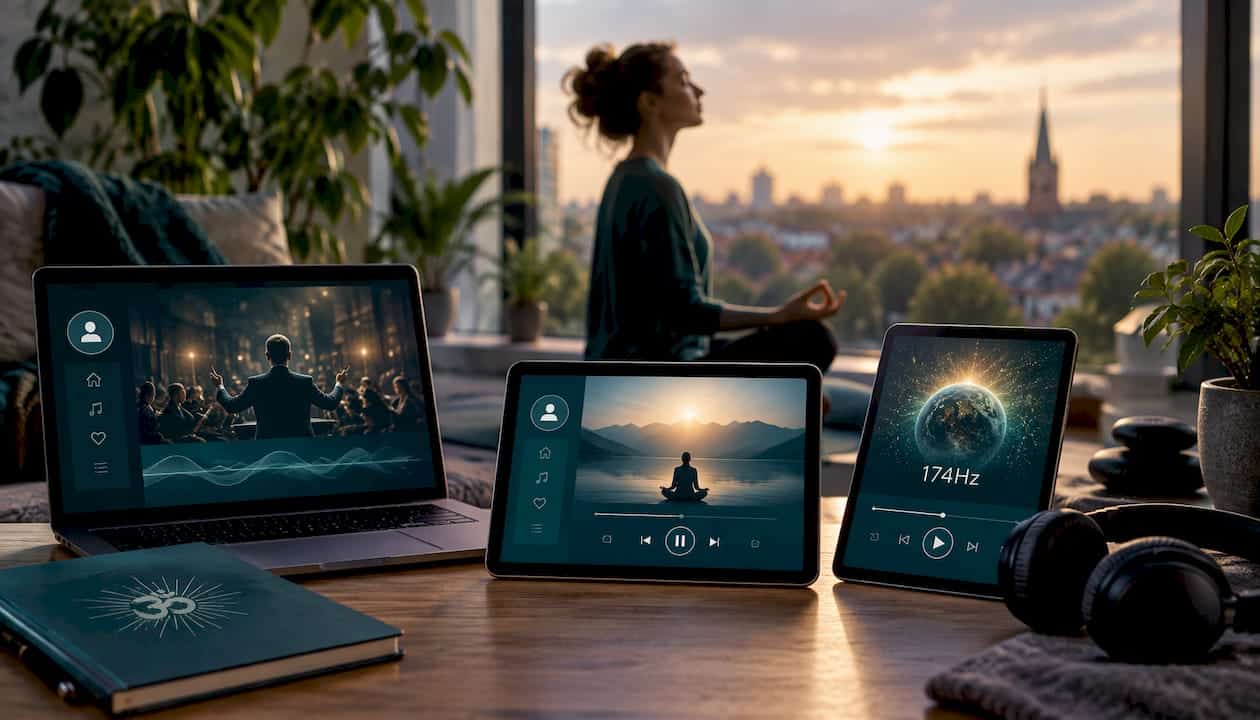
If you are not sure where to begin, pick one piece that suits the goal in the table above and use it for a week with the five-step routine. Your attention will tell you quickly whether it is right.
FAQ
What is orchestral mindfulness music?
It is music for live orchestra composed to support attention and relaxation: slow tempo, simple melodic material and very few sudden changes. Unlike general ambient or cinematic playlists, it is designed to be used as an anchor during meditation, breathwork, yoga or rest.
Can orchestral music really help with stress?
Research points that way. A meta-analysis of 104 randomised trials found that music interventions reduced both psychological and physiological stress. Choosing a piece you like and listening with the intention to relax appears to strengthen the effect.
What is the best orchestral music for focus?
Choose steady, low-variation pieces without big crescendos, and keep the volume low. Using the same piece for the same kind of task helps, because the music becomes a cue for concentration. For deeper, more inward practice, slower theta-based tracks suit better.
Do I need headphones for binaural beats?
Yes. Binaural beats depend on each ear receiving a slightly different tone, so you need stereo headphones. Without them, you still hear the orchestral music, but not the binaural layer.
Can I use orchestral meditation music in my classes or sessions?
Yes, with the right licence. Our subscriptions and tracks come with personal or professional licensing, and the professional licence covers use in therapy, yoga, apps, guided audio, massage and wellness content.
Sources
- Effects of music interventions on stress-related outcomes (de Witte et al., 2019)
- Music therapy for stress reduction (de Witte et al., 2020)
- Impact of music-based interventions on subjective wellbeing (Frontiers in Psychology, 2025)
- Effects of sound interventions on mental stress (PMC, 2025)
- Role of music in intensive care medicine (Trappe, 2012)
- The Aim Justifies the Means (Mattes et al., 2019)
- Effects of self-administered binaural beats (PLOS ONE, 2026)
- Auditory driving of the autonomic nervous system (Frontiers in Psychology, 2014)
- Music for relaxation: a comparison across two age groups (Journal of Music Therapy, 2018)
- Familiar music listening with binaural beats for older people (Journal of Neuropsychiatry, 2017)
- Zur Wirkung von Stille: ein Überblick (Musiktherapeutische Umschau, 2022)
- Robert Emery (pianist)
- Stress management therapy: what adults need to know
- Oxygen breathing exercises for stress relief