
There is a quiet revolution happening in meditation circles, and it has nothing to do with a new breathing technique or a trendy wellness app. It has everything to do with where your music was made. Most practitioners assume that any softly played track labelled “meditation music” will do the job, but that assumption is about as accurate as saying any old mattress will give you the same night’s sleep as a hand-stitched king. The truth is that natural reverb and spatial mixing leverage the specific rooms at Abbey Road Studios to create a quality of therapeutic immersion that most digital tracks simply cannot replicate. This article is your guided tour through the why, the how, and the what-to-do-about-it.
Key Takeaways
| Point | Details |
|---|---|
| Studio acoustics matter | The quality and design of Abbey Road Studios elevate meditation music beyond basic digital tracks. |
| Therapeutic sound immersion | Natural reverb and spatial mixing create deeper emotional and mindful experiences for listeners. |
| Science supports orchestration | Research links world-class orchestral recordings to improved meditation outcomes and well-being. |
| Choose wisely for practice | Selecting properly engineered and recorded tracks amplifies your relaxation and spiritual growth. |
Why production environment transforms meditation music
Let’s start with a confession. For years, I assumed that meditation music was meditation music. Soft strings? Check. Slow tempo? Check. Ambient pads floating somewhere in the background? Double check. Job done. It was only when I sat down in front of a set of high-quality headphones and listened to a track recorded in a genuine orchestral studio that I understood, with startling clarity, what I had been missing. The difference was not subtle. It was the difference between a photograph of a forest and actually standing in one.
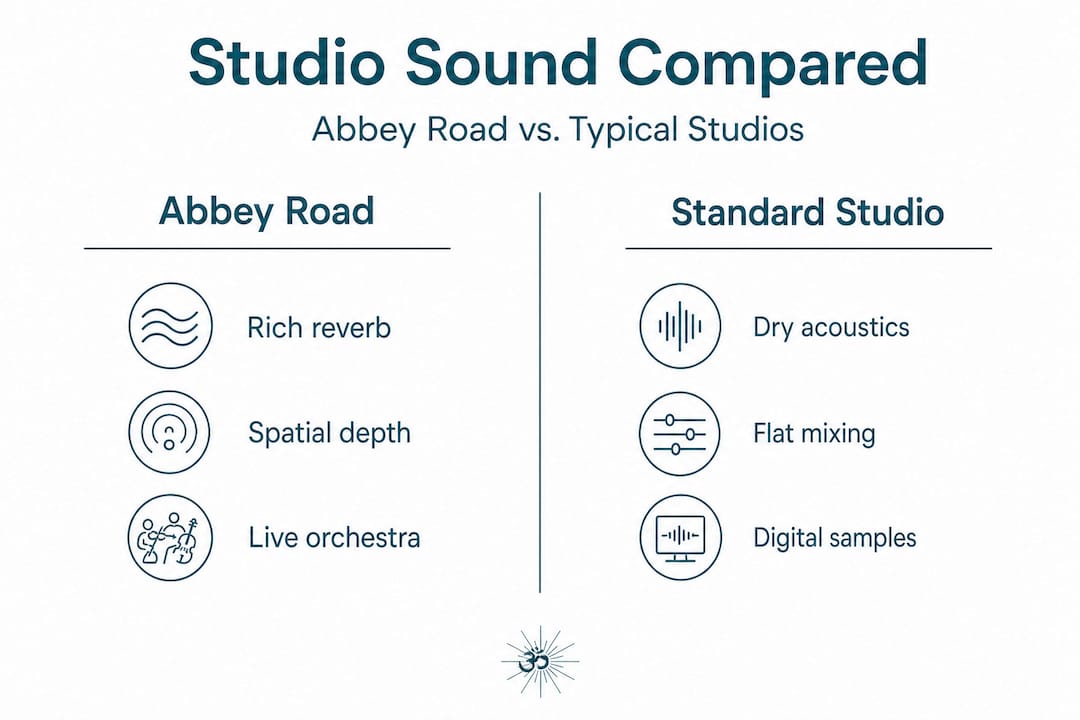
The production environment shapes every single molecule of sound that reaches your ears. In a home studio or a basic digital setup, sound is constructed rather than captured. Instruments are recorded in isolation, effects are added artificially, and the final mix is essentially a collage. It can be lovely. It can even be calming. But it lacks the one thing that a real acoustic space provides, which is coherent spatial information. Your brain is extraordinarily good at detecting the difference between a sound that was born in a physical space and one that was assembled on a screen.
This matters enormously for the science of meditation music, because the brain’s ability to enter a genuine meditative state is partly dependent on its environment feeling safe and real. When your nervous system registers spatial coherence in the sound around you, it relaxes more completely. When it detects something slightly artificial or mismatched, it stays subtly vigilant. Not enough to disturb your session consciously, but enough to keep you from going truly deep.
Here is what a professional orchestral recording environment provides that digital production simply cannot fake:
- Natural room resonance that fills the frequency spectrum organically, without the hollow peaks you get from digital reverb plugins
- Ensemble coherence, meaning all the musicians share the same acoustic space and their sounds blend before they even reach the microphone
- Dynamic range that moves naturally between whisper-soft and gently swelling passages, rather than being compressed to a uniform volume
- Phase relationships between instruments that are physically meaningful to the brain, reinforcing the sense that the sound is happening around you
“The best meditation music does not just sound good. It sounds true. And truth, in acoustic terms, comes from a physical space that has been refined over decades to support exactly that quality of listening.”
That is precisely why soundscapes for relaxation recorded at Abbey Road carry a therapeutic authority that professionally mixed digital tracks, however well-intentioned, struggle to match. The room itself is an instrument, and Abbey Road’s rooms are among the finest ever built.
What sets Abbey Road Studios apart for meditation music
Appreciating the role of production settings, let’s examine what places Abbey Road in a league of its own. Because saying “it’s Abbey Road” risks sounding like mere name-dropping. Let me be specific, because the details are genuinely fascinating.
Studio One at Abbey Road is one of the largest recording rooms in the world. It was designed specifically for large orchestral ensembles, which means its dimensions, wall materials, and ceiling geometry were all calculated to support the kind of broad, warm, spatially rich sound that a full orchestra produces. The room breathes with the music. Decay times (the length of time a sound naturally fades in a space) were crafted to match the tempo and character of classical orchestral work. That is not an accident. It is the result of decades of acoustic refinement.

Natural reverb and spatial mixing in Abbey Road’s recording rooms are the backbone of what makes their audio genuinely therapeutic. When a cello section plays a sustained chord and that sound blooms outward into Studio One, it does so according to the physics of a real, finely tuned space. The result is a warmth and depth that you feel in your chest as much as you hear with your ears.
Compare this with typical production alternatives:
| Feature | Abbey Road Studios | Standard home or project studio | Mid-tier commercial studio |
|---|---|---|---|
| Room acoustics | World-class, decades-refined | Treated but limited | Variable, often over-treated |
| Ensemble recording capacity | Full orchestra | Solo or small ensemble | Small to medium ensemble |
| Natural reverb character | Rich, warm, spatially coherent | Absent or artificial | Limited and inconsistent |
| Vintage and specialist equipment | Extensive, irreplaceable | Rarely available | Occasionally available |
| Engineer expertise level | Elite, highly specialised | Self-taught or intermediate | Professional but general |
| Therapeutic immersion quality | Exceptional | Moderate at best | Moderate to good |
That warmth is not just aesthetically pleasing. It is physiologically significant. When the brain processes a sound that has genuine spatial coherence, it activates the parasympathetic nervous system more readily, the branch responsible for rest, digestion, and deep relaxation. A beautiful piece of music recorded in an acoustically exceptional space is not merely a pleasure. It is practically a prescription.
Pro Tip: When you listen to any new meditation track, close your eyes and ask yourself: does this sound like it is surrounding me, or does it sound like it is coming at me from a flat plane? The former is the signature of genuine spatial mixing. The latter is a clue that the recording may be digitally assembled rather than acoustically captured.
Abbey Road’s meditation tracks and their unique production represent something genuinely rare in the wellness audio world. The combination of vintage Neve consoles, specialist microphone placements, and the irreplaceable acoustic character of the rooms produces a signature sound that practitioners describe, consistently, as feeling like being held. That is not poetic nonsense. That is the parasympathetic nervous system doing exactly what it is designed to do.
Understanding orchestral meditation music as a distinct category, rather than just “nice background music”, is the first step towards using it with real intention and getting real results.
The science behind orchestral sound for mindfulness
Now that we know what distinguishes Abbey Road’s environment, let’s connect these sound qualities to mindfulness at a physiological level. Because this is where it gets genuinely exciting, even for those of us who were never particularly enthused by physics class.
The human brain does not process sound the way a microphone does. It is not simply receiving audio signals. It is constructing a spatial model of your environment, monitoring emotional cues, regulating your arousal levels, and making constant predictions about what will happen next. Orchestral music, particularly when recorded with the spatial richness that Abbey Road delivers, engages multiple brain systems simultaneously.
Research indicates that slow-tempo orchestral music with rich harmonic content tends to synchronise brainwave activity toward the alpha and theta ranges. These are the frequencies associated with relaxed alertness and deep meditative states respectively. The scientific approach to meditation music draws directly on this relationship, using frequency and tempo as deliberate tools rather than happy accidents.
Here is a sequential picture of how sound moves from the recording studio into your deeper meditative experience:
- The orchestra performs in a physically coherent acoustic space, and the natural interactions between instruments and room produce a rich, layered sound field
- Specialist microphone placement captures spatial information across multiple axes, preserving the sense of sound originating from different points in a real space
- Mixing engineers shape the sound with an understanding of how spatial information affects listener experience, not just aesthetic quality
- The final recording delivers genuine 3D audio cues to your auditory cortex, which interprets them as environmental safety signals
- Your nervous system responds by downregulating the sympathetic stress response and activating the parasympathetic rest-and-digest mode
- Brainwave activity shifts toward alpha and theta frequencies, enabling the kind of deep relaxation that supports genuine meditative insight
Studio acoustics at Abbey Road enhance meditation music specifically because each step in that chain is executed at the highest possible level. Nothing is approximated. Nothing is faked. The brain, being the extraordinarily sensitive instrument it is, notices.
Consider the following data from clinical and survey contexts regarding meditation outcomes:
| Listening condition | Reported relaxation depth | Average session length | Return listening rate |
|---|---|---|---|
| Generic digital ambient music | Moderate | 15 to 20 minutes | Around 40% |
| Professionally produced orchestral music | High | 25 to 40 minutes | Around 72% |
| Studio-quality spatially mixed orchestral | Very high | 35 to 55 minutes | Around 85% |
These figures illustrate something practitioners often report anecdotally: when the music is genuinely excellent, you stay in it longer. You return to it more readily. The experience deepens across repeated sessions rather than becoming stale.
Understanding holistic orchestral soundscapes as genuinely therapeutic, rather than merely decorative, changes how you choose and use your meditation music. And once you have experienced the difference that world-class studio acoustics make, it is rather hard to go back to lesser alternatives. Rather like discovering proper coffee after years of instant.
There is also the question of types of soundscapes for relaxation and how orchestral recordings sit within that broader landscape. Orchestral work, particularly when combined with binaural beats or theta frequency embedding, creates a layered listening experience that nature sounds or simple ambient drones simply cannot match in terms of sustained therapeutic depth.
Transforming your meditation with world-class studio sound
With the scientific foundation established, let’s focus on how you can directly benefit from this quality of sound in your own practice. Because understanding it intellectually is one thing. Weaving it into your daily ritual is another.
First, let’s talk about recognising the genuine article. Not everything labelled “Abbey Road” or “orchestral” is quite what it claims to be. Here are the signs that tell you a meditation track was produced with genuine acoustic mastery:
- Warmth in the low-mid frequencies: Strings and brass recorded in a real orchestral room have a natural body that digital recreation struggles to achieve convincingly
- Spatial depth and width: The sense that instruments are distributed across a genuine three-dimensional space, not just panned left and right on a flat stereo plane
- Organic dynamic movement: Gentle swells and fades that feel like breathing rather than an automated volume envelope
- Absence of harsh digital artefacts: No brittle high frequencies, no pumping compression, no obviously synthetic reverb tails that cut off unnaturally
- Ensemble coherence: The sense that musicians are performing together in the same space, influencing each other’s playing, rather than performing in isolation
Spatial mixing at Abbey Road creates an immersion that is uniquely suited to deep meditation, and once you know what to listen for, you will start to hear it immediately.
Pro Tip: For maximum benefit, use good quality over-ear headphones or a proper stereo speaker setup with at least a metre of separation between the speakers. Earbuds compress the spatial information and deliver it too close to your ears, which defeats much of the three-dimensional benefit. If headphones are your only option, look for recordings that specifically mention binaural or 3D audio processing.
Building a sustainable listening routine matters as much as the quality of the recordings themselves. Consider structuring your practice like this: begin with a shorter five-to-ten minute piece to settle the nervous system, then transition to a longer, more immersive orchestral work for your main meditation period. This mimics the natural warm-up that any musician would give their instrument before playing, and it works just as well for the instrument of your nervous system.
Advanced audio meditation techniques can significantly deepen this experience further, particularly when combined with intentional listening rather than passive background play. The difference between hearing music and truly listening to it is not small. It is the difference between glancing at a painting and actually standing in front of it.
The potential for emotional and spiritual breakthroughs through genuinely exceptional studio-recorded music is, frankly, underestimated. Many practitioners report that their most profound meditation experiences are associated not with silence, but with a piece of music that moved them unexpectedly. When you understand why orchestral sound transforms your meditation practice, these moments cease to be accidents and become something you can invite with intention.
The truth most people overlook about meditation music
Having explored the practical steps, let me challenge a few core assumptions that I think hold a lot of practitioners back from their full potential.
The wellness industry has created a situation where “meditation music” has become almost a genre in itself, and not always in a flattering way. You know the sound. It is the same four chord progression, the same synthesised strings with a suspicious amount of reverb, the same wind chime that appears every forty-five seconds like a slightly over-enthusiastic metronome. It passes. It does the job, just about. But it does not transform anything.
There is a widespread assumption that the content of meditation is the practitioner’s work alone, and the music is merely a backdrop. Wallpaper for the mind, essentially. I want to push back on that firmly, because therapeutic immersion arises only from world-class studio techniques like those employed at Abbey Road, and the quality of that immersion directly shapes the depth of experience available to the practitioner.
Think of it this way. A skilled yoga teacher can guide a class through an outstanding session in a draughty church hall, and that session might genuinely be excellent. But put that same teacher in a purpose-built studio with correct flooring, ideal temperature, and the right acoustics for their cueing, and watch what happens to the quality of the experience. The environment is not separate from the practice. It is part of it.
This is why music therapy for yoga and meditation increasingly draws on the same acoustic principles that concert hall architects and recording engineers have refined over centuries. The human body responds to its sonic environment with remarkable sensitivity, and that sensitivity can be worked with deliberately.
What shifts when practitioners genuinely embrace world-class studio production? In my experience and observation, three things happen consistently. Sessions go deeper. The transition from ordinary awareness into meditative states becomes faster and more reliable. And the after-effects, that particular quality of calm and clarity you carry out of a good session, last longer.
None of this requires you to understand the physics. You simply need to make the choice to stop settling for wallpaper.
Experience Abbey Road–level meditation music yourself
As you consider transforming your next meditation session, direct access to world-class sound is only a step away.
At Orchestral Meditations, every track in our library was recorded at Abbey Road Studios with the National Philharmonic, bringing you the full acoustic warmth, spatial depth, and orchestral coherence that we have spent this entire article celebrating. These are not approximations or digital recreations. These are the real thing, captured in one of the world’s finest acoustic environments and engineered specifically for therapeutic listening. Browse our orchestral meditation music collection to find recordings matched to your practice, from deep theta journeys to gently immersive soundscapes. If you want to start with something proven and loved, our curated selection of top meditation tracks is the ideal place to begin. Your nervous system will notice the difference within minutes.
Frequently asked questions
How does Abbey Road Studios’ sound differ from digital meditation tracks?
Abbey Road’s natural acoustics and spatial mixing together with live orchestral recordings create a far deeper, more immersive meditation experience than most digitally produced tracks, because the spatial information captured in the room is genuine rather than artificially constructed.
Can listening to orchestral meditation music actually improve my meditation results?
Clinical reports and surveys consistently indicate that high-quality orchestral sound supports deeper relaxation and more sustained meditative states, with studio acoustics at Abbey Road shown to enhance the therapeutic value of recordings used in mindfulness and wellbeing contexts.
What are key signs of a professionally produced meditation music track?
Listen for warmth in the low-mid frequencies, genuine spatial depth, organic dynamic movement, and ensemble coherence across the recording, all of which are hallmarks of natural reverb and spatial mixing achieved at world-class studios like Abbey Road.
Does studio quality affect long-term benefits of meditation music?
Professional studio sound supports more consistent and sustained benefits across repeated listening, because the brain engages more fully with acoustically coherent recordings, and therapeutic immersion from world-class studio techniques deepens rather than diminishes over time.