If you teach yoga in Germany and play music in your classes, you need the right to use that music publicly. In practice that means one of two routes. You either register the use with GEMA and pay under its tariffs, or you play music from a source that can prove it sits outside the GEMA repertoire, and keep the paperwork to show it. Online classes follow different rules from classes in a room, so the licence you hold for one does not cover the other.
This guide walks through both routes, with the real numbers, the legal logic behind them and a few traps I have watched teachers fall into. It is not legal advice, and for a specific dispute you want a lawyer who handles copyright (a Fachanwalt für Urheber- und Medienrecht).
TL;DR
- Playing music in a paid yoga class in Germany is generally a public performance, so GEMA expects you to register it unless you only use music you can prove is outside its repertoire.
- For classes with only individual fees, the current GEMA tariff is 4.46% of net course revenue, with minimum fees per hour from €0.54 for up to 10 participants.
- Streaming or recording classes online needs its own licence, separate from your studio tariff.
- “Royalty-free” is a commercial term, not a legal shield against GEMA. What protects you is a written licence plus a track list showing the music is not GEMA-managed.
- Our subscriptions start at €21 per month (personal) and €150 per month (professional, for commercial use).
Why a yoga class counts as public music use
It feels odd at first. A dozen people lying on mats while a gentle piece of music plays hardly sounds like a concert. German copyright law sees it differently. Section 19 of the Urheberrechtsgesetz defines the performance right as the right to make a musical work audible to the public, and “public” is drawn quite widely.
GEMA’s own guidance says the same thing in plainer words: whenever music is used publicly, you turn to GEMA for the matching licence. Experts also point out that whether something is public often depends on whether it is directed at a new, indeterminate audience or serves a business purpose. A paid course open to booking by anyone ticks both boxes. A few friends practising in your living room does not.
The grey zone is the interesting bit. A private class for one person at home? A corporate workshop for a single employer? A community group that pays no fees? Each of those can tip either way, and the honest advice is that licensing is the safest path, because arguing the threshold with a collecting society is nobody’s idea of a relaxing afternoon.
Route one: playing GEMA music in your classes
If you want to play music from commercial releases, you register with GEMA. For yoga and similar courses, the relevant rule is the WR-KS-F tariff for fitness and health courses, which applies to courses with music where participants pay either a monthly membership or individual course fees.
What it costs
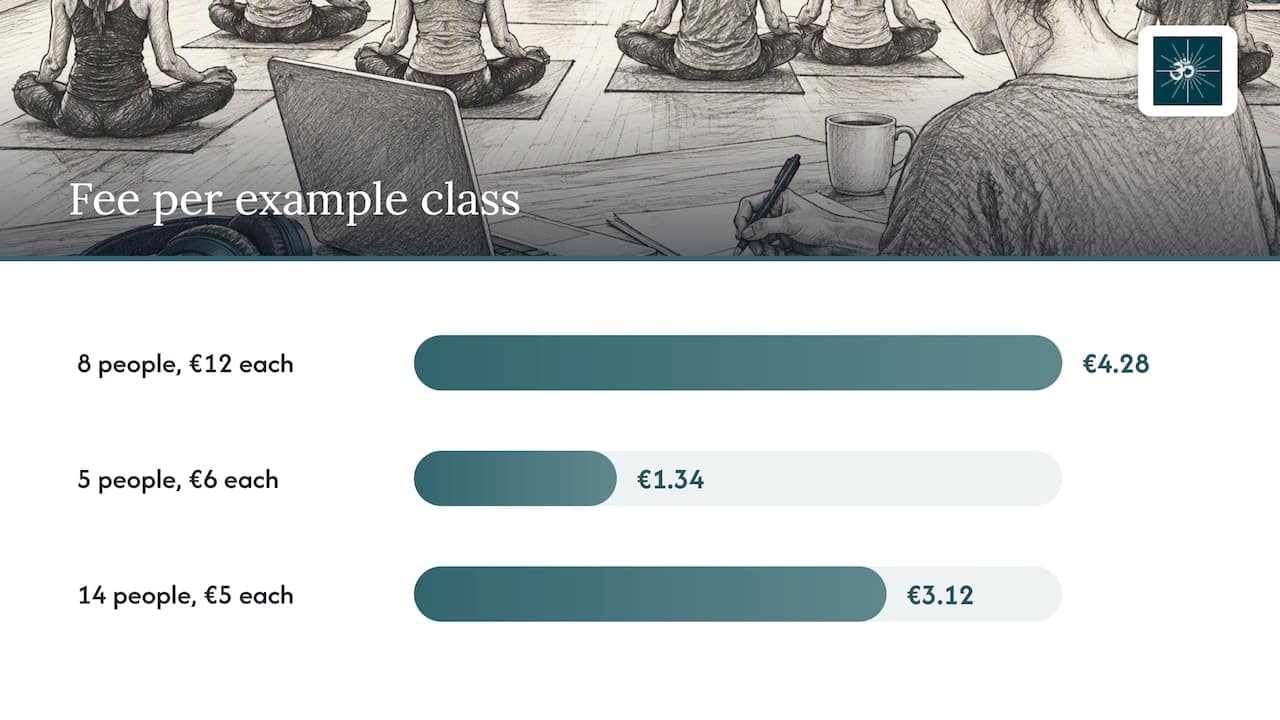
For courses with only individual fees (the typical drop-in or course-block model), the tariff document sets the rate at 4.46% of net revenue. There is also a minimum per hour: €0.54 for up to 10 participants, €0.81 for 11 to 15 participants, and a further €0.27 for every additional 5 participants.
Here is a worked example, using the published figures and invented class numbers:
| Scenario | Net course revenue | 4.46% of revenue | Minimum for the hours taught | Which applies |
|---|---|---|---|---|
| 8 participants, €12 each, 1 hour | €96 | €4.28 | €0.54 | Percentage (higher) |
| 5 participants, €6 each, 1 hour | €30 | €1.34 | €0.54 | Percentage (higher) |
| 14 participants, €5 each, 1 hour | €70 | €3.12 | €0.81 | Percentage (higher) |
The maths is mine, applied to the published rate, and it assumes the percentage and the minimum work as the tariff describes. Check the current document for how your own course structure is classified before you budget. The fees look modest per class, and for a small teacher they usually are. The real cost is administration: registration, reporting and keeping records straight.
What the registration involves
GEMA’s page for fitness studios lists music in courses (fitness, rehab gymnastics and similar) among the typical uses. In short, you register the use, report your courses and revenue, and pay. If you rent a room inside a studio, ask the studio who holds the licence. Sometimes the studio covers courses taught on its premises; sometimes it expects the teacher to report separately. Get the answer in writing, because “I thought the studio had it” is a sentence that has launched many an awkward invoice.
Route two: music outside the GEMA repertoire
The second route is to play only music that GEMA does not manage. This is what people mean by “GEMA-free” music, and it is the reason royalty-free libraries do well among German yoga teachers.
The catch is the so-called GEMA presumption. Under the GEMA-Vermutung, it is legally assumed that music used publicly belongs to the GEMA repertoire. Commercial users owe fees unless they can show, through detailed track lists, that the music they used is exclusively non-GEMA content. The burden of proof sits with you, not with GEMA.
That has three practical consequences.
- Keep a track list. Date, class, title, composer, source. A spreadsheet is fine.
- Keep the licence. Save the licence terms and the receipt for every track or subscription period.
- Do not mix. One stray pop song in the cool-down and your “GEMA-free” claim for that class is in trouble.
Royalty-free is not the same as GEMA-free
This is the misunderstanding I would most like to retire. “Royalty-free” generally means you pay once, or on a subscription, and then do not owe per-play royalties to the music’s producer. It says nothing about whether the composer has signed over rights to a collecting society. A composer who is a GEMA member generally brings their works into the GEMA repertoire, whatever the library calls its licence.
So before you rely on any library, including ours, ask three direct questions and get the answers in writing:
- Is the composer or producer a member of any collecting society for these tracks?
- Does the licence cover public playback in classes, and in which countries?
- Does it cover recording, streaming or uploading, or only live playback?
A reputable provider will answer plainly. If the reply is vague, treat that as the answer.
Online classes, videos and apps are a different licence
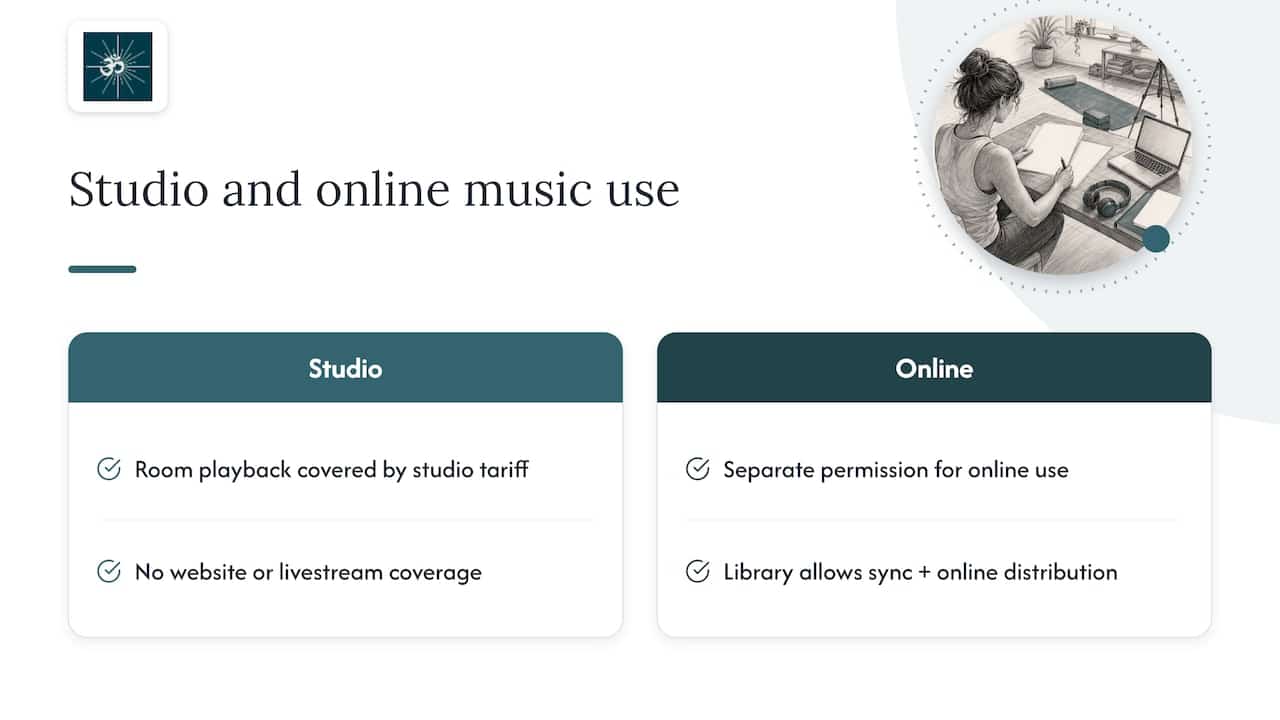
A studio tariff covers playback in a room. It does not cover putting music on your website, in a recorded course or in a livestream. GEMA treats online use separately, and for small-scale use under €24,000 net annual revenue from music content, the VR-OD 10 tariff applies a flat-fee model based on usage packages instead of the studio rules.
Two things follow. First, if you teach both in a studio and online, you may need two arrangements. Second, if your music comes from a library, the licence has to explicitly allow synchronisation (putting music to video) and online distribution. A personal-listening licence will not do.
If you are setting up a streaming schedule, this guide to livestreaming fitness classes for studio owners covers the practical side of running live and on-demand classes, and it is a good companion once your music rights are settled.
A quick decision guide
| Your situation | Likely route | What to keep |
|---|---|---|
| Teaching paid classes in a room, playing commercial music | GEMA registration (WR-KS-F) | GEMA contract, reports, revenue records |
| Teaching paid classes, playing only licensed non-GEMA music | Library licence plus track lists | Licence, receipts, track list per class |
| Selling recorded classes or running a membership site | Library licence that covers sync and online use, or a GEMA online licence | Licence wording, usage records |
| Building an app or guided-audio product | Professional or commercial licence | Written commercial licence, delivery records |
| Practising privately at home | Usually no licence for your own listening | Nothing special |
When two rows apply to you, the stricter one wins.
What a yoga teacher should look for in licensed music
Price is the loudest factor and rarely the most important one. Think about the following.
- Scope of use. Classes, workshops, retreats, online sales, apps, social media: does the licence name each one?
- Territory. A German studio is one thing; a retreat in Portugal is another.
- Duration. One-off licences can be perpetual; subscriptions often cover only the period you pay for. Find out what happens to videos you published once you cancel.
- Proof. Can the provider give you a licence document with your name and the tracks covered?
- Fit for the practice. Music for a vinyasa flow is not music for yin or savasana. Slow, spacious pieces with a steady, unobtrusive pulse tend to serve restorative work. This is craft, not science, but your students notice.
Our perspective
We make meditation music, so we have a stake here, and you should know that. Still, after years of watching teachers fight with this topic, we think the answer is simple: treat music as a professional input, like insurance or a mat supply, and document it.
Our approach starts from live musicians. Robert Emery, our composer and conductor, started piano at seven, studied at the Royal College of Music and has composed and produced across albums, stage and screen. Moritz Schneider, our composer and producer, has written for feature films, album productions and musicals for over 20 years. The two have worked together for around thirteen years, and in 2017 they wrote a musical, The Witch, that premiered in Switzerland. When Robert says that digital instruments “just don’t resonate with your body in the same way”, he is describing the whole reason this library exists: acoustic instruments played by people, recorded at Abbey Road Studios with the National Philharmonic.
Why does that matter for licensing? Because a library built by a small team of named composers is far easier to audit than a vast catalogue of anonymous uploads. You know who wrote the music and who to ask. If a student or a rights body queries a track, you have a name, a licence and an answer.
Our advice for any teacher, whichever library you choose: ask for your licence in writing, keep a track list, and never assume “royalty-free” answers the GEMA question for you. We would rather lose a sale than have you find out the hard way.
— ROBERT
Licensed music for classes from Orchestral Meditations
If you want orchestral, live-recorded music with binaural, theta and Solfeggio-frequency tracks for your classes, we offer two subscriptions and a professional library:
- The personal subscription costs €21 per month and suits your own practice and listening.
- The professional subscription costs €150 per month and is the one built for professional and commercial use.
- Our royalty-free meditation music library is where to look if you are licensing tracks for classes, therapy, apps, guided audio or wellness content. Prices there are not published, so check the page for the licence that fits.
If you are unsure which licence matches your plans, or you need written confirmation of the rights status for your records, get in touch via our site before you buy.
Mistakes we see again and again
Relying on a streaming subscription. A consumer plan from a streaming service is licensed for private listening. Playing it in a paid class is not covered by that.
Assuming small means exempt. A class of five people paying you is still a paid, public event in the eyes of the tariff, even if the fee is small.
Forgetting the video. Teachers who record a class for social media often find the licence was only for playback in the room. Added music in a post-production edit counts as a separate use.
Skipping the track list. If you go the non-GEMA route, your evidence is your records. No list, no defence.
Believing a YouTube tutorial is a licence. Videos explaining how to add background music to your yoga videos are useful, but they are not a rights document. The licence is whatever the music’s rights holder signed.
A simple setup you can finish this week
- List every place you play music: studio classes, workshops, retreats, online, social posts.
- Decide route one (GEMA) or route two (non-GEMA library) for each. Splitting is allowed, but keep each class clean.
- If you pick GEMA, contact GEMA and check which tariff your course structure falls under.
- If you pick a library, read the licence for scope, territory and duration, and save a copy.
- Start a track list now. One line per class.
- Tell the studio you rent from what you decided, and ask what they cover.
- Review once a year, or whenever you add a new format such as livestreams or an app.
That is about an afternoon of work, and it takes a nagging doubt off the table.
FAQ
Do I need a licence to play music in a yoga class in Germany?
In most paid classes, yes. Public use of music is generally covered by GEMA’s licensing, and under the GEMA presumption it is assumed that the music belongs to its repertoire unless you can prove otherwise. If you only use music you can show is outside GEMA, with a licence and a track list, you can avoid GEMA fees for those classes.
How much does GEMA charge for yoga classes?
For courses with only individual fees, the WR-KS-F rate is 4.46% of net course revenue, with minimum fees per hour starting at €0.54 for up to 10 participants. Courses with monthly fees follow a different rate within the same tariff, so check the tariff document for your own model.
Is royalty-free music automatically GEMA-free?
No. Royalty-free describes how you pay the music’s producer, not whether a collecting society manages the composer’s rights. Ask the provider in writing whether the tracks are outside the GEMA repertoire, and keep that answer with your records.
Can I use the same music in my online yoga classes?
Only if the licence covers it. Online use is licensed separately from studio playback, and GEMA has its own online tariffs, including VR-OD 10 for small-scale use. Make sure any library licence you buy explicitly allows recording, streaming and publishing.
Sources
- GEMA: tariff WR-KS-F for fitness and health courses
- GEMA: WR-KS-F tariff document
- GEMA: music for fitness studios
- GEMA: register and license music
- GEMA: online use of music and music videos
- GEMA: tariff VR-OD 10
- GEMA: questions and answers on copyright and usage rights
- Urheberrechtsgesetz, section 19
- Orchestral Meditations: about the composers