Meditation music can be a gentle companion during trauma recovery. It can help you settle your body, mark out a calm corner of the day and make sleep feel less like a negotiation. It is not trauma therapy. Therapy is a treatment, delivered by a trained professional inside a protective relationship. Music is a resource you can bring to that work, or use beside it.
That distinction matters, and most of the pages that rank for this topic blur it. Many promise to “remove all damage” in eleven hours of looping tones. We would rather tell you what the research actually shows and what a careful listening practice looks like. We will also say when to put the headphones down and call a professional.
TL;DR
- Music therapy, delivered by a trained therapist, has shown a clear benefit for PTSD symptoms against no treatment. Against other active treatments the difference was small, and the certainty of the evidence was rated low.
- Listening to meditation music is something you do yourself. It can support relaxation and sleep, but it does not replace trauma-focused treatment.
- Trauma-informed listening means starting with music that feels safe, keeping sessions short, keeping your eyes open if you want to, and stopping when you feel pressure or fear.
- In Germany, outpatient music therapy is generally not covered by statutory health insurance, so many people use music at home as a low-cost support between sessions.
- If meditation brings up panic, flashbacks or numbness, stop and speak to a psychotherapist or your GP.
Meditation music is not music therapy (and that is fine)
Let me start with a confession. When I first started recording for meditation, I assumed the word “healing” was a slightly decorative adjective, like “artisan” on a sandwich. Then I watched how people responded to live strings in a room, and I stopped being so cynical. Sound does something to the body. What it does, and for whom, is where the care comes in.
Here is the difference in plain terms:
| Meditation music | Music therapy | Trauma-focused psychotherapy | |
|---|---|---|---|
| Who leads | You | A trained music therapist | A trained psychotherapist |
| Purpose | Relaxation, focus, sleep, a calmer baseline | Therapeutic work through musical experience and relationship | Processing and treating traumatic stress |
| Personalised | You choose the music | The therapist tunes the work to you | Planned around your history and symptoms |
| Safety framework | Yours to build | Built in | Built in |
The German Music Therapy Society (DMTG) describes trauma-specific music therapy as work in which voice, sounds and instruments are used in a particularly dosed and careful manner because of the danger of overstimulation. It adds that a protective framework and a respectful, supportive relationship matter especially. A playlist cannot supply that relationship. What a playlist can do is give you a reliable, repeatable sound environment, which is a different and still useful thing.
What the research says about music and PTSD
The best-known recent evidence comes from a 2024 systematic review and meta-analysis of nine randomised trials with 527 people with PTSD. Post-treatment symptom scores were significantly lower in the music therapy groups than in groups that received no active treatment (SMD = −1.64). Against groups that received another active treatment, the difference was small and not statistically significant (SMD = −0.28). The authors rated the certainty of the evidence as low.
How should you read that? Three honest takeaways:
- Music-based work performed better than doing nothing. That is encouraging.
- It performed about as well as other active approaches, which makes it a reasonable partner to them rather than a rival.
- The studies were small and varied, so nobody should promise outcomes.
Note also that these were music therapy trials, with trained therapists. They tell us about structured treatment, not about pressing play on a long track in bed. We find it more useful to say so plainly than to borrow their results for ourselves.
Meditation and trauma: helpful, with care
Meditation research tells a similar story. A 2024 meta-analysis of 61 studies with 3,440 participants compared several meditation categories for trauma-related stress and found reductions across all of them, and no study reported serious side effects. An earlier 2017 systematic review of ten trials with 643 participants found that mindfulness-based stress reduction, yoga and mantram repetition, used as add-ons to usual care, improved PTSD and depression symptoms. The evidence quality was low to moderate, and only half the studies reported on safety.
There is a caveat worth taking seriously. A 2021 meta-analysis on military-related PTSD found mindfulness meditation reduced symptoms compared with control conditions, and its authors noted that meditation training might aggravate symptoms in some circumstances. That is not a reason to avoid calm music. It is a reason to practise in a way that keeps you in charge, which is what the rest of this article is about.
Binaural beats and theta music: what is actually known
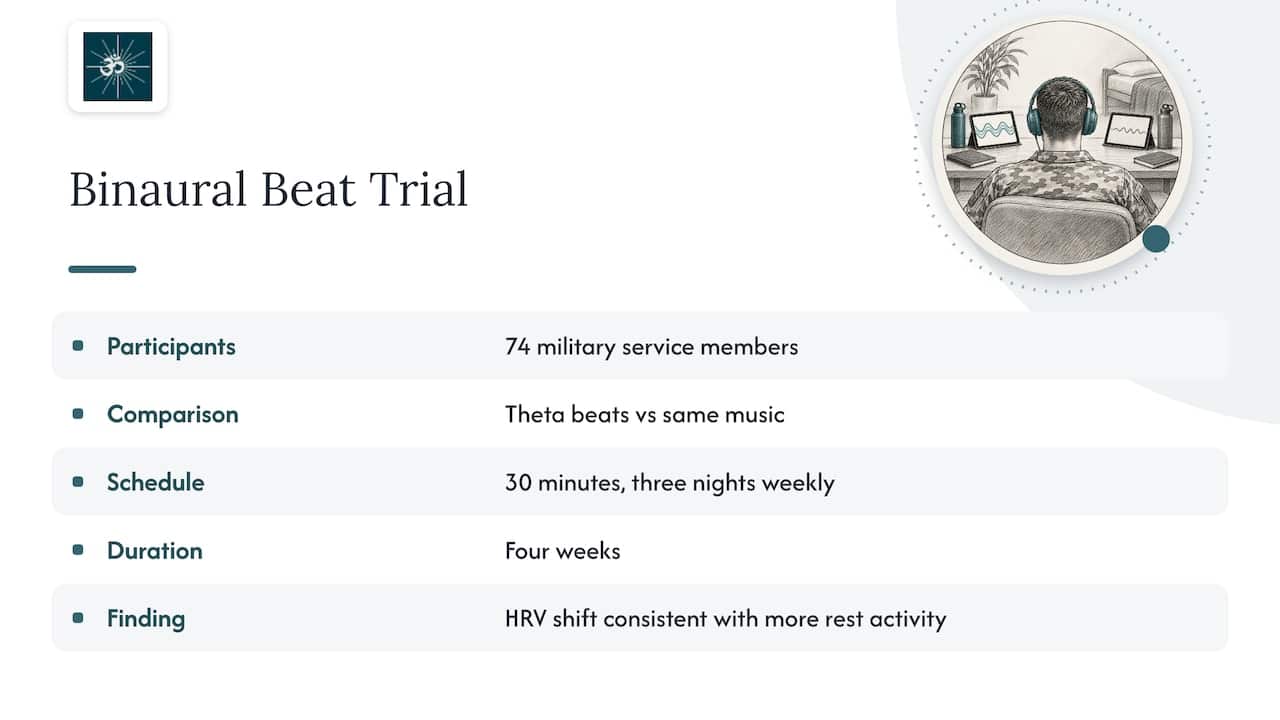
Binaural beats are the thing readers ask about most, so here is the one study we can point to with confidence. A 2017 double-blind randomised trial of 74 military service members with postdeployment stress compared music with embedded theta-range binaural beats against the same music without them. Over four weeks, with 30 minutes of listening at bedtime three nights a week, the binaural group showed a shift in heart-rate variability consistent with less sympathetic (stress) and more parasympathetic (rest) activity.
That is a small, specific finding about physiological arousal in one group. It is not a cure claim, and we do not make one. It does give a sensible reason why theta-range design is part of how we build certain tracks: it aims at the sleepy, slowed-down state in which the body can unwind. Headphones are needed for binaural effects, and the volume should be low enough to be comfortable.
As for the many videos promising that a single frequency will “free you from trauma”, we cannot point to evidence for that kind of promise. We would rather be a good soundtrack to your recovery than a miracle in a thumbnail.
Why live orchestral sound suits a nervous system that needs safety
People who have lived through frightening events often become expert at scanning for threat. A sudden synth stab, a harsh loop or an unexpected dynamic jump can set that scanner off. So what you want from calming music is predictability, warmth and room to breathe.
Annie Heiderscheit and Kathleen Murphy, writing for Oxford University Press, note that slow-tempo music of around 60 to 80 beats per minute can help slow heart and breathing rates and foster relaxation. They also stress that choosing the music yourself gives you a sense of control and empowerment. For a nervous system that has felt powerless, choice is part of the medicine.
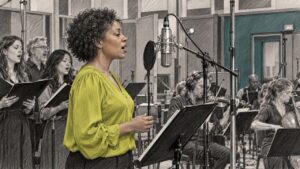
This is the design thinking behind our recordings. Our orchestral meditations are performed by live musicians, with sessions recorded at Abbey Road Studios with the National Philharmonic, and some in 3D surround sound. We believe acoustic instruments played by people carry a quality digital sounds do not, and our tracks are designed to support deep relaxation. They are designed for meditation, relaxation and sleep. They are not a clinical treatment, and we never present them as one.
How to listen safely: a trauma-informed routine
The same Oxford authors recommend starting with music where you feel safe and that does not add stress, and they warn that repeatedly listening to music that keeps you stuck in a low mood can be unhelpful. They add that a trauma-informed approach is a sound safety measure in everyday practice, because many people do not know they have experienced trauma.
Berlin trauma therapist Ninette Müllensiefen lists what the nervous system tends to need before inner observation becomes healing. It is a handy checklist to adapt for listening at home, as she describes on her practice’s site:
- Safety: a place and a person (or pet) that help you feel oriented and protected.
- Grounding: contact with the floor, your body and the room, rather than closing your eyes straight away.
- Titration: small, dosed steps rather than overwhelm.
- Pendulation: moving between something resourcing and something harder, and back again.
- Choice: permission to open your eyes, move, or stop at any moment.
- Accompaniment: an experienced trauma-informed professional in the background.
A five-minute starting routine
- Pick the room. Somewhere you feel secure, with the door positioned the way you like it. Keep the lights on or the curtains open if that helps.
- Keep your eyes open. Rest your gaze on a fixed point or let it wander. Closed eyes can come later, or never.
- Set the volume low and choose instrumental music at a slow, steady tempo. Avoid tracks with sudden swells until you know them.
- Feel the ground. Notice your feet, the chair, your hands on your knees. Do this before pressing play.
- Listen for five minutes. Not thirty. Stay with the sound of one instrument if your attention drifts.
- Finish on purpose. Stretch, drink some water, look around the room and name three things you can see.
If you want a gentler, structured way to practise, our guide to step-by-step guided meditation techniques walks through the basics at a relaxed pace.
Build a small “safe sound” library
The DMTG brochure describes how, in trauma-specific music therapy, therapists help clients find a calming tone or a grounding rhythm that can be drawn on in a crisis. You can borrow the spirit of that at home. Keep two or three pieces you know well and that reliably feel okay. Use them to end a session, to come back from a harder moment, or as a wind-down before bed. Familiarity is the point: surprises are for concerts.
Warning signs: when to stop and who to call
The same Berlin therapist explains that meditation can be very valuable for trauma survivors, but only when the nervous system has enough stability, orientation and safety. If it brings fear, pressure or restlessness instead of calm, she reads that as the nervous system protecting itself in its own way, which deserves respect rather than pushing through.
Meditation researcher Ulrich Ott of the University of Giessen told Deutschlandfunk Kultur that even simple breathing exercises can stir up inner processes, and that intensive practice can trigger anxiety, panic or psychotic episodes, in which case psychotherapeutic support is often needed. Gentle listening is far from a retreat-style intensive practice, but the principle holds.
Stop the session and reach out to a professional when you notice:
- flashbacks, intrusive images or a sense of reliving something;
- panic, racing heart, or feeling unable to breathe properly;
- dissociation: feeling numb, far away, or unreal;
- sleep getting worse rather than better after a few weeks of regular listening;
- thoughts of harming yourself.
In Germany, start with your GP (Hausärztin or Hausarzt), who can refer you to a psychotherapist, or contact a local crisis service. In an emergency, call 112. The Telefonseelsorge is available around the clock on 0800 111 0 111 or 0800 111 0 222.
A note on devices: some people go beyond headphones and use vibrating mats or tables that transmit sound through the body. If that interests you, read up on vibroacoustic contraindications and talk to your doctor first. Listening through speakers or headphones at a comfortable volume is the simplest and gentlest option.
Music therapy in Germany: what to expect
If you are wondering whether to pursue music therapy alongside your listening, it helps to know how it works here. Music therapy is excluded as an individual Heilmittel under § 33 SGB V and in the Heilmittel-Richtlinie, in the version last amended on 19 January 2023. The practical result is that statutory insurers generally do not pay for outpatient sessions. The VFP reports that cost coverage for outpatient music therapy was a core demand at the 13th European Music Therapy Congress in Hamburg, and that the DMTG chair, Professor Dr Lutz Neugebauer, is calling for changed financing.
So what does that mean for you?
- Music therapy is often available inside hospital, psychiatric and rehabilitation stays.
- Outpatient sessions are usually self-funded, so ask providers about group formats, which tend to cost less.
- Trauma-focused psychotherapy is a separate route, and your GP can help you find the right door.
- Daily listening at home is a low-cost way to keep the calm going between appointments.
The people behind our music
Music that is meant to be heard by sensitive ears should come from people who care how it lands. Our composers and producers, Robert Emery and Moritz Schneider, have worked together for thirteen years and are, helpfully, best friends. That matters in a studio: you need to be able to say “that cello entry is too sharp” and still go for dinner.
Robert is a composer and conductor who started piano at seven and studied at the Royal College of Music. He puts his belief simply: acoustic instruments played by humans resonate with the body in a way digital ones don’t. Moritz has written for feature films, albums and musicals for over 20 years, and believes the frequencies of a live instrument played by a talented heartbeat cannot be beaten. Together they produce the recordings you hear on our site, including the Abbey Road sessions.
Perspective: why we make music this way
We are often asked whether our music “treats” trauma. We answer honestly: no piece of recorded music is a therapy, and we would be uncomfortable if you came to us hoping for one. What we make is a sound space in which a nervous system can feel a little safer than it did an hour ago.
That is why we record with live musicians. When a cellist breathes into a phrase, the phrase has a human shape: slightly uneven, never mechanical. We believe your body recognises that, and that it is part of why people tell us our tracks help them settle. We shape tempo, texture and dynamics for calm, avoid harsh transients, and offer theta-range and Solfeggio-based pieces for people who like those approaches.
Our advice to anyone with a trauma history is the same advice we would give a friend: pick something that feels safe, keep it short, keep your eyes open if you want to, and let a trained professional lead the heavy lifting. Then let the music do what it does best, which is make the in-between hours softer.
ROBERT
Bring orchestral calm into your routine
If you would like a steady supply of calming, live-recorded music for your own practice, our personal subscription costs €21 per month. It gives you a growing library to build that “safe sound” collection from.
If you are a therapist, yoga teacher, app developer or content creator who needs licensed music for sessions or products, the professional subscription costs €150 per month, and our royalty-free meditation music page explains the professional options. You can also start from our home page and browse.
FAQ
Can meditation music heal trauma?
No recording can heal trauma on its own. Trauma is treated through trauma-focused psychotherapy, and trained music therapists can support that work. Calm, well-chosen music can be a helpful companion for relaxation and sleep alongside professional care.
Is music therapy covered by German health insurance?
Generally not for outpatient sessions. Music therapy is excluded as an individual Heilmittel in the statutory system, though it is commonly part of hospital, psychiatric and rehabilitation stays. Ask your insurer and the therapist about your specific situation.
Are binaural beats safe if I have PTSD?
The one randomised trial we know of, in service members with postdeployment stress, reported shifts in heart-rate variability and no harm in that setting. Individual reactions vary, so begin at low volume, listen briefly, and stop if you feel agitated. If you are in treatment, mention your listening to your therapist.
Should I close my eyes when I listen?
Only if it feels safe. Many trauma-informed therapists suggest staying grounded in the room first, with eyes open and feet on the floor. You can always close them later or never.
Sources
- Efficacy and acceptability of music therapy for PTSD, meta-analysis (2024)
- Effectiveness of meditation techniques in treating trauma-related stress, meta-analysis (2024)
- Meditation for posttraumatic stress: systematic review (2017)
- Military-related PTSD and mindfulness meditation, meta-analysis (2021)
- The effect of binaural beat technology on postdeployment stress (2017)
- DMTG: Musiktherapie mit traumatisierten Menschen
- Oxford University Press blog: managing the power of music to foster safety
- Ninette Müllensiefen: Warum Meditation bei Trauma problematisch sein kann
- Deutschlandfunk Kultur: Wann Meditation hilft und wann sie schadet
- Wolters Kluwer: Ist Musiktherapie eine Leistung des SGB?
- VFP: Fachleute fordern Kostenerstattung bei Musiktherapie
- Vibroacoustic contraindications