
Sound frequencies are defined as vibrations measured in hertz (Hz) that the human auditory system perceives as pitch, tone, and texture. The healthy human ear perceives frequencies from 20 Hz to 20,000 Hz, though sensitivity above 15–17 kHz declines noticeably with age. That range is not just a technical curiosity. Every frequency within it carries a distinct emotional and physiological weight, which is precisely why composers like Robert Emery and producers like Moritz Schneider treat the frequency spectrum as their primary creative instrument. Emery, whose orchestral compositions have been recorded at Abbey Road Studios with the National Philharmonic, and Schneider, whose production work shapes the spatial and harmonic character of those recordings, both understand that choosing the right frequencies is as deliberate as choosing the right melody.
How do different sound frequency ranges affect mental health and relaxation?
The audio frequency range is not one undifferentiated wash of sound. It divides into distinct bands, each with its own character and effect on the listener.
The standard frequency band categories are:
- Sub-bass (20–80 Hz): The frequencies you feel more than hear. Sub-bass creates a sense of physical grounding. Think of the low rumble of a cello section playing pianissimo. At the right volume, it can slow breathing and reduce physical tension.
- Bass (80–250 Hz): The warmth and body of sound. Bass frequencies give music its sense of weight and presence. Too much, and a piece feels muddy. Too little, and it feels thin and anxious.
- Midrange (250–4,000 Hz): The most information-dense part of the spectrum. The human voice, most orchestral instruments, and the harmonic overtones that define timbre all live here. This is where emotional meaning is communicated most directly.
- Treble (4,000–20,000 Hz): Clarity, air, and sparkle. High frequency waves add definition and space to a recording. They also carry the greatest risk of listener fatigue if mishandled.
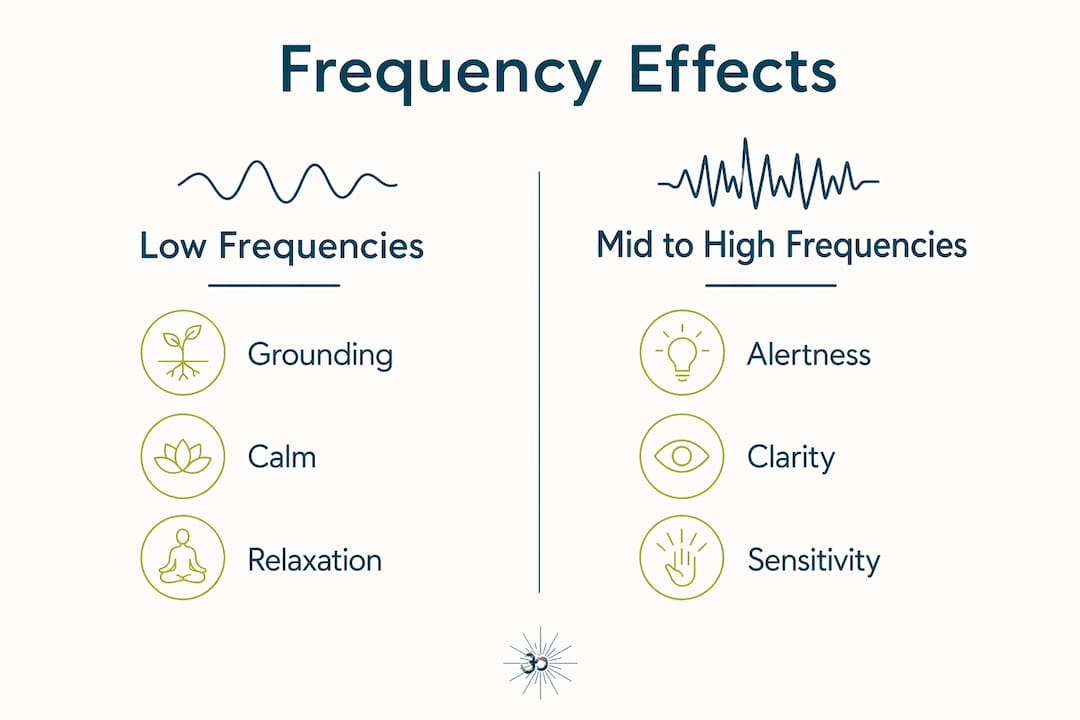
Each of these bands influences perception and emotional response in a different way. Sub-bass and bass frequencies tend to feel grounding and calming. Midrange frequencies carry emotional nuance. Treble frequencies create alertness and, when overdone, discomfort.
Robert Emery’s compositions for Orchestralmeditations deliberately balance these bands. The orchestral arrangements use the warmth of strings in the bass and lower midrange to create a sense of safety, while Moritz Schneider’s production ensures the treble remains present but never harsh. The result is a soundscape that feels enveloping rather than intrusive.
Human ears are most sensitive to frequencies between 2 kHz and 5 kHz. That sensitivity peak means sounds in this range feel louder than they actually are, which is why poorly mixed meditation music can feel grating even at modest volumes.
Pro Tip: Start any new listening session at a lower volume than you think you need, particularly with treble-rich recordings. Your ears will adjust, and you will avoid the fatigue that makes relaxation impossible.
Why do harmonics and timbre matter more than pitch alone?
Most people think of sound frequency as simply pitch. A note is high or low. But that framing misses most of what makes sound therapeutically useful or emotionally resonant.
What timbre actually is
Timbre depends on harmonic content beyond the fundamental frequency. When a cello and a flute play the same note at the same volume, you hear them as completely different instruments. The fundamental pitch is identical. What differs is the pattern of overtones, called harmonics, that sit above that fundamental. Those harmonics are what give each instrument its unique texture, warmth, or brightness.
This matters enormously for meditation music. A pure sine wave at 432 Hz is technically a sound frequency, but it is about as relaxing as a dial tone. The same pitch played by a string section, with its complex web of harmonics, creates depth, movement, and emotional resonance that a pure tone simply cannot replicate.
How harmonic layering creates relaxation
Harmonic layering in meditation music creates depth and relaxation more effectively than single pure tones. This is not a subjective preference. It reflects how the auditory cortex processes complex sound. Rich harmonic content engages more neural pathways, which appears to support the kind of sustained, diffuse attention that characterises deep relaxation and meditation.
Robert Emery’s orchestral writing for Orchestralmeditations exploits this principle deliberately. His string arrangements layer multiple harmonic voices, creating what listeners often describe as a “surrounding” quality. Moritz Schneider’s production then preserves and enhances that harmonic richness through careful use of 3D surround sound techniques, ensuring that the spatial spread of harmonics feels natural rather than artificially processed.
The international standard tuning reference places A4 at 440 Hz, with each octave defined as a doubling of frequency. That means the harmonic series above any given note follows a mathematically predictable pattern. Composers who understand this can write music where the harmonics of different instruments align and reinforce each other, creating a coherent, resonant whole rather than a muddy clash.
Pro Tip: When choosing meditation music, listen for recordings that feel “full” even at low volumes. That fullness is harmonic richness at work. If a track sounds thin or hollow when played quietly, it will not deliver the therapeutic depth you are looking for.
How do room acoustics affect your meditation listening experience?
Here is something most wellness guides completely ignore: the room you sit in shapes the sound frequencies you actually hear, often more dramatically than the recording itself.

Room modes and standing waves
Room modes cause standing waves particularly in bass frequencies between 40 Hz and 120 Hz. A standing wave forms when a sound wave bounces between two parallel walls and the reflected wave reinforces or cancels the original. The result is that certain bass frequencies become dramatically louder in some spots in the room and almost inaudible in others. You can test this yourself by playing a low bass tone and walking slowly across your room. The volume will rise and fall noticeably.
For meditation, this matters because room acoustics influence low-frequency perception greatly. If you happen to sit in a bass null (a spot where the standing wave cancels itself), the grounding warmth of the sub-bass and bass frequencies disappears entirely. The music loses its physical presence, and the calming effect diminishes.
Wavelengths and why low frequencies are hard to control
The wavelength formula is straightforward: wavelength equals the speed of sound divided by frequency. Low frequencies have long wavelengths that require specific room treatments to manage properly.
The table below illustrates the relationship between frequency and wavelength, with real-world analogies to make the physics tangible.
| Frequency | Approximate wavelength | Real-world analogy |
|---|---|---|
| 40 Hz | ~8.5 metres | Roughly the length of a double-decker bus |
| 80 Hz | ~4.3 metres | About the height of a two-storey house |
| 250 Hz | ~1.4 metres | Slightly taller than an average adult |
| 1,000 Hz | ~34 centimetres | The length of a standard ruler |
| 4,000 Hz | ~8.5 centimetres | About the width of a smartphone |
A wavelength of 8.5 metres cannot be absorbed by a thin foam panel on the wall. That is why bass traps, which are thick, dense acoustic absorbers placed in room corners, are the only effective treatment for low-frequency standing waves. Standard soft furnishings help with midrange and treble but do almost nothing for bass.
Practical positioning for meditation
Proper seating and acoustic treatment mitigate room mode issues for a better meditation sound experience. The most practical advice, short of installing bass traps, is to avoid sitting directly against a wall or in the exact centre of the room. Both positions tend to coincide with the worst standing wave nodes. Sitting roughly one third of the way along the room’s length often provides the most balanced bass response.
You can also use the audio frequency and wavelength calculator from BoomSpeaker to identify the specific room modes your space produces, based on its dimensions. Knowing which frequencies are problematic lets you make informed choices about speaker placement and seating position.
Pro Tip: Place a thick rug, a bookshelf full of books, or a large sofa between yourself and the wall behind you. These irregular surfaces scatter midrange and treble reflections, making the overall sound feel more natural and less “boxy,” even if they cannot fully tame the bass.
What practical steps help you use healing sound vibrations effectively?
Getting the most from frequency-based meditation music is less about finding a magic frequency and more about creating the right conditions for sound to do its work.
Volume, exposure, and ear health
Gradual volume increase prevents ear fatigue, particularly during high-frequency exposure in meditation music listening. Start low. Give your ears two or three minutes to adjust before deciding whether to increase the volume. This is especially relevant for recordings that feature prominent treble content, such as singing bowls, flutes, or high string harmonics.
High-frequency sounds around 3–4 kHz are perceived as louder than lower frequencies at the same physical volume. This explains why a meditation track can feel fatiguing even when the volume meter reads low. The solution is not to turn everything down indiscriminately but to be aware of this sensitivity and adjust accordingly.
Do’s and don’ts for therapeutic listening
Do:
- Choose recordings with rich harmonic content rather than pure tones or heavily synthesised sounds.
- Use headphones or quality speakers that reproduce the full 20 Hz to 20,000 Hz range without distortion.
- Listen in a room with some soft furnishings to reduce harsh reflections in the midrange and treble.
- Explore frequencies for meditation to understand which frequency ranges suit different relaxation goals.
- Give yourself at least 20 minutes per session. The nervous system needs time to respond to sustained sound exposure.
Don’t:
- Play meditation music at high volumes, particularly if the recording features prominent frequencies in the 2–5 kHz sensitivity range.
- Use earbuds with a poor seal, as they leak bass frequencies and distort the frequency balance the composer intended.
- Expect instant results from a single session. Consistent, regular listening produces cumulative benefits.
- Ignore discomfort. If a particular recording causes tension or irritation, the frequency balance is wrong for your current state.
Orchestralmeditations’ catalogue, shaped by Robert Emery’s compositional expertise and Moritz Schneider’s production craft, is built around these principles. The recordings are designed to deliver the full therapeutic benefit of orchestral sound frequencies without the fatigue that poorly balanced audio produces. For a broader understanding of how these principles apply across different healing contexts, the complete guide to sound healing is worth reading alongside this article.
Key takeaways
Sound frequencies shape mental and emotional states through their physical properties, harmonic content, and interaction with the listening environment, making informed listening as important as the music itself.
| Point | Details |
|---|---|
| Human hearing range | The audible range spans 20 Hz to 20,000 Hz, with sensitivity peaking between 2 kHz and 5 kHz. |
| Frequency bands and mood | Sub-bass grounds, bass warms, midrange communicates emotion, and treble adds clarity but risks fatigue. |
| Harmonics over pure tones | Rich harmonic content relaxes more effectively than pure tones, which is why orchestral recordings outperform synthesised ones. |
| Room acoustics matter | Standing waves in bass frequencies alter what you actually hear; seating position and soft furnishings make a measurable difference. |
| Gradual volume exposure | Starting at low volume and increasing slowly protects against ear fatigue, especially in the treble-sensitive range. |
What I have learned from years of listening to sound frequencies
I will be honest with you: I spent years thinking that meditation music was meditation music. A bit of ambient drone, some reverb, perhaps a singing bowl fading in and out. Job done. It was only when I started paying serious attention to the work of composers like Robert Emery that I realised how much I had been missing.
Emery’s background in orchestral composition means he approaches frequency not as a wellness gimmick but as a craft problem. How do you write for strings in a way that the harmonic overtones reinforce each other rather than clash? How do you use the bass register to create physical calm without making the music feel heavy? These are questions a serious composer asks, and the answers show up in the listening experience in ways that are genuinely difficult to articulate but immediately felt.
Moritz Schneider’s contribution as producer is equally significant. Production at the level Schneider works at, using 3D surround sound and binaural techniques recorded at Abbey Road Studios, is not about adding effects. It is about preserving the spatial and harmonic integrity of the original performance. When you listen to an Orchestralmeditations recording, the sense of being surrounded by sound is not an illusion created in post-production. It reflects the actual acoustic character of the room and the ensemble.
The misconception I see most often in wellness circles is the idea that a specific frequency number is the active ingredient. “Listen to 432 Hz and feel better.” The number is almost irrelevant without the harmonic context around it. A poorly recorded pure tone at 432 Hz will do far less for you than a beautifully arranged orchestral piece at standard 440 Hz tuning. Context, timbre, and harmonic richness are what actually move the nervous system. The frequency label is just the address. What matters is what lives there.
— ROBERT
Orchestralmeditations: where frequency science meets orchestral craft
If this article has made you curious about what thoughtfully composed, frequency-aware meditation music actually sounds like, Orchestralmeditations offers a direct answer.

The platform’s catalogue, composed by Robert Emery and produced by Moritz Schneider, is built on the principles covered here: careful frequency balance across the full audio range, rich harmonic layering from live orchestral recordings, and spatial production that places you inside the sound rather than in front of it. Every recording was made at Abbey Road Studios with the National Philharmonic, which means the acoustic quality is not a marketing claim. It is audible from the first few seconds. Browse the orchestral meditation music collection to find recordings matched to your specific relaxation and wellbeing goals. You can also explore therapeutic orchestral soundscapes to understand the compositional thinking behind each piece.
FAQ
What is the human audible frequency range?
The healthy human ear perceives sound from 20 Hz to 20,000 Hz. Sensitivity above 15–17 kHz typically declines with age.
Which sound frequencies are best for meditation and relaxation?
Sub-bass and bass frequencies (20–250 Hz) create physical grounding and calm, while harmonically rich midrange content (250–4,000 Hz) carries emotional depth. The most effective meditation recordings combine both.
Why do some meditation tracks cause ear fatigue?
Human hearing is most sensitive between 2 kHz and 5 kHz, meaning sounds in this range feel louder than their actual volume. Recordings with excessive energy in this band cause fatigue even at modest listening levels.
How do room acoustics affect what I hear during meditation?
Room modes create standing waves, particularly in bass frequencies between 40 Hz and 120 Hz, which cause uneven bass response depending on where you sit. Avoiding positions directly against walls or in the room’s exact centre reduces this effect.
Does the specific frequency number matter for healing sound vibrations?
The fundamental frequency matters less than the harmonic content surrounding it. A richly harmonised orchestral note at standard 440 Hz tuning produces more therapeutic benefit than a pure tone at any specific “healing” frequency.