Energy frequencies are defined as the oscillations of sound and vibrational energy that interact with the body’s physical and energetic systems to influence mood, focus, and wellbeing. If that sounds a bit like something your yoga teacher says while burning incense, bear with me. There is genuine science here, and it is worth understanding properly. The field sits at the intersection of acoustic physics, neuroscience, and wellness practice, drawing on techniques like brainwave entrainment, Solfeggio frequency tuning, and binaural beat therapy. Composers such as Robert Emery and Moritz Schneider have spent careers translating these principles into music that actually works in a meditation session, not just in a laboratory. This guide covers what vibrational energy really means, which frequency ranges do what, and how you can use sound practically for personal healing.
What are energy frequencies and how do they work?
Energy frequencies, in the acoustic sense, are the number of sound wave cycles that occur per second, measured in hertz (Hz). One cycle per second equals 1 Hz. A bass guitar note sits around 80–100 Hz; a soprano singing a high C reaches roughly 1,046 Hz. The term “energy frequency” is widely used in wellness contexts, but the recognised physics term is simply frequency, and understanding that distinction matters.

In physics, photon energy is directly proportional to frequency. Gamma rays at approximately 10^20 Hz carry vastly more energy than radio waves at approximately 10^6 Hz. That relationship, expressed as E = hf, is why higher frequencies carry more energy at the electromagnetic level. Sound frequencies operate differently. They are mechanical waves moving through air or tissue, not electromagnetic radiation. The energy they carry depends on amplitude (volume) as much as frequency.
Vibrational energy in molecules involves quantised periodic motion, where molecules absorb specific frequencies and transition between energy states. This is the basis of spectroscopy. It is a real and measurable phenomenon, but it is fundamentally different from the acoustic sound frequencies used in meditation. Conflating the two is the most common misconception in wellness writing about vibrational healing.
Here is the honest picture: acoustic sound frequencies do not directly alter molecular vibration in the way spectroscopy does. What they do, when applied thoughtfully, is influence the nervous system, brainwave states, and emotional responses through resonance and entrainment. That is still genuinely powerful. It just works through different mechanisms than some wellness content implies.
- Frequency (Hz): the number of wave cycles per second; the core unit of measurement for sound
- Amplitude: the height of the wave, which determines volume and perceived intensity
- Resonance: when an object or system vibrates most efficiently at a specific frequency
- Entrainment: the tendency of the brain to synchronise its electrical activity with an external rhythmic stimulus
- Vibrational energy: in acoustics, the kinetic energy carried by a sound wave through a medium
Pro Tip: When reading wellness content about “vibrational healing,” check whether the author means acoustic sound frequencies or molecular vibration. They are related concepts but not interchangeable. Knowing the difference helps you evaluate claims accurately.
How do different frequency ranges affect your mind and body?
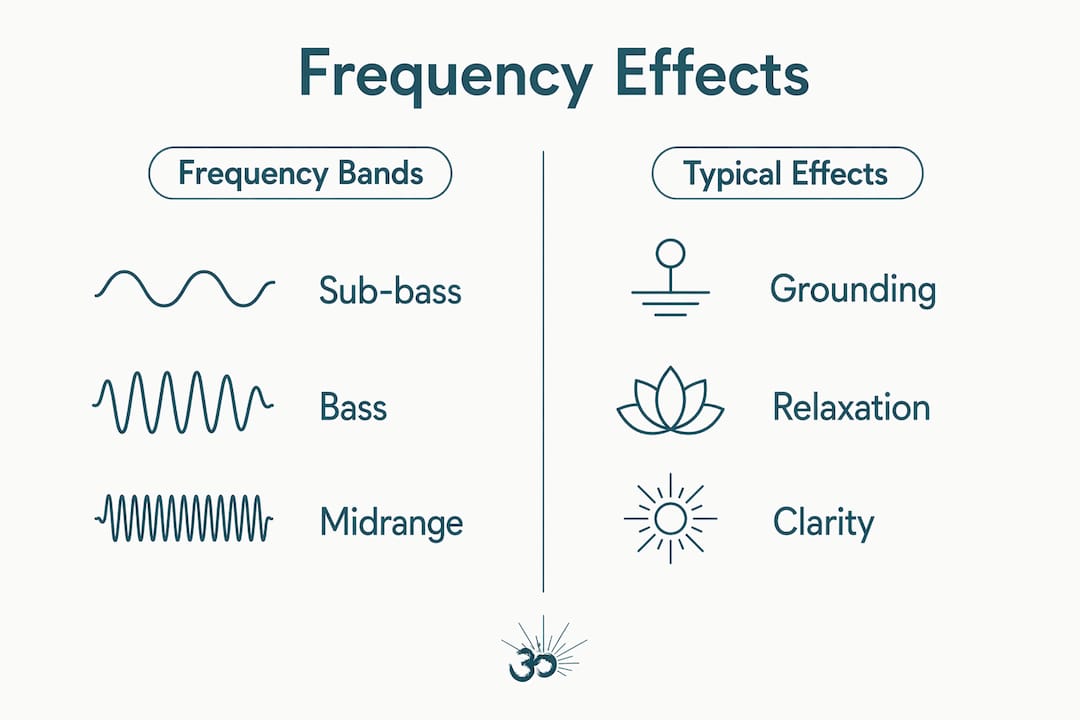
The audio frequency spectrum divides into four main bands, each with distinct perceptual and physiological effects. Understanding these bands is the foundation of any serious sound wellness practice.
| Frequency band | Range | How it is perceived | Typical effects |
|---|---|---|---|
| Sub-bass | 20–60 Hz | Felt physically in the chest and body | Deep calm, grounding, physical relaxation |
| Bass | 60–250 Hz | Heard and felt; adds warmth and fullness | Emotional depth, sense of security |
| Midrange | 250–4,000 Hz | Primarily heard; captures speech and melody | Mental clarity, focus, emotional engagement |
| Treble | 4,000–20,000 Hz | Heard as brightness and detail | Alertness, spatial awareness, energy |
Human hearing spans 20 Hz to 20,000 Hz, though age-related hearing loss commonly reduces the upper limit to 15–17 kHz for most adults. That upper-range decline is gradual and often unnoticed, but it does affect how you perceive high-frequency content in meditation recordings.
Human hearing sensitivity peaks around 3–4 kHz, which is why identical volume levels across different frequencies do not feel equally loud. A 60 Hz bass tone at 70 decibels sounds noticeably quieter than a 3 kHz tone at the same decibel level. This non-linearity is why gradual volume adjustment matters so much in sound wellness practice. Jumping straight to high volume at unfamiliar frequencies can cause ear fatigue before you have even settled into a meditation.
Sub-bass frequencies below 60 Hz deserve special mention. These frequencies are often felt rather than heard, registering as physical sensation in the chest, abdomen, and even the bones. Think of standing near a large pipe organ during a low pedal note. You feel it in your sternum before your ears fully process it. Reproducing these frequencies cleanly requires capable hardware. Standard laptop speakers or cheap earbuds will distort or simply fail to produce sub-bass, which strips the experience of its most physically grounding quality.
Pro Tip: If you are using sub-bass frequencies for relaxation or grounding, invest in over-ear headphones with a frequency response that extends to at least 20 Hz. Many mid-range consumer headphones roll off below 40 Hz, which means you are missing the most physically resonant part of the spectrum.
What scientific evidence supports healing frequencies?
The scientific case for sound-based healing is more nuanced than either enthusiasts or sceptics tend to admit. The evidence is real, but it is specific. Sound frequencies influence the nervous system through measurable mechanisms, not through vague “energy transfer.”
Brainwave entrainment is the best-documented mechanism. The brain produces electrical oscillations at different frequencies depending on mental state: delta waves (0.5–4 Hz) during deep sleep, theta waves (4–8 Hz) during light meditation and creativity, alpha waves (8–13 Hz) during relaxed wakefulness, and beta waves (13–30 Hz) during active thinking. When you listen to rhythmic audio at a specific frequency, the brain tends to synchronise its own electrical activity to match. This is entrainment. Binaural beats exploit this by playing slightly different frequencies in each ear, with the brain perceiving the difference as a third, internal frequency. Theta frequency tracks, like those produced by Orchestralmeditations, target the 4–8 Hz range associated with deep meditative states.
Vibrational resonance can be enhanced through phase modulation, producing greater efficiency in energy transfer. Applied to sound wellness, this suggests that carefully modulated frequency content, rather than a single static tone, produces more effective physiological responses. This is precisely why well-produced meditation music outperforms a simple tone generator for sustained practice.
“Flat frequency response is an ideal rarely achieved in real listening environments. Listeners should adjust volume gradually when using sound-based wellness practices to avoid ear fatigue or ineffective exposure. Non-linear hearing sensitivity means that what sounds moderate at one frequency can be fatiguing at another.”
Room acoustics dramatically influence sound perception. Bass frequencies in particular can boom or disappear entirely depending on room dimensions, because room modes occur when room dimensions equal half the wavelength of a given sound. A 40 Hz tone has a wavelength of roughly 8.5 metres. In a small bedroom, that creates standing waves that make the bass response wildly uneven. Headphones eliminate this variable entirely, which is one practical reason why serious practitioners prefer them for frequency-based meditation.
The science behind healing sounds continues to develop, with researchers examining how specific frequencies influence cortisol levels, heart rate variability, and pain perception. The evidence base is growing, though it remains an active area of research rather than settled consensus.
Key mechanisms supported by current research:
- Brainwave entrainment: rhythmic audio synchronises neural oscillations to target frequency bands
- Autonomic nervous system modulation: low-frequency sound reduces sympathetic activation and promotes parasympathetic response
- Resonance effects: certain frequencies create sympathetic vibration in body tissues, particularly at low Hz ranges
- Psychological conditioning: repeated association of specific frequencies with relaxation states creates a conditioned response over time
How can you use sound frequencies for healing and meditation?
Practical application is where most people get stuck. The theory is interesting; knowing what to actually do on a Tuesday evening when you want to decompress is more useful.
-
Start with a defined intention. Choose whether you want deep relaxation (theta or delta range, 4–8 Hz or below), focused calm (alpha range, 8–13 Hz), or energised clarity (low beta, 13–15 Hz). Different intentions call for different frequency targets.
-
Choose your listening environment carefully. Headphones are the most reliable option for frequency-specific work, because they eliminate room acoustic variables. If you prefer speakers, a treated room or open outdoor space reduces the standing wave problem. Sound frequencies and their effects on health vary significantly depending on how cleanly they are reproduced.
-
Set volume before you begin. Start at a comfortable conversational level and adjust downward if needed. Because hearing sensitivity peaks at 3–4 kHz, midrange-heavy content can feel louder than bass-heavy content at the same decibel level. Gradual adjustment protects against ear fatigue.
-
Allow at least 20 minutes per session. Brainwave entrainment takes time. The brain does not snap instantly to a new frequency state; it drifts gradually. Sessions under 10 minutes rarely produce the deeper effects associated with theta or delta entrainment.
-
Progress frequency ranges gradually. If you are new to sub-bass content, begin with bass-range material (60–250 Hz) before moving to sub-bass (20–60 Hz). The physical sensation of sub-bass can feel disorienting if you are not accustomed to it.
-
Use quality source material. This is where the artistry of composers like Robert Emery and Moritz Schneider becomes practically relevant. Robert Emery is a composer and producer whose work spans orchestral and ambient music, with a particular focus on the therapeutic application of sound. Moritz Schneider brings a background in classical composition and sound engineering, contributing to the technical precision that makes Orchestralmeditations recordings effective rather than merely pleasant. Their tracks, recorded at Abbey Road Studios with the National Philharmonic, are engineered to specific frequency targets, not assembled from generic loops.
-
Track your responses. Keep a brief note of which frequencies or tracks produce the most consistent relaxation or focus response for you. Individual variation is real. The best frequency for the human body varies between people, and personal observation is the most reliable guide.
Pro Tip: Pair your frequency meditation with energy healing practices like pranic breathing to amplify the body’s response to vibrational sound. The combination of breathwork and targeted frequency listening produces noticeably deeper states of calm than either practice alone.
Key takeaways
Sound-based healing works through measurable mechanisms, including brainwave entrainment, resonance, and autonomic nervous system modulation, and its effectiveness depends on frequency selection, listening environment, and source quality.
| Point | Details |
|---|---|
| Frequency basics matter | Energy frequencies are measured in Hz; acoustic and molecular vibration are related but distinct phenomena. |
| Frequency bands have specific effects | Sub-bass grounds physically, bass adds warmth, midrange aids clarity, and treble increases alertness. |
| Hearing is non-linear | Peak sensitivity at 3–4 kHz means volume must be adjusted gradually to avoid fatigue at different frequencies. |
| Environment shapes the experience | Room acoustics distort bass frequencies; headphones are the most reliable option for frequency-specific practice. |
| Source quality determines results | Professionally produced recordings, engineered to specific frequency targets, outperform generic tone generators for sustained meditation. |
Why I think most people are using sound frequencies backwards
Here is something I have noticed after years of working with meditation music: most people treat frequency selection like a vending machine. They pick “528 Hz for healing” or “432 Hz for relaxation” because they read it somewhere, press play, and then wonder why nothing much happens after three minutes. The frequency number is almost beside the point if the recording itself is poorly produced, played through tinny speakers, or listened to while checking emails.
The real variable is attention. Frequency alignment, in my experience, is less about hitting a precise Hz target and more about creating the conditions where your nervous system actually lets go. That requires good source material, a decent listening environment, and enough uninterrupted time for entrainment to occur. When I first heard the Orchestralmeditations recordings by Robert Emery and Moritz Schneider, what struck me was not the frequency specification but the space in the music. There is a quality to orchestral recordings made at Abbey Road Studios with live musicians that synthetic tracks simply cannot replicate. The room acoustics, the natural harmonic overtones of real instruments, the breath of the performance. These qualities matter to the nervous system in ways that are difficult to quantify but very easy to feel.
My honest advice: spend less time researching which specific frequency number to use, and more time finding music that actually quiets your mind. The benefits of sound frequency healing are real, but they arrive through consistent, attentive practice rather than frequency number optimisation. Start there.
— ROBERT
Orchestralmeditations: meditation music built around vibrational alignment
Orchestralmeditations produces meditation music specifically engineered around the frequency principles covered in this article. The recordings, composed by Robert Emery and Moritz Schneider, were captured at Abbey Road Studios with the National Philharmonic, giving them the acoustic depth and harmonic richness that supports genuine brainwave entrainment.
The catalogue includes binaural beat tracks, theta frequency compositions, Solfeggio-based pieces, and 3D surround sound recordings designed for deep meditative states. Each track targets specific frequency ranges for relaxation, focus, or healing, rather than offering generic ambient music. If you want to experience what professionally produced, frequency-targeted meditation music actually sounds like, the Orchestralmeditations library is the place to start.
FAQ
What are energy frequencies in simple terms?
Energy frequencies are the oscillations of sound waves, measured in cycles per second (Hz), that interact with the body and nervous system to influence mood, focus, and physical relaxation. In wellness contexts, the term refers specifically to acoustic frequencies used in meditation and sound healing.
What frequency range is most effective for meditation?
Theta frequencies in the 4–8 Hz range are most closely associated with deep meditative states, light sleep, and creative insight. Alpha frequencies at 8–13 Hz support relaxed, focused wakefulness and are a good starting point for beginners.
Do I need special equipment to use healing frequencies?
Over-ear headphones with a frequency response extending to at least 20 Hz give the most reliable results, particularly for sub-bass content. Standard laptop speakers typically cannot reproduce frequencies below 100 Hz cleanly, which limits the effectiveness of low-frequency meditation tracks.
How long does a sound frequency session need to be?
A minimum of 20 minutes is recommended for brainwave entrainment to take effect. The brain shifts frequency states gradually rather than instantly, so shorter sessions rarely produce the deeper theta or delta states associated with significant relaxation or healing responses.
Are there risks to using sound frequencies for wellness?
The primary risk is ear fatigue from excessive volume, particularly in the 3–4 kHz range where human hearing is most sensitive. Starting at low volume and adjusting gradually eliminates most risk. People with epilepsy or sound-related sensitivities should consult a medical professional before using binaural beat or entrainment-based audio.