Solfeggio frequencies are single, steady tones. Binaural beats are a trick your brain plays when each ear hears a slightly different tone. Put the two together and you get a track where a Solfeggio pitch (say 528 Hz) sits underneath a gentle, slow pulse that only exists between your ears. It is a lovely way to meditate. It is not a medical treatment, and the research is more mixed than most YouTube titles would have you believe.
Below, we explain how the combination actually works, what the science supports, what it doesn’t, and how to listen without hurting your ears. We are a team of musicians, so you will get a bit of the music side too.
TL;DR
- A Solfeggio tone is one pitch (174, 285, 396, 417, 528, 639, 741, 852 or 963 Hz). A binaural beat is a perceived pulse created when your two ears receive tones a few hertz apart, so it needs headphones.
- Combined tracks usually keep the Solfeggio pitch as the musical anchor and add a small left/right difference to create a slow beat, often in the theta or alpha range.
- Evidence for brainwave entrainment is inconsistent, and clinical evidence for specific “healing” effects of Solfeggio tones is lacking. Treat it as a relaxation and focus aid.
- Keep the volume low, and speak to your doctor first if you have epilepsy.
- Live, well-recorded music under the tones makes the whole thing far easier to sit with than a bare sine wave.
Two ideas that get mixed up constantly
I’ll confess something: for years I assumed “Solfeggio” and “binaural” were two words for the same thing, in the way I assumed a viola was just a slightly embarrassed violin. They are not. They describe different layers of a recording.
What a binaural beat actually is
A 2023 systematic review by Ingendoh, Posny and Heine defines a binaural beat as the perception of a third, oscillating tone when two tones of different frequencies are presented separately to the two ears. The beat you hear equals the difference between them: 400 Hz in one ear and 420 Hz in the other gives a 20 Hz beat. The same review notes that binaural beats are generally perceived for differences of roughly 1 to 30 Hz, and that headphones are normally used so each tone stays in its intended ear.
Germany’s health insurer BARMER gives a similar example in its explainer on binaural beats: 400 Hz on the left and 410 Hz on the right is perceived as a 10 Hz oscillation. Notice that neither ear is hearing a 10 Hz tone. The pulse is built by your brain.
What a Solfeggio frequency is
A Solfeggio frequency is just a single pitch from a set of nine that is popular in meditation circles: 174, 285, 396, 417, 528, 639, 741, 852 and 963 Hz. According to HowStuffWorks, they are linked with claims such as pain relief at 174 Hz, DNA repair at 528 Hz and spiritual connection at 963 Hz, but these are not proven benefits.
That is worth sitting with. The tones are real, the pitches are measurable, and plenty of people find them calming. The big claims attached to each number are tradition and marketing, not clinical findings.
The practical difference
Oura’s explainer sums up the practical side neatly: binaural beats depend on separate left and right tones and therefore on headphones, while a standalone Solfeggio tone does not rely on stereo separation and can come through headphones or speakers.
| Solfeggio tone | Binaural beat | |
|---|---|---|
| What it is | One steady pitch | Two close pitches, one per ear |
| What you perceive | The pitch itself | A slow pulse equal to the difference |
| Needs headphones? | No | Yes |
| Typical range | 174 to 963 Hz | Difference of about 1 to 30 Hz |
| Strength of evidence | No clinical proof of distinct effects | Inconsistent results on brainwave entrainment |
How the two are combined in a track
Here is where the mechanics get fun. Because a binaural beat only needs a difference between the ears, it can ride on top of almost any carrier pitch. A producer can choose a Solfeggio tone as the carrier and shift one ear’s version by a few hertz.
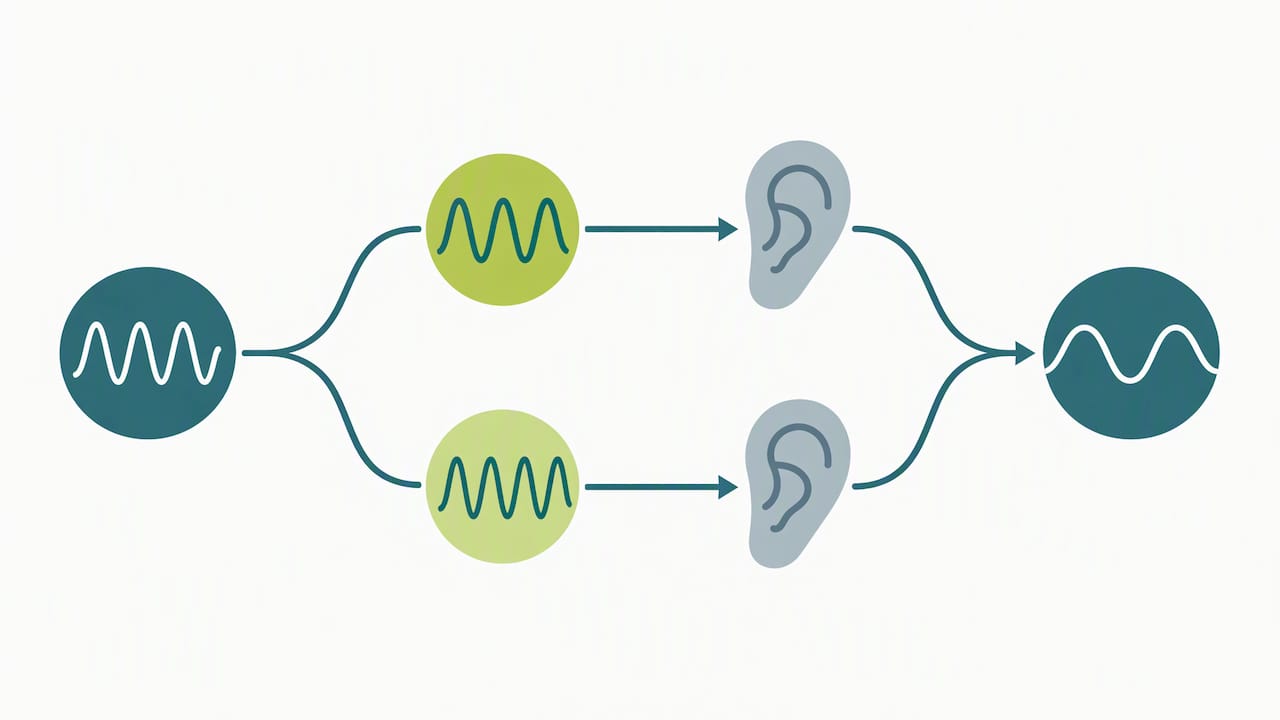
Take a simple example. You want a 528 Hz track with a 6 Hz theta-range beat. One channel carries 528 Hz and the other carries 534 Hz. Your brain perceives a slow 6 Hz pulse, while the pitch you consciously hear sits close to 528 Hz. The arithmetic is just subtraction, which is about the limit of my own mathematical talent, so I am glad it is that simple.
In practice, there are three common ways to build a combined track:
- Solfeggio carrier with binaural offset. The approach above. The Solfeggio pitch is the musical centre, and the beat is a quiet undercurrent.
- Solfeggio drone plus separate binaural layer. A steady Solfeggio pitch plays in both ears, while a different pair of tones creates the beat.
- Music tuned around a Solfeggio pitch. Instruments are recorded in a key or drone that matches the pitch, with the binaural layer mixed underneath at low level.
The beat range is usually chosen by the mood you want: slower differences for sleep and deep rest, a little faster for relaxed focus. Be wary of anyone promising that a given number does a specific thing to your body. The research doesn’t back that precision.
What the research really says
This is the part where I’d normally make a joke to soften the blow. Let me just say it plainly: the science is unsettled.
The 2023 systematic review mentioned above looked at 14 studies on whether binaural beats entrain brainwaves. Five results were in line with entrainment, eight contradicted it and one was mixed, and differences in methods made the studies hard to compare. That is not a verdict that binaural beats do nothing. It is a verdict that nobody can yet say they reliably do what the tracks claim.
For Solfeggio tones on their own, HowStuffWorks reports that reliable clinical evidence does not establish distinct disease-treating effects. If you are told that 528 Hz repairs DNA, or that any pitch cures anything, you are being sold a story.
So why bother? Because listening practice is not only about measurable brainwaves. A Discovery UK piece on Solfeggio tones makes the fair point that these tones can be soothing or meditative in the way whale songs, coastal soundscapes or distant thunder can be. A steady tone gives a restless mind something to rest on. That is a perfectly good reason to use one.

What about 963 Hz?
People often ask what happens if you listen to 963 Hz. Mostly, you hear a steady, fairly high-pitched tone. A German breakdown of 963 Hz notes that, as a quiet and steady sound, it can be a point to rest attention on, and it finds no evidence for the popular claims about the pineal gland or “oneness”. Keep it quiet: high pitches are tiring when they are loud.
Perspective: what we have learned making this music
We make meditation music for a living, so you might expect us to wave a banner for frequencies. We don’t, quite. Here is our honest view.
First, the tone is only part of the experience. Our composers, Robert Emery and Moritz Schneider, have worked together for thirteen years, and their belief is that live acoustic instruments carry something digital ones don’t. Robert, a composer and conductor who started piano at seven and studied at the Royal College of Music, puts it as a conviction that digital instruments do not resonate with the body in the same way. Moritz has written for feature films, album productions and musicals for over 20 years, and he talks about the power of frequencies created by a live instrument played by a real person.
Second, we record with live musicians, including sessions with the National Philharmonic at Abbey Road Studios, and we treat binaural, theta and Solfeggio elements as part of the sound design rather than the whole product. A bare sine wave can be wearing after ten minutes. Strings, a warm room and a human bow arm make you want to stay.
Third, we try not to oversell. We think the honest claim is that thoughtfully designed sound can help many people settle, breathe and focus, and that is worth plenty. Cures are for doctors.
— ROBERT
How to listen: equipment and setup
This was the one question the usual guides answer vaguely, so here is a concrete routine.
Headphones, mostly
For any track with a binaural layer, use stereo headphones, because the effect needs each ear to receive its own tone. Closed-back or in-ear models both work. Speakers blend the two channels in the air, and the beat is lost. Pure Solfeggio tones without a binaural layer are fine on speakers.
A small tip from the musician’s side: low pitches (174 to 285 Hz) are reproduced more convincingly on decent headphones than on tinny laptop speakers. You don’t need a studio rig, just something that doesn’t distort.
A simple session
- Choose a quiet spot and put your phone on do-not-disturb.
- Set the volume low, comfortably quieter than speech. If you notice the sound at all times as “loud”, turn it down.
- Start with 10 to 20 minutes. Sit or lie down, eyes closed.
- Don’t chase a feeling. If your mind wanders, return to the sound, as you would return to the breath.
- Stop if you feel dizzy, anxious or uncomfortable, and try again another day or skip the binaural layer.
For sleep, many people prefer a track that ends by itself, or a timer. Falling asleep with headphones on all night is not ideal for comfort or for your ears.
Safety: hearing, epilepsy and common sense
Hearing comes first. Germany’s health information portal gesund.bund.de says the risk of hearing loss rises at roughly 80 to 85 dB, depending on how long you are exposed, and advises reducing or avoiding loud music. Meditation audio should never be near that level. Because tones are steady and have no dynamics, it is easy to creep the volume up without noticing, so set it low before pressing play.
If you have epilepsy, talk to your doctor before trying binaural beats; a review of binaural beats and the brain specifically flags this. For a broader look at who should be careful with rhythmic sound and vibration, this overview of vibroacoustic contraindications is a good companion read.
And if you are dealing with anxiety, depression, chronic pain or insomnia, see a doctor or psychotherapist. Music can sit beside treatment, but it should not replace it.
Choosing a good Solfeggio and binaural track
Not every track labelled “528 Hz binaural” deserves your twenty minutes. Here is what we would check.
- Sound quality. Is there audible hiss, clipping or a harsh synthetic edge? A fatiguing track defeats its own purpose.
- Music, not just tone. Real instruments and thoughtful arrangement keep your attention soft rather than strained.
- Honest descriptions. Be sceptical of promises about DNA, curing disease or “cleansing” anything. A good description tells you the intention and the beat range.
- Clear headphone guidance. If a track uses binaural layers, it should say so.
- Licensing. If you teach, run classes or publish guided audio, check that the licence covers professional use.
Where our music fits
Our library is built around exactly this blend: orchestral meditation recordings with live musicians, 3D surround sound, binaural beats, theta music and Solfeggio-frequency tracks. If you want to listen regularly, the personal subscription costs 21 € per month. If you teach, run a studio or build apps and need professional licensing, the professional subscription costs 150 € per month, and our royalty-free meditation music page explains the library for commercial use.
The full catalogue lives on our homepage, where you can also browse individual meditations if you would rather buy a single piece than subscribe.
Using combined tracks as a teacher or creator
If you lead yoga, breathwork or meditation groups, a few extra points are worth thinking about.
Tell people when a track has binaural elements, so anyone with epilepsy or sensitivity can opt out. Room speakers won’t deliver the binaural effect, so if your class is on speakers, treat the track as ordinary music, which is fine. For online classes, ask participants to use headphones if you want the full effect.
And describe what you play honestly. “This track uses a 528 Hz tone and a slow beat to support relaxation” is accurate. “This will repair your cells” is not, and in a professional setting it can land you in trouble.
A few myths to retire
- “Each Solfeggio tone heals a specific organ.” No clinical evidence supports that.
- “A binaural beat forces your brain into theta.” The evidence for entrainment is inconsistent, as the 2023 review shows.
- “Louder works better.” It doesn’t. Louder just endangers your hearing.
- “You need expensive gear.” Decent stereo headphones will do.
FAQ
How do Solfeggio frequencies work?
They are single pitches that many people find calming and use as a focus point in meditation. There is no clinical evidence that each tone has a distinct physical effect. Their value lies mainly in the steady sound and the relaxed routine around it.
What can binaural beats help with?
People use them for relaxation, focus and sleep. Research on whether they entrain brainwaves is inconsistent: in a review of 14 studies, five supported it and eight contradicted it. They may suit you as a calming listening habit, but they are not a treatment.
Can you list the Solfeggio frequencies?
The commonly cited set is 174, 285, 396, 417, 528, 639, 741, 852 and 963 Hz. Traditional meanings are attached to each, but these are not proven benefits.
Do I need headphones for Solfeggio tones?
Only if the track includes a binaural layer. A plain Solfeggio tone works on speakers, but binaural beats require a separate signal in each ear, so use stereo headphones.
Is it safe to listen every day?
For most people, quiet listening for 10 to 20 minutes is low risk. Keep the volume low to protect your hearing, and speak to your doctor first if you have epilepsy.
Sources
- Binaural beats to entrain the brain? A systematic review (2023)
- BARMER: Binaurale Beats
- Oura: Binaural beats vs. Solfeggio frequencies
- HowStuffWorks: Are Solfeggio frequencies actually healing?
- Discovery UK: What are Solfeggio frequencies?
- Ears & Waves: 963 Hz
- gesund.bund.de: Auswirkungen von Lärm auf die Gesundheit
- A Review of Binaural Beats and the Brain
- Vibroacoustic contraindications