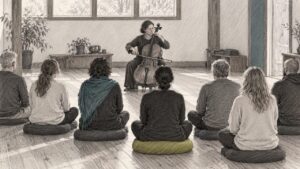
Music that raises your vibration is defined as sound composed at specific frequencies and structural qualities that directly shift your mental, emotional, and spiritual state. This is not a vague wellness claim. A 2026 peer-reviewed randomised controlled trial found that high-frequency music therapy produced significantly greater stress reduction than low-frequency alternatives in psychiatric inpatients. That finding matters because it gives scientific weight to what meditators and sound healers have practised for centuries. Composers like Robert Emery and Moritz Schneider have built entire creative careers around this principle, crafting orchestral soundscapes that use Solfeggio frequencies, binaural beats, and theta tones to produce measurable shifts in listener wellbeing. If you want uplifting music that actually does something, the frequency and structure of what you listen to is where to start.
1. What are the most effective frequencies used in music that raises your vibration?
The most widely used frequencies in vibrational sound healing are 528 Hz, 432 Hz, and the broader Solfeggio scale. Each carries a distinct character and a specific set of reported benefits.

528 Hz is known in sound therapy circles as the “Love Frequency” or “Miracle Tone.” Practitioners associate it with DNA repair, deep emotional transformation, and spiritual alignment. You can read a thorough breakdown of its properties in this guide to the 528 Hz healing tone. Whether or not you subscribe to the DNA repair claim, the subjective experience of listening to 528 Hz music is consistently described as warm, centring, and calming.
432 Hz carries a different reputation. Many musicians and meditators describe it as more natural sounding than the standard concert pitch of 440 Hz. The 432 Hz Solfeggio frequency is associated with reduced anxiety and a sense of being more “in tune” with the body. The mythology around it is rich (some claim it aligns with cosmic mathematics), but its practical value lies in how it feels during sustained listening.
Beyond these two, the Solfeggio scale includes frequencies such as 396 Hz (releasing guilt and fear), 417 Hz (facilitating change), 639 Hz (harmonising relationships), and 741 Hz (awakening intuition). Sound healing practitioners use these as tools, not magic buttons. The table below summarises the most commonly used high-vibration frequencies.
| Frequency | Common Name | Reported Effect |
|---|---|---|
| 396 Hz | Liberation Tone | Releases fear and guilt |
| 432 Hz | Natural Pitch | Calming, grounding, anxiety reduction |
| 528 Hz | Love Frequency | Emotional transformation, spiritual alignment |
| 639 Hz | Connection Tone | Harmonising relationships and communication |
| 741 Hz | Intuition Tone | Mental clarity, awakening intuition |
Scientific studies classify “high-frequency” music therapies by tempo and pitch modulation rather than specific Solfeggio tones. That distinction matters. The clinical evidence supports high-frequency music broadly, while the Solfeggio framework comes from sound therapy tradition. Both have value, and the best vibrational music often draws from both worlds.
Pro Tip: Try listening to a single Solfeggio frequency for 20 minutes before your meditation session rather than mixing several. Your nervous system responds more clearly to one sustained tone than to a frequency cocktail.
2. Which types of music and soundscapes best raise your vibration?
Frequency alone does not determine whether music shifts your energy. The type of sound, its structure, and its texture all play a role. Understanding waveform and timbre helps you choose more deliberately.
Pure sine waves carry no harmonics. They produce a clean, focused tone that suits deep meditation where you want minimal distraction. Complex soundscapes, by contrast, layer multiple timbres to create texture and depth. Most people find complex soundscapes more immersive for relaxation, while sine waves work better for focused breathwork or body scanning.
The main categories of high-vibration music worth knowing are:
- Binaural beats: Two slightly different frequencies played in each ear. The brain perceives a third “beat” at the difference between them. Theta binaural beats (4–8 Hz) are particularly effective for deep meditation states.
- Ambient orchestral music: Full orchestral arrangements at low tempo create a sense of grandeur and safety simultaneously. Robert Emery’s work in this space is a strong example of how classical instrumentation can carry meditative intent.
- Nature soundscapes with tonal underlays: Rain, forest, or ocean sounds layered with a sustained frequency tone. The natural sounds reduce mental chatter while the tone does the vibrational work.
- Guided meditation music: Structured compositions that move through preparation, immersion, and resolution phases. This mirrors the three-phase journey of preparation, soaring, and destination that effective transformational music follows.
Research into low BPM music shows that slower tempos reduce cortisol and slow the heart rate, which creates the physiological conditions for vibrational receptivity. Tempo is not an afterthought. It is part of the architecture.
Moritz Schneider’s meditative compositions lean heavily on slow harmonic movement and long sustain, which gives the listener time to settle into each phrase rather than chase the melody. That approach is deliberate and effective.
Pro Tip: When building a vibrational music playlist, alternate between a pure-tone track and a complex orchestral piece. The contrast keeps your nervous system engaged without creating overstimulation.
3. How can you safely use high-frequency music without risking hearing damage?
High-frequency tones are not inherently dangerous, but volume and duration matter enormously. Sustained tones above 1 kHz at high volume can cause permanent hearing damage. That is not a theoretical risk. It is a documented outcome of careless listening.
The recommended volume cap for sustained high-frequency tones is at or below 30% of your device’s maximum output. This applies especially when using headphones, where the sound has nowhere to dissipate. Over-ear headphones distribute pressure more evenly than in-ear models, making them the safer choice for extended vibrational listening sessions.
The human ear is not a flat receiver. Ear sensitivity peaks around 3–4 kHz, which means sounds in that range feel louder than they actually are. A tone that seems comfortable at 2 kHz may feel harsh and fatiguing at 3.5 kHz even at the same volume setting. This is why some high-frequency tracks feel physically uncomfortable even at moderate volumes.
Safe listening practices for vibrational music:
- Start every session at 20% volume and increase gradually over two to three minutes.
- Keep sessions with pure high-frequency tones to 20–30 minutes maximum.
- Use over-ear headphones rather than in-ear buds for sustained tone work.
- Take a five-minute silence break between tracks when listening to multiple high-frequency pieces.
- If you notice ringing, pressure, or discomfort, stop immediately and rest for at least an hour.
- Avoid listening to high-frequency tones while tired, as ear fatigue compounds quickly in that state.
The goal is a sustainable practice. Damaging your hearing in pursuit of higher vibration is, to put it plainly, counterproductive.
4. What are the top recommended tracks and composers that raise your vibration?
Two composers stand out in the professional meditation music space for the quality and intentionality of their work: Robert Emery and Moritz Schneider.
Robert Emery is a composer and producer whose orchestral ambient work sits at the intersection of classical tradition and sound healing. His compositions have been recorded at Abbey Road Studios with the National Philharmonic, which gives them a sonic richness that most digital meditation tracks simply cannot replicate. Live strings, recorded in a world-class acoustic environment, carry a warmth and resonance that synthetic sounds lack. Emery’s approach integrates Solfeggio frequencies and binaural elements within full orchestral arrangements, so the listener receives both the emotional impact of classical music and the neurological benefits of frequency-based sound therapy. His work is available through Orchestralmeditations.
Moritz Schneider brings a different sensibility. His compositions favour slow harmonic movement, long melodic phrases, and minimal percussion. The effect is music that feels like it breathes. Schneider’s work is particularly well suited to body scan meditations and sleep preparation, where the listener needs to release muscular tension progressively. His tracks often incorporate theta frequency underlays, which support the transition from waking consciousness into deeper meditative states.
Characteristics to look for in tracks that genuinely raise your vibration:
- Tempo below 60 BPM (matching or slightly below resting heart rate)
- Sustained tonal elements rather than rapid melodic movement
- Frequency content centred on Solfeggio tones or theta binaural beats
- Dynamic range that moves from quiet to full without sharp peaks
- Minimal or no lyrics (language activates the analytical mind, which works against deep meditation)
The science of heart-rate calming soundtracks confirms that music with these structural features produces measurable physiological relaxation. That is the foundation on which composers like Emery and Schneider build their work.
5. How to personalise and integrate vibrational music into your wellness routine
The most common mistake people make with sound healing tracks is treating them as background noise. Music that truly raises your vibration functions as an anthem that recalibrates energy, not wallpaper. It requires your attention, at least initially.
Start by identifying which frequency range resonates with you personally. Spend a week listening to 432 Hz music for 20 minutes each morning. The following week, switch to 528 Hz. Notice which produces a more settled, energised feeling in your body. This is not mysticism. It is self-observation, and it gives you real data to work with.
A practical approach to building your routine:
- Morning: Use an uplifting orchestral track at 432 Hz to set a calm, grounded tone for the day. Keep it to 15–20 minutes.
- Midday reset: A five-minute binaural beat session (theta range) can clear mental fog without requiring a full meditation.
- Evening wind-down: Slow ambient music with nature underlays at 528 Hz supports the transition from activity to rest.
- Deep meditation sessions: Use a structured composition that moves through preparation, immersion, and resolution phases. Emery’s orchestral meditations work particularly well here.
Merging stillness with immersive soundscapes creates the conditions for listeners to bypass mental noise and connect with a quieter, clearer state. Practically, this means building silence into your listening practice. Start with two minutes of silence, then begin your track. End with two minutes of silence after it finishes. The contrast amplifies the effect.
Pro Tip: Rotate your tracks every two to three weeks. The brain habituates to repeated stimuli, which reduces the emotional and neurological impact over time. Keeping your vibrational music playlist fresh maintains its effectiveness.
A simple blueprint for a weekly vibrational music playlist:
- Monday and Wednesday: Orchestral ambient at 432 Hz
- Tuesday and Thursday: Binaural theta beats with nature sounds
- Friday: 528 Hz Solfeggio composition
- Weekend: Free listening from a curated library, following instinct rather than schedule
Key takeaways
Music that raises your vibration works through specific frequencies, sound structures, and listening practices that directly influence your nervous system, emotional state, and meditative depth.
| Point | Details |
|---|---|
| Frequency selection matters | 528 Hz and 432 Hz are the most widely used Solfeggio tones for emotional and spiritual elevation. |
| Structure shapes impact | Tempo below 60 BPM, sustained tones, and minimal lyrics produce the strongest vibrational effect. |
| Safety is non-negotiable | Keep volume at or below 30% for sustained high-frequency tones to prevent hearing damage. |
| Composers make a difference | Robert Emery and Moritz Schneider produce orchestral meditation music that integrates frequency science with artistic depth. |
| Routine beats randomness | A structured weekly listening plan with rotating tracks prevents habituation and sustains results. |
Why I think most people are using vibrational music all wrong
I have spent years working with orchestral meditation music, and the single most consistent error I see is passive listening. People put on a 528 Hz track, half-watch something on their phone, and then wonder why they feel no different. That is not how this works.
The composers whose work I find most compelling, Robert Emery and Moritz Schneider in particular, build their compositions with intention at every layer. Emery’s orchestral arrangements recorded at Abbey Road are not ambient filler. They are structured experiences with a beginning, a middle, and an end. When you listen to them properly, with headphones, eyes closed, and nothing else demanding your attention, the effect is genuinely striking. The strings carry a warmth that synthetic pads simply cannot replicate, and the frequency content does its work underneath without announcing itself.
Moritz Schneider’s approach taught me something different: patience. His tracks move slowly. There are moments where almost nothing seems to be happening. And that is precisely when something is happening. The nervous system needs time to stop bracing. Most of us are so accustomed to stimulation that silence feels like failure. Schneider’s music holds you in that discomfort long enough for it to dissolve.
My honest recommendation is this: choose one track, commit to it fully for 20 minutes, and treat it as a practice rather than a product. The sound healing frequencies are real. The benefits are real. But they require your participation, not just your ears.
— ROBERT
Orchestralmeditations: curated music collections for raising your vibration
Orchestralmeditations produces meditation music recorded at Abbey Road Studios with the National Philharmonic, integrating Solfeggio frequencies, binaural beats, and 3D surround sound into full orchestral compositions. The library includes works by Robert Emery and Moritz Schneider, designed for deep meditation, relaxation, and spiritual growth.
Each recording is built around the same principles covered in this article: intentional frequency selection, careful sound structure, and the kind of sonic richness that only live orchestral recording can deliver. Whether you are new to sound healing tracks or looking to deepen an existing practice, the meditation music collection at Orchestralmeditations offers a genuinely different listening experience. You can also browse the full best meditation music selection to find the right starting point for your practice.
FAQ
What does “raising your vibration” actually mean?
Raising your vibration refers to shifting your emotional and neurological state towards greater calm, clarity, and positive energy through deliberate practices, including music. In sound therapy, it specifically describes using frequencies and soundscapes to influence brainwave activity and reduce stress responses.
Is there scientific evidence that high-frequency music reduces stress?
A 2026 randomised controlled trial found that high-frequency music therapy produced significantly greater stress reduction than low-frequency alternatives in clinical settings. The effect on anxiety and depression was less pronounced, but stress symptom improvement was statistically significant.
What is the difference between 432 Hz and 528 Hz music?
432 Hz is associated with grounding, calm, and a natural sense of resonance, making it well suited to morning meditation and anxiety reduction. 528 Hz is the “Love Frequency,” linked to emotional transformation and spiritual alignment, and works particularly well in deeper evening meditation sessions.
How long should I listen to vibrational music each day?
20–30 minutes per session is the practical sweet spot for most people. Sustained high-frequency tones should not exceed 30 minutes without a break, and volume should stay at or below 30% of maximum output to protect hearing.
Do I need headphones to benefit from vibrational music?
Headphones are strongly recommended for binaural beats, which require separate frequencies in each ear to produce their effect. For orchestral ambient and Solfeggio frequency tracks, quality speakers work well, but over-ear headphones generally deliver a more immersive and precise listening experience.