
Lossless audio (FLAC, ALAC) keeps every bit of the original recording, while lossy audio (MP3, AAC, Opus) throws away detail your ears are least likely to miss. For most listeners, a good lossy file at a high bitrate is hard to tell from lossless. For meditation, where you lie still for 30 minutes with headphones on, the bigger gains come from the recording itself and from a clean playback chain. We make the case here with the evidence, and we will point out where a lossless file earns its extra storage.
TL;DR
- Lossless compression (FLAC, ALAC) decodes to a bit-identical copy of the original, and files are typically 40 to 50% of uncompressed size. Lossy formats (MP3, AAC, Opus) can shrink files by 80 to 95%.
- In a double-blind BBC test, listeners could not reliably tell uncompressed audio from AAC at 320 kbps. Low bitrates were a different story.
- Lossless matters most for archiving, editing, and for stereo-critical material such as binaural and 3D recordings on good headphones.
- Your headphones, your room, your Bluetooth connection and the quality of the original recording often decide more than the file format does.
What lossy and lossless actually mean
Every digital audio file starts life as a long stream of numbers describing a sound wave. Uncompressed files (WAV, for example) store all of them. That is accurate, and also large: a few minutes of stereo music runs to tens of megabytes. Compression is the art of making that smaller.
There are two philosophies. Lossless compression works like a zip file for sound. According to MDN’s codec guide, lossless codecs such as FLAC and ALAC reduce size without compromising fidelity: decode the file and you get back a bit-identical result, with a typical size reduction of 40 to 50%. Lossy compression is more ruthless. The same guide explains that codecs such as MP3, AAC, Opus and Vorbis exploit how human hearing works, stripping out content we are least likely to notice, and can reach compression of 80 to 95%.
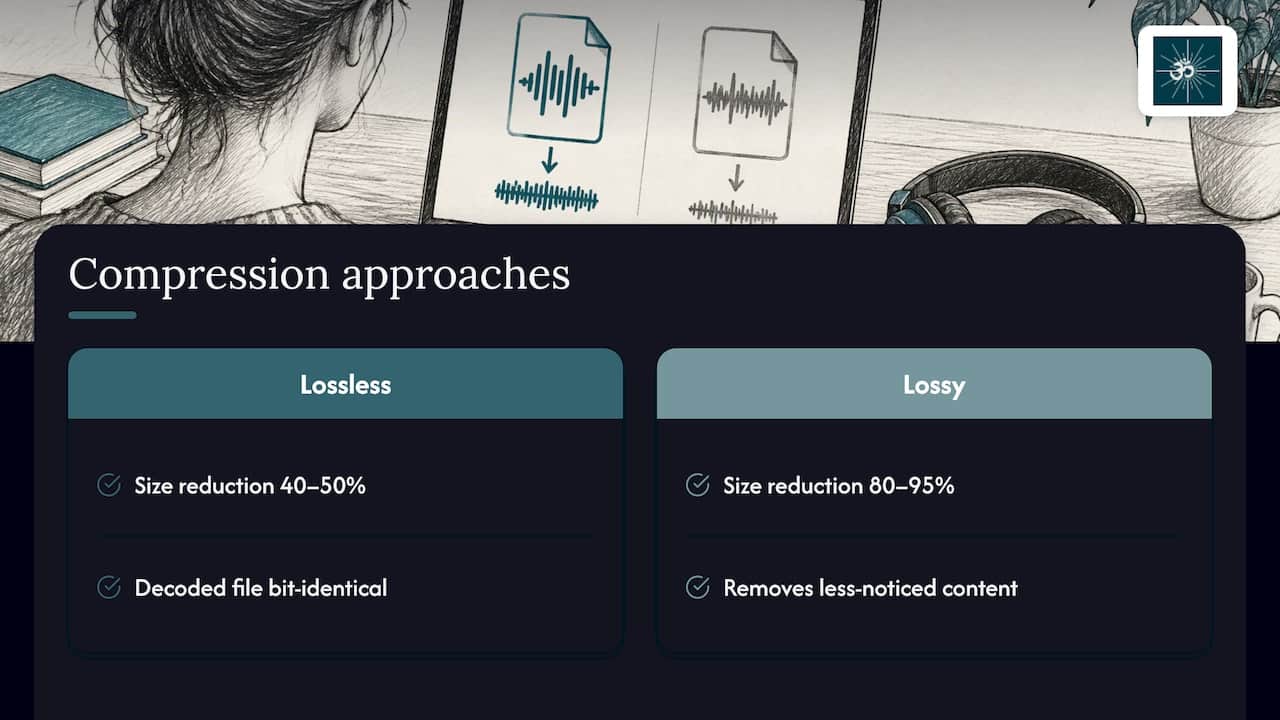
Think of it like packing for a long trip. Lossless folds your clothes very neatly. Lossy leaves behind the third pair of boots you were never going to wear. Done well, nobody notices what stayed at home. Done badly (hello, 64 kbps), you arrive at the wedding in hiking gear.
Three numbers worth knowing
- Bitrate is how much data is spent per second of audio, in kilobits per second (kbps). Higher bitrates keep more detail in lossy files.
- Sample rate (in kHz) is how many times per second the wave is measured. CDs use 44.1 kHz.
- Bit depth is how finely each measurement is recorded. CDs use 16 bit; “hi-res” files often use 24 bit.
Lossless files can carry any combination of these. Lossy files are mostly judged by bitrate. A 320 kbps MP3 and a 24-bit/192 kHz FLAC are not simply “small and large versions of the same thing”: they work in different ways, which is why the next question comes up so often.
Can you really hear the difference?
This is the part that sparks forum wars. The calmer evidence comes from controlled listening tests, where neither the listener nor the person running the test knows which file is playing.
BBC Research & Development ran exactly such a test. In their 2018 white paper on high bitrate coding, 18 participants listened to 12 samples (orchestral, jazz, vocal and speech) under a double-blind protocol. The result: no statistically significant difference between uncompressed audio and AAC-LC at 320 kbps. A low-bitrate format (HE-AAC at 48 kbps) was, unsurprisingly, clearly worse.
A 2022 literature review from Sweden’s KTH, which pulled together four A/B-test studies, points the same way. Most people with consumer-grade equipment could not tell 128 kbit/s MP3 from uncompressed audio, and even with trained ears and high-end equipment the cutoff sat around 256 kbit/s.
So is lossless pointless? No. It means the answer depends on what you do with the file.
What lossy artefacts sound like when they do appear
The BBC paper lists the common problems with AAC at lower bitrates: loss of high-frequency content, “pre-echo” around sharp attacks, distortion, aliasing and a degraded stereo image. Those are the clues trained listeners hunt for. Notice the last one. Stereo imaging is the thing that binaural and 3D recordings lean on most, and we will come back to it.
Is 24-bit/192 kHz better than 320 kbps?
It is bigger. Whether it is audibly better is another matter. Higher sample rates capture frequencies far above what most adults can hear, and the benefits show up mainly in production, where headroom is useful when editing, processing and mastering. For playback, a well-made 16-bit/44.1 kHz lossless file and a good 256 to 320 kbps lossy file are both comfortable territory for most people.
The streaming world has moved in the lossless direction anyway. According to AVITECT’s 2026 German streaming comparison, Spotify has delivered lossless FLAC up to 24 bit/44.1 kHz in Germany since October 2025, Apple Music, TIDAL and Qobuz go up to 24 bit/192 kHz, Deezer stays at 16 bit/44.1 kHz and YouTube Music has no lossless tier. The same page notes that Apple’s higher rates need an external DAC (a digital-to-analogue converter, the box that turns numbers back into voltage for your headphones) above 48 kHz. Prices and tiers on these services move often, so check the live pricing page before you subscribe.
The practical lesson: lossless availability is now ordinary, so you do not need to agonise over it. You do need to know what else in the chain can undo it.
Where the chain breaks before the codec does
A lossless file is only as good as everything between it and your eardrums. Four things usually matter more than the format.
- Bluetooth. Spotify’s support page says lossless depends on device support and connection type, and notes that Bluetooth may not support lossless. Most wireless headphones re-compress the signal on its way to your ears, so a lossless file played over a standard Bluetooth link is not heard as lossless.
- Bandwidth. The same page recommends a steady 1.5 to 2 Mbps connection for the best lossless streaming. A wobbly signal on a train is not the place for it.
- The original recording. Spotify also states that quality depends on the original recording. A flat, synthetic source stays flat in any format.
- Your headphones and room. Closed-back headphones that seal out the washing machine will improve a meditation more than a fancier codec ever will.
For sleep tracks played through a phone speaker under a pillow, the format is nearly irrelevant. For a seated practice with wired headphones, the details start to count.
File size and compatibility, side by side
MDN’s digital audio concepts guide gives the sizes: lossless codecs usually produce files 40 to 50% of the original uncompressed size, while modern lossy codecs can output 5 to 20%, depending on how complex the audio is. It adds that the quality loss from lossy compression is usually hard for the average listener to discern.
| Lossless (FLAC, ALAC) | Lossy (MP3, AAC, Opus) | |
|---|---|---|
| What is kept | Every bit of the source | What hearing models say you will notice |
| Typical size vs uncompressed | About 40 to 50% | About 5 to 20% |
| Best for | Archiving, editing, critical listening, spatial audio | Streaming on the move, phones, long playlists, sleep timers |
| Weak point | Storage and bandwidth | Artefacts at low bitrates, repeated re-encoding |
| Bluetooth | Usually re-compressed anyway | Native fit for most Bluetooth codecs |
One more rule from MDN is worth keeping. Lossless is recommended for archival-quality storage or when you plan to remaster, because re-encoding a lossy file again and again piles artefacts on top of artefacts. Lossy codecs, meanwhile, are usually required for real-time streaming so playback keeps up whatever the network is doing.
Why format matters differently for meditation music
Meditation is an odd listening situation. You are not scanning for flaws as an audiophile does. You are trying to stop scanning altogether. So what could a codec possibly disturb?
Slow, quiet and spacious music exposes things
Pop music is loud and dense, which hides compression artefacts. A meditation built from sustained strings, soft dynamics and long reverb tails is the opposite: long decays, silence between notes and fine textures. Lossless formats are very efficient at quiet passages: the sort of near-silence in a slow piece costs almost nothing to store. Lossy codecs have to make decisions about those same fading tails, and at low bitrates the decisions can be audible as a faint swirl or graininess.
Stereo and spatial work depends on the image
Binaural beats present a slightly different frequency to each ear, and 3D or surround-style mixes place instruments in space around the head. Both depend on a precise stereo image, and the BBC paper lists degraded stereo imaging among the known artefacts at lower bitrates. If you listen to this kind of recording, avoid low-bitrate copies, and prefer lossless or a high-bitrate lossy file played over wired headphones.
Where sound reaches beyond the ears
Some practitioners think about sound as something felt as well as heard. Work on vibroacoustic therapy and its clinical research looks at how low-frequency vibration is used in wellness settings. If you play audio through a sound-bed, a transducer or a subwoofer-equipped room, the low end of the signal carries real weight, and a clean source is a sensible starting point.
The source matters more than the container
Here is the thing we say to every friend who asks. You can store a mediocre recording in the finest lossless format on Earth and it will remain a mediocre recording, perfectly preserved. Lossless is a container, not a talent.
That is why the music itself is the first decision. Our tracks are recorded with live musicians from the National Philharmonic at Abbey Road Studios, composed and produced by a small team that includes composer and producer Robert Emery and producer Moritz Schneider. When string players breathe, bow and shape a phrase together in a famous room, the result carries tiny variations in timing and tone that a sample library does not. Those micro-variations are exactly the detail a clean playback chain lets you enjoy.
Our library also includes binaural, theta and Solfeggio-frequency tracks and 3D surround recordings, so the stereo-image points above are not abstract for us. If you want to see how a long practice track can be made to repeat gracefully, our guide to loopable meditation music goes into it.
A practical guide: which format when?
For a daily seated practice at home
Use wired or good wireless headphones, play the highest-quality version you have, and keep volume low enough that the music sits under your attention rather than on top of it. If you stream, check that lossless is switched on in the app and that your device actually supports it.
For sleep
A lossy file at a high bitrate is perfectly comfortable. The timer, a stable connection and a reasonable volume matter more. Save storage space on your phone for what you will use.
For travel
Download before you leave. A lossy file at 256 kbps or more keeps the storage modest and travels well over Bluetooth, which will re-compress lossless anyway.
For teachers, therapists and content creators
This is where lossless earns its keep. If you are building a class playlist, editing a guided meditation with a voice-over, or making an app, work from the best-quality source you can license and export the lossy version last. Editing a lossy file and re-exporting it adds artefacts each time, as MDN’s advice on remastering suggests. Also remember that format is only half of the question for professional use: you need the right licence for the setting.
A quick home test
Pick one track you know well. Listen to a low-bitrate copy, then a high-bitrate copy, with the same headphones and same volume, ideally having someone else switch them so you do not know which is which. If you cannot tell the high-bitrate file from lossless, you have just saved yourself a lot of storage. If you can, you now know your own ears are worth listening to.
Our offer for listeners and professionals
For personal listening, our personal subscription is €21 per month. For teachers, therapists, app builders and content creators, our professional subscription is €150 per month and covers professional use. Individual tracks can be bought on their own, each with a personal or professional licence, and our royalty-free meditation music page explains the professional route.
You will find theta, 528 Hz, 396 Hz and 174 Hz recordings, mantra meditations and more, all with the live-orchestra character described above.
Perspective: why we care about the recording first
We are musicians before we are format people, so we will be honest about how this looks from the studio.
When a string section plays in a room like Abbey Road, the thing that arrives at your ears is the end of a long chain: the players, the room, the microphones, the mix, the file and finally your headphones. Most people only argue about the file. We love a good FLAC as much as the next nerd, but we have never heard a codec rescue a lifeless performance or ruin a beautiful one when the bitrate was sensible.
What we obsess over is what happens before the file exists. Robert Emery composes and produces with live players, and Moritz Schneider works on the frequency and production side, so that the theta and Solfeggio layers sit inside the music rather than on top of it. Our 3D surround and binaural work asks listeners for something simple: a good pair of headphones and ten undisturbed minutes.
That is why we believe in live orchestral meditation music over mass-produced digital tracks. A clean format keeps what the musicians gave you. We are here to make sure there is something worth keeping.
ROBERT
FAQ
Is FLAC really better than MP3?
FLAC is lossless, so it decodes to exactly the original, while MP3 discards some detail to save space. Whether you can hear the difference depends on the bitrate, your equipment and the music. In listening tests, high-bitrate lossy files were hard to separate from uncompressed audio, but FLAC is the safer choice for archiving and editing.
Does lossless audio make a difference?
It can, in the right conditions: wired headphones, a quiet room and a well-recorded source, particularly with spatial or binaural material. Over standard Bluetooth, or from a poor recording, the gain mostly disappears. The chain matters as much as the file.
Which audio compression is best?
There is no single best. Lossless (FLAC, ALAC) is best for storage, editing and critical listening. A high-bitrate lossy format such as AAC or Opus is best for streaming, travel and sleep, where file size and connection stability count.
Is 24-bit/192 kHz better than 320 kbps?
It is a larger and more precise file, which helps in production and editing. For ordinary listening, the BBC’s double-blind test found no significant difference between uncompressed audio and AAC at 320 kbps, so the extra data is rarely audible.
Sources
- Web audio codec guide, MDN
- Digital audio concepts, MDN
- A subjective evaluation of high bitrate coding of music, BBC R&D (2018)
- Diminishing returns of higher mp3 bitrates, KTH (2022)
- Musikstreaming-Dienste im Vergleich, AVITECT (2026)
- Lossless Audio Quality, Spotify Support
- Vibroacoustic therapy benefits and clinical research