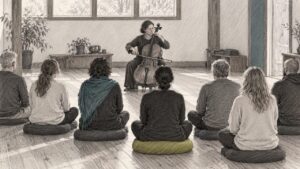
A mantra is defined as a “mind vehicle” — a sound, word, or phrase used to carry the mind into deeper states of stillness during meditation. The list of mantras for meditation spans three broad families: beeja (seed) sounds like “Om,” traditional Sanskrit chants such as “Om Namah Shivaya,” and modern affirmations like “I am enough.” Each family serves a different purpose and suits a different practitioner. Composers Robert Emery and Moritz Schneider, whose orchestral recordings are produced at Abbey Road Studios with the National Philharmonic, have long understood that sound frequency and mantra vibration work together. Choosing the right mantra from this list is less about power and more about personal fit.
1. What are beeja (seed) mantras and why are they foundational?
Beeja mantras are single-syllable sounds that carry concentrated vibrational energy. Think of them as cosmic tuning forks. Each one corresponds to a specific quality of consciousness: “Om” represents universal awareness, “Shrim” relates to abundance, “Hrim” to the heart, and “Klim” to attraction and will. They are not words with dictionary meanings. They are pure sound signatures.
The vibrational resonance of mantras influences brain states more profoundly than any intellectual understanding of their meaning. That is the key insight. You do not need to understand a beeja mantra to feel its effect. You simply need to repeat it with attention.

Traditional tantric practice recommends sustained repetition for 3–12 minutes to induce deep meditative states. That is a practical, achievable window for most people, whether you are sitting before breakfast or winding down after work.
A word of caution: potent beeja mantras like “Kreem” or “Dreem” are traditionally given through initiation (known as deeksha) to avoid energetic imbalance. If you have not received formal instruction, begin with “Om.” It is universally accessible, deeply stabilising, and carries no risk of misuse.
- Om: Universal consciousness; suitable for all practitioners
- Shrim: Associated with abundance and grace
- Hrim: Connected to the heart and creative power
- Klim: Related to attraction, will, and desire
- Aim: Linked to wisdom, learning, and the teacher principle
- Kreem: Potent transformative energy; best received through initiation
Pro Tip: Try whispering your beeja mantra rather than chanting it aloud. The whisper sits between outer sound and inner silence, which many practitioners find accelerates the shift into stillness far more quickly than full-volume chanting.
2. Which longer Sanskrit mantras are most widely used?
Longer Sanskrit mantras carry meaning alongside vibration. They work on two levels simultaneously: the sound frequency and the semantic intention. That dual action makes them particularly useful for practitioners who want their meditation to feel purposeful and directional.
Experts classify mantras into Saguna and Nirguna types. Saguna mantras invoke a deity with form, such as Shiva or Lakshmi. Nirguna mantras point toward the formless absolute. Neither is superior. The right type depends entirely on what resonates with you.
Short nama mantras suit contemplative meditation far better than long liturgical hymns. A mantra like “Om Namah Shivaya” is short enough to synchronise with the breath, yet rich enough to carry a full spiritual intention. Long hymns are better suited to ritual recitation than to the quiet, repetitive focus of seated meditation.
Chanting a mantra 108 times is the traditional standard for aligning personal vibration with cosmic frequencies. The number 108 appears across Vedic astronomy, sacred geometry, and yogic philosophy. It is not arbitrary. Using a mala (prayer beads) makes counting effortless and keeps the hands engaged, which itself reduces mental restlessness.
| Mantra | Type | Deity association | Best use |
|---|---|---|---|
| Om Namah Shivaya | Saguna | Shiva | Contemplative meditation, daily practice |
| Gayatri Mantra | Nirguna | Solar consciousness | Morning practice, clarity of mind |
| Mahamrityunjaya | Saguna | Shiva | Healing, protection, overcoming fear |
| Om Mani Padme Hum | Saguna | Avalokiteshvara | Compassion, Buddhist-influenced practice |
| So Hum | Nirguna | None (breath itself) | Breath-synchronised meditation |
The Om Mani Padme Hum mantra deserves particular attention. It translates loosely as “the jewel in the lotus” and is one of the most widely chanted mantras on earth. Its six syllables are said to correspond to six realms of existence in Tibetan Buddhist cosmology. You do not need to be Buddhist to benefit from its rhythmic, calming quality.
3. How can modern affirmations serve as mantras?
Modern affirmations are the secular branch of the meditation mantras list. They work on the same principle as traditional mantras: repetition trains the mind to return to a chosen thought rather than wander. The difference is that affirmations use plain language and require no cultural or spiritual context to feel meaningful.
Modern affirmations like “I am enough” are effective secular alternatives that promote mindfulness and reduce stress when practised consistently. The word “consistently” is doing a lot of work in that sentence. A single repetition of “I am at peace” does very little. Three hundred repetitions over several weeks rewires habitual thought patterns.
The mantra works as a vehicle to energise the mind’s intention, which makes belief in it essential. If you choose an affirmation that feels hollow or dishonest, your subconscious will resist it. The phrase “I am a millionaire” might produce internal eye-rolling rather than calm. “I am safe” or “I choose peace” tends to land more cleanly.
Practical ways to integrate affirmations into your practice:
- Pair each repetition with a slow exhale to anchor the phrase in the body
- Write your chosen affirmation on a card and place it where you meditate
- Use it as a return phrase whenever the mind wanders, rather than a strict chant
- Choose phrases in the present tense (“I am” rather than “I will be”)
- Keep it short enough to complete in one breath
Affirmations also pair well with faith-based emotional wellbeing practices, particularly for practitioners who want their meditation to support relationships and personal values alongside individual calm.
4. How to select the best mantra for your practice
Choosing from the best mantras for meditation is not a shopping exercise. You are not looking for the most powerful option on the shelf. You are looking for the one that feels like it already belongs to you.
Suitability matters more than power for effective meditation. A beginner who forces themselves to use a complex Tantric mantra because it sounds impressive will spend most of their session feeling confused rather than still. A simple “So Hum” (meaning “I am that”) synchronised with the breath will take that same beginner far deeper, far faster.
Here is a practical process for testing a mantra before committing to it:
- Sit quietly for two minutes and repeat the mantra softly, either aloud or in a whisper
- Notice whether the sound feels settling or agitating
- Check whether the meaning (if it has one) produces resistance or acceptance
- Try it again the following morning before your mind is cluttered with the day
- If it still feels right after three sessions, adopt it as your working mantra
Choosing a mantra “adjacent to your heart” ensures better personal resonance and effectiveness. That phrase sounds poetic, but it has a practical meaning: the mantra should produce a subtle sense of warmth or recognition, not intellectual approval. Your mind may say “this is a good mantra.” Your heart says “yes, this one.”
If you have access to a teacher or guru, ask for guidance. A teacher who knows your temperament and intention can save you months of trial and error. If no teacher is available, the heart-test above is a reliable substitute.
Pro Tip: Avoid choosing a mantra based on what you have seen trending online. Popularity is not the same as suitability. The mantra that works for ten thousand people on social media may do absolutely nothing for you, and that is perfectly fine.
The mantra meditation guide for beginners from Orchestralmeditations offers structured guidance on this selection process, particularly for those who are new to seated practice and unsure where to begin.
5. How do different mantras impact well-being and mindfulness?
Different mantra types produce measurably different effects, even if the underlying mechanism (repetition creating mental focus) is the same. Understanding those differences helps you choose with intention rather than guesswork.
Beeja mantras work primarily through vibration. The sound itself, repeated steadily, creates a physiological shift. The breath slows. The nervous system settles. The mind stops generating new thoughts because it is occupied with the sound. This is why beeja mantras are particularly effective for practitioners who struggle with a busy, analytical mind.
Sanskrit mantras like the Gayatri or Mahamrityunjaya add a layer of semantic intention. The practitioner is not just repeating a sound; they are repeatedly orienting the mind toward a specific quality, such as healing, clarity, or devotion. That orientation accumulates over time. Regular practitioners often report that the mantra begins to arise spontaneously during stressful moments, functioning as an automatic reset.
Modern affirmations shift mindset and reduce stress by replacing habitual negative self-talk with chosen, constructive phrases. Their effect is more psychological than vibrational, which makes them particularly well-suited to secular practitioners or those working through anxiety and self-doubt.
| Mantra type | Primary effect | Ideal for |
|---|---|---|
| Beeja (seed) mantras | Deep vibrational stillness | Busy minds, experienced practitioners |
| Sanskrit nama mantras | Spiritual focus and devotion | Those with a spiritual or devotional orientation |
| Modern affirmations | Mindset shift, stress reduction | Secular practitioners, beginners, mental health support |
| Breath mantras (So Hum) | Breath-body integration | Anxiety, restlessness, physical tension |
The wellness checklist for meditation from Orchestralmeditations explores how Bija, Saguna, and Nirguna mantras each support different dimensions of well-being, which is worth reading alongside this guide.
Robert Emery and Moritz Schneider, the composers behind Orchestralmeditations’ recordings, have built their work around the principle that sound frequency and mantra vibration are natural partners. Their use of theta frequencies and binaural beats in orchestral compositions creates an acoustic environment where mantra repetition deepens more quickly. The music does not replace the mantra. It amplifies its effect.
Key takeaways
The most effective mantra practice combines personal resonance, consistent repetition, and sound that supports rather than distracts from stillness.
| Point | Details |
|---|---|
| Choose for fit, not fame | A mantra that resonates with you personally outperforms any “powerful” mantra that does not. |
| Beeja mantras need care | Potent seed sounds like “Kreem” are best received through initiation; beginners should start with “Om.” |
| 108 repetitions is the standard | Traditional practice chants a mantra 108 times to align personal vibration with cosmic frequencies. |
| Affirmations are valid mantras | Modern phrases like “I am enough” reduce stress and support mindfulness when practised consistently. |
| Sound supports mantra depth | Orchestral music using theta frequencies, as produced by Orchestralmeditations, accelerates the shift into stillness. |
Why I think most people choose their mantra backwards
Here is something I have noticed over years of working with meditation music and the practitioners who use it: most people pick a mantra the way they pick a restaurant. They read the menu, choose the most impressive-sounding dish, and then wonder why it does not satisfy them.
The Mahamrityunjaya mantra is extraordinary. It genuinely is. But if you sit down with it and feel nothing except the mild anxiety of mispronouncing Sanskrit in your own living room, it is not doing its job. The mantra is supposed to quieten the mind, not give it a new problem to solve.
What actually works, in my experience, is starting embarrassingly simple. “Om” on its own, repeated for ten minutes, will take most people somewhere genuinely interesting. “So Hum” synchronised with the breath is almost unfairly effective for calming a racing mind. These are not beginner mantras in the sense of being inferior. They are beginner mantras in the sense that they remove every obstacle between you and stillness.
I have also found that the music surrounding the mantra matters more than most guides admit. When Robert Emery and Moritz Schneider compose for Orchestralmeditations, they are not just creating pleasant background sound. They are engineering an acoustic environment where the nervous system has permission to let go. The theta frequencies and 3D surround sound in their Abbey Road recordings create a kind of sonic scaffolding. Your mantra sits inside that structure and goes deeper than it would in silence or with ordinary background music.
My honest recommendation: choose the simplest mantra that feels true, pair it with music that genuinely supports stillness, and practise it for thirty days before evaluating. You will know by then whether it is working. And if it is not, try a different one. There is no shame in that. The mantra is a vehicle, not a vow.
— ROBERT
Orchestralmeditations: music built for mantra practice
Orchestralmeditations produces orchestral meditation music recorded at Abbey Road Studios with the National Philharmonic, composed by Robert Emery and Moritz Schneider. Their recordings use theta frequencies, binaural beats, and 3D surround sound to create an acoustic environment that supports deep meditative states. Whether you practise beeja mantras, Sanskrit chants, or modern affirmations, the right sound environment makes a measurable difference to how quickly and deeply you settle. The English collection at Orchestralmeditations is designed precisely for this purpose, with tracks that complement rather than compete with your chosen mantra. Browse the full library and find the sound that fits your practice.
FAQ
What does the word “mantra” actually mean?
Mantra derives from Sanskrit and translates as “mind vehicle.” It is a sound, word, or phrase used to carry the mind into deeper states of stillness and focus during meditation.
How many times should I repeat a mantra during meditation?
The traditional standard is 108 repetitions, which is said to align personal vibration with cosmic frequencies. For beginners, a timed session of 3–12 minutes of steady repetition is equally effective.
Are modern affirmations as effective as Sanskrit mantras?
Modern affirmations are effective for mindset shifts and stress reduction, particularly for secular practitioners. Sanskrit mantras add a vibrational dimension that affirmations lack, but both work through the same core mechanism: consistent, focused repetition.
Do I need a teacher to use a mantra?
For general mantras like “Om” or “So Hum,” no teacher is required. For potent beeja mantras like “Kreem” or “Dreem,” traditional guidance recommends receiving the mantra through initiation to avoid energetic imbalance.
Can meditation music help my mantra practice?
Yes. Orchestral recordings using theta frequencies and binaural beats, such as those produced by Orchestralmeditations, create an acoustic environment that deepens the meditative state and supports sustained mantra repetition.