The earth frequency 7.83 Hz, formally known as the Schumann resonance, is a naturally occurring electromagnetic pulse generated in the cavity between Earth’s surface and the ionosphere. No robust evidence exists that it directly rewires your biology, but audio tracks engineered to reference this frequency, using binaural beats or orchestral theta compositions, can genuinely support relaxation and meditative states through patterned sound exposure.
Quick takeaways before we go deeper:
- 7.83 Hz sits well below the threshold of human hearing (which starts around 20 Hz), so you never hear the Earth’s frequency directly.
- Binaural and isochronic tracks use audible carrier tones to create a perceived beat at 7.83 Hz.
- Theta brainwave overlap (4–8 Hz) makes this range plausible for relaxation, even if geophysical causation is unproven.
- For a safe first session: quality headphones, 20–30 minutes, low-to-moderate volume, and a comfortable lying or seated position.
- Orchestralmeditations produces studio-grade theta tracks recorded at Abbey Road Studios, with composers Robert Emery and Moritz Schneider bringing serious musical craftsmanship to the process.
What is the Schumann resonance and why 7.83 Hz?
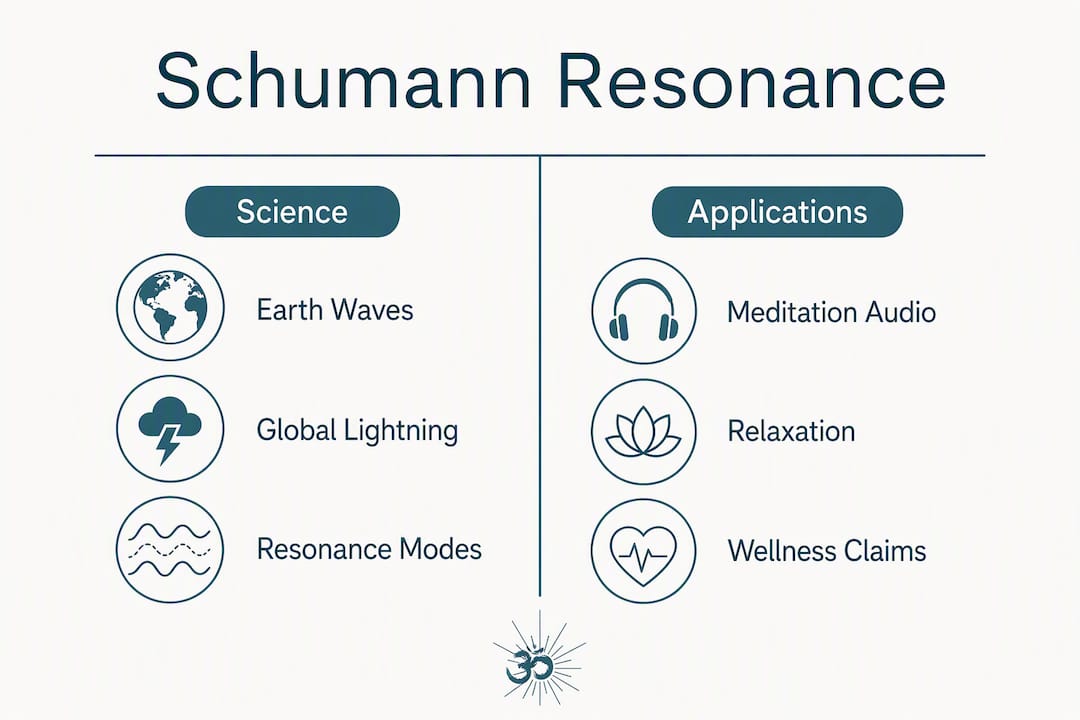
Picture the Earth wrapped in a giant electromagnetic shell. The space between the planet’s surface and the ionosphere forms a cavity, and like any enclosed resonant space, it supports standing waves. Physicist Winfried Otto Schumann predicted this mathematically in 1952, and subsequent measurements confirmed it. The result is a set of extremely-low-frequency (ELF) electromagnetic resonances that hum away continuously, largely unnoticed.
The fundamental electromagnetic resonance mode typically sits near 7.83 Hz, with a series of harmonics stacking above it. Think of it like the overtone series on a cello string, except the “string” is 40,000 kilometres of atmosphere.
The principal harmonics include fundamental and higher modes that appear as distinct peaks at extremely low frequencies above the fundamental resonance.
What keeps this resonance alive? Global lightning. Global lightning activity continuously injects electromagnetic energy into the cavity formed between Earth’s surface and the ionosphere. It is, in a sense, the planet’s own electrical heartbeat, sustained by the collective crackle of every storm on Earth.

One important correction worth making early: the 7.83 Hz value is not a fixed, immovable number. The fundamental resonance frequency typically drifts within a small range depending on ionospheric conditions, solar activity, and seasonal changes. Amplitude varies considerably more than frequency does, which matters a great deal when interpreting those dramatic spectrogram “spikes” you may have seen shared on social media.
What does the evidence actually say about 7.83 Hz and the human body?
Honestly? Less than the wellness internet would have you believe. The scientific consensus, as covered by BBC Sky at Night Magazine, is that there is little to no peer-reviewed biomedical evidence for direct biological effects from the Schumann resonance. That is not a fringe position; it is the mainstream view.
The physics makes direct coupling implausible. At ground level, the Schumann resonance signal strength is measured in picoteslas, orders of magnitude too weak to physically entrain brainwave activity. Your brain is not a radio receiver tuned to ELF fields in any meaningful sense.
So why do so many people report feeling calmer after listening to 7.83 Hz tracks? The more plausible explanation lies in the audio itself. Binaural beats in the theta range (4–8 Hz) are associated with subjective reports of deep relaxation, and the likely mechanism is neural response to patterned audio combined with expectation, not direct coupling to the Earth’s ELF field. That distinction matters, but it does not make the experience less real or less useful. You can find a broader look at how frequencies interact with the body if you want to dig further into the evidence.
| Claim | Evidence status |
|---|---|
| Schumann resonance exists and is measurable | Well-established geophysics |
| 7.83 Hz directly entrains human brainwaves | No strong peer-reviewed support |
| Binaural theta audio produces subjective relaxation | Small-scale studies, plausible mechanism |
| Spectrogram “spikes” mean frequency jumps | Incorrect; they represent amplitude/power changes |
How producers actually use 7.83 Hz in meditation audio
Here is the thing that surprises most people: you cannot hear 7.83 Hz. Human hearing begins at around 20 Hz, so the ELF frequency itself is entirely inaudible. What you hear on a “7.83 Hz track” is always a set of audible carrier tones engineered to create a perceived beat at the target frequency.
The three main techniques producers use:
- Binaural beats: Two slightly different carrier tones are fed separately to each ear (requiring headphones). If your left ear receives 200 Hz and your right ear receives 207.83 Hz, your brain perceives a phantom beat at 7.83 Hz. You hear the carriers; the beat is a neural construction.
- Isochronic tones: A single tone is switched on and off rhythmically at 7.83 times per second. No headphones required, making these useful for group settings or speaker playback.
- Orchestral ambient layering: Experienced producers embed binaural anchors within lush orchestral textures, using 3D surround mixing and careful dynamics so the theta pulse sits beneath the music rather than dominating it.
That last approach is where craft really separates the good from the generic. Wellness composers use 7.83 Hz conceptually, combining binaural anchors with professional orchestration to create immersive soundscapes that feel genuinely transportive rather than clinical. A cheap download with a sine wave drone and a slapped-on binaural beat is a very different listening experience from a track built around live strings, spatial mixing, and a thoughtfully chosen carrier pair.
Pro Tip: If you are using binaural beats specifically, check that the track notes specify the carrier frequencies and the beat frequency. A producer who cannot tell you these details probably has not thought carefully about the audio design.

How to try 7.83 Hz safely for relaxation or meditation
A few sensible precautions before you press play. Binaural beats and isochronic tones are generally considered safe for most adults, but if you have epilepsy, a history of seizures, or cardiovascular instability, consult your GP first. Pregnancy is another reason to take medical advice before using any pulsed audio therapy. For everyone else, the main risk is simply playing things too loud for too long.
A simple session recipe:
- Choose quality, over-ear headphones (essential for binaural beats; less critical for isochronic or ambient tracks).
- Set volume to a comfortable conversational level, around 50–60% of your device’s maximum.
- Sit or lie in a comfortable position with eyes closed.
- Run the session for 20–30 minutes. Longer is not necessarily better, especially when starting out.
- Pair the audio with slow diaphragmatic breathing or a simple body-scan practice for noticeably deeper results.
- After the session, sit quietly for two to three minutes before resuming activity.
How to judge whether a track is worth your time:
Look for tracks that state their carrier frequencies and beat frequency explicitly. Be sceptical of any product claiming to “cure” conditions, “raise your vibration to match the Earth,” or produce guaranteed measurable health outcomes. Those are red flags, not selling points. Simple personal metrics work well: note your subjective calmness before and after a session, track sleep quality over a week of regular use, and pay attention to how easily you settle into stillness. You can also explore sound therapy best practices for a fuller framework.
Statistic callout: The theta brainwave band spans 4–8 Hz, placing 7.83 Hz at its upper edge. This overlap is why theta-range audio is consistently associated with the drowsy, pre-sleep state most people are trying to reach in deep meditation.
Why production quality matters, and what Orchestralmeditations brings to it
There is a meaningful difference between a 7.83 Hz track assembled in an afternoon and one built with live musicians, professional studio acoustics, and composers who understand both the science and the art. High-quality production affects carrier clarity, dynamic balance, spatial depth, and ultimately how well a listener can actually relax into the music rather than being distracted by it.
Orchestralmeditations records with live orchestral musicians, including sessions at Abbey Road Studios with the National Philharmonic. That is not a marketing flourish; it changes the texture of the sound in ways that matter for sustained listening.
Two composers central to the catalogue are worth knowing:
- Robert Emery is a composer and producer whose work spans orchestral scoring and meditation music. His approach to theta-based tracks prioritises musical coherence alongside frequency design, so the binaural architecture never feels bolted on as an afterthought.
- Moritz Schneider brings a similarly rigorous sensibility to production, with a background that bridges classical composition and contemporary sound design. His tracks tend to use 3D surround mixing to create a sense of spatial immersion that supports the meditative state rather than simply filling the room.
What the Orchestralmeditations catalogue offers in practical terms:
- Binaural-ready stereo masters with clearly designed carrier frequencies.
- Theta-frequency layering within full orchestral arrangements.
- 3D surround mixes for immersive speaker or spatial audio playback.
- Recorded live with orchestral musicians, not synthesised approximations.
- Personal and professional licensing, covering individual use through to yoga studios, therapy practices, and app development.
Pro Tip: If you are a practitioner running group sessions, check the professional licence options. A personal download licence does not cover public or commercial playback, and the professional tier is designed exactly for that use case.
Key takeaways
The Schumann resonance is real, measurable geophysics; its direct biological effects on humans remain unproven, but theta-range audio built around the 7.83 Hz concept can support genuine relaxation through patterned sound exposure and expectation.
| Point | Details |
|---|---|
| What 7.83 Hz actually is | The fundamental Schumann resonance, an ELF electromagnetic wave in the Earth–ionosphere cavity, not an audible sound. |
| Scientific consensus | No strong peer-reviewed evidence for direct physiological effects; subjective benefits likely stem from audio design and expectation. |
| Frequency variability | The fundamental frequency typically drifts within a small range; spectrogram spikes reflect amplitude changes, not frequency jumps. |
| Safe listening practice | 20–30 minutes, quality headphones at moderate volume, paired with slow breathing; check contraindications if you have epilepsy or cardiovascular conditions. |
| Orchestralmeditations | Studio-grade theta tracks recorded at Abbey Road with live musicians, composed by Robert Emery and Moritz Schneider, available for personal and professional licensing. |
The science is honest; the music is still worth your time
The wellness world has a habit of taking genuinely interesting physics and stretching it until it snaps. The Schumann resonance is a real and rather beautiful phenomenon, a planetary electromagnetic hum sustained by every lightning bolt on Earth. What it is not, at least not according to any credible evidence, is a biological tuning fork that directly synchronises your brain.
That said, dismissing 7.83 Hz audio entirely would be throwing the baby out with the bathwater. Theta-range audio works, in the sense that patterned sound at the right frequency genuinely helps many people reach a calmer, more meditative state. The mechanism is audio design and neural response, not geophysical coupling, but the outcome is the same: you feel better.
My honest recommendation is this. Approach the dramatic health claims with the scepticism they deserve, but do not let that scepticism stop you from trying a well-produced theta track. The difference between a cheap sine-wave download and something built by composers like Robert Emery or Moritz Schneider, recorded with live musicians in a proper studio, is not subtle. Orchestralmeditations aims to sit at that intersection of artistic rigour and scientific honesty, and that is a combination worth seeking out.
Studio-grade theta tracks for your practice
If you have read this far and want to actually try what good 7.83 Hz-inspired audio sounds like, Orchestralmeditations is the place to start. The catalogue features orchestral theta tracks recorded at Abbey Road Studios with the National Philharmonic, composed and produced by Robert Emery and Moritz Schneider, and built with binaural-ready masters and 3D surround mixes.
Tracks are available for individual download or through a subscription, with separate personal and professional licences covering everything from private listening to yoga studios and therapy practices. You can preview the full library and find the right licence for your situation at the Orchestralmeditations meditation music page. For a curated view of the bestselling personal tracks, the best meditation music collection is a good place to start.
Useful sources and further reading
For readers who want to verify the science or explore further, these are the most reliable places to look:
- EarthBeat Schumann Resonance: Clear physics explainer covering the excitation mechanism and cavity resonance, with live monitoring data.
- SchumannResonance.today: Live spectrograms with Kp-index overlays. Useful for watching amplitude changes in real time; remember that spikes show power increases, not frequency shifts.
- BBC Sky at Night Magazine: Authoritative science journalism covering the resonance and the wellness claims made around it, with appropriate scepticism.
- Wikipedia: Schumann resonances: Solid overview of the physics, harmonic values, and historical background.
- Orchestralmeditations articles: Production notes and frequency guides covering theta, Solfeggio, and related meditation-music topics.
For electromagnetic therapy context, the PEMF therapy side effects guide offers a useful external perspective on safety considerations around low-frequency electromagnetic exposure.
This article is general information, not medical advice. If you have a health condition affected by electromagnetic exposure or pulsed audio, consult a qualified healthcare professional before use.
FAQ
What does 7.83 Hz do to your body?
There is no strong peer-reviewed evidence that the Schumann resonance directly alters human physiology. Subjective relaxation from 7.83 Hz audio tracks is more plausibly explained by the theta-range audio design and expectation than by any direct geophysical effect.
Is it good to listen to 7.83 Hz?
For most healthy adults, listening to well-produced theta-range audio is safe and can support relaxation and meditation. Those with epilepsy, seizure disorders, or cardiovascular conditions should consult a GP before using pulsed audio formats such as binaural beats or isochronic tones.
What causes the Schumann resonance to spike?
Spectrogram spikes represent increases in amplitude (power), not jumps in frequency. They are typically driven by sudden bursts of global lightning activity or solar-driven ionospheric disturbances, and the fundamental frequency remains anchored near 7.83 Hz throughout.
How is 7.83 Hz used in meditation music?
Because 7.83 Hz is below the threshold of human hearing, producers use audible carrier tones to create a perceived beat at the target frequency via binaural beats or isochronic tones. Orchestralmeditations layers these techniques within live orchestral arrangements for a more immersive listening experience.