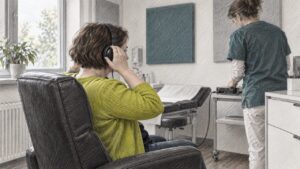
True binaural perception needs two separate audio channels reaching each ear independently, which is precisely what headphones are built to do. Play the same track over speakers and the sound waves mix together in the air before they reach you, so the effect weakens or disappears depending on your setup. Speaker-based tricks, like panning and monaural beats, can approximate some of the relaxation effects, but the evidence for any of this remains genuinely mixed.
TL;DR:
- Speaker playback likely influences relaxation through spatial cues, panning, or audio quality rather than true binaural entrainment.
- Monarual beats can produce brainwave entrainment comparable to binaural beats and are effective when played through a single speaker.
- Achieving authentic binaural separation with speakers requires complex, specialized setups that are sensitive to head movement and room acoustics.
- Short, well-produced audio sessions of around five minutes using monaural or panned sounds can improve calmness and focus in controlled conditions.
- Headphones remain the only reliable way to experience the classic binaural illusion, but speaker-based methods can still promote relaxation through alternate mechanisms.
How binaural beats work: the percept, carrier frequencies and auditory physiology
Here’s the bit that surprises most people: a binaural beat doesn’t exist in the audio file at all. It’s assembled entirely inside your head. Feed one tone (say, 400 Hz) into the left ear and a slightly different tone (say, 410 Hz) into the right, and your brain perceives a phantom third tone, a pulsing “beat”, at the difference between the two: 10 Hz in this case. No speaker, however good, produces that 10 Hz wobble as an actual sound wave. Your auditory system manufactures it.
This happens thanks to a cluster of neurons called the superior olivary complex, which sits early in the auditory brainstem and specialises in comparing timing and phase differences between your two ears. It’s the same circuitry that helps you work out where a sound is coming from in a room. When it receives two close-but-different frequencies, one per ear, it interprets the mismatch as a rhythmic pulse rather than two separate tones.
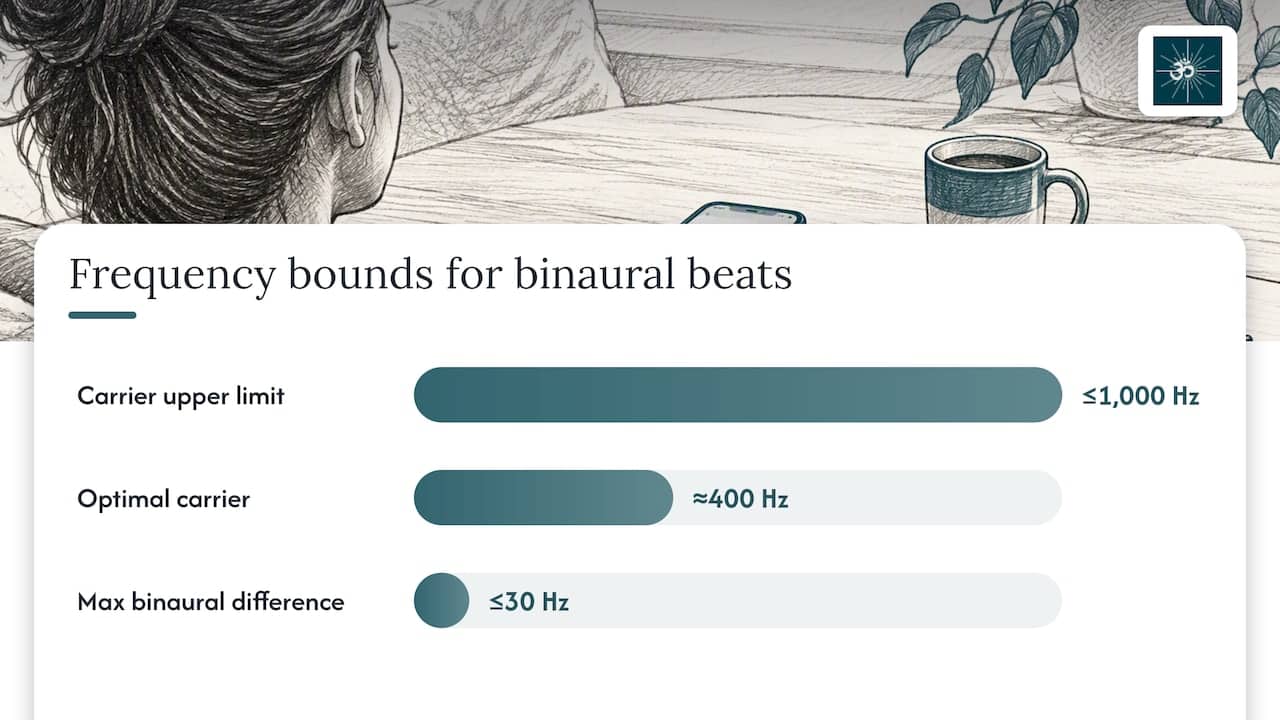
The physics only works within fairly narrow bounds, something the classic psychoacoustic literature has established clearly:
- Carrier tones generally need to stay under 1,000 Hz, with research suggesting something around 400 Hz tends to produce the clearest, most stable percept.
- The frequency difference between the two tones rarely exceeds about 30 Hz before the illusion breaks down and you just hear two separate pitches.
- Strict channel isolation is non-negotiable: if both ears hear a blend of both tones, as happens with ordinary stereo speakers, the olivary complex has nothing clean to compare.
This is also where binaural beats part ways from their cousin, monaural beats. A monaural beat mixes the two frequencies together before it ever reaches your ears, so the resulting pulse is a genuine amplitude-modulated wave you could record with a single microphone. That distinction matters enormously once we start talking about speakers, because one of these effects survives acoustic mixing and the other doesn’t.
What the science says about entrainment, studies and speaker playback limits
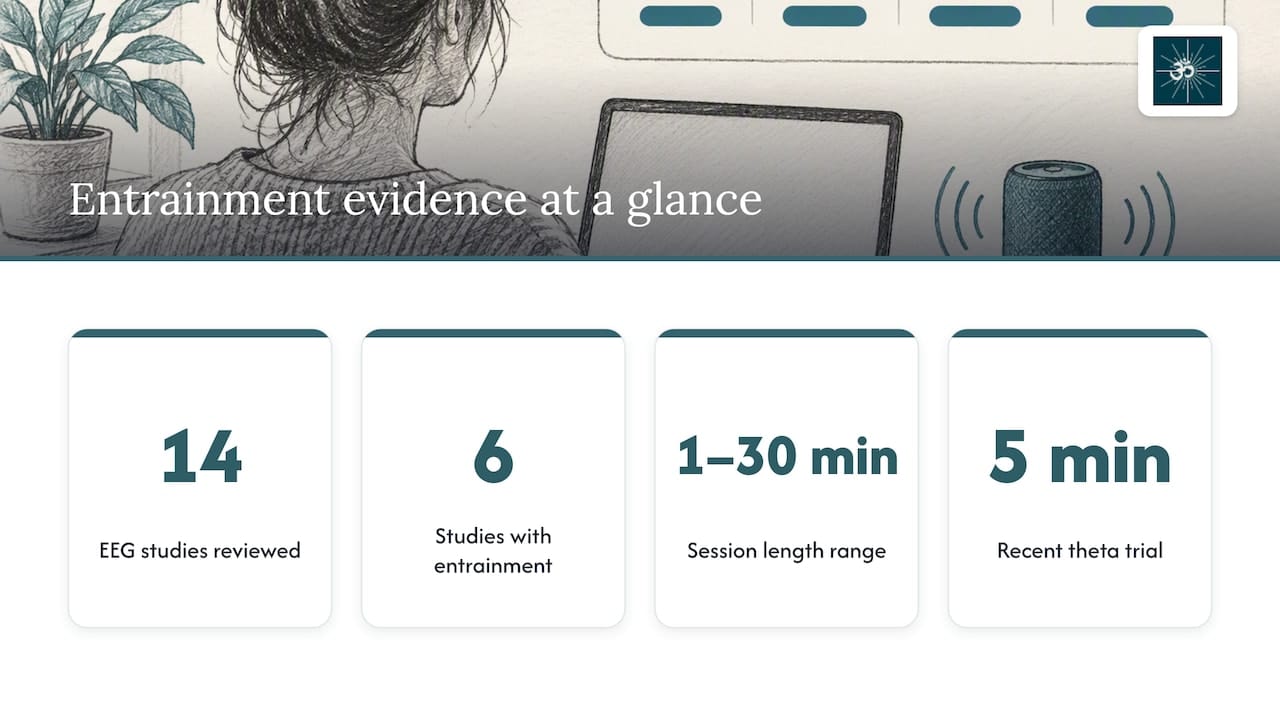
The honest answer is that the research base is a bit of a patchwork quilt, stitched together from small studies using different frequencies, durations and equipment. A systematic review published in PLOS ONE looked at 14 EEG studies testing whether binaural beats actually entrain brainwave activity, and found that only six produced results consistent with genuine entrainment. The rest showed weak, inconsistent or null effects. The reviewers pointed to wildly varying carrier frequencies, session lengths running anywhere from one to thirty minutes, and inconsistent definitions of what counts as “entrainment” in the first place.
A subset of reviewed EEG studies found results consistent with binaural beat entrainment, a reminder that the effect is real in some conditions but far from universal across the existing literature.
A separate PubMed entry on methodological heterogeneity makes much the same point from a different angle: researchers have been implementing “binaural beats” in so many inconsistent ways that comparing studies is genuinely difficult, and the authors call for standardised protocols before anyone draws firm conclusions.
Things get more interesting, and more relevant to anyone without headphones, when you look at what happens with spatial sound rather than true binaural pairs. A 2024 study compared binaural beats against spatially moving sounds, tones panned or alternated between left and right, at 6 Hz and 40 Hz. The spatial versions produced pronounced EEG changes and relaxation effects that looked a lot like what’s normally credited to binaural beats themselves. The implication is a little humbling for the binaural beat mythology: some of what people feel when “listening to binaural beats” might actually be a response to movement and spatial cues in the sound, not the phantom-tone illusion at all.
An earlier controlled EEG study adds a further wrinkle. It found that monaural beats, the acoustically “cruder” cousin, often produced stronger brainwave entrainment than true binaural beats, and neither reliably shifted participants’ mood in that experiment. If monaural beats entrain just as well or better, and they survive being played through a single speaker, the practical case for insisting on headphones starts to look weaker than the marketing around binaural audio usually suggests.
More recently, a 2026 behavioural trial tested brief, five-minute, self-administered theta binaural-beat sessions, reporting improvements in self-reported calmness and focus, particularly when the beats were embedded in pink noise rather than played as a bare tone. That’s a genuinely encouraging result, but it was conducted under controlled, structured conditions with real headphone separation. It tells us something about short theta protocols done properly. It doesn’t tell us that the same five minutes over a laptop speaker will deliver the same lift.
Put together, the pragmatic reading is this: speaker playback is probably doing something to your nervous system when you find it relaxing, but it’s more likely leaning on spatial movement, panning and the psychological comfort of a calm soundscape than on authentic binaural entrainment.
Alternatives to headphones: monaural beats, panning and crosstalk cancellation
If headphones aren’t an option, you’ve got three realistic routes, and they vary a lot in how much effort they demand.
Monaural beats are the simplest fix, because the amplitude-modulated pulse is baked directly into the waveform rather than relying on two ears comparing notes. Play a monaural track through a single decent speaker, or even a phone, and you’re hearing the same pulsing pattern a pair of headphones would deliver. Given that monaural beats sometimes out-performed binaural ones in controlled EEG testing, this isn’t really a compromise option so much as a legitimate alternative in its own right.
Panning and alternating-beep techniques sit a notch above that. Rather than two static tones, the sound is made to sweep or alternate between your left and right speaker. The 2024 spatial-sound study found this produces its own EEG and relaxation effects, independent of any binaural illusion, so a well-mixed track using movement rather than static channel separation can be a genuinely effective substitute, not just a placebo.
Transaural reproduction, sometimes called crosstalk cancellation, is the serious engineering answer to the whole problem. A loudspeaker array study published by the Institute of Acoustics demonstrates that it’s technically possible to reproduce genuine binaural separation over loudspeakers by processing the signal to cancel out the sound that “leaks” from the left speaker into your right ear, and vice versa. It works, in principle. The catch is that it’s extremely sensitive to where your head is: lean a few centimetres the wrong way, or sit in a room with lively acoustic reflections, and the cancellation falls apart. It generally needs specialist speaker arrays, careful calibration and a listener who stays remarkably still, which rules it out for casual living-room use.
- Monaural beats: work through any single speaker, backed by evidence suggesting they entrain comparably to or better than binaural beats.
- Panning and spatial movement: produce their own measurable EEG effects and work well through a normal stereo pair.
- Transaural crosstalk cancellation: technically achieves true separation but needs specialist hardware and a nearly motionless listener.
Pro tip: If you’re choosing between options, start with a well-produced monaural track rather than chasing a “true” binaural effect through ordinary speakers; it’s the one approach that doesn’t depend on you sitting perfectly still.
How to set up a speaker session for binaural-style listening safely
A good speaker session takes a few minutes to set up properly and rewards a bit of patience.
- Position your speakers symmetrically, equal distance from your listening spot, ideally forming a triangle with your head at the apex.
- Sit still and centred for at least the first few minutes, since both panning effects and any attempt at crosstalk cancellation degrade quickly once you move off-axis.
- Start with short sessions, around five minutes, mirroring the duration used in the 2026 theta protocol study that reported improved calm and focus.
- Keep volume moderate, loud enough to mask background noise but never pushed to the point of strain.
- Log how you feel afterwards, noting mood, focus or tension, so you can tell over a few sessions whether a particular track or frequency is doing anything for you personally.
- Try a monaural or panned version of the same frequency band alongside a nominally “binaural” one and compare, since the research suggests the two may feel similar through speakers anyway.
Some tracks embed the beat frequency within pink noise rather than presenting it as a bare tone, an approach the 2026 trial found participants preferred subjectively. It’s worth testing both formats to see which one you find easier to settle into.
Pro tip: Treat the first few sessions as an experiment, not a cure, and stop immediately if you notice dizziness, headache or unusual anxiety; sound-based relaxation techniques should feel calming, never distressing.
Why professionally produced soundscapes still matter without headphones
None of this changes the physics, but production quality changes a lot about the experience around it. We record our meditation library live at Abbey Road Studios with the National Philharmonic, then layer in 3D surround mixing and carefully mastered binaural, theta and Solfeggio frequency elements, rather than relying on a synthesised tone generator. Our composer and producer Robert Emery and composer Moritz Schneider shape that process, and that craft shows up in details an amateur upload rarely gets right: consistent carrier tones, properly balanced stereo imaging, and pink noise layered in deliberately rather than as an afterthought.
- Live orchestral recording and 3D surround techniques aim to make the soundscape immersive even when played through ordinary speakers.
- Composer-led production, credited to Robert Emery and Moritz Schneider, means the frequency work sits inside a musically coherent piece rather than a bare sine wave.
- Mastering consistency keeps carrier frequencies and beat differences within the ranges the research associates with a stable percept.
A better recording still can’t rewrite the rules of channel separation. Headphones remain the only way to guarantee the binaural illusion itself; what good production buys you is a richer, more carefully built soundscape to listen to while you experiment with speakers.
Our honest take: fidelity versus convenience
We’d rather you went in with realistic expectations than a false promise. Headphones remain the only reliable route to the classic binaural illusion, full stop. Speakers can still relax you, through panning, monaural pulses or sheer production quality, but that’s a different mechanism doing the work. Try short, logged sessions, treat strong claims with scepticism, and read the primary research rather than the marketing around it.
— ROBERT
Hear the difference for yourself with Orchestral Meditations
If you’re curious how a properly produced soundscape compares to a free online tone generator, our library gives you somewhere to start. 
Our personal subscription runs £21 a month and gives you ongoing access to our catalogue of live orchestral recordings, binaural and theta tracks, and 3D mixed soundscapes, composed and produced with the same care Robert Emery and Moritz Schneider bring to every session at Abbey Road. For practitioners, therapists and content creators who need licensed tracks for client or commercial work, our professional subscription at £150 a month covers that use case directly.
- Personal subscription: ongoing access to our full meditation library for £21 a month.
- Professional subscription: licensed tracks for therapeutic, creative or commercial use for £150 a month.
Sample a few tracks first, through headphones if you can, and judge the difference between a mastered recording and a generic tone for yourself.
FAQ
Is it okay to listen to binaural beats without headphones?
Yes, it’s generally safe to listen through speakers, though you won’t get the true binaural illusion since that relies on strict left and right channel separation. What you’ll likely experience instead comes from spatial panning, monaural pulses or the calming quality of the recording itself, all of which carry no particular safety risk at normal volumes.
What is the dark side of binaural beats?
The main concerns raised in the research are methodological rather than medical: a systematic review found highly inconsistent results across studies, so claims of guaranteed mood or cognitive benefits are often overstated. Some listeners also report mild dizziness or unease during sessions, so stopping if you feel uncomfortable is sensible.
Do theta waves work without headphones?
Theta-frequency protocols have shown promising results in controlled settings, including a 2026 behavioural trial reporting improved calm and focus after brief sessions, but that study used proper binaural separation via headphones. Through speakers, any theta-associated calm is more likely coming from panning, monaural modulation or the recording’s overall quality rather than true entrainment.
Does bilateral stimulation work without headphones?
Bilateral stimulation techniques, which rely on alternating left-right sensory input rather than simultaneous dual tones, can translate reasonably well to speakers since the alternation itself is audible without needing strict channel isolation. Research into spatially moving and alternating sounds has found measurable relaxation effects that function independently of true binaural separation.