
Systematic reviews and recent trials through 2026 point to small-to-moderate, frequency-dependent benefits of binaural beats for sleep, anxiety and some cognitive tasks, but the picture is patchy. Pooled effects for insomnia sit around an SMD of −0.45, with anxiety and cognition landing somewhere between 0.3 and 0.6. Heterogeneous protocols explain a lot of the disagreement you’ll see between studies.
TL;DR:
- For sleep, delta or theta beats may complement a bedtime routine, but evidence does not support them as a standalone treatment for chronic insomnia.
- One preoperative trial found that a 20 to 30 minute session lowered remimazolam use to 15.0 mg versus 17.7 mg at the same sedation target.
- For short term attention or working memory, alpha or gamma protocols show promise, but the evidence is task specific and 40 Hz findings remain exploratory.
- When judging a study, look for reported carrier tones and intensity, an active control, preregistration, and objective measures alongside self reports; EEG entrainment remains inconsistent.
1. What do systematic reviews and meta-analyses say by 2026?
We’ve spent years recording meditation music, so we read these reviews the way a cellist reads a tuning fork report: carefully, and with a healthy respect for how much the details matter. The headline news from 2026 is that binaural beats are no longer a fringe curiosity dismissed in a single sentence. They’re accumulating a real evidence base, just not a tidy one.
A recent meta-analytic summary found a significant reduction in insomnia symptoms, with a pooled standardised mean difference around −0.45 (p = 0.03), alongside moderate improvements across anxiety, stress and cognitive tasks, with standardised mean differences clustering between 0.3 and 0.6. That’s not a dramatic effect by clinical standards, but it’s not nothing either. Think of it as the difference between a mediocre violin bow and a well-rosined one: noticeable, useful, but not a miracle worker.
A 2026 systematic review focused on young adults reinforced this pattern, reporting effects of d = 0.3 to 0.6 across sleep, anxiety and cognition, and singling out theta-frequency beats as having a stronger pull on physiological stress markers, closer to d = 0.59. That review also made a point we think deserves more attention: the most credible positive findings tend to appear when researchers combine objective biomarkers, EEG, heart rate variability, fNIRS, with validated subjective scales, rather than relying on self-report alone.
Not every domain fares equally well. Sleep and anxiety outcomes show the most consistent positive signals across reviews. Cognition is messier: some tasks respond, others don’t budge, and the direction sometimes flips depending on which frequency band researchers chose.
Where the pooled evidence is strongest and weakest:
- Sleep quality and insomnia symptoms show the most reproducible small-to-moderate improvements across independent reviews.
- Anxiety reduction, particularly short-term and situational anxiety, shows moderate and fairly consistent effects.
- General cognition is inconsistent, with working memory and attention tasks responding better than broader executive function measures.
- Mood outcomes outside anxiety (general wellbeing, depressive symptoms) have the thinnest evidence base so far.
One pooled estimate worth remembering: insomnia symptom reduction around an SMD of −0.45 (p = 0.03), meaning the average listener in these trials saw a meaningful, if modest, improvement in sleep complaints compared with controls.
2. Which recent trials matter most for interpreting the evidence?
If the reviews are the orchestra’s overall sound, the individual trials are the first violins you actually want to hear up close. A handful of studies from 2023 to 2026 carry disproportionate weight because they used objective outcomes rather than relying purely on “how did you feel afterwards?”
The most striking of these is a clinical trial on preoperative anxiety, where patients who listened to roughly 30-minute of binaural beats before surgery needed significantly less remimazolam to reach the same sedation target: 15.0 ± 3.6 mg versus 17.7 ± 4.5 mg in controls (p = 0.006). They also showed a lower incidence of intraoperative hypotension. That’s about as objective as a cognitive-audio intervention gets. Nobody’s self-report bias changes how much sedative drug a patient requires.
On the cognitive side, a Frontiers in Neuroscience study from early 2026 randomised healthy participants to alpha (10 Hz), beta (14 Hz) and gamma (30 Hz) binaural beats and tracked both digit-span performance and EEG network metrics. Participants across these bands showed post-stimulation improvements in digit-span scores, and those gains correlated with measurable shifts in theta-band network organisation. This is one of the few studies linking a subjective-adjacent cognitive outcome to an objective neural signature in the same cohort, which matters enormously for credibility.
Elsewhere, exploratory work on 40 Hz gamma stimulation paired with preferred music has shown promise in disorders of consciousness and memory-related tasks, with effect sizes in the moderate range of roughly 0.5 to 0.9. We’d flag this one as genuinely exciting but still early: some of these trials lack adequate controls or run on small samples, so treat the numbers as a direction rather than a settled fact.
A few patterns stand out across these trials:
- Objective physiological or biochemical endpoints (drug dosage, EEG metrics) tend to produce more convincing effects than subjective mood scales alone.
- Preoperative and clinical-context studies, where stakes and attention are high, show some of the clearest results.
- Working memory and attention tasks respond better to targeted frequency protocols than general wellbeing measures do.
- Several groups have moved toward preregistered protocols, including a multi-night sleep-stage sequencing study designed to test binaural beats across different sleep stages in a randomised crossover design, a sign the field is maturing past single-session convenience trials.
3. Which frequency bands produce which effects?
One of the more useful things to come out of the 2026 literature is a clearer map of what each frequency band tends to do, even if the borders are still blurry in places.
Delta and theta frequencies, roughly 0.5 to 8 Hz, are the ones most consistently tied to sleep improvements. The pooled insomnia effect of around −0.45 reported in recent meta-analyses sits largely within this range, and the sleep-stage sequencing protocol from Frontiers in Neurology specifically designs its phased stimulation around matching frequency bands to different sleep stages rather than using one flat tone all night.
Theta and alpha bands (roughly 4 to 13 Hz) show up repeatedly in relaxation and stress-reduction research. The young-adult systematic review found theta beats produced the strongest physiological stress reduction of any band tested, around d = 0.59, which is a respectable effect size for something you listen to through headphones rather than swallow.
Beta frequencies (14 to 30 Hz) are associated with alertness, but the anxiety picture here is mixed: some protocols using beta-range stimulation report reduced anxiety, others find no change or a slight increase, which tracks with beta’s general association with heightened arousal rather than calm.
Gamma, especially around 40 Hz, is the newest frontier. The Frontiers in Psychology work on disorders of consciousness and the working memory network study both point to 40 Hz stimulation producing measurable, if preliminary, cognitive and consciousness-related effects, often paired with preferred music rather than delivered as a pure tone.
What the frequency map looks like in practice:
- Delta and theta (roughly 0.5 to 8 Hz): most reliably linked to sleep quality improvements.
- Theta and alpha (roughly 4 to 13 Hz): associated with relaxation and measurable stress reduction.
- Beta (14 to 30 Hz): linked to alertness, with inconsistent and sometimes contradictory anxiety effects.
- Gamma, particularly 40 Hz: emerging cognitive and consciousness-related effects, still largely exploratory.
A figure worth holding onto: theta-frequency binaural beats showed the strongest physiological stress reduction among tested bands, around d = 0.59 in young adults, which is why theta shows up so often in relaxation-oriented soundscapes.
4. How might binaural beats actually work in the brain?
Here’s where we have to be honest cellists rather than cheerleaders: the mechanism is plausible, but it isn’t proven the way gravity is proven.
The basic physiological premise rests on the frequency-following response, where neural populations in the auditory pathway can synchronise their firing patterns to rhythmic acoustic input, including the perceived “beat” that emerges when two slightly different tones are presented to each ear. That’s the theoretical basis for calling this entrainment. Whether it reliably produces whole-brain effects beyond the auditory cortex is where things get murky.
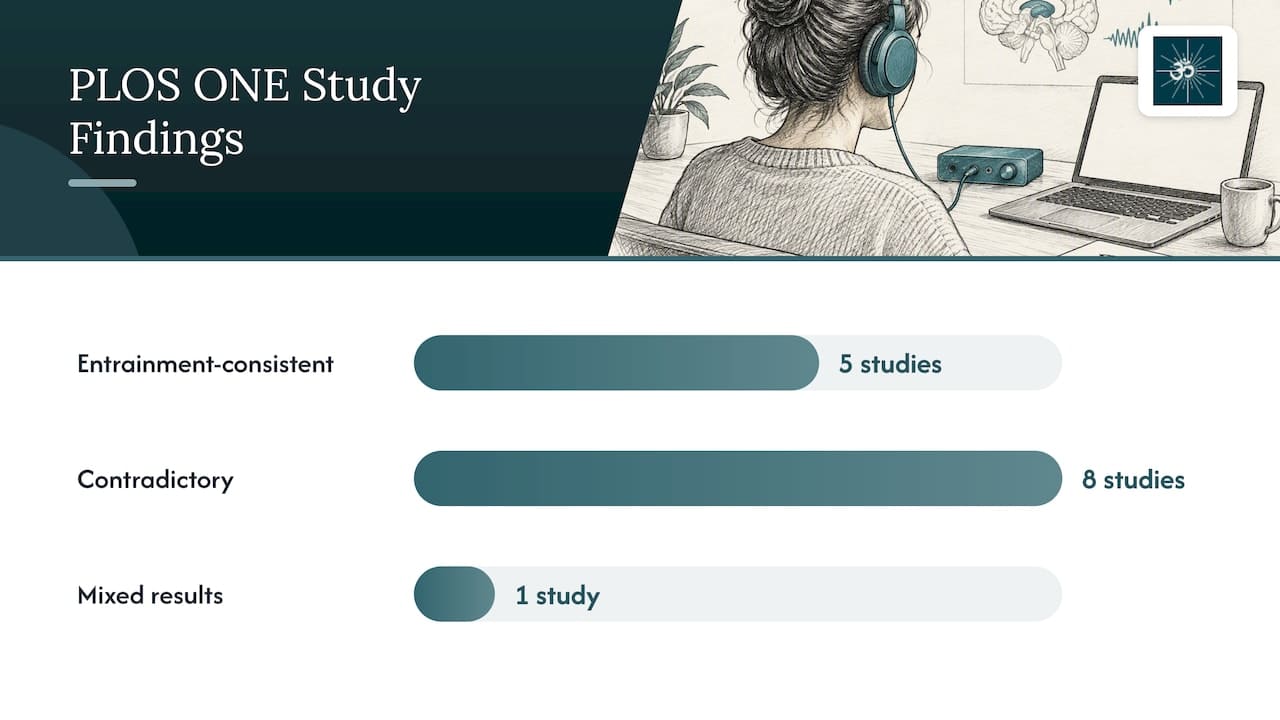
A large systematic review in PLOS ONE looked specifically at whether binaural beats entrain brainwaves as claimed. Of 14 studies reviewed, five reported results consistent with entrainment, eight reported contradictory findings, and one was mixed. That’s about as close to a coin flip as research gets, and the review attributed much of the inconsistency to differences in carrier tone, session duration, electrode placement and how “entrainment” was even defined from study to study.
Where the picture brightens slightly is in network-level EEG analysis. The Frontiers in Neuroscience working memory study used graph-theory metrics, things like clustering coefficient and local efficiency, to show that alpha and gamma binaural beats altered theta-band network organisation in ways that correlated with digit-span improvements. This is a more sophisticated approach than simply asking “did the EEG show more theta power afterwards,” and it’s one of the more convincing mechanistic threads in the current literature.
What the neurophysiological evidence currently supports:
- A plausible frequency-following response in the auditory pathway, serving as the biological basis for entrainment claims.
- Inconsistent EEG entrainment findings across studies, with roughly a third showing clear entrainment-consistent patterns and more than half showing contradictory results.
- Promising, though still early, network-level findings linking specific frequency bands to measurable changes in brain network efficiency and working memory performance.
5. Why do studies disagree, and what would better research look like?
If you’ve read this far and noticed the evidence feels like it’s arguing with itself, you’re not imagining it. We think that’s less a sign binaural beats don’t work and more a sign the field hasn’t agreed on how to study them properly yet.
Several recurring problems show up across the literature. Sample sizes are often small, sometimes a few dozen participants, which makes it hard to detect a modest effect reliably. Carrier tones vary wildly between studies: some use pure sine waves, others layer in music or nature sounds, and that choice almost certainly changes the experience and the outcome. Session duration ranges from a few minutes to all-night protocols, with little consistency in between. Blinding is also genuinely difficult, since a participant can sometimes tell when a beat is present versus absent, which undermines the placebo comparison that makes a trial convincing in the first place.
A practical checklist for researchers designing the next generation of trials:
- Report full acoustic metadata: carrier frequency, beat frequency, intensity and whether music or noise was layered underneath.
- Preregister the study design, primary outcome and analysis plan before data collection begins.
- Use a validated active control condition rather than silence, to better isolate the beat’s specific contribution.
- Combine subjective scales with at least one objective measure, EEG, heart rate variability or a behavioural task.
- Recruit samples large enough to detect an effect in the 0.3 to 0.6 range, which generally means more than the 20 to 40 participants common in older studies.
- Standardise session duration and listening conditions (headphones, environment) across arms.
Pro Tip: If you’re designing or evaluating a binaural beats study, check first whether the acoustic parameters are fully reported; a study that won’t tell you its carrier tone and intensity is one you should read with real scepticism.
6. How should clinicians and researchers apply this evidence now?
Translating a pile of studies into something you’d actually recommend is a different skill from reading them, and we think the honest answer sits somewhere between “promising adjunct” and “not a replacement for anything established.”
For sleep, the evidence supports using delta or theta-range binaural beats as a reasonable adjunct within a broader bedtime routine, not as a standalone cure for chronic insomnia. For short-term, situational anxiety, such as the kind studied in the preoperative trial, a 20 to 30 minute listening session beforehand has some of the strongest objective backing in the current literature. For cognitive tasks, alpha and gamma protocols around 10 to 40 Hz show the most promise for short-term attention and working memory support, though the effects are modest and task-specific rather than a general brain boost.
Sensible parameters drawn from the trials we’ve covered:
- Session length of roughly 20 to 30 minutes for anxiety-focused use, matching the preoperative protocol’s design.
- Theta-range stimulation (around 4 to 8 Hz) for relaxation and stress-reduction goals.
- Stereo headphones are essential; binaural beats rely on each ear receiving a distinct tone, so speakers won’t produce the effect.
- Consistent, quiet listening environments to reduce confounding noise, particularly for research use.
For clinicians, track both a subjective measure (a validated anxiety or sleep-quality scale) and, where feasible, an objective marker, heart rate variability is accessible and reasonably well tolerated. For researchers, the network-metric approach used in the working memory study is worth adopting more widely, since it offers a more granular picture than raw EEG power alone.
Pro Tip: Keep a simple listening log, frequency, duration, time of day, and pair it with whatever outcome measure matters most to you; most of the useful signal in binaural beats research comes from consistency, not intensity.
7. What does high-fidelity production bring to binaural beats research?
We produce meditation music recorded with live musicians, and one thing years of studio work has taught us is that the quality of a carrier tone matters more than people assume. A thin, poorly mixed stimulus introduces acoustic noise that can muddy any attempt to isolate a beat’s effect, which is precisely the kind of confound the PLOS ONE review flagged as a driver of inconsistent findings.
Our catalogue is built around orchestral compositions and 3D surround production, including work shaped by composer and producer Robert Emery, whose background spans large-scale orchestral and choral projects, and Moritz Schneider, whose composition work brings a different textural sensibility to theta and Solfeggio-frequency pieces. Having expert composers involved means the carrier material underneath a binaural layer is deliberately structured rather than an afterthought bolted onto a sine wave, which supports exactly the kind of reproducible, well-documented acoustic stimulus the methodological checklist above calls for.
For researchers or clinical pilots that need consistent, well-produced audio with clear licensing, having studio-level production and documented production detail is a practical asset, not just an aesthetic one.
8. Where should binaural beats research focus next?
Our honest take is that the field’s biggest problem isn’t a lack of interesting findings, it’s a lack of shared standards that would let those findings stack up into something conclusive. The preoperative anxiety trial and the working memory network study both show what’s possible when researchers pair a binaural stimulus with a genuinely objective endpoint. That should become the norm, not the exception.
We’d like to see more partnerships between high-fidelity audio producers and neuroscientists, because the acoustic quality of the stimulus is itself a variable worth controlling, not an afterthought. The priority list is straightforward: preregistration as standard practice, biomarkers alongside subjective scales, and samples diverse enough in age and background to tell us whether these effects generalise. Larger, standardised randomised trials with objective endpoints would do more for this field than another dozen small, inconsistent single-session studies.
— ROBERT
9. A research-friendly source for high-fidelity binaural and orchestral tracks
For anyone running a sleep study, an anxiety pilot or simply building a consistent personal listening practice, the quality and documentation of the underlying audio genuinely matters. 
We offer a catalogue of studio-recorded orchestral meditations, including binaural, theta and Solfeggio-frequency tracks produced with live musicians and 3D surround techniques, available through our Personal subscription at €21 per month for individual listening, or our Professional subscription at €150 per month for practitioners and researchers who need licensing for clinical or study use. For one-off needs, our royalty-free meditation music catalogue offers individual track licensing suited to pilot studies or app integration. If you’re exploring complementary non-pharmacological approaches, resources like this clinician sleep-hypnosis script cover a different but related angle on bedtime routines.
This article is general information, not a substitute for advice from a qualified doctor. Consult a qualified healthcare professional about your own circumstances before acting on anything here.
FAQ
Are binaural beats a real thing?
Yes, binaural beats are a genuine auditory phenomenon: when each ear receives a slightly different tone, the brain perceives a third, rhythmic “beat.” Whether that perception reliably changes brain activity or behaviour is still being studied, with systematic reviews reporting mixed entrainment evidence alongside small-to-moderate benefits for sleep and anxiety.
Can I listen to 40 Hz binaural beats while studying?
Some exploratory research links 40 Hz gamma stimulation to attention and memory-related outcomes, with moderate effect sizes around 0.5 to 0.9 in targeted samples, but these studies remain preliminary and often small. It’s reasonable to try as a study aid, but treat it as a minor supplement rather than a guaranteed cognitive boost.
What does 7 Hz do to the brain?
A 7 Hz beat sits in the theta range, which research has associated with relaxation and measurable stress reduction, with theta-frequency effects reaching around d = 0.59 for physiological stress markers in young adults. It’s also frequently used in sleep-focused protocols given theta’s overlap with early sleep stages.
Can you overdo binaural beats?
There’s no strong evidence of serious harm from typical listening sessions of 20 to 30 minutes, which is the duration used in clinical trials on preoperative anxiety. As with any audio, listen at a comfortable volume through headphones, and people with epilepsy or significant neurological conditions should check with a doctor before regular use, since the field still lacks large long-term safety studies.
Sources
- PubMed entry summarising recent meta-analyses (2026)
- PubMed: binaural beats reducing preoperative anaesthetic need (2026)
- PLOS ONE systematic review: binaural beats to entrain the brain?
- Cambridge University Press: music and binaural-beat interventions for young adults (2026)
- Frontiers in Neuroscience: Impact of binaural beat stimulation on working memory (2026)