
Yes, a thoughtfully curated meditation music subscription can speed up relaxation, reduce stress and support better sleep. Recent meta-analyses back measurable gains in wellbeing, sleep quality and anxiety reduction from music-based listening. At Orchestral Meditations, our recordings (helmed by composer Robert Emery and producer Moritz Schneider) are built with exactly those outcomes in mind.
TL;DR:
- A 2025 meta-analysis found a medium effect on anxiety (g = 0.357), suggesting a noticeable average shift rather than a dramatic cure for every listener.
- Choose tracks without lyrics lasting 10 to 30 minutes for meditation; sleep listening runs 30 to 60 minutes, usually with slow, minimally changing music.
- Guided practice benefits from arrangements that leave room for narration; avoid lyrics, abrupt changes, and familiar songs that can pull attention elsewhere.
- Music preference affects results, so preview several styles and choose tracks you enjoy; catchy melodies and strong hooks can undermine sustained focus.
- Personal subscriptions cost €21 monthly, while the Professional plan costs €150 monthly and adds licensing for paid sessions and published content.
What are the evidence-backed benefits of meditation music?
We won’t pretend every benefit of meditation music is equally well proven, but the honest picture is still a good one. Here’s what tends to hold up across listeners:
- Relaxation: calming music lowers physiological arousal, nudging heart rate variability and stress hormones toward a steadier baseline.
- Stress and anxiety reduction: a 2025 multilevel meta-analysis of music therapy across 51 trials found a medium effect size (g = 0.357) on anxiety symptoms, which in plain terms means a noticeable, real shift for most listeners, not a dramatic cure.
- Sleep: music often works as a gentle, non-pharmacological aid rather than a replacement for good sleep habits.
- Focus and concentration: music with no lyrics and few surprises can support sustained attention, while anything too catchy tends to pull it away.
- Mood and emotional regulation: even a single session can lift mood temporarily, and the habit compounds with repetition.
A 2025 Frontiers in Psychology meta-analysis found music-based interventions produced a nonclinical effect size of SMD = 0.95 on subjective wellbeing, a substantial shift by research standards. Responses vary enormously by listener though, so we’d always encourage testing a few styles before settling into a routine.
How should you actually use music during meditation?
The “how” matters just as much as the “what”. A few practical steps make the difference between music that helps and music that just plays in the background:
- Use music as a signal before practice starts, to tell your nervous system it’s time to slow down.
- During practice, keep it as gentle support rather than the main event, especially if you’re following guided instructions.
- For sleep, extend the session: shorter tracks of 10 to 30 minutes suit active meditation, while 30 to 60 minutes tends to suit winding down for the night, echoing the longer listening windows used in sleep-focused music research.
- Choose headphones for depth and detail, or speakers for a softer, room-filling feel; either way, keep volume low enough that you could hold a quiet conversation over it.
- If you’re layering a guided voice over music, pick tracks with space in the arrangement so the narration never has to compete.
Pro Tip: Start every session at the same volume and time of day. Consistency trains your body to recognise the cue faster than variety does.
Avoid lyrics, abrupt dynamic swings and songs you already associate with something else entirely: your brain will wander straight back to that memory.
What kind of music actually works for meditation?
Not all calming music is built the same, and the differences matter more than people expect.
- Tempo and texture: slow tempos, minimal melodic hooks and long sustained string or pad textures tend to outperform anything with a clear chorus.
- Binaural beats and 3D sound: these formats layer subtly different frequencies to each ear, and while the strongest evidence sits with general music listening rather than binaural effects specifically, many listeners report a deeper, more enveloping sense of calm.
- Theta-frequency layering: often marketed for deep relaxation; think of it as one tool among several rather than a guaranteed switch.
- Genre choices: ambient orchestral works well for relaxation and focus, solo piano suits quieter reflective sessions, and nature soundscapes often help as a sleep layer underneath other music.
- Live versus synthetic: a handcrafted orchestral recording, especially one tracked in a room like Abbey Road Studios, tends to carry a richness and depth that looped synthetic samples rarely match.
What does the research actually say about meditation music?
The strongest studies on this topic come from meta-analyses, which pool results across many smaller trials to get a more reliable picture than any single study could offer.
| Source | Outcome measured | Headline effect |
|---|---|---|
| Frontiers in Psychology, 2025 | Subjective wellbeing | Nonclinical SMD = 0.95; clinical SMD = 0.37 |
| European Psychiatry, 2024 | Sleep quality | Hedges’ g = -0.66 |
| Systematic review, 2025 | Anxiety symptoms | Medium effect, g = 0.357 |
A medium effect size in this context means a real, noticeable shift for the average person, though not a dramatic transformation for everyone. The Frontiers Neuroscience trial on music mindfulness adds a physiological layer: sessions acutely enhanced several heart rate variability measures and reduced subjective stress scores, suggesting the body responds to this kind of listening in measurable ways, not just in self-reported mood. As with most behavioural research, studies vary in design and population, and a chunk of the benefit is almost certainly preference-driven: music you enjoy will usually outperform music that’s merely “correct” on paper.
Why does a subscription make sense for regular practice?
A single downloaded track can carry you through a handful of sessions, but a subscription changes the shape of a practice altogether.
- Curated packs for sleep, focus or guided sessions save the time you’d otherwise spend hunting for the right track at 11pm.
- Higher production values, including live orchestral recordings and layered 3D mixes, often deepen immersion compared with looped stock audio.
- Professional licensing matters if you’re a teacher, therapist or creator building music into client sessions or published content; using an unlicensed track commercially can create real problems down the line.
- Convenience features like offline downloads, new monthly releases and thematic tagging make it easier to stay consistent.
- On the practical side, recent German court rulings have found that clauses forcing subscribers to use up pre-paid credit before cancellation can be unlawful, so it’s worth checking that any subscription you choose offers a genuinely simple monthly cancellation path.
How do you choose between meditation music subscriptions?
A short checklist keeps the decision simple rather than overwhelming:
- Check whether tracks use live musicians and high sample rates, not just synthesised loops.
- Look for themed collections tagged by sleep, focus or guided practice, with previews before you commit.
- Confirm licensing terms match your use: personal listening is different from using tracks in paid sessions or published content.
- Favour services with a clear trial period, transparent pricing and straightforward cancellation.
- Look for named composers and producers, such as Robert Emery or Moritz Schneider, since credited creative teams tend to signal a more deliberate, less generic catalogue.
Subscriptions versus free tracks or one-off purchases
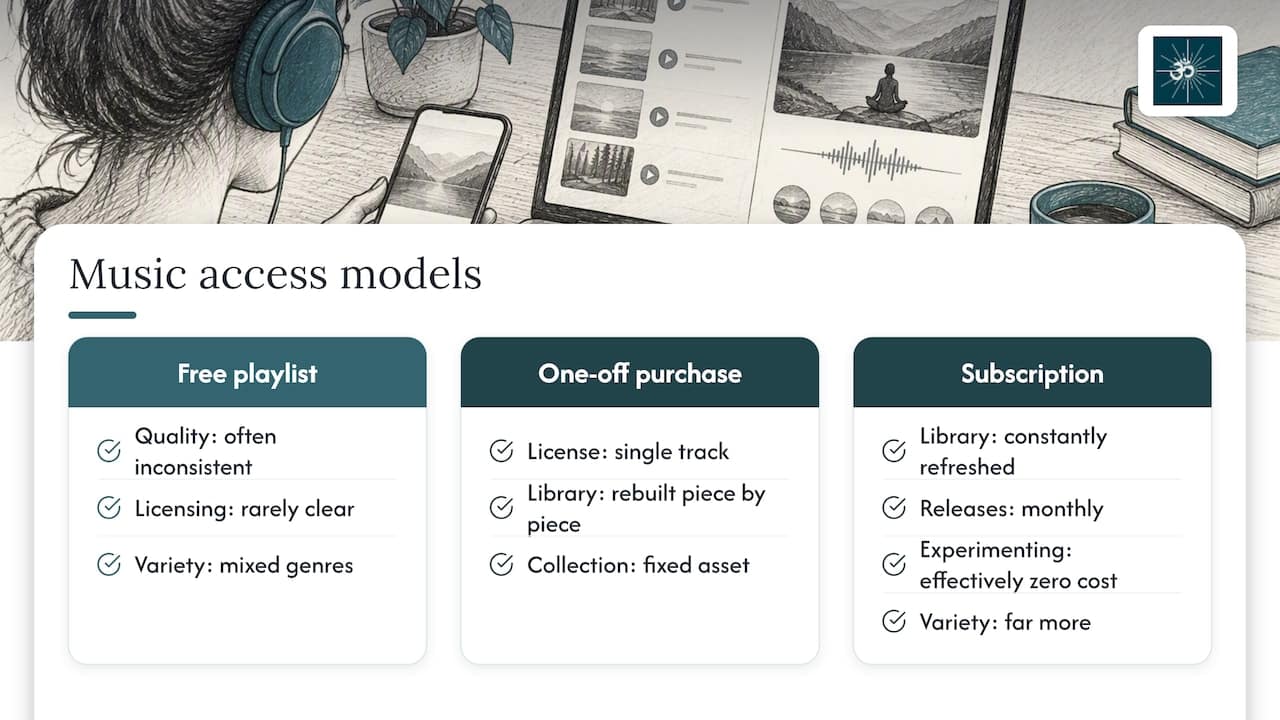
A free playlist or a single purchased track can absolutely get you started, and there’s no shame in beginning there. The limitation shows up over time: free libraries are often inconsistent in quality, mix genres that don’t suit meditation at all, and rarely offer any licensing clarity if your practice turns professional.
A one-off purchase solves the licensing question for that single track, but it leaves you rebuilding your library piece by piece every time your needs shift, whether that’s a new sleep programme or a different mood for a client session. A subscription instead gives you a constantly refreshed pool to draw from, so the cost of experimenting with a new style or theme is effectively zero once you’re already a member.
For a meditation teacher or wellness creator, this difference compounds quickly: a personal collection of twenty purchased tracks is a fixed asset, while a subscription catalogue growing every month means the material never quite goes stale. For casual listeners, the calculation is simpler: if you meditate most days, the per-session cost of a subscription tends to work out lower than repeatedly buying individual tracks, and you get far more variety along the way.
What do you only get with a subscription?
Some features genuinely aren’t available through free streaming or single-track purchases, and they’re worth knowing about before you assume all meditation music sources are interchangeable.
Exclusive tracks recorded specifically for subscribers, rather than licensed from a general stock library, tend to be the biggest differentiator. Access to new monthly releases keeps a practice from becoming repetitive, which matters more than people expect: familiarity can dull the relaxation response over time. Thematic pathways, grouping tracks by goal such as deep sleep, morning focus or grief processing, help you move straight to what you need instead of guessing from a track title.
Technical extras like 3D surround mixes or binaural layering are also more commonly reserved for subscription catalogues than free platforms, partly because producing them properly takes real studio time and expertise. Offline downloads, detailed composer credits and the ability to request or vote on future themes round out the list. None of this replaces a free playlist entirely, but it does explain why serious practitioners tend to graduate toward a subscription once their practice becomes a daily habit rather than an occasional experiment.
How subscriptions support ongoing production and artists
Recurring subscription revenue does something a single purchase can’t: it funds the next recording session, not just the last one. Booking a full orchestra, securing studio time and engineering a proper 3D mix all cost real money, and that only happens repeatedly when there’s a predictable income stream behind it.
This is part of why composer and producer credits matter so much in this space. Robert Emery has built a career as a composer and producer across orchestral and film-adjacent work, and producer Moritz Schneider brings technical sound design expertise to how these recordings are mixed and layered for immersive listening. When a catalogue credits its creative team clearly, it’s usually a sign that the music was made with intention rather than assembled cheaply and anonymously.
Subscription income also lets a catalogue keep investing in live musicians rather than defaulting to cheaper synthesised alternatives, which matters given how much richer a recorded orchestra tends to sound compared with a looped sample pack. In a market full of interchangeable stock meditation tracks, that ongoing investment is often the clearest signal of quality you can look for.
Customer support and experience: what to expect
A subscription is also a relationship, not just a download. Good meditation music services tend to offer searchable libraries organised by mood, length or purpose, so you’re not scrolling endlessly at the end of a long day.
Responsive customer support matters more than it might seem: licensing questions come up often for therapists and teachers, and a quick, clear answer about whether a track can be used in a paid class is worth a great deal. Easy account management, including simple cancellation and billing transparency, also shapes whether a subscription feels trustworthy over the long run, particularly given the consumer protection scrutiny that subscription cancellation clauses have faced recently.
Smaller touches, such as offline access for areas with patchy signal, or the ability to download high-quality files rather than compressed streams, tend to separate a genuinely well-run service from one that’s simply reselling a generic catalogue.
Does the right subscription depend on your meditation style?
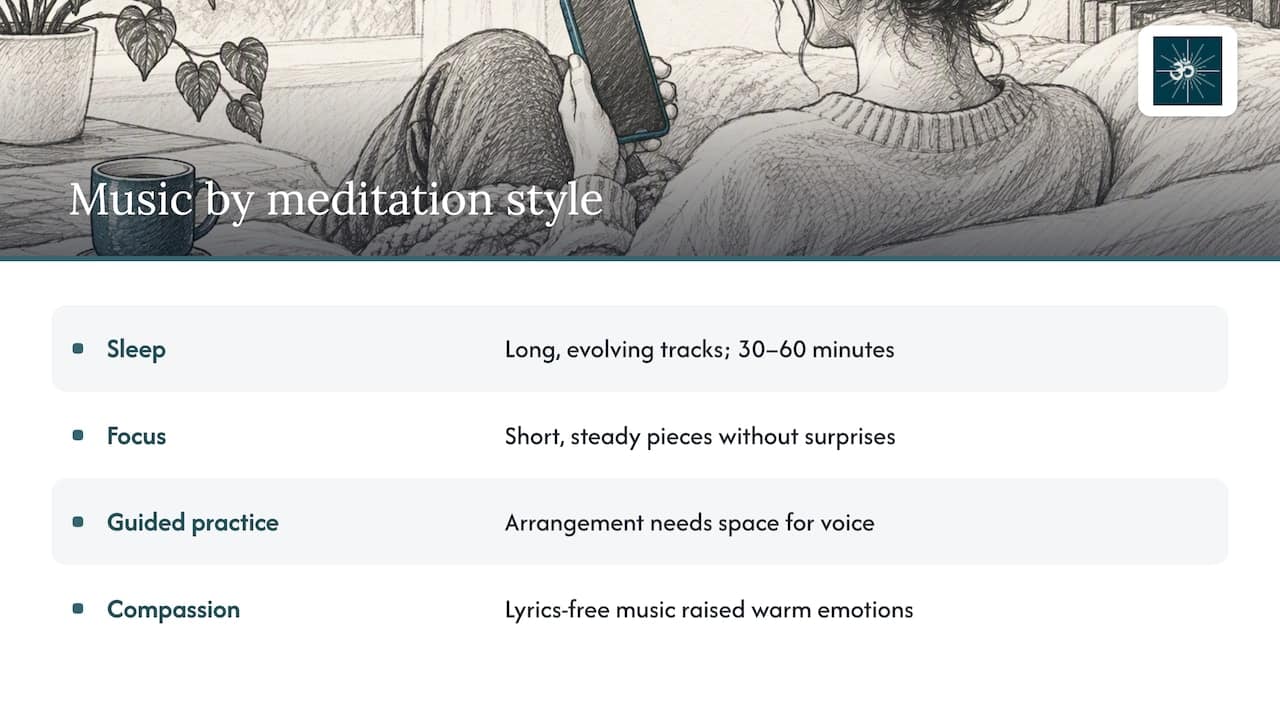
It does, more than most people assume going in. Someone meditating for stress relief after work has different needs from someone using music to support a structured mindfulness-based programme, or a yoga instructor soundtracking a full class.
If your goal is sleep, you’ll want longer, slowly evolving tracks with minimal structure, closer to the 30 to 60 minute range used in sleep-focused trials. If you’re after focus during work or study, shorter, more rhythmically steady pieces without surprises tend to suit better. For guided practice, especially anything following step by step guided meditation techniques, music with space in the arrangement matters more than the genre itself, since it needs to sit underneath a voice rather than compete with it.
Loving-kindness and compassion-based practices seem to benefit particularly from simple, lyrics-free background music: a randomised study of 200 participants found it increased warm, low-arousal positive emotions without making the practice feel any harder. The practical upshot is that a subscription with genuinely varied, well-tagged content serves a mixed practice far better than a single playlist ever could, because your needs on a Monday morning rarely match your needs at 11pm on a Thursday.
Why orchestral recordings matter to us
We’re biased toward musician-led, intentionally produced recordings because we’ve seen how much a handcrafted arrangement can carry a listener somewhere a loop simply can’t. Robert Emery’s composition work and Moritz Schneider’s production choices both aim at that same outcome: sound designed with purpose, not assembled by default. We’d rather you try a curated pack and judge the difference for yourself.
— ROBERT
A simple way to start listening with us
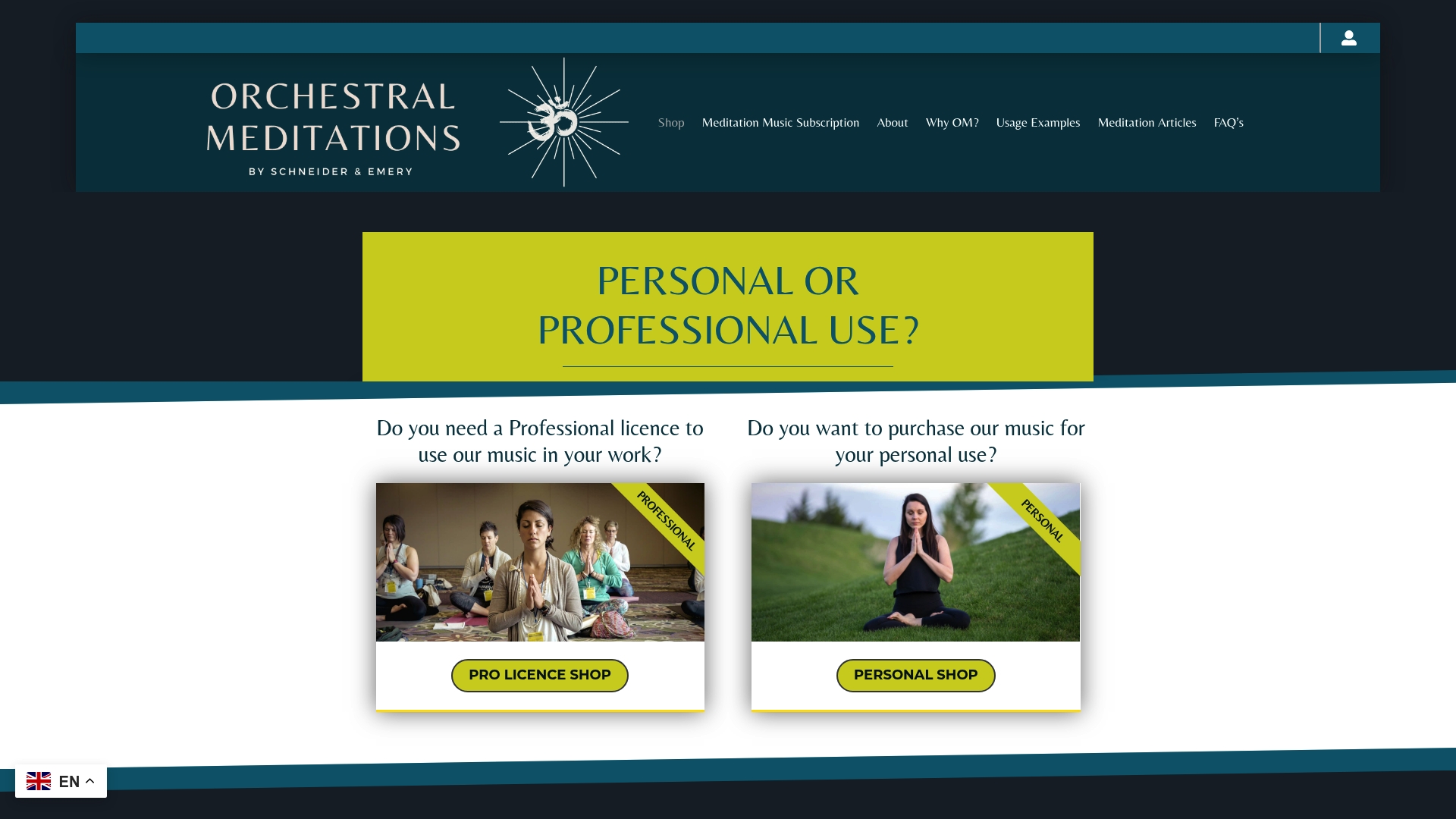
If the checklist above resonates, our Personal subscription at €21 a month gives you ongoing access to our library and personal-use licensing, which covers most of what a regular meditator needs. For teachers, therapists and creators who need to use tracks commercially, our Professional subscription at €150 a month adds the licensing cover that protects your work.
A few reasons it tends to fit the checklist well:
- Recordings made with live musicians, rather than synthetic loops.
- Composer and producer credits are provided for many tracks, including those by Robert Emery and Moritz Schneider.
- Options for both personal and professional licensing help match usage needs.
If you’d rather explore individual tracks first, our Royalty Free Meditation Music line is worth a browse before you commit to a plan.
This article is general information, not a substitute for advice from a qualified doctor. Consult a qualified healthcare professional about your own circumstances before acting on anything here.
FAQ
What are the benefits of meditation music?
Meditation music is linked to measurable gains in relaxation, stress reduction, sleep quality and mood, with a 2025 meta-analysis reporting a substantial effect on subjective wellbeing. Benefits vary by individual, so personal testing across styles is worth doing before settling on a routine.
What happens after 40 days of meditation?
There’s no single study in this article measuring outcomes at a precise day mark, but broader evidence supports that consistent practice over weeks tends to produce more stable improvements in stress and mood than occasional sessions.
Can 7 days of meditation rewire your brain?
Short meditation programmes can produce measurable short-term changes in stress markers and subjective state, as seen in trial-based HRV and EEG research, but lasting structural brain change typically requires sustained practice over a longer period. Building the habit with consistent practice, rather than expecting a dramatic shift quickly, is key.
How long should I listen to calming music a day?
Research on sleep-focused listening commonly uses sessions of around 30 to 60 minutes, while shorter sessions of 10 to 30 minutes often suit daytime relaxation or focus practice. The right length depends on your goal, so it’s worth adjusting based on how you feel afterwards rather than following a fixed rule.
Sources
- Meta-analysis: music-based interventions and subjective well-being (Frontiers in Psychology, 2025)
- Music listening interventions and sleep quality (European Psychiatry, 2024)
- Music therapy for anxiety: systematic review and multilevel meta-analysis (2025)
- Music mindfulness acutely modulates autonomic activity and improves psychological state (Frontiers Neuroscience, 2025)