The right music for yoga teacher training and class settings is slow to moderate in tempo, light on lyrics, and built to sit quietly behind your voice rather than compete with it. We lean on sources like Orchestral Meditations, whose catalogue includes work from composer and producer Robert Emery, as a benchmark for what a professionally produced, teaching-ready track should sound like. Below, you will find phase-by-phase templates, licensing notes, and where to source tracks without a licensing headache.
TL;DR:
- For restorative, yin, and savasana sections, target 60 to 80 beats per minute; keep lyrics, heavy percussion, and abrupt changes away from cueing.
- Map a 60 minute class across six phases, extend the playlist beyond the scheduled finish, and disable shuffle to protect savasana from peak tracks.
- In Germany, confirm in writing whether the studio’s GEMA registration covers your public classes; independent teachers renting space may need to register themselves.
- Free streaming and standard downloads may not grant public performance rights, so check each license or use a library whose professional subscription covers commercial use.
1. Core rules for choosing tracks that actually serve your class
Most music mistakes in yoga classes come down to four things: tempo, vocals, texture, and dynamics. Get those right and almost any track will work; get them wrong and even a beautiful piece of music will fight your cues.
Tempo is the big one. For restorative, yin, or savasana-heavy sequences, aim for roughly 60 to 80 beats per minute, the range most associated with slower breathing, since research on tempo manipulations and autonomic function links tempos around 60 bpm with increased parasympathetic activity, the physiological signature of a calmer state. Faster vinyasa or power sequences can run higher, but breath should still lead the pace, not the beat.
Vocals are trickier than they look. A gorgeous song with a chorus can be the exact thing that pulls a student’s attention away from your cueing, because the brain cannot help but listen to words. Practitioner guidance collected through sessions like The Art of Yoga Music backs this up directly: lyrics often distract, and instrumental or mantra-style tracks keep your spoken instruction as the primary signal in the room.
A few practical red flags to listen for before you ever press play in front of students:
- Abrupt endings that cut off mid-phrase and jolt the room out of stillness.
- Sudden tempo shifts that clash with a long hold or a slow transition.
- Heavy percussion or sharp dynamic spikes during breath work or savasana.
- Dense, layered arrangements that compete with your voice instead of supporting it.
Pro Tip: Listen to any new track with your eyes closed, as if you were a student mid-pose, and notice the exact moment your attention leaves your breath and goes to the music.
2. Class arc: a six-phase playlist framework you can reuse
A well-built playlist follows the shape of the class itself, not a random shuffle. A widely used 60-minute template, described in guidance from the International Yoga Conference, maps musical character to six phases, and it is a genuinely useful starting point for a training portfolio or an exam sequence.
- Arrival (0 to 5 minutes): very sparse, slow pads or a single sustained drone, almost no rhythm. Try searching “ambient drone meditation” or “solo piano arrival yoga.”
- Warm-up (5 to 15 minutes): gentle melodic movement enters, still unhurried. Search “soft piano yoga warm-up” or “gentle strings flow.”
- Flow (15 to 35 minutes): light rhythm and a clearer pulse support sun salutations and transitions. Try “vinyasa flow instrumental” or “world fusion yoga beat.”
- Peak (35 to 45 minutes): the most rhythmic and energetic point of the set, matching your strongest postures. Search “power yoga instrumental” or “uplifting orchestral crescendo.”
- Cool-down (45 to 53 minutes): tempo tapers back down, textures thin out again. Try “slow descent yoga music” or “soft ambient strings.”
- Savasana (53 minutes onward): near-ambient orchestral or binaural textures, or silence. Search “savasana meditation music” or “binaural relaxation orchestral.”
Build the playlist a few minutes longer than your scheduled class time, since transitions and holds always run longer than planned, and always disable shuffle: a randomised order can land a peak track during savasana without warning.
A nudge-based approach to tempo beats a fixed one. An interactive-music study comparing fixed-tempo tracks against personalised, breathing-responsive tempo designs found the personalised approach slowed participants’ breathing and reduced markers of physiological arousal more effectively than a static soundtrack. For teacher training specifically, this points to a more advanced possibility worth experimenting with in workshops: tracks or apps that adapt pace to a student’s breath rather than asking the breath to follow a fixed beat.
3. Practical playlist-building and playback tips for trainees
A good playlist on paper can still feel clunky in the room if the handoffs between tracks are rough. The fix is mostly mechanical, and it is the kind of detail examiners and senior teachers notice.
Trim the start and end of each file so there is no dead air or abrupt fade, and use a simple crossfade (most players, including free ones, let you set this in a few seconds) so one track melts into the next rather than cutting. Set your overall playback volume low enough that your voice, not the music, is the loudest thing a student hears during cueing; you should be able to speak at a normal, grounded volume and still be heard clearly at the back of the room.
A workflow worth following every time you build a new set:
- Assemble your candidate tracks against the six-phase map before touching a playlist app.
- Rehearse the full sequence in your own practice, marking any transition that feels abrupt.
- Edit those marked transitions with crossfades and adjusted start or stop points.
- Prepare an offline, licensed backup (a downloaded file or USB drive) in case streaming drops out.
- Test the final set in the actual teaching room, since small speakers and full studio systems reveal very different things.
Lyric and cultural checks matter too, particularly for chant or mantra-based tracks borrowed from traditions you may not be trained in; when in doubt, choose instrumental.
Pro Tip: What sounds balanced through laptop speakers during planning can sound thin or boomy through a studio system, so always do a final volume check in the room you will actually teach in.
4. Licensing and GEMA: what public classes require
Playing music in a public yoga class is not the same as playing it at home, and in Germany this distinction has a name: the GEMA WR-KS-F tariff for fitness and health courses. Studios commonly register and pay under this tariff on behalf of the classes they host, but freelance teachers who rent a room and bill students directly often have to register themselves, and skipping this step can lead to retroactive fees once discovered.
A short checklist worth keeping on file:
- Confirm with your studio, in writing, whether GEMA registration already covers your classes.
- If you teach independently or rent space, register under the relevant tariff yourself.
- Keep receipts, licence statements, and purchase confirmations for every track you use publicly.
- Favour libraries that state commercial or professional licensing explicitly, especially for tracks you plan to reuse across many classes.
A single spreadsheet with track title, source, licence type, and a saved copy of the purchase terms simplifies record-keeping and eases audits later.
5. Where to source music that is actually licensable
Free platforms like YouTube, SoundCloud, or Insight Timer are fine for personal practice, but most come with caveats for public or commercial use: ads can interrupt a class mid-flow, and the licence terms rarely cover paid teaching. Bandcamp and similar buy-to-own platforms give you a permanent file, but you still need to check whether the purchase includes public performance rights, which many standard downloads do not.
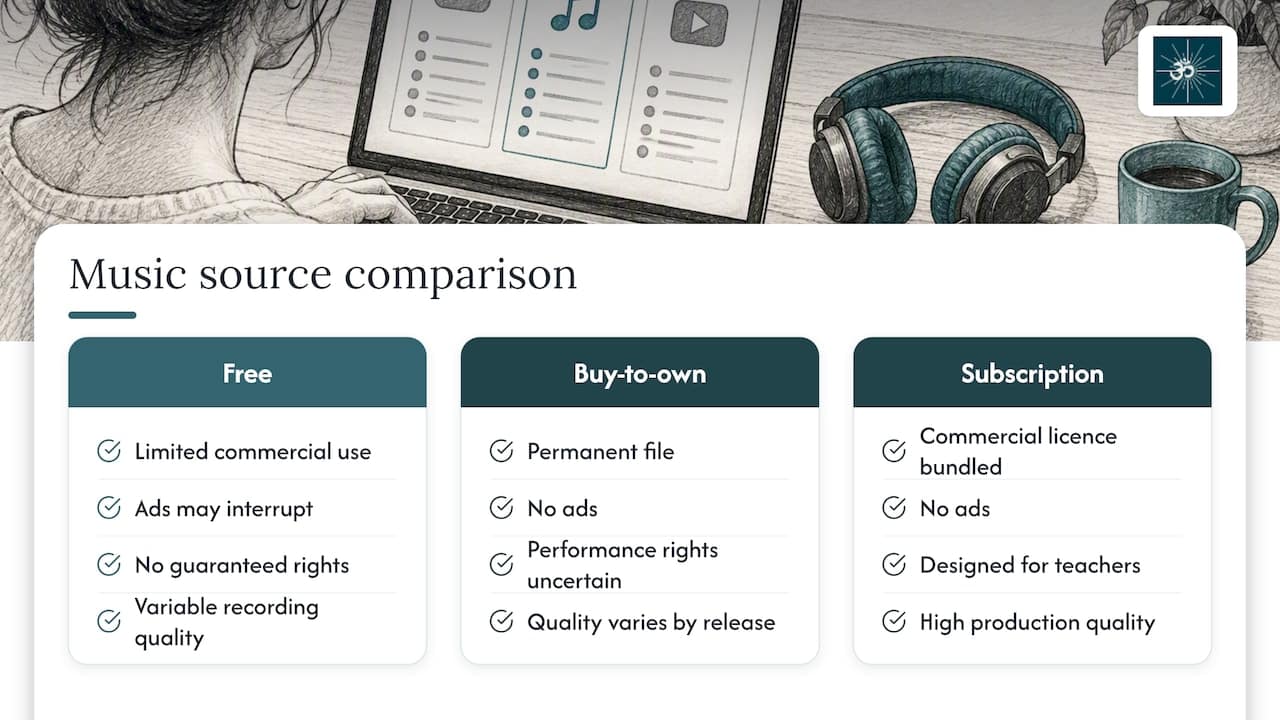
For teachers running regular public classes, a royalty-free or subscription library built for exactly this use case removes the guesswork. These typically bundle commercial licensing into the subscription itself, so you are not negotiating rights track by track.
This is the gap a library like Orchestral Meditations is built to fill: orchestral, binaural, and 3D surround recordings made with live musicians, offered under personal and professional licences, with composer and producer Robert Emery among the names behind the production. For a savasana bed or a guided meditation segment, that kind of recording quality is hard to replicate from a free download.
A supportive bed of sound keeps the teacher’s voice clear; lyrics or dense arrangements often pull attention away from the cues.
Taz Rashid, Mindfulness Meets Music
6. Using meditation and binaural beat tracks in your own training
Binaural beats, two slightly different frequencies played one in each ear, are increasingly common in yoga teacher training itself, not just in client-facing classes. During self-practice modules or peer-teaching labs, a binaural or theta-frequency track can help trainees drop into a quieter observational state before they step up to teach, which makes the subsequent feedback conversation sharper.
The key is matching the track to the task. A binaural layer under a silent meditation module works differently to one under an active teaching rehearsal, where you still need enough spatial awareness of the room to watch your peers. For training sessions that include extended stillness, a slower binaural or theta-based piece supports the drop into a meditative state; for sessions mixing discussion and practice, a lighter ambient bed without strong binaural pulsing avoids pulling focus away from verbal instruction.
Trainees experimenting with these tracks for the first time should try them solo before introducing them to a group setting, since the effect varies person to person and some listeners find binaural layers distracting rather than calming.
7. Bringing scientifically designed soundscapes into your teaching method
Sound design has moved well past “nice background music” for many teachers. Tracks built around specific frequency ranges, layered textures, and production techniques such as 3D spatial recording are increasingly part of how teachers think about class design, not just playlist curation.
Folding this into your teaching methodology means treating music as a sequencing tool with the same intentionality as your postures. If your peak sequence is designed to build heat and intensity, the soundscape underneath should build with it structurally, not just get louder. If your cool-down is designed to downshift the nervous system, the track beneath it should thin out in the same way your cueing does, fewer layers, less rhythmic drive, more space.
This is where paying attention to how a track was actually produced starts to matter. A recording made with live musicians in a controlled acoustic space behaves differently in a room than a looped digital sample, and trainees who study a few high-production examples, the kind found in catalogues like Orchestral Meditations, start to hear those differences quickly.
8. Using 3D surround sound to shape the room
3D surround recording places sound in space rather than flattening it into a single stereo image, and the effect in a yoga room can be genuinely noticeable, particularly during savasana when students are lying still with eyes closed and nothing else competing for attention.
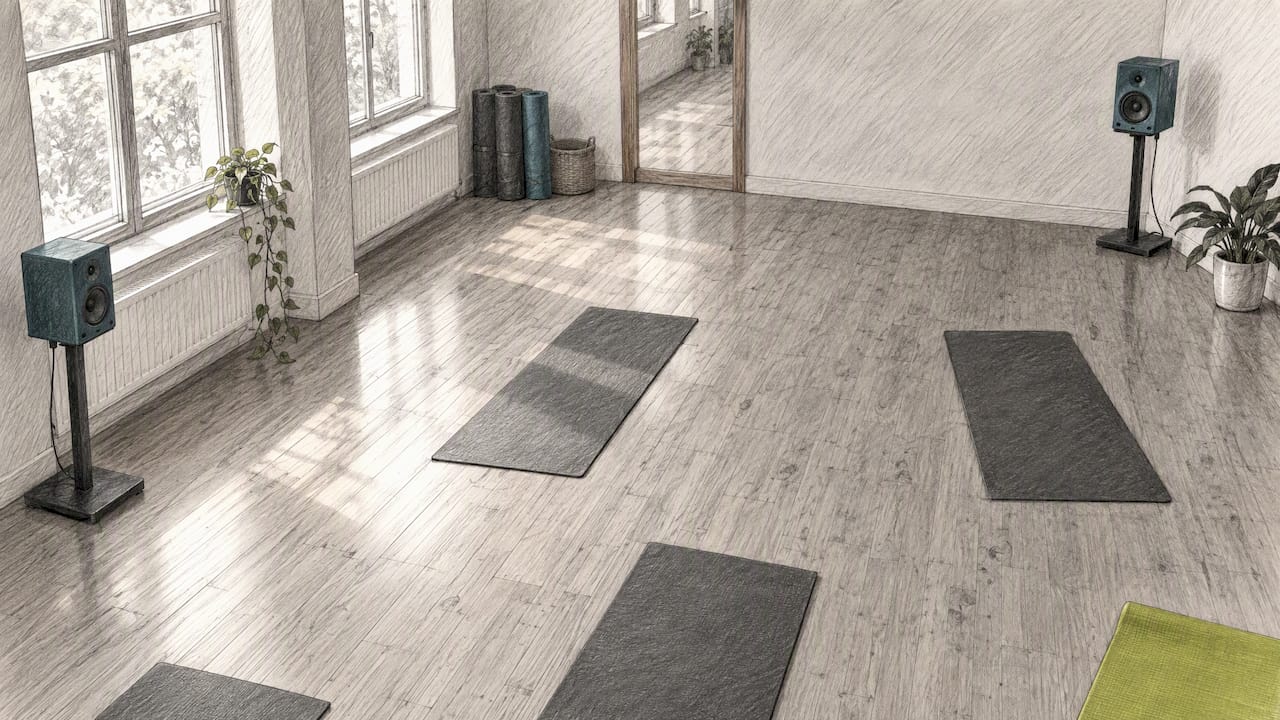
A few practical points for teachers working with a decent studio sound system: position speakers so sound arrives from more than one direction rather than a single front-facing source, keep the overall mix on the quieter side so spatial detail does not become overwhelming, and reserve the most immersive tracks for the phases where students are least active, savasana and extended holds, rather than a flowing sequence where their attention needs to stay on movement.
Smaller studios without a surround setup still benefit from choosing tracks that were recorded with spatial depth in mind, since even a basic stereo playback carries some of that production quality through.
9. Matching music to different meditation states
Not every meditative state calls for the same soundscape. A grounding, body-scan style meditation benefits from a steadier, more rhythmic underlay that gives the mind something gentle to track. An open-awareness or formless meditation tends to work better with sparser, more drone-like textures, since too much melodic movement can pull attention back into active listening rather than letting it settle.
Guided meditations with spoken instruction need the same volume discipline as a live class: the music sits underneath, never above, the voice. Unguided or silent meditation segments have more room for a fuller soundscape, including binaural or theta layers, since there is no competing vocal to protect.
Trainees building a portfolio of meditation sessions for assessment should treat this matching exercise as a skill in itself, choosing music deliberately for the state they are trying to support rather than defaulting to “anything calm.”
10. Matching intensity to the room, not just the clock
The six-phase template is a strong starting point, but the best teachers adjust it in real time based on the energy actually in the room, not just the minute mark on the plan. A class that arrives tired needs a gentler ramp into the peak phase than a class that walks in already energised.
Watch for physical cues: breath rate, how quickly students settle into the first few postures, whether energy feels tense or sluggish. If the room reads low energy, delaying the rhythmic pickup by a few minutes and extending the warm-up texture gives bodies time to catch up before the music pushes them. If the room reads high energy, an earlier, slightly stronger rhythmic entrance can meet that energy rather than feel like a mismatch.
This is less about swapping tracks mid-class, which rarely goes smoothly, and more about building two or three versions of your playlist in advance, each shifted slightly in pacing, so you can choose the right one in the first few minutes rather than fighting the wrong one for an hour.
Treating music curation as a teaching skill, not an afterthought
We think music selection deserves the same scrutiny in teacher training as alignment cues or sequencing. A trainee who can explain why a track suits a particular phase, citing tempo, texture, and production quality, is showing real teaching judgement. Studying high-production examples, including orchestral work from composers like Robert Emery, sharpens that ear. Document your playlists and licences in your training portfolio.
— ROBERT
Orchestral Meditations: a professional music resource for teachers
For teachers who want licensed, high-production music without chasing permissions track by track, Orchestral Meditations offers a royalty-free library of orchestral, binaural, and 3D surround recordings made with live musicians, including work from composers and producers.
- Build savasana beds, guided meditation segments, or full class soundtracks from one licensed catalogue.
- Use personal or professional licensing depending on whether you teach privately or run paid public classes.
- Keep offline, downloaded files ready for classes with patchy connectivity.
A professional subscription at €150 per month covers repeated commercial use and gives clear licence terms to show a studio or GEMA if ever asked. A personal subscription at €21 per month suits trainees building a practice playlist for themselves. Sample a track and check the royalty-free licensing details before your next class.
FAQ
What is the best music for yoga practice?
The best music for yoga practice is slow to moderate in tempo, mostly instrumental, and shaped to match the class phase it accompanies. For restorative or savasana segments, tempos around 60 to 80 beats per minute support slower breathing, according to research on tempo and autonomic function.
Is yoga teacher training hard?
Yoga teacher training is demanding because it combines physical practice, anatomy and philosophy study, and practical teaching skills like sequencing and music curation. Many trainees find the teaching-practice components, including building and rehearsing playlists, just as challenging as the physical postures.
What is a good playlist for a yoga class?
A good yoga class playlist follows the energy arc of the class: sparse and slow at arrival, gradually more rhythmic through warm-up and flow, peaking mid-class, then tapering back down through cool-down and savasana. A commonly used template for a 60-minute class is detailed in guidance from the International Yoga Conference.
What is a good yoga song?
A good yoga track is instrumental or mantra-based rather than lyric-heavy, since practitioner guidance from The Art of Yoga Music notes that lyrics often distract from a teacher’s cueing. Orchestral or ambient pieces, such as those produced for Orchestral Meditations, work well because they are built specifically to sit behind spoken instruction.
Do I need a music licence to teach a public yoga class?
In many markets, including under Germany’s GEMA framework, playing music in a public or paid yoga class requires registration under a tariff such as WR-KS-F, with responsibility falling on the studio or the independent teacher depending on the setup. Royalty-free libraries with professional licensing can simplify this by covering commercial use directly.