
Integration is the part of psychedelic therapy where the insight meets your Tuesday morning, and music can help you carry one into the other. The best integration music is usually calmer and more grounding than the music of a dosing session. It is unhurried and warm, and it leaves room for your own thoughts instead of telling you what to feel. This guide covers what the research says, what German law means for you, and how to choose and use music in the days and weeks afterwards.
A confession first. Years of watching musicians fuss over a single bar of Mahler taught me one thing: people take sound very personally. Put the wrong cello line under a tender moment and the whole room winces. Put the right one under it and nobody can say why they are crying. Integration is full of those moments, so the choice of music deserves more than a shrug and a random playlist.
TL;DR
- Integration is the supervised, reflective work that follows a psychedelic session. Music is a support for it, never a substitute for a therapist.
- In Germany, psilocybin and similar substances remain prohibited outside clinical trials and tightly controlled compassionate use, so check where you stand before anything else.
- Research suggests that the music’s ability to support emotion and meaning matters more than its genre, and that grounding textures often suit the post-session phase.
- Choose varied, non-prescriptive music, keep a few pieces you return to, and avoid tracks that push a ready-made spiritual story onto you.
- Our orchestral meditation library, recorded with live musicians, is built for exactly this kind of unhurried, body-level listening.
Where Germany stands on psychedelic therapy
Before the music, the law, because it shapes who can talk about integration and in what setting. According to a 2026 practice guide on psychedelic medicines in Germany, psychedelics are still classified as prohibited substances under German narcotics and psychoactive substances legislation, and the regulatory framework is highly restrictive. In practice, that means psilocybin therapy happens inside clinical trials or exceptional programmes, not at a regular practice around the corner.
The exceptional programmes are real, though. The Lancet Psychiatry reported that Germany’s Federal Institute for Drugs and Medical Devices (BfArM) approved a compassionate use programme for psilocybin in adults with treatment-resistant depression in 2025. It remains a narrow pathway for a specific group of patients, not a general route to treatment.
Germany also has an active research scene. The Central Institute of Mental Health in Mannheim describes its work on classic psychedelics such as psilocybin, LSD and DMT, and research news from March 2026 reported significant efficacy for psilocybin combined with psychotherapy in treatment-resistant depression.
What this article is not: advice to obtain or use any controlled substance. If you are in a trial or an authorised programme, your therapy team decides the plan, and what follows should be agreed with them. If you have had a difficult experience, or you are in distress, speak to a psychotherapist, psychiatrist or your GP (Hausarzt) rather than trying to sort it out with a playlist.
What integration actually means
Integration is the work of making sense of an experience and letting it change something in daily life. In the clinical setting described in the research, it is the supervised psychotherapeutic support given before and after dosing sessions. It is the conversation, the journaling, the slow translation of “that felt enormous” into “so what do I do differently on Monday?”
The experts at the MIND Foundation, a German-based organisation in this field, stress that the quality of the therapeutic framework, including preparation and integration, matters more than the molecule itself. Psychedelics may act as a catalyst, but the setting and support are what help turn a breakthrough into lasting change.
That is worth pausing on. If the framework carries the weight, then everything in the framework deserves care, and that includes the sound in the room and the sound in your headphones on the tram afterwards.
What the research says about music
Music has been part of psychedelic therapy since the early days, but the evidence is younger than the practice. A few findings are worth knowing.
Music is a participant, not wallpaper
Researchers led by Justin Dwyer, writing in Frontiers in Psychiatry, argue that music in altered states should be seen as a dynamic collaborator, not merely something administered. For participants, it stops being ordinary audio and becomes a personalised, multisensory experience that can feel internally generated. Therapists, the authors say, need to be mindful of that active influence.
You can feel the same thing in a small way with an ordinary song. Hear it at a wedding and it means one thing. Hear it again after a funeral and it means another. Now imagine that effect with the volume knob turned up by a thousand.
Genre matters less than you might think
Older protocols leaned heavily on Western classical music. A randomised study of different musical genres in psilocybin therapy compared Western classical and overtone-based music in a small group of participants and found comparable outcomes. It is a small study and should not be over-read, but it hints that the music’s capacity to support deep emotion and a sense of transcendence counts for more than its label.
Two recent overviews point the same way. A 2026 scoping review in Brain and Behavior gathers the quantitative evidence on music in psychedelic-assisted therapy, and a 2026 paper in npj Mental Health Research treats music as one component of a complex intervention rather than a standalone ingredient. The shared message: music works inside a framework, not instead of one.
Programming follows a trajectory
The Guided Imagery and Music-informed perspective on music programming describes music chosen to match the likely emotional arc of a session. Modern thinking is moving away from simple genre playlists towards deliberate curation that considers emotional arcs and cultural inclusivity.
Notice that this describes the dosing session. Integration is a different phase with different needs, which brings us to the practical part.
Integration music is not journey music
High-intensity music is common during active dosing sessions, where it helps with non-verbal processing. After the session, the job changes. According to the same programming paper in PubMed Central, post-experience integration often benefits from different, grounding textures that help bridge the gap between the internal, mystical state and everyday reality.
Think of it as a decompression chamber. Someone who has surfaced from a deep dive does not need a drum solo. They need warmth, a steady floor and a bit of space.
Here is how that tends to translate into a listening palette.
| Purpose | What to look for | What to avoid |
|---|---|---|
| Quiet reflection after a session | Slow, warm acoustic textures, gentle strings, long phrases | Sudden dynamic jumps, dramatic crescendos |
| Journaling or writing | Instrumental, no lyrics, low and steady | Voices that compete with your own words |
| Body settling and breathwork | Soft low-register sound, regular pacing | Tracks that command a particular breathing pattern |
| Sleep after an intense day | Very gentle, slow, unbusy, a reliable fade | Anything with a sharp start or a story arc |
| Re-entering ordinary life | Familiar, comforting music you already love | Brand-new, emotionally loaded music |
That last row surprises people. Not every piece needs to be a profound discovery. A bit of ordinary, loved music on your commute can be the most integrating thing you hear all week.
How to choose music: five criteria
- Does it leave you room? Good integration music accompanies your thoughts without finishing them for you. If you notice the music steering your feelings, it is doing too much.
- Is it varied? The research on curation emphasises variety, and one album on endless repeat will wear thin. Keep a small set of different moods and lengths.
- Is it culturally and spiritually open? More on this below, but a track that arrives with a built-in religious or cultural narrative may not fit your experience.
- Does it sound alive? Live instruments carry small human irregularities, a breath before a phrase, a bow changing direction. Many listeners find that more settling than a perfectly quantised loop. This is a listener experience, not a clinical claim.
- Can you control it? Duration, volume, and the ability to stop. Integration is not a time to feel trapped by a playlist.
A simple way to build your own integration listening
This is a practical routine for general reflective listening, suitable alongside whatever your therapist advises. It does not replace professional support.
- Write down what you want from the music. One sentence: “I want to feel steady while I journal”, or “I want to wind down without being pushed anywhere.”
- Pick three pieces, not thirty. Different moods: one grounding, one reflective, one gently uplifting. Small libraries get used. Huge ones get abandoned.
- Give each listening a frame. Ten to twenty minutes, a notebook, headphones or a good speaker, and a clear end point. A frame stops the music becoming another form of avoidance.
- Notice, then write. After the track, jot down two lines: what came up and what you might do about it. That is the integration part. The music just set the table.
- Review weekly. Which pieces helped, which irritated you, which you skipped. Swap one out. Your needs change as the experience settles.
If something painful surfaces and does not ease, stop and speak to your psychotherapist or, if you are in acute distress, to emergency services or a crisis line. Music is a companion, not a rescue service.
The trap of the prescriptive playlist
There is a quieter risk in curation. A critique of the Copenhagen music programme highlights that music choices can inadvertently enforce particular cultural or religious narratives on the person listening, which the authors discuss as a form of psychological coercion. Practitioners are encouraged to keep a diverse library and avoid overly prescriptive tracks.
For your own listening, the lesson is simple. If a piece keeps nudging you towards a story you do not believe, you are allowed to switch it off. The experience is yours, and the music is there to serve it. Choral Latin might be gorgeous and still be the wrong thing at 7 a.m. on a grey Hamburg morning.
Why live orchestral sound suits the body
A lot of popular meditation music is built from digital synthesis. It can be lovely, but many practitioners say that acoustic recordings feel more tactile and resonant, and less fatiguing over repeated listening. That claim was made at the launch of our library, in a 2023 press release about the Abbey Road recordings, made with the National Philharmonic.
Sound that you feel as well as hear is a research area of its own. If you are curious about how vibration and sound are studied in a therapeutic setting, this overview of vibroacoustic therapy research is a good place to read around the topic.
For integration, the practical point is this: slow orchestral strings, soft winds and low resonance can give the nervous system something steady to lean on. They are not a treatment. They are a good floor to stand on while you do the real work.
Our perspective: what we have learned making this music
We did not set out to make music for psychedelic therapy, and we will not pretend our library is a clinical tool. We make meditation music, recorded live, and people use it in all sorts of reflective moments, including the quiet weeks after something big has happened in their inner life.
What we can say honestly is this. We record with live musicians because we believe acoustic instruments reach the body in a way digital ones do not. We build tracks for slow, unhurried listening, with soundscapes that include binaural, theta and Solfeggio-based work, and some in 3D surround. We deliberately avoid telling listeners what to think. A piece should hold the door open, not walk you through it.
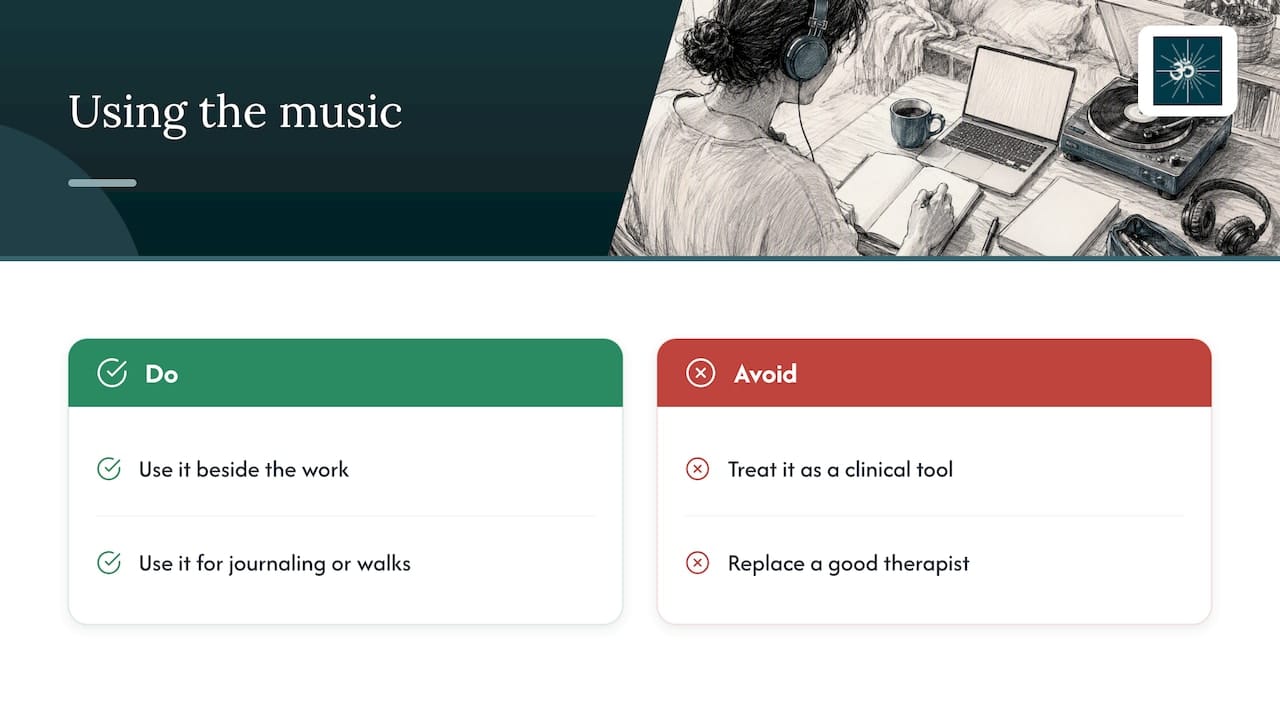
And we are firm on one point: no track replaces a good therapist. If you are in a trial or authorised programme, follow your team’s guidance, and treat our music as something to sit beside the work, not as the work itself. Use it for the journaling hour, the long walk, the bath, the bedtime. Stop it the moment it stops serving you.
— ROBERT
Who makes our music
Because trust matters in this field, here is who is behind the recordings. Our music is written and produced by Robert Emery and Moritz Schneider, who have worked together for thirteen years and are close friends.
Robert Emery is a composer and conductor. He started piano at seven, studied at the Royal College of Music, and has conducted orchestras including the London Philharmonic, the Royal Philharmonic and the Sinfonieorchester Basel. He is now Music Director of the National Philharmonic Orchestra of Great Britain. His view is simple: acoustic instruments played by humans resonate with the body in a way digital ones do not.
Moritz Schneider is a composer and producer who has written for feature films, album productions and musicals for over twenty years, and he has had several No. 1 albums in the UK Classical Charts. A few years ago he discovered a particular passion for meditation music, which he thinks of as music for inner films.
That combination, a conductor’s ear for live orchestral performance and a film composer’s sense of pacing, is what shapes the slow, spacious sound of the library.
Using our music, personally or professionally
If you want an unhurried orchestral library for your own reflective hours, our personal subscription costs €21 per month and gives you access to the meditation music library for personal listening.
If you are a therapist, coach, yoga teacher or content creator who wants to use music with clients or in your own audio, our professional subscription is €150 per month and comes with professional licensing. For one-off needs, browse our royalty-free meditation music for professional use. If you simply want to start with a look around, our main site has samples and articles.
A note for practitioners: always check the licence matches your use. Playing music to clients in a practice is a professional use, and personal listening is a different matter.
Practical tips for the first weeks
- Keep volume low. After an intense experience, sensitivity can be high, and a quiet level is kinder.
- Avoid shuffling unfamiliar music. Surprise is wonderful in a concert and unhelpful in a fragile week.
- Use headphones for private work, speakers for shared space. The room matters too.
- Pair music with a ritual. The same chair, the same tea, the same three tracks. Routine is a surprisingly good teacher.
- Tell your therapist what you listen to. It can open a useful conversation about what the music brings up.
- Let silence in. Some of the best integration happens in the gaps between tracks.
FAQ
Is psychedelic therapy legal in Germany?
Not as a routine treatment. Psychedelics such as psilocybin remain prohibited substances under German law, with use limited to clinical trials and tightly controlled compassionate use, such as the programme approved by BfArM in 2025 for treatment-resistant depression. Ask a psychiatrist or psychotherapist about what applies to your situation.
Does the type of music really matter for integration?
It matters, though probably not by genre alone. A small comparison study found similar outcomes for Western classical and overtone-based music, which suggests that emotional depth and a sense of transcendence count for more than labels. For integration, many sources favour grounding, varied textures over intense peaks.
Can music replace an integration therapist?
No. Research frames music as one part of a wider therapeutic framework, and the MIND Foundation emphasises preparation and integration as central. Music can support journaling, reflection and rest, but a trained professional helps you make sense of what came up.
Should I use the same music I heard during the session?
It depends on you. For some people, a familiar piece is comforting. For others, it can pull them straight back into a state they are trying to digest. Try it briefly, in a calm moment, and stop if it feels like too much. Your therapist can help you decide.
Is orchestral meditation music suitable for integration?
Many people find slow, live-recorded orchestral music settling for reflective time, because it is warm, spacious and not pushy. It is not a clinical treatment, and we do not claim it is. Start with short listening sessions and choose pieces that leave you room.
Sources
- Medical Cannabis & Psychedelic Medicines 2026: Germany, Chambers and Partners
- Compassionate use of psilocybin for treatment-resistant depression in Germany, The Lancet Psychiatry
- Psychedelics in psychiatry and psychotherapy, ZI Mannheim
- Psilocybin combined with psychotherapy in treatment-resistant depression, Research in Germany
- Augmented psychotherapy training, MIND Foundation
- Music as a dynamic collaborator, Frontiers in Psychiatry
- Set and Setting: A Randomized Study of Different Musical Genres, PMC
- Psychedelic Therapy and the Role of Music: A Scoping Review, Brain and Behavior
- A complex intervention perspective on psychedelic-assisted psychotherapy: the role of music, npj Mental Health Research
- Music programming for psilocybin-assisted therapy, Frontiers in Psychology
- Music programming for psilocybin-assisted therapy, PMC
- Critique of the Copenhagen music programme, Frontiers in Psychology
- Revolutionary New Meditation Music: Recorded at Abbey Road Studios, EIN Presswire
- Vibroacoustic therapy benefits backed by clinical research