Here is the short answer, and it may surprise you: in trauma-informed yoga, the music matters less than the way you offer it. A track is never safe in itself. It becomes safe when it is quiet, steady and predictable, and when every student can turn it down, ask for it to be turned off, or practise in silence without having to explain why.
I say this as someone who has spent a lot of time around musicians and recording rooms, and who once believed that a lovely cello line could fix almost anything. (It cannot. A lovely cello line played at the wrong moment, at the wrong volume, can make a hypervigilant nervous system sit bolt upright like a cat that has heard the tin opener.) This guide walks you through what the research and practising teachers say, how to build a class soundtrack, and where well-produced orchestral music can fit.
TL;DR
- Music in trauma-informed yoga is defined by choice, not by genre: offer volume control, silence, and a clear way to pause the sound.
- Keep it low, slow and consistent. Sudden shifts in volume, intensity or style can act as unexpected triggers.
- Slow-tempo music (roughly 60 to 80 BPM) is commonly recommended for a relaxation response, but start where your students feel safe, not where the playlist looks calming.
- Tracks with no lyrics, no sudden crescendos and a steady texture are easier to predict than most streaming “yoga” playlists.
- If you teach professionally in Germany, check your licence: a personal download or a free playlist is not automatically cleared for classes or apps.
What “trauma-informed” actually asks of you
Trauma-informed yoga is not a single branded method. Simply Psychology describes trauma-sensitive yoga as a set of principles and adaptations that create safety for trauma survivors, with the most rigorously researched form coming from a clinical programme rather than a studio trend.
That programme has a long history. The Trauma Center Yoga Program in Brookline, Massachusetts has offered yoga since 2003 to a range of trauma survivors, including war veterans and at-risk youth.
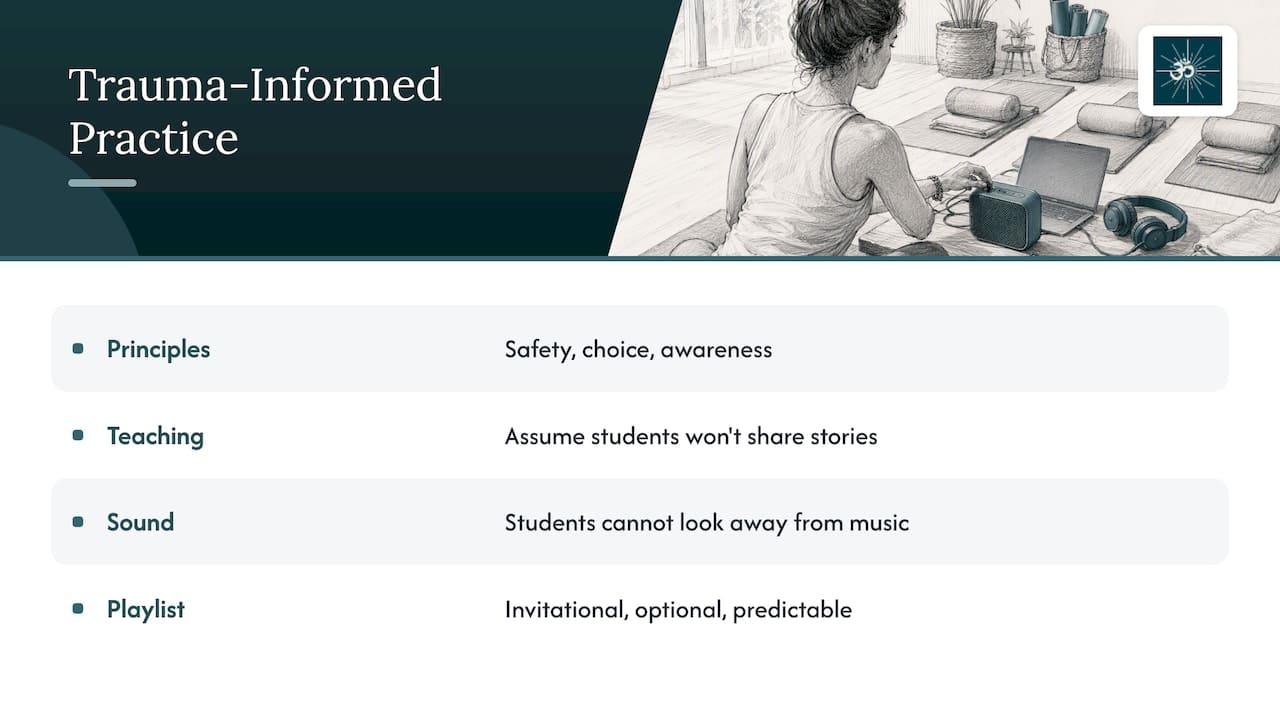
In everyday studio terms, Vikasa’s account of trauma-informed yoga in real studios puts it well: you do not ask students to share their stories, you teach in a way that assumes they will never tell you. The approach rests on safety, choice and awareness.
Now apply that to sound. Music is a sensory input that students cannot close like an eyelid. They can’t look away from it. So the same rules that govern your language and your hands-on adjustments (invitational, optional, predictable) must govern your playlist.
Why music can help, and why it can backfire
The upside is real. A systematic review of music interventions for posttraumatic stress disorder notes growing literature supporting music for anxiety, stress and pain, alongside research on the neurobiology of musical experience. The OUPblog piece on managing the power of music discusses how slow-tempo music, around 60 to 80 beats per minute, is used to encourage slower heart and breathing rates and a shift from stress towards a feeling of safety.
The downside is just as real, and it is the part most playlists ignore. Sound can remind a body of something before the mind has caught up. A sudden swell, a bell struck without warning, a voice, a sound of water for someone who nearly drowned: none of these are “wrong” in themselves, and all of them can land badly.
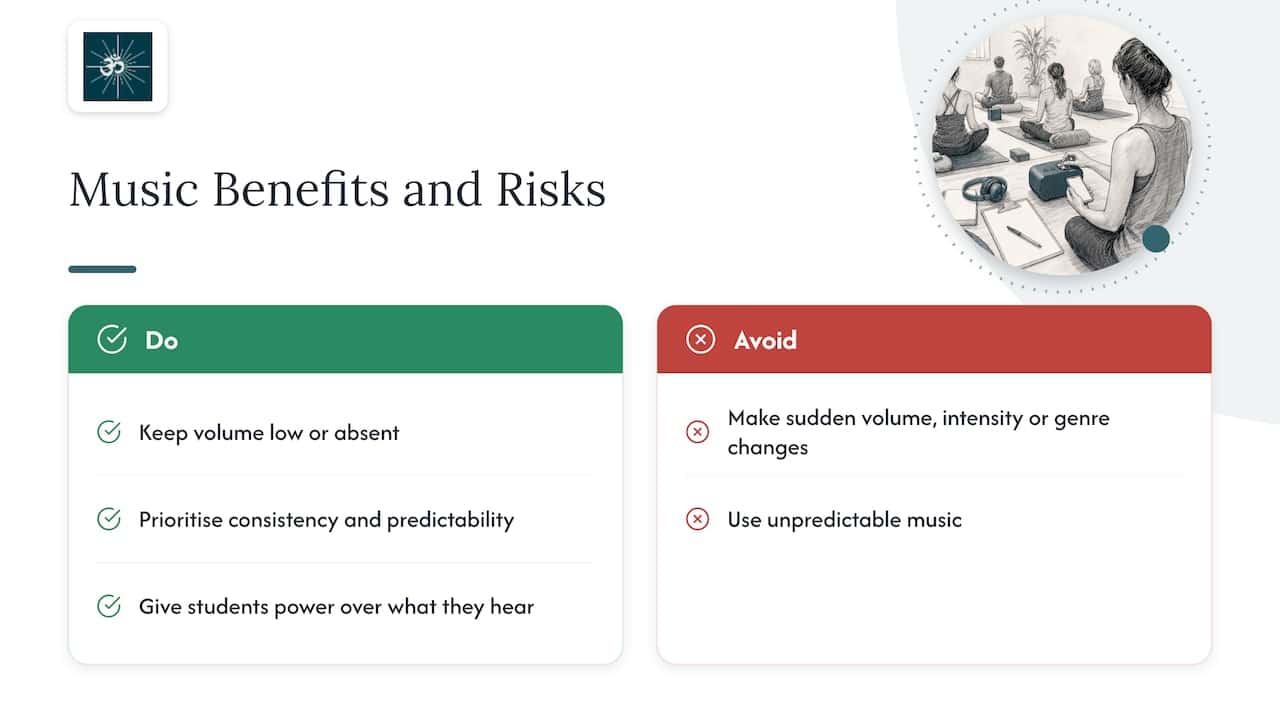
Vikasa’s guidance is blunt on this point: keep the volume low or absent, because sudden changes in volume, intensity or genre can act as unexpected triggers for a hypervigilant nervous system. Prioritise consistency and predictability. Unpredictable music, the article suggests, can provoke the same stress response as an uninvited touch.
So the question “which track is trauma-informed?” is slightly the wrong question. The better one is: “Does this student have power over what they hear?”
The principle behind the playlist: agency
The OUPblog authors make a point I wish more teachers would tattoo on their wrists: trauma-informed music use is about the how, not the what. Offer choice, volume control, even silence. Never treat a piece labelled “meditation music” as inherently safe.
Their core principle is to start where the student feels safe. Practitioners often err by introducing complex soundscapes too early. Music should support the student’s agency, and choosing quiet or lowering the volume is itself a way of practising choice.
If a student finds a sound triggering, a pre-agreed “pause” or “silence” signal restores their sense of control. Agree it before you press play, not after.
Practically, that gives you four questions to ask before any class:
- Can everyone hear it at a level they choose, or only the level I chose?
- Have I told them that silence is always an option, and meant it?
- Will anything in this piece surprise them (a dynamic jump, a new instrument, a voice)?
- Is there a simple, no-explanation-needed signal to stop it?
What to look for in a track
There is no official standard for “trauma-informed music”, so what follows is a practical checklist drawn from the guidance above and from how music is actually built. Treat it as a starting point and adjust to your students.
| Quality | Why it helps | What to avoid |
|---|---|---|
| Slow, steady tempo (around 60 to 80 BPM) | Supports a slower breathing and heart rate | Drum loops, anything that pushes or urges |
| Narrow dynamic range | No sudden loud moments | Crescendos, cymbal crashes, struck bells |
| Predictable texture | The nervous system can “settle in” and stop scanning | Genre shifts, tracks that change character halfway |
| No lyrics or spoken voice | Nothing to interpret, no stranger’s voice in the room | Mantras and affirmations unless students choose them |
| Gentle, natural-sounding timbres | Feels human rather than synthetic or harsh | Piercing high frequencies, heavy bass rumble |
| Long form (10 to 30 minutes) | Fewer silences, fewer abrupt starts and stops | Playlists with jarring gaps and adverts |
Notice that a hard-hitting sound-healing gong bath fails most of that table for a trauma-informed group class, however beautiful it can be in another context. Notice, too, that streaming “yoga” playlists often fail it for a duller reason: the algorithm hops from one track to the next without caring whether the key, mood or volume match.
Binaural beats, theta and Solfeggio: handle with care
Binaural beats, theta-range tracks and Solfeggio-tuned music are popular in the meditation world, and we make some of them ourselves. Research on music interventions mentions binaural beat technology among approaches studied for helping the nervous system move from stress towards relaxation, but the evidence is still developing, and none of it replaces clinical care.
Two practical cautions for a trauma-informed class. First, binaural beats are designed for headphones, which means individual listening. That can be a gift (a student controls their own volume) or a problem (headphones can feel isolating, or make it harder to notice what is going on in the room). Offer them as an option, not the default.
Second, low-frequency or unusual-sounding tones can be disorienting for some people. Introduce them late in a series of classes rather than in the first one, and always ask how they landed. Starting where students feel safe applies to technology as much as to anything else.
Building a soundtrack for a class, step by step
- Decide whether to use music at all. For a first session with new students, silence is a perfectly good choice. Some people want to hear their own breath and the room, and nothing else.
- Announce it in plain words. “I have some quiet instrumental music. You can ask me to lower it or switch it off at any point, and you never need to say why.”
- Start quiet. Set the volume lower than feels necessary. It is easier to raise than to retreat from.
- Choose one piece for the whole practice. Consistency beats variety. A single 30-minute track is gentler than six three-minute ones.
- Do not change anything mid-class. No new track, no volume nudge, without telling people first.
- Agree a signal. A raised hand, a word, a note on a card. Whatever it is, honour it instantly.
- Ask afterwards. A simple “was the music helpful, neutral or too much?” gives you the data a playlist never will.
One more tip from the musician’s side of the fence: play the track all the way through at home, with your eyes closed, before you use it in class. Many pieces that sound serene in the first two minutes introduce a surprise at minute nine. You want to be the one who knows.
What does the evidence say about yoga itself?
It helps to keep proportions. Music is the garnish here, and yoga is the main course. A systematic review and meta-analysis in the Journal of Trauma & Dissociation looked at mindfulness-based interventions and yoga for psychological trauma, and the research summary we were given reports a pooled effect size of g = 0.46 for yoga interventions, with duration as an important moderator.
A more recent systematic review of randomised controlled trials in PMC examines how yoga affects the different symptom clusters of PTSD, and starts from the finding that yoga has been shown to reduce PTSD symptoms overall.
Take from this what a careful teacher would: yoga is a promising complement for trauma-related symptoms, and the details of how it is taught matter. It is not a treatment you can promise to cure anything with. If a student is living with PTSD or complex trauma, their psychotherapist or doctor should be part of the picture, and you should say so plainly.
A note for teachers working in Germany
In Germany, two professional bodies are worth knowing. The Deutsche Musiktherapeutische Gesellschaft (DMtG) represents music therapy, and the DeGYT, the German professional association for yoga therapists, describes yoga as a holistic approach aimed at maintaining health, prevention and therapy.
Both stress evidence-based practice, and the benchmark for clinical trauma treatment here is the S3-Leitlinie, the highest-level medical guideline standard. Where a student needs treatment, that is the territory of qualified clinicians. A yoga class with good music is support, not therapy, and it helps to be clear about that line in your own marketing.
The same goes for the word “therapy” in class descriptions. Unless you hold the relevant qualification, “trauma-informed yoga” or “gentle yoga with choice” says what you do honestly. If you are unsure what you may call your offer, ask your professional association or a lawyer before you print the flyer.
Sound you feel, and sound you hear
Some teachers also wonder about instruments and devices that you feel as much as hear. The topic of vibroacoustic therapy research sits next door to this one. The same rule applies: the more physical the sensation, the more important explicit consent and an easy exit become. Never surprise a body with vibration.
Our perspective: why we record the way we do
We are a music library, so you might expect us to say “just buy our tracks”. We would rather say something more useful: your students’ sense of control comes first, and the music second.
Orchestral Meditations produces meditation music recorded with live musicians, including sessions at Abbey Road Studios with the National Philharmonic. We care about live players for a simple reason. A real orchestral string section breathes. Phrases rise and fall the way a person’s breath does, and that organic quality is hard to fake with a synthesiser pad. We also build in scientific sound design (binaural, theta and Solfeggio-frequency tracks) and 3D surround sound for people who want an immersive listening experience.
For trauma-informed settings, what matters to us is what we leave out. Think no lyrics, no drum pulse, no flashy changes of character. A good meditation piece should be something you can stop noticing. It should hold the room rather than perform for it.
Our composer and producer Robert Emery shapes that approach, together with our wider team of composers. We would never claim that any recording is a therapy or that it is safe for everybody. Some people will find any music too much on some days, and that is information to respect, not a problem to fix. Our tracks are a tool, and the teacher’s attention is the real instrument.
If you want a broader look at how we think about sound and mindfulness, we wrote about it in science-backed sound and music for mindfulness.
— ROBERT
Using our music in your classes
If you teach yoga, run a therapy practice or build wellness content, the licence matters as much as the sound. Our royalty-free meditation music is offered with professional licensing options for use in yoga, therapy, guided audio, massage, apps and wellness content, so you do not have to wonder whether your class playlist is permitted.
For personal practice at home, the personal subscription costs €21 per month. For teachers and professionals who want to use the library commercially, the professional subscription costs €150 per month. You can also explore the whole library from our home page.
A small suggestion: before you commit, listen to a track the way your quietest student would. Low volume, eyes closed, one go through. If anything makes you flinch, it is not the right piece for that group.
Common mistakes (all of which I have made, or watched someone make)
- The “relaxing” playlist on shuffle. Different tempos, different keys, a surprise advert. Avoid.
- Music too loud to hear your own breathing. If the music dominates the room, you have taken something away from students.
- Changing the track mid-class because the energy “felt flat”. Predictability is the point. Your sense of flatness may be someone else’s safety.
- Assuming nature sounds are neutral. Thunder, running water and birdsong can each mean something very different to different people.
- Treating silence as a failure. Silence is not dead air. It is an option, and for some students it is the best one.
- Promising healing. You are offering a calm, choice-rich space. That is plenty.
FAQ
What is the best music for trauma-informed yoga?
There is no single best piece. Look for quiet, slow, steady instrumental music without lyrics or sudden changes, and, more importantly, give students control over volume and the option of silence. The how matters more than the what.
Should I play music at all in a trauma-informed class?
It is optional. Silence is a legitimate and often wise choice, especially in early sessions. If you do use music, explain it beforehand, keep it consistent, and agree a signal to pause it.
Are binaural beats safe for trauma survivors?
Evidence is still developing, and reactions differ from person to person. Offer binaural tracks as an optional, headphone-based choice rather than a default, and introduce them gradually. Anyone living with PTSD should talk to their therapist or doctor before relying on any sound technique.
Can I use royalty-free meditation music in my paid yoga classes?
Only if the licence covers it. Personal-use downloads often do not extend to classes, apps or recordings, so check the licence terms. Our professional options are made for that purpose, and you can review them on our professional licensing page.
Sources
- Simply Psychology: Trauma-Sensitive Yoga
- Vikasa: What Trauma-Informed Yoga Looks Like in Real Studios
- Music interventions for posttraumatic stress disorder: A systematic review
- OUPblog: Managing the power of music to foster safety and avoid harm
- Mindfulness and yoga for psychological trauma: systematic review and meta-analysis
- The impact of yoga on PTSD symptom clusters: systematic review and meta-analysis
- DMtG press kit 2026
- DeGYT: Verband
- Vibroacoustic therapy research