
Use curated, licence-safe, high-fidelity music matched to the specific moment you’re designing for: focus, calm or a genuine reset. Research generally supports mood and stress benefits from workplace listening, though the delivery and the personalisation matter more than the genre you pick. Professional libraries with composers like Robert Emery and Moritz Schneider behind the recordings give planners a ready-made starting point.
TL;DR:
- Personalised playlists and licensing are crucial, as effectiveness depends heavily on individual preferences and proper rights for commercial use.
- Binaural and theta tracks require headphones, while ambient and orchestral music can be used through shared speakers, depending on the moment.
- Short pilot programs of two to four weeks, with clear goals and simple feedback measures, are more effective than large-scale rollouts.
- Professional, high-fidelity recordings from orchestral musicians offer more reliable emotional and physiological effects than generic background music.
- Music reliably improves mood and stress markers but has mixed results on productivity, so it should be part of a broader wellness strategy.
Types and formats of corporate wellness music
Not every moment in the working day wants the same sound. Ambient and low-tempo instrumental tracks suit focus work because they stay out of the way of thought. Orchestral pieces, particularly slower string-led compositions, tend to work well for mindful breaks and group relaxation sessions. Binaural and theta-based audio sits in its own category entirely: it’s designed for headphone listening during short guided resets rather than as background noise. Guided meditation sessions, meanwhile, need dedicated time and quiet, not a shared office floor.
Delivery matters as much as content. A streamed channel piped through office speakers works for ambient background use, but anything binaural needs headphones to do its job properly. Downloadable lossless files give you more control over scheduling than relying on a public streaming playlist.
- Ambient or orchestral instrumental: best for sustained focus and low-stimulus backgrounds.
- Binaural or theta tracks: headphone-only, best for short guided resets.
- Guided meditation sessions: need dedicated time, suited to scheduled group breaks.
- Curated playlists with clear tempo bands: flexible across most office moments, provided lyrics are avoided during concentration periods.
Lyrics, tempo spikes and unfamiliar instrumentation are the usual culprits when a well-meaning playlist backfires, so test before rolling out widely.
What the research says about music at work
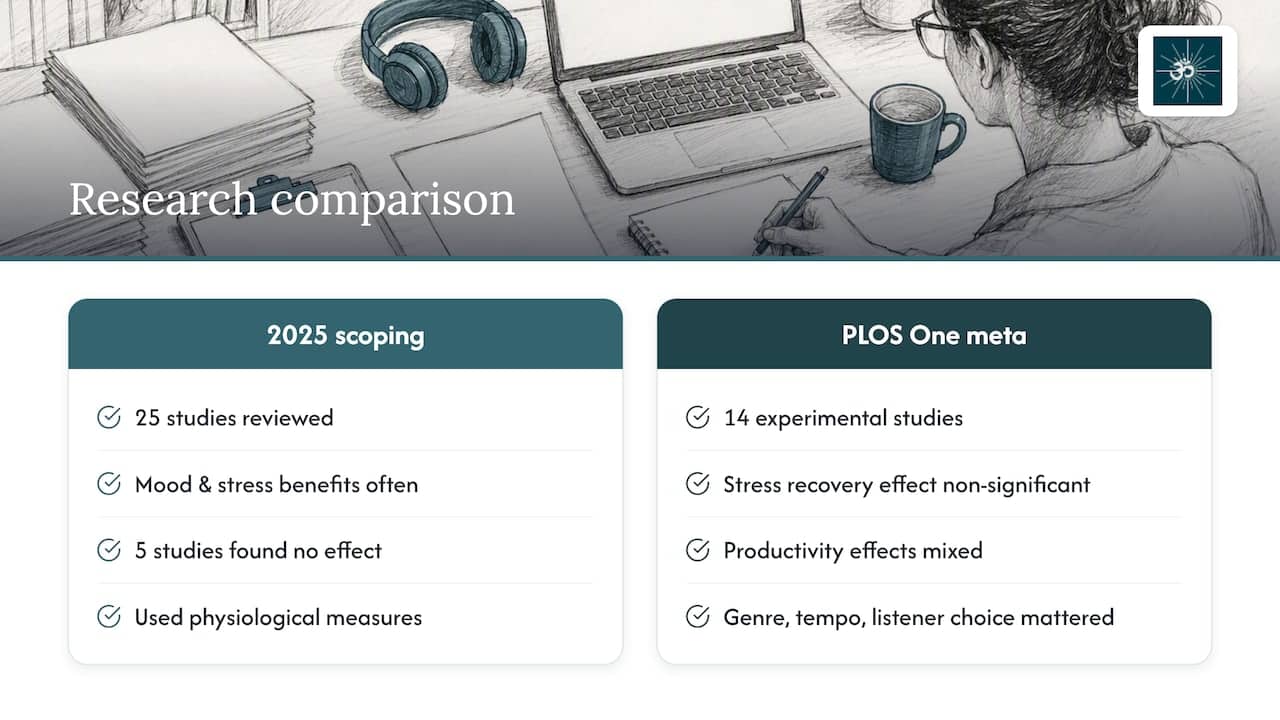
The evidence is genuinely encouraging, with a caveat worth repeating to any sceptical stakeholder: mood and stress benefits show up fairly consistently, but productivity effects are mixed and depend heavily on context. A 2025 scoping review summarised 25 studies on music-based interventions in workplaces and found they often improved mood, reduced anxiety and lowered physiological stress markers, though five of those studies found no effect at all. That split matters: it tells us the intervention works often, not universally.
Nearly all the reviewed studies used some physiological measure alongside self-report, including heart rate, blood pressure and salivary markers, which gives planners a credible toolkit for their own pilots, according to the BMC scoping review.
A separate PLOS One meta-analysis of 14 experimental studies found the overall effect of music listening on stress recovery was non-significant once you account for genre, tempo and whether listeners chose their own tracks. In other words, the music that works is the music people actually want to hear. A narrative review of workplace interventions echoes this: promising results, but heterogeneous designs and a clear need for bigger, better-controlled studies.
The practical takeaway writes itself: personalise where you can, run a small pilot before any office-wide rollout, and measure something simple rather than nothing at all.
How to design and run a workplace music pilot
Treat this like any other small workplace trial rather than a grand wellness initiative. Start with a decision framework before you touch a playlist.
- Define the goal first. Are you after calmer afternoons, better focus blocks or a genuine stress reset during a tough quarter?
- Know your audience and environment. An open-plan sales floor needs a different approach to a quiet back office.
- Pick a delivery channel. Ambient speaker channels work for shared spaces; binaural and guided content needs headphones.
- Check your licence before you play anything. Workplace playback usually requires commercial rights, not a personal streaming account.
- Run a short pilot. Two to four weeks with a defined group, tracking self-reported mood, engagement and absenteeism, plus a simple physiological check if you have the means.
- Review and decide. Compare against your stated goal, not against vague impressions.
Consent and opt-in design deserve real thought here. Ambient background music can run without individual sign-off, but guided sessions and anything played through shared headphones should be opt-in, with a clear explanation of what staff are being asked to listen to and why.
Pro Tip: Keep tempo control in someone’s hands: a single person responsible for the playlist prevents the slow creep towards music nobody actually asked for.
Licensing and audio quality for workplace playback
A personal streaming subscription is not built for commercial playback, and that distinction catches planners out more often than it should. Workplace use needs a licence that explicitly covers commercial settings, the likely number of listeners, and any redistribution across multiple sites.
- Commercial use clause: confirm the licence names workplace or business playback, not personal listening only.
- Listener count and location limits: some licences cap the number of rooms or staff covered.
- Redistribution rights: check whether you can reuse tracks across internal wellbeing apps or recorded sessions.
- Royalty-free status: Orchestral Meditations’ royalty-free meditation music line is built with professional and commercial licensing in mind.
Fidelity matters more than most planners expect, particularly for binaural or theta content, where the intended effect depends on subtle frequency layers that a heavily compressed file can flatten. Lossless formats delivered to headphones, rather than compressed streams through tinny desk speakers, give these tracks a fair chance of doing what they’re designed to do.
Ready-to-use templates for common workplace moments
These templates are a starting point you can brief to a composer or search for directly.
- Morning focus channel: steady ambient or low-tempo instrumental at 30 to 50 BPM, minimal percussion, no lyrics.
- Mid-day reset: a 10 to 15 minute guided calm session, headphone-only, low dynamic range.
- Afternoon focus block: instrumental tracks at 60 to 80 BPM, string or piano-led, steady rhythm with no sudden shifts.
- Low-stimulus background: ambient orchestral pieces with long sustained notes, suited to open-plan spaces where music needs to stay in the background.
Deliver the focus and background channels through shared speakers at low volume, keep guided sessions strictly to headphones, and schedule group relaxation sessions as a fixed calendar slot rather than an ad hoc offer nobody remembers exists.
Why production quality matters: Orchestral Meditations, Robert Emery and Moritz Schneider
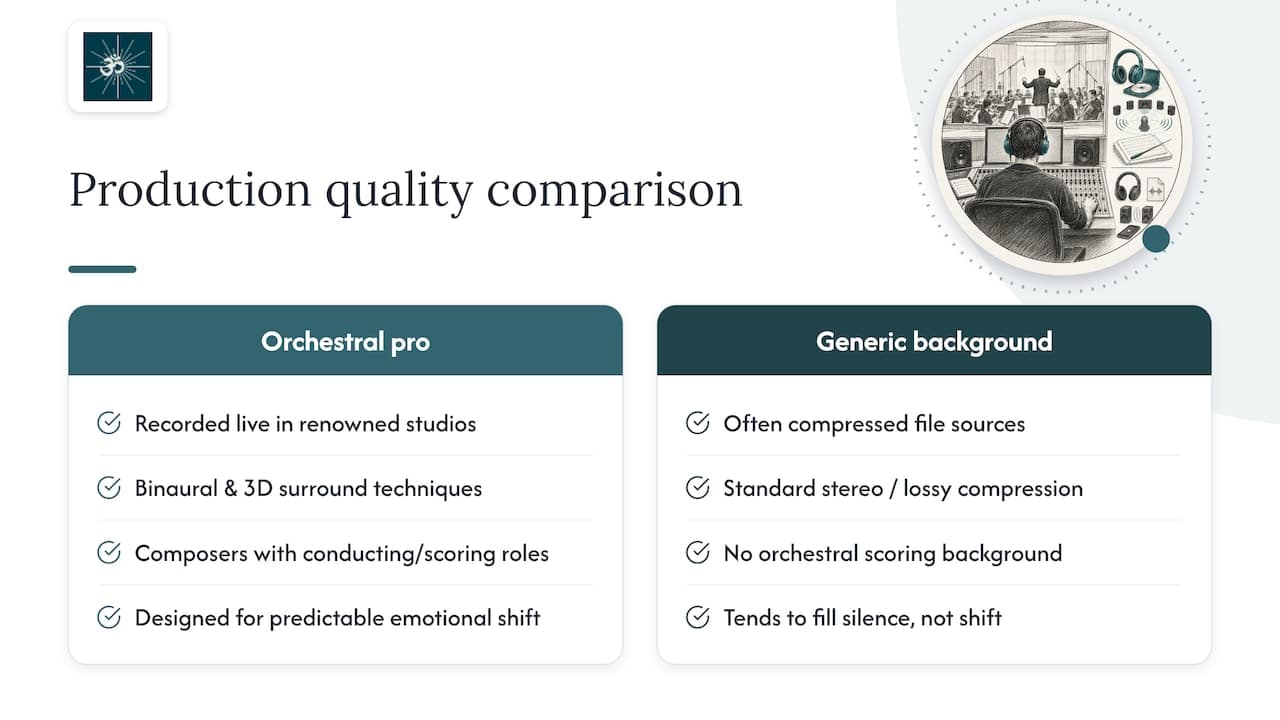
Professional recording genuinely changes what music can do for a workplace programme. Some professional meditation music catalogues are recorded in renowned studios with live orchestral musicians, using binaural and 3D surround techniques designed to preserve subtler frequency work that a compressed file tends to lose.
Composer and producer Robert Emery brings conducting and orchestral experience to this catalogue, while composer and producer Moritz Schneider contributes a cinematic scoring background, the kind of work built around sustaining emotional tone over an extended piece rather than chasing a catchy hook.
Live orchestral recording and careful frequency design exist to produce a predictable emotional or physiological shift, not simply to fill silence.
That distinction between structured, professionally produced audio and generic background noise is worth remembering before you brief anyone on a workplace programme.
A realistic view of what workplace music can and can’t do
Music is a genuinely useful, low-cost lever for mood and stress, and the evidence supports that modest claim well for healthcare teams facing high demands, as discussed in Healthcare Worker Burnout: A Guide for Clinicians & Managers. It is not a treatment for clinical anxiety, depression or burnout, and no playlist should be asked to do a clinician’s job. When a member of staff is struggling well beyond what a calmer soundscape can touch, the right move is a referral to occupational health or a qualified music therapist, not a longer playlist.
Measure what you roll out, keep the process transparent with staff, and adjust as you learn. That honesty tends to earn more trust than any grand claim about transformation ever could.
— ROBERT
Getting started with Orchestral Meditations for a workplace pilot
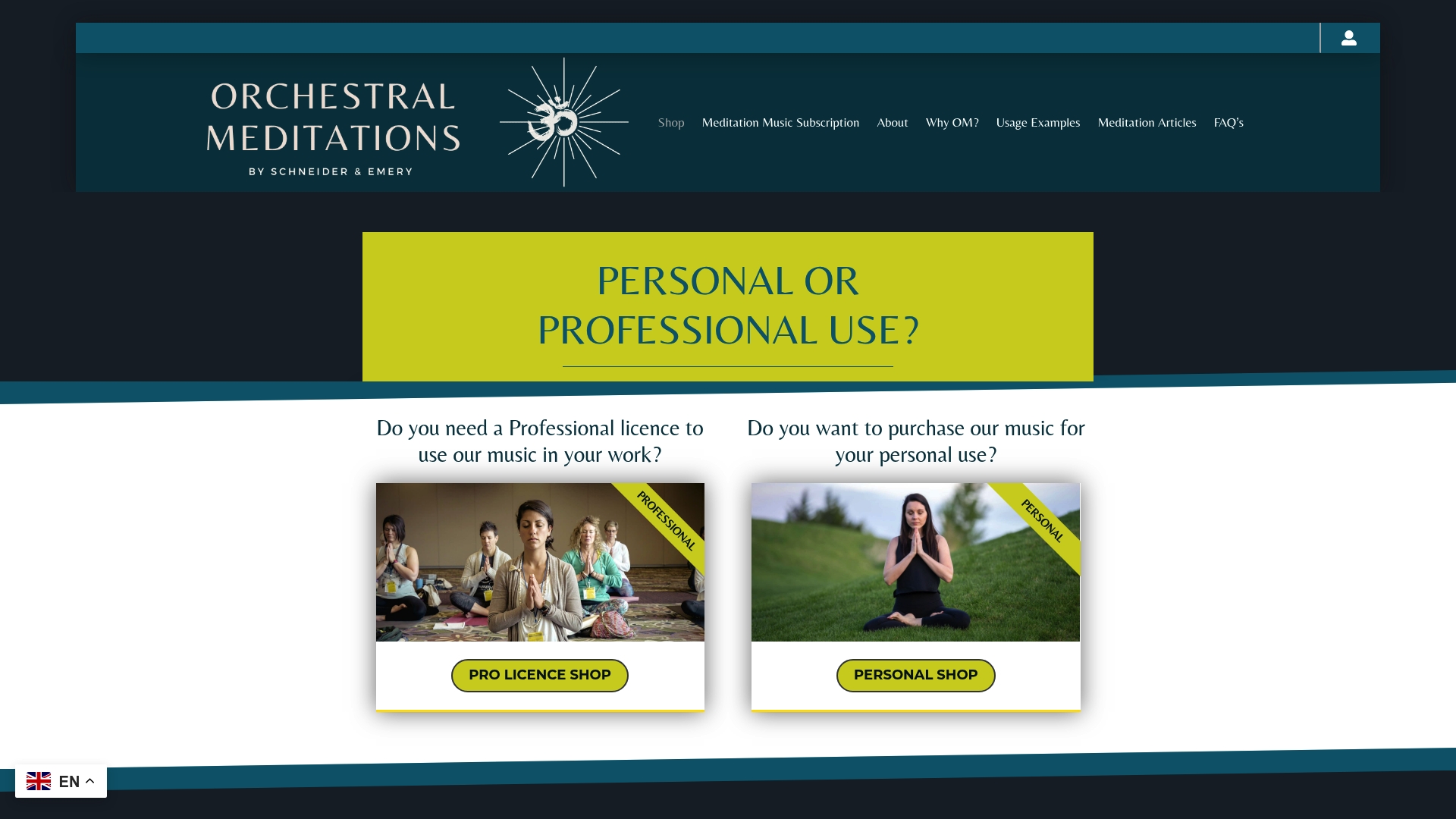
If you’re ready to trial something rather than keep debating playlists in a meeting, we offer a few straightforward routes in. Our personal subscription at €21 a month suits a small pilot group or a single department testing the waters. For broader workplace playback, our professional subscription at €150 a month covers the commercial licensing a shared office needs. Our royalty-free meditation music line is also available for teams that want individual tracks rather than an ongoing subscription.
- Start with one licensed track or a short curated series for your pilot group.
- Gather simple staff feedback before deciding on a wider rollout.
- Move to the professional subscription once you need office-wide, licence-safe playback.
A short pilot with proper licensing tells you far more than months of guesswork ever will. Browse our full library to pick your starting point.
FAQ
What is the best background music for corporate events?
Instrumental or orchestral tracks with a steady tempo and no lyrics work best for corporate events, since they support conversation rather than compete with it. Keep volume low and avoid sudden tempo or dynamic shifts that pull attention away from the room.
What are some good songs to use at corporate events?
Rather than specific commercial songs, which usually carry restrictive licences for business playback, planners tend to do better with a royalty-free instrumental set built around a consistent mood and tempo. This avoids licensing risk and keeps the tone consistent across the whole event.
How does music improve workplace productivity?
The evidence here is mixed rather than conclusive: mood and stress benefits are fairly consistent, but productivity effects depend on the task, the listener and the music itself, according to the workplace scoping review. Personalised or self-selected music tends to produce steadier results than a fixed playlist imposed on everyone.
What are the top empowering songs for workplace motivation?
There’s no single agreed list, since “empowering” depends heavily on individual taste and the specific team culture. A safer approach for shared spaces is an instrumental set with a confident, steady tempo, leaving the more personal motivational tracks for individual headphone listening.
Sources
- Music-based interventions at workplaces: a scoping review | BMC Complementary Medicine and Therapies | Springer Nature Link
- Music listening and stress recovery in healthy individuals: A systematic review with meta-analysis of experimental studies | PLOS One
- Music in the workplace: A narrative literature review of intervention studies