Put on a chakra-specific tonal track, ideally one built around a solfeggio or tuned frequency, with a gentle binaural layer or a warm orchestral backing underneath. That combination does the double job of giving your mind something steady to settle on while nudging your body towards a slower, calmer rhythm. The research behind chanting and tonal sound is still developing, but what exists points towards real (if modest) benefits for relaxation and focus. Here’s how to choose well and use it properly, including incorporating effective ways to relax your mind naturally.
TL;DR:
- Quality recordings from reputable producers, like Abbey Road Sessions, significantly impact the calming effect compared to low-fidelity synth tracks.
- The evidence for sound-based chakra work mainly shows small to moderate benefits for reducing stress and anxiety, but research quality varies.
- Listening to well-structured full-chakra sessions lasts around 20 to 40 minutes, ideally beginning with breathing, moving through each chakra, and ending with silence.
- Binaural beats are effective only with headphones and should be used cautiously by people with seizure history or certain health conditions.
- The specific Hz-to-chakra claims are traditional, not scientifically proven, so focus on content quality and alignment with your mood rather than exact frequencies.
What the research says about sound, chanting and chakra tones
I’ll be honest: I went looking for a single, slam-dunk study proving that a 528Hz tone realigns your heart chakra, and I didn’t find one. What I found instead was more interesting, a slow accumulation of decent evidence that chanting, tonal focus and mantra-style listening genuinely shift how the nervous system behaves, even if nobody has pinned down the exact mechanism.
A systematic review of mantra meditation looked at studies across non-clinical populations and found small-to-moderate benefits for anxiety and stress. The catch, and it’s a real one, is that most of the underlying studies were judged weak in quality, so the results deserve a measured “promising” rather than a confident “proven.”
Separately, the clinical literature on Mind Sound Resonance Technique has been more specific about mechanism. A narrative review of MSRT reports reductions in anxiety alongside improvements in sleep and autonomic balance, the kind of vagal-tone shift that shows up as a slower heart rate and steadier breathing. The same body of work notes that chanting “Om” correlates with limbic deactivation and rises in alpha and theta brain-wave activity, patterns generally associated with relaxed, focused states.
- Mantra meditation: small-to-moderate benefits for stress and anxiety, but most included studies were low quality.
- MSRT: autonomic and sleep benefits reported, though researchers call for larger randomised trials.
- Chanting and tonal focus: linked to alpha and theta EEG increases, patterns tied to calm, attentive states.
The strongest evidence we have for chant-based practice comes from that MSRT review, which draws on autonomic and sleep outcomes across clinical and quasi-experimental studies. It’s suggestive rather than conclusive, and your own response may differ from the average. None of this replaces medical treatment, and if you’re managing a diagnosed condition, sound is a complement, not a substitute.
How to choose chakra music: practical criteria
Not all chakra tracks are built the same, and the difference matters more than people assume. Here’s what I’d actually check before adding something to my playlist.
- Favour live-instrument or high-fidelity orchestral timbre over thin synthetic tones. A cello drone or a string pad recorded properly carries overtones that a basic synth patch simply can’t fake, and your ear notices even when your conscious brain doesn’t.
- Decide upfront whether binaural beats suit your session. They only work through headphones, since each ear needs to receive a slightly different frequency for the brain to perceive the beat.
- Check for clear labelling. A trustworthy track states its target frequency in Hz or names the chakra it’s aimed at, alongside duration and licensing terms, so you’re not guessing at what you’ve bought.
- Match the format to your mood. Guided tracks suit beginners or stressful days, unguided instrumental pieces suit anyone who wants to sit with their own thoughts, and slower tempos generally support deeper settling than brisk ones.
- Mind your listening setup. Keep volume moderate rather than loud, since very high volumes can undercut the relaxation response you’re after, and avoid binaural or heavily entraining audio if you have a history of seizures or certain cardiac conditions, checking with a clinician first if in doubt.
Pro Tip: Test any new track at low volume with headphones before committing to a full session, since the stereo separation on binaural pieces can feel oddly intense the first time you hear it.
Chakra frequencies and a simple session blueprint
Solfeggio frequencies have become shorthand for chakra work, even though a literature review on chanting and solfeggio is careful to frame the Hz-to-chakra links as traditional associations awaiting firmer scientific backing, not settled fact. Treat the numbers below as practical cues rather than prescriptions.
- Root (base of spine): grounding and security; often paired with 396Hz; around 3 to 5 minutes.
- Sacral (lower abdomen): creativity and emotion; often paired with 417Hz; 3 to 5 minutes.
- Solar plexus (stomach): confidence and will; often paired with 528Hz; 3 to 5 minutes.
- Heart (chest centre): connection and compassion; often paired with 639Hz; 3 to 5 minutes.
- Throat: expression and honesty; often paired with 741Hz; 3 to 5 minutes.
- Third eye (brow): intuition and clarity; often paired with 852Hz; 3 to 5 minutes.
- Crown (top of head): awareness and release; often paired with 963Hz in some traditions; 3 to 5 minutes.
A full seven-chakra sweep at around a few minutes per centre typically fits comfortably within a 20 to 40 minute timeframe, which fits comfortably into most people’s morning or evening routine. Open with two or three slow breaths, move through the chakras from root to crown, and let a minute of silence close the session so your nervous system has a chance to settle before you stand up.
If you’re using binaural beats within that blueprint, keep the carrier tone gentle and the volume well below uncomfortable, and skip them entirely if you have a seizure history or are pregnant, since caution is generally advised in those cases. Longer single-chakra tracks suit a targeted session (say, working through heartbreak with heart-chakra audio alone), while the full multi-chakra suite suits a general alignment practice. For more on how sound affects the body physiologically, Orchestral Meditations has written about the science behind therapeutic sound in more depth.
Why recording quality and named composers matter
Here’s something I think gets underrated: who actually played the music, and how it was recorded, changes how your body responds to it. A thin, looped synth pad and a cello recorded in a world-class hall are not interchangeable just because both claim “432Hz” on the label.
Orchestral Meditations records its library at Abbey Road Studios with the National Philharmonic, using 3D surround and binaural production techniques, the kind of provenance that’s genuinely rare in a market full of stock-library drones. The composer and producer Robert Emery, known for his work bridging classical orchestration with film and media scoring, brings a trained ear for dynamics and pacing to these recordings, the same instincts that make a film score swell at the right moment rather than just sit there. Alongside him, producer Moritz Schneider contributes to the sound design and mixing, shaping how the binaural and orchestral layers sit together so neither overwhelms the other.
- Recorded at Abbey Road Studios with the National Philharmonic, a genuine orchestral provenance rather than sample libraries.
- Composed and produced with named credits (Robert Emery, Moritz Schneider), so you can judge the musical authorship rather than trusting an anonymous track.
- Mastered in 3D surround and binaural formats designed to increase immersion over flat stereo synthetic audio.
Live dynamics, the tiny swells and breaths a real string section gives you, tend to hold attention better than a static loop, which is partly why high-fidelity production is worth paying attention to rather than dismissing as marketing gloss.
My honest view on chakra music and the hype around it
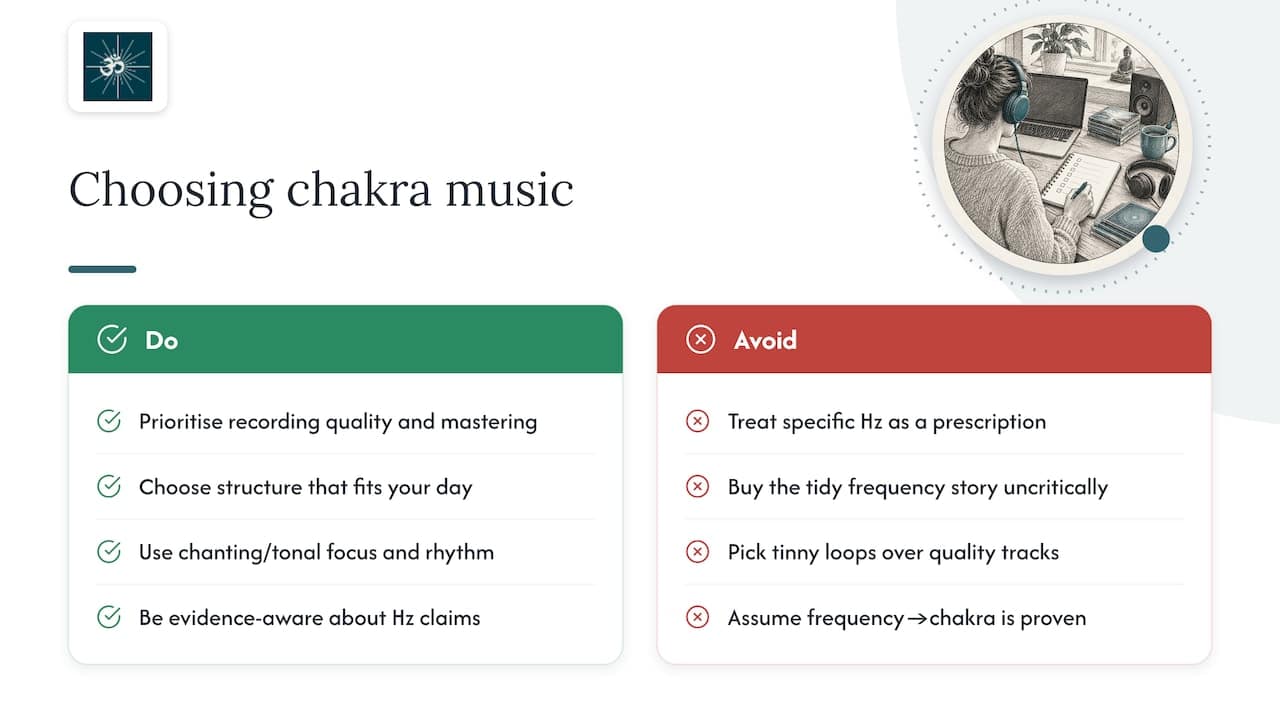
Here’s my gripe with how chakra music usually gets sold: the Hz numbers get treated like a prescription, as though 528Hz is aspirin for your solar plexus. It isn’t. The reviews on solfeggio and chanting are honest that the frequency-to-chakra links are traditional, not clinically proven, and I’d rather you knew that than bought into a tidier story.
What the evidence does support is something less dramatic but more useful: chanting, tonal focus and rhythmic sound genuinely shift brain-wave patterns and autonomic tone, the stuff that makes you feel calmer and more focused. That’s worth your time. What I’d prioritise first isn’t the exact Hz label, it’s the quality of the recording and whether the structure (guided or not, long or short) actually fits your day. A beautifully mastered orchestral piece at the “wrong” frequency will likely do more for you than a tinny synth loop at the “right” one.
— ROBERT
Listening options from Orchestral Meditations
If you’d rather not build your own frequency cheat sheet from scratch, some platforms offer curated collections. Personal subscriptions can give individual meditators access to a full library, including binaural and orchestral chakra tracks recorded with live musicians rather than stock synths, which helps answer the “is this actually well produced” question before you even press play.
For yoga teachers, therapists and content creators who need to use tracks professionally, professional subscriptions may add commercial licensing, and royalty free meditation music lines may cover licensing needs for apps, classes or guided audio projects.
- Personal subscription: full library access, binaural and orchestral options, built for individual practice.
- Professional subscription: commercial licensing for practitioners, studios and creators.
- Royalty Free Meditation Music: licensing for apps, wellness content and professional projects.
| Option | Best suited to | Price |
|---|---|---|
| Personal subscription | Individual meditators | Current prices are available on the pricing page. |
| Professional subscription | Practitioners and creators needing commercial use | Current prices are available on the pricing page. |
Start with a short guided session from the personal subscription to hear the production quality for yourself, and if you’re planning to use tracks in classes or commercial content, check the professional subscription licensing terms before you publish anything.
Sources
- Systematic review: Mantra meditation for mental health in the general population
- Therapeutic evaluation of mind sound resonance technique (MSRT)
- A review on the effects of chanting and Solfeggio frequencies on well‑being
FAQ
Does listening to chakra music actually work?
Evidence suggests chanting and tonal sound can produce small-to-moderate benefits for stress, anxiety and relaxation, supported by a systematic review of mantra meditation. Results vary between people, and the exact chakra-frequency claims are traditional rather than clinically proven.
What are the seven chakra sounds used for healing?
Tradition pairs each chakra with a solfeggio frequency: 396Hz for the root, 417Hz for the sacral, 528Hz for the solar plexus, 639Hz for the heart, 741Hz for the throat, 852Hz for the third eye and often 963Hz for the crown. A review of solfeggio frequencies documents these associations while noting more controlled research is needed.
What is the best approach to chakra meditation?
A simple full-body session moves from root to crown chakra, spending 3 to 5 minutes on each with calm breathing, totalling roughly 21 minutes or more with a short silent close. Pairing this structure with well-produced orchestral or binaural tracks, like those recorded at Abbey Road Studios, tends to support deeper focus than thin synthetic audio.
Which chakra is considered the most powerful?
There’s no settled scientific ranking, since chakra systems come from traditional frameworks rather than clinical measurement. Many practitioners treat the heart chakra as central because it sits at the midpoint of the system, linking the lower, body-focused chakras to the upper, awareness-focused ones, but this reflects tradition rather than evidence.
How long should a chakra meditation session last?
A full seven-chakra routine typically runs 21 minutes or more, allowing 3 to 5 minutes per centre. Shorter, single-chakra sessions of a few minutes work well for targeted practice, such as focusing solely on the heart or throat chakra when that’s what the day calls for.