
You can use meditation music on YouTube only when you hold the rights or a licence that explicitly covers YouTube use, including monetisation. Without that, the platform’s automated system, Content ID, will very likely spot the match, and a “no copyright” caption in your description does nothing to change that. The good news is that securing proper rights is straightforward once you know where to look, from Creator Music inside YouTube to Creative Commons tracks cleared for commercial use.
TL;DR:
- Using meditation music on YouTube requires proper rights or licenses covering both the composition and the sound recording, especially for monetized content.
- Content ID automatically matches your audio against a database, and claims often lead to monetization sharing or blocking, not formal strikes, but they still impact your channel.
- Creative Commons licenses vary widely; ensure the specific recording also has clear permissions for commercial use and YouTube monetization before usage.
- Licensing options include one-time sync and master licenses, subscription services, and direct negotiations through YouTube’s Creator Music, each suited for different upload frequencies.
- Always keep proof of licensing readily available, verify license territory coverage, and avoid relying on claims or “no copyright” labels as legal permission.
Understanding youtube meditation music copyright and how enforcement actually works
YouTube doesn’t rely on a human scanning your upload for stolen audio. It uses Content ID, an automated matching system that compares your video’s soundtrack against a database of registered recordings. When it finds a match, the rights holder’s chosen policy kicks in automatically, and that policy is where most creators get caught out.
A Content ID claim can do one of three things to your video, depending on what the claimant has told YouTube to do with matches of their work:
- Monetise: ads run on your video, but the rights holder collects the revenue, not you.
- Block: your video becomes unwatchable, sometimes only in specific countries.
- Track: the video stays exactly as it is, but the claimant can see viewership data.
A claim is not the same as a strike. Copyright strikes come from a separate, formal takedown process initiated by a rights holder, and they carry real consequences for your channel, including live-streaming restrictions and, after three strikes, account termination. A Content ID claim is largely a revenue and visibility problem; a strike is an account-survival problem.
Shorts carry their own wrinkle: a claimed Short, typically running a brief duration, can be blocked entirely depending on the claimant’s policy, with none of the partial monetisation options longer-form video sometimes gets. If you’re clipping a meditation session into a Short, check the claim status separately from the full-length upload.
You’ll see any of this in YouTube Studio under the Copyright section, where each claim lists the claimant, the matched segment, and which policy applies. Check there first before assuming the worst.
What music you can use: licence types and a creator’s checklist
Two separate rights exist in every piece of recorded music, and mixing them up is where most licensing confusion starts. The composition is the underlying melody and structure, owned by the songwriter or their publisher. The sound recording (the “master”) is the specific captured performance, owned by whoever paid for the recording, often a label or the artist themselves. You need clearance on both to use a track legally.
The two permissions that grant that clearance have names worth knowing:
- Sync licence — permission to synchronise the composition with your video.
- Master use licence — permission to use that specific recording of the composition.
A track can be perfectly cleared for sync and still land you a claim if the master isn’t covered, because it’s the recording, not just the tune, that Content ID matches against.
Here’s a working checklist for what’s genuinely safe to use:
- Music you’ve composed and recorded yourself, or commissioned outright.
- Tracks sold with an explicit sync and master licence that names YouTube and monetised use.
- Eligible tracks inside YouTube’s own Creator Music tool.
- Creative Commons tracks under a licence that permits commercial use, such as certain CC BY variants, where you’ve separately confirmed the master recording is also cleared.
That last point matters more than most creators realise. Creative Commons licences vary widely in what they permit, and a composition licensed for commercial reuse doesn’t automatically mean the specific recording you downloaded carries the same clearance. Always read the licence text attached to the actual file, not just the general CC badge on the page.
Genuine sync and master licence language reads something like: “Licensee is granted a worldwide, non-exclusive licence to synchronise the Composition and Master Recording with video content for distribution on YouTube, including monetised content, in perpetuity.” If a licence you’re offered doesn’t mention YouTube or monetisation specifically, don’t assume it’s covered.
Pro Tip: Save the licence document, receipt, and any correspondence in one folder per track before you upload. If a claim lands six months later, you want that proof in seconds, not a frantic email hunt.
How to licence meditation music: practical routes and what they cost
Three realistic paths exist for clearing meditation music, and the right one depends on how often you upload and how long your videos stay live.
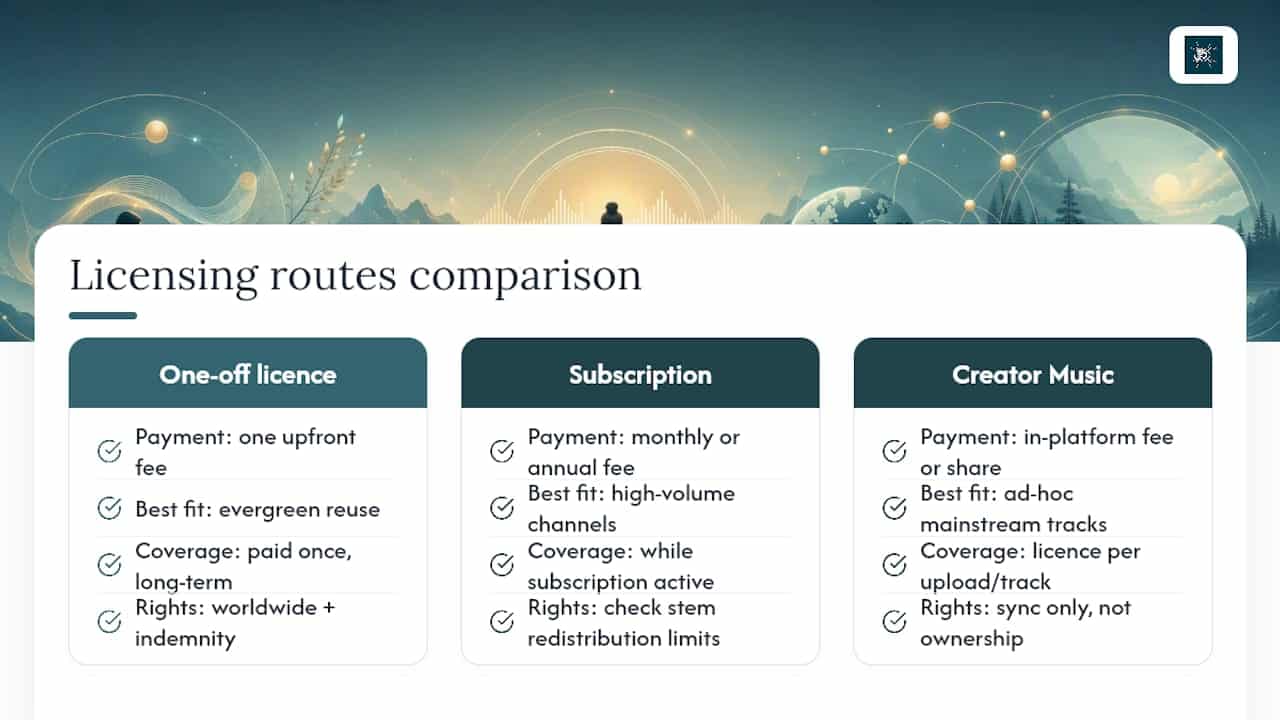
Route A: one-off sync and master licence. This suits evergreen content, courses, or a signature meditation you’ll reuse across a channel for years. Pay once, and look for language covering worldwide use, commercial and monetised distribution, YouTube specifically, and some form of indemnity protection if the seller’s claim to the rights turns out to be wrong.
Route B: subscription or royalty-free library. Monthly or annual membership gives you a large catalogue for a flat fee, which suits high-volume channels. The trade-off is licence lapsing: if you cancel the subscription, older uploads may no longer be covered, depending on the library’s specific terms. Some libraries also restrict whether you can download and redistribute stems, so check before you build a series around one.
Route C: Creator Music or direct licensor negotiation. Creator Music lets you licence mainstream tracks directly inside YouTube’s own upload flow, sometimes with revenue-sharing instead of a flat fee. It’s a genuine convenience, but availability varies track by track, and a licence here is permission to sync, not a transfer of ownership.
Whichever route you choose, understand what a real licence document looks like: it names the composition, the specific recording, the territory, the permitted platforms, and the duration. Serious music libraries also register their masters directly in Content ID, meaning your use of their track is pre-recognised rather than flagged as a mismatch, which cuts out a lot of the guesswork on claims.
A professional option: studio recordings with documented licences
Orchestral Meditations records its catalogue at Abbey Road Studios with the National Philharmonic, using 3D surround sound and binaural techniques built specifically for meditative listening rather than adapted from generic background-music templates. The tracks are composed and produced with input from Robert Emery, a British conductor and producer known for large-scale orchestral projects and for bringing classical production standards into wellness and mindfulness recording work, alongside composer Moritz Schneider.
That production pedigree matters for a practical reason beyond sound quality. When a track is recorded and licensed by a named studio operation rather than pulled from an anonymous “free download” site, the paperwork trail exists from day one.
- Licences are documented with clear terms covering personal and professional use, including YouTube and monetised video.
- Masters recorded and licensed this way can be registered against Content ID, which reduces the odds of a false claim surfacing later.
- Licence certificates give you something concrete to attach if a claim ever needs disputing.
Pro Tip: Keep your licence certificate and purchase confirmation in the same cloud folder as your video project file. If YouTube ever asks for proof of rights, you want it attached to the dispute in under a minute, not searched for in an inbox from eight months ago.
Step‑by‑step: what to do if your video is claimed
Getting a claim notification isn’t a crisis, but how you respond in the first hour shapes how quickly it resolves.
- Open YouTube Studio’s Copyright tab and read exactly who claimed it and which policy applies. Monetise, track, and block each call for a different response.
- If it’s a genuine mismatch or you hold rights, gather your licence document, purchase receipt, or composer agreement before filing a dispute. Disputing without real evidence risks the claim being reinstated and can, in repeated cases, escalate towards a strike.
- If you don’t hold the rights, consider the fast fixes YouTube itself offers: mute the claimed segment, replace it with a different track, or swap in something from the YouTube Audio Library, which is free of Content ID matches by design.
- If the claim seems wrong or overly broad, contact the rights holder directly and ask for a retraction in writing, or negotiate a licence there and then if the track genuinely suits your channel long-term.
Pro Tip: Never dispute a claim just because it’s inconvenient. A dispute is a legal statement that you have the right to use the material. Only file one when you can actually back it up.
Common mistakes creators make (and the quick fixes)
Most copyright trouble on meditation channels traces back to a handful of repeated habits.
- Assuming a credit or “no copyright” caption counts as permission. It doesn’t. Fix: get an actual written licence before uploading.
- Downloading tracks labelled “free” without reading the licence. Free often means free for personal use only, not commercial or monetised. Fix: check the licence’s exact scope and territory every time.
- Ripping the audio from someone else’s YouTube upload. That’s someone else’s licensed master, not an original source. Fix: go back to the original licensor or use your own cleared recording.
- Assuming a subscription library licence covers downloads or redistribution. Many don’t. Fix: confirm export and offline-use rights before you build a series around one track.
International copyright considerations for meditation creators
Copyright law isn’t uniform worldwide, and a track cleared under one country’s rules can still trigger enforcement elsewhere, because YouTube applies Content ID globally regardless of where you or your viewer are based. A claim policy can also be set to block a video only in specific territories rather than everywhere at once, which is why a track that streams fine for viewers in one country can vanish for viewers in another.
This matters particularly for meditation and wellness content, which tends to attract a genuinely international audience searching for sleep, anxiety, or relaxation help at all hours. If your licence agreement only names a specific territory rather than “worldwide,” you may be technically compliant in one market and exposed in another, without ever realising it until a regional block appears.
Always confirm a licence states worldwide coverage explicitly, rather than assuming a licence bought from a domestic seller travels everywhere your audience does. This is also where working with a single, well-documented source for your entire back catalogue pays off. Chasing separate regional permissions for dozens of individual tracks across different countries multiplies the paperwork and the risk of a gap nobody noticed.
A composer’s perspective on licensing and channel health
Cheap or uncleared music always looks like the sensible choice until the claim arrives on your best-performing upload, the one your monetisation actually depends on. The maths rarely works out: the hours lost disputing a claim, or the ad revenue redirected to a rights holder, usually cost more than a proper licence would have.
Studio-quality, properly licensed music, supported by clinical vibroacoustic therapy benefits, does something else too. It removes a recurring administrative headache from your workflow and it simply sounds better, which matters more on a meditation channel than almost anywhere else on YouTube. Viewers stay, or they don’t, based on whether the sound holds them.
— ROBERT
Where to get cleared meditation music
Orchestral Meditations exists precisely for the moment you decide chasing free downloads and dispute forms isn’t worth your channel’s growth. The shop sells studio recordings, captured at Abbey Road with the National Philharmonic, each sold with a documented licence covering personal and professional use, including YouTube and monetised video.
That means no guessing at licence wording, no wondering whether the master is cleared alongside the composition, and a licence certificate you can produce instantly if a claim ever needs disputing. For creators building a long-term meditation channel, using the same trusted source across your whole back catalogue also solves the international coverage problem: one worldwide licence, one paper trail, every upload. Browse the Orchestral Meditations shop for sample downloads and licensing options before your next upload goes live.
This article is general information, not a substitute for advice from a qualified lawyer. Consult a qualified legal professional about your own circumstances before acting on anything here.
Sources
- YouTube Help — Copyright basics
- Creative Commons — About the licenses
- How to properly licence music for meditation/relaxation apps — TunePocket
FAQ
Is it legal to use copyrighted music in YouTube videos?
Only with the rights holder’s permission or a valid licence covering YouTube and monetised use; uploading copyrighted music without one risks a Content ID claim or a copyright strike.
Is there any royalty-free meditation music available?
Yes, through libraries, Creative Commons tracks cleared for commercial use, and studio catalogues such as Orchestral Meditations, which sells sync and master licences specifically for creator and commercial use.
Is music on YouTube free from copyright?
No. All music carries copyright unless the composer or rights holder has explicitly released it into the public domain, and even tracks labelled “royalty-free” or “no copyright” remain protected works with their own licence terms.
What music can I use on YouTube without getting copyrighted?
Music you’ve composed yourself, tracks with an explicit sync and master licence naming YouTube and monetisation, eligible Creator Music tracks, or Creative Commons tracks confirmed for commercial reuse on both composition and recording.