The most effective breathwork session music is sequenced to match the arc of your breathing, not just picked for mood. Choose tracks tagged for warm-up, peak, and integration, favour high-fidelity recordings, and check the licence before playing to a group. Orchestral Meditations, whose catalogue features composer and producer Robert Emery, is a strong source for this kind of phase-built, orchestral sound.
TL;DR:
- Phase tagging ensures music fits the emotional and energetic needs of warm-up, breakthrough, and integration stages, regardless of genre.
- Sequencing should start with slow, spacious sounds, build with layered orchestral swells during the breakthrough, and return to simple motifs for cooling down.
- Crossfades of three to five seconds during peak moments prevent jolts, while manual volume control helps manage participant comfort.
- Lossless audio formats and high-quality playback equipment are crucial for preserving the depth and spatial qualities of orchestral breathwork music.
- Licensed offerings from Orchestral Meditations feature recordings made at Abbey Road with the National Philharmonic, suitable for both personal and group sessions.
Which types of breathwork music matter for each session phase?
Walk into most breathwork catalogues and you’ll notice something odd: tracks aren’t sorted by genre. They’re sorted by function. That’s deliberate, and once you understand why, choosing music stops being guesswork.
Serious catalogues tag tracks by energy, mood, instrument, and “breakthrough” intensity, alongside grounding pieces built for the wind-down. This system exists because a session isn’t a static listening experience. It moves. Your breath moves. The music needs to move with it.
Phase tagging (first hour, breakthrough, close) does the heavy lifting when you’re assembling a playlist under time pressure. Rather than auditioning fifty ambient tracks hoping something fits, you filter by phase and narrow the field to pieces built for that exact emotional register. One resource lists over 1,600 hand-curated tracks organised this way, which tells you how granular the tagging can get in professional-grade libraries.
When you’re picking individual tracks, three filters matter more than genre:
- Tag — does it say warm-up, breakthrough, or integration?
- Tempo — a peak-phase track rarely works below 100 BPM; a grounding track rarely works above 70.
- Dynamic range — orchestral swells suit breakthrough moments; flatter, sustained tones suit integration.
Get those three right and the genre label barely matters. A Solfeggio-tuned piano piece and an orchestral string arrangement can both work at the same phase if the tempo and dynamics align.
How do you sequence music across warm-up, peak, and integration?
Sequencing is where most home-built playlists fall apart. People pick beautiful tracks, then string them together in an order that fights the breath instead of supporting it.
Here’s a structure that works for most sessions:
- Warm-up (first 5 to 10 minutes) — slow, spacious, minimal percussion. Think sustained pads or solo strings. The goal is settling the nervous system, not stimulating it.
- Peak or breakthrough (the longest segment, often 20 to 40 minutes) — build in layers. Orchestral swells, rising dynamics, occasional silence. This is where emotional release tends to happen, and the music should have room to breathe alongside the participant.
- Integration (final 10 to 15 minutes) — strip it back. Return to a simpler texture, ideally echoing a motif from earlier in the set, so the ear recognises “we’re coming home.”
Crossfades matter more than most people expect. A hard cut between tracks during peak intensity can jolt someone out of a deep state entirely. Aim for 3 to 5 second crossfades during peak, and don’t be afraid of a few seconds of near-silence going into integration.
Pro Tip: Keep one hand near the volume control during the peak phase. If someone’s breathing becomes ragged or distressed rather than intensely engaged, easing the volume down gradually is often more effective than stopping the track outright.
A quick safety note: breathwork isn’t universally appropriate. People with cardiovascular conditions, epilepsy, pregnancy, or a history of psychosis should check with a doctor first, and facilitators should always have a way to slow or pause the session if someone becomes overwhelmed.
What do sample breathwork playlists look like by session length?
Templates save time, and they also stop you from accidentally building a set that peaks too early or drags on too long. Here’s how the arc typically scales.
Short sessions (20 to 30 minutes): three or four tracks total. Roughly 5 minutes warm-up, 15 minutes peak, 5 minutes integration. No room for a slow build, so start with something already moderately spacious.
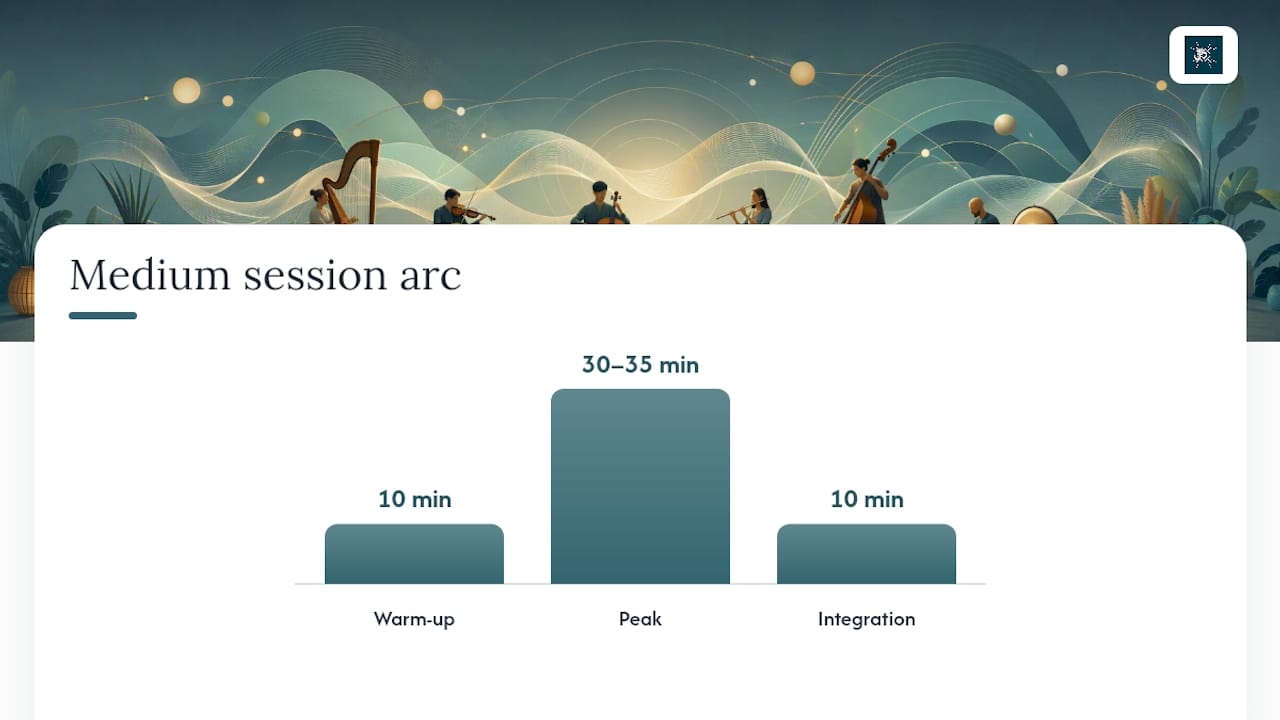
Medium sessions (45 to 60 minutes): this is the most common format, and it’s where a proper arc shows itself. Around 10 minutes warm-up, 30 to 35 minutes peak with two or three dynamic layers, then 10 minutes integration. Public playlists give a decent sense of pacing here. Apple Music’s Breathwork playlist runs 100 songs across five and a half hours, which breaks down into plenty of usable medium-length blocks.
Long sessions (90 minutes or more): used mainly in group holotropic-style work. These need at least two internal builds rather than one long climb, otherwise energy flatlines around the 45-minute mark. Facilitators often mirror the structure of a live workshop, with a secondary micro-peak roughly two-thirds through.
If you’re adapting purchased tracks rather than following a pre-built album, automate the volume rather than relying on a track’s built-in mix. A few seconds of manual fade at the start and end of each track prevents jarring transitions.
- Personal, private practice: most individual licences cover this without extra paperwork.
- Group classes or paid facilitation: check whether the licence explicitly covers commercial or public playback, since personal licences frequently exclude it.
How do you get high-fidelity playback for breathwork immersion?
Compressed streaming audio flattens exactly the low-frequency depth and spatial detail that makes orchestral breathwork music work. If your setup allows it, lossless formats (FLAC, ALAC, or high-bitrate WAV) preserve the sub-bass and reverb tails that a heavily compressed MP3 simply discards.
- Headphones vs speakers: headphones (especially open-back or studio-grade) give more precise stereo and binaural placement; speakers suit group settings but need a room with minimal echo.
- Loudness: keep peak volume comfortable, not painful. Sustained low-frequency tones at high volume can be physically overwhelming during an already intense breath phase.
- Binaural or 3D mixes: excellent for solo, headphone-based sessions where full immersion is the goal, but facilitators running group work should test them carefully first, since not everyone responds the same way to strong spatial effects.
Should you use an integrated breathwork album or build your own playlist?
An integrated album is composed as one continuous piece, with breath cues, dynamic shifts, and sometimes spoken guidance built directly into the composition rather than assembled afterwards. The upside is cohesion: the composer has already solved the sequencing problem for you, and transitions feel intentional rather than stitched together.
The trade-off is control. You can’t easily shorten a 60-minute integrated album to 30 minutes without losing its internal arc, and you can’t swap out a track that doesn’t suit a particular group.
Facilitators running varied session lengths for different groups often prefer building custom playlists for that flexibility. Solo practitioners doing a consistent personal practice tend to get more out of an integrated album’s finished, no-decisions-needed structure.
The orchestral difference in breathwork facilitation
Live orchestral recording adds something a synthesised pad can’t fully replicate: the natural swell and decay of real instruments responding to a room. That texture matters more than people expect during a breakthrough phase, where the music needs to hold emotional weight without dictating it.
Composer credits matter too. Knowing a track comes from Robert Emery, whose orchestral work spans film scoring and large-scale live performance, gives facilitators a production pedigree to trust rather than an anonymous stock file. Orchestral Meditations records at Abbey Road Studios with the National Philharmonic, and that combination of named composer and recording standard is rare in a category often dominated by generic ambient loops.
— ROBERT
Where to find phase-tagged orchestral tracks and licensing
If you’ve read this far, you already know the two things that separate a forgettable breathwork set from one that actually holds a room: phase-appropriate sequencing and recording quality that doesn’t thin out under a subwoofer. Orchestral Meditations builds its catalogue around exactly that combination.
The library includes single tracks, full albums, and a subscription option, alongside binaural and 3D mixes for facilitators who want a more immersive, headphone-friendly layer. Every recording comes from sessions with live orchestral musicians at Abbey Road Studios with the National Philharmonic, produced with composers including Robert Emery and Moritz Schneider, so the production pedigree is documented rather than assumed.
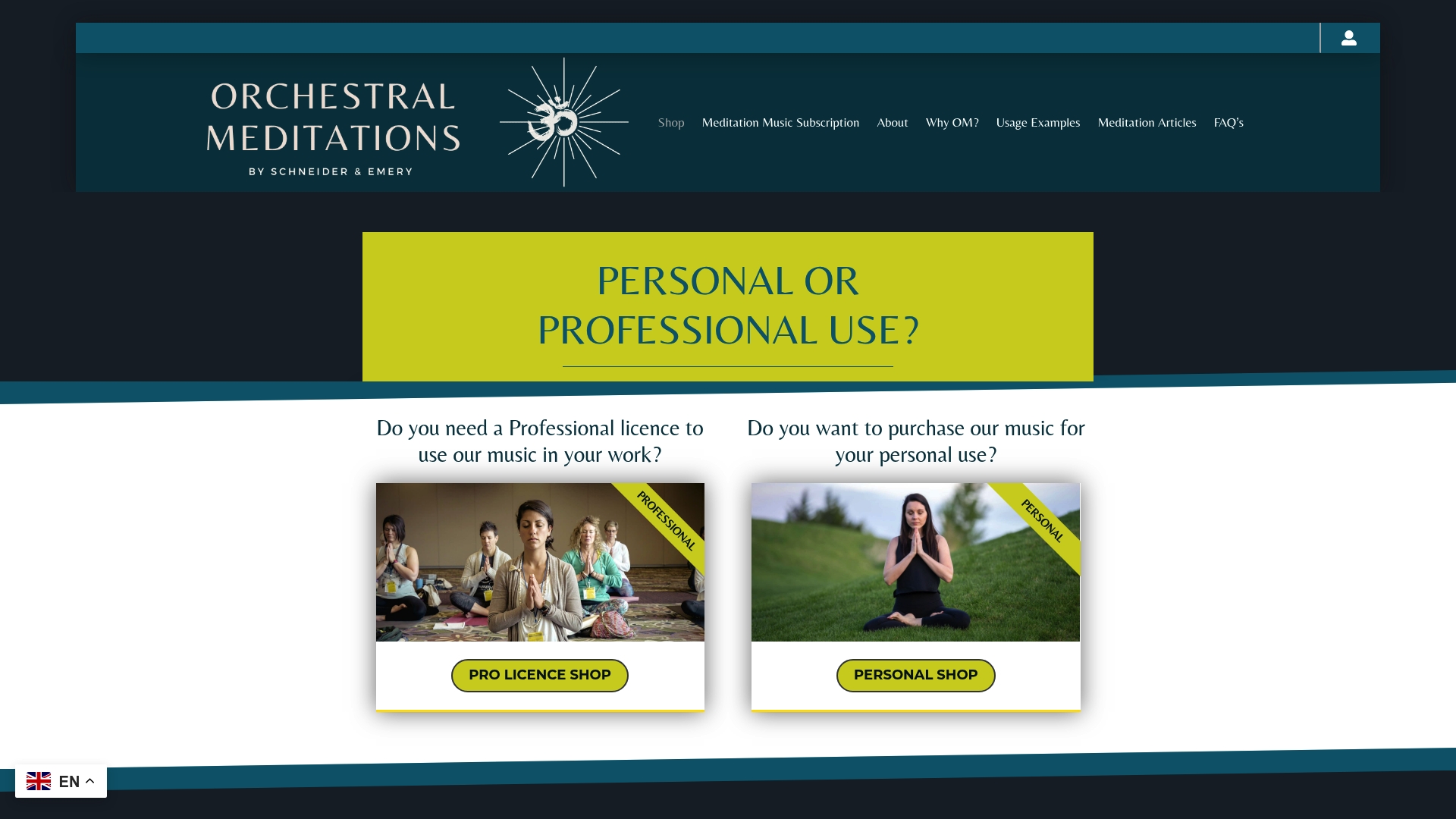
Licensing is split clearly: personal-use tracks suit solo practice, while professional licences cover group classes, therapy sessions, yoga studios, apps, and other commercial or public-facing work. If you’re building a set for paying clients, confirm you’re on the professional tier before you press play. Preview samples and compare licensing tiers on the shop landing page, and read more on the science behind the sound in this piece on mindfulness-supportive orchestral audio.
Further resources for breathwork music and facilitation
For deeper catalogue browsing, Music for Breathwork offers 1,624 tagged tracks with playlist export tools. The Holotropic Association covers facilitator safety guidance, and our guide on guided meditation techniques expands on integrated audio formats. For breathing technique fundamentals, Coherent Breathing: A Practical Guide to Calm is worth a read.
Sources
- Holotropic Breathwork Music Resource | Discover & Stream Online
- Music for Holotropic Breathwork — Curated Playlists for Facilitators | Music for Breathwork
- Breathwork – Playlist – Apple Music
- Holotropic Association North America
FAQ
Why does breathwork release trauma?
Extended, intensified breathing patterns can shift brain chemistry and reduce the usual cognitive filtering, allowing suppressed emotional material to surface more readily. Music that mirrors this rising and falling intensity helps contain that process rather than intensifying it unpredictably.
What do you do in a breathwork session?
A typical session moves through warm-up, an intensive breathing phase often called the peak or breakthrough, and a closing integration period, usually with music sequenced to match each stage. Sessions can be guided by a facilitator or done solo with a pre-built playlist or integrated album.
When should you not do breathwork?
Breathwork isn’t recommended for people with cardiovascular conditions, epilepsy, severe asthma, pregnancy, or a history of psychosis, and anyone with health concerns should check with a doctor first. Facilitators should also screen participants and keep intensity adjustable throughout.
What kind of music can calm the parasympathetic nervous system?
Slow-tempo, low-dynamic music with sustained tones, minimal percussion, and gentle orchestral textures tends to support parasympathetic activation during integration phases. Orchestral Meditations’ grounding-tagged tracks, recorded with live musicians for natural tonal decay, are built specifically for this closing stage.