The right length depends on the job the music is doing: a short session for a quick reset or first attempt at meditating, a moderate duration for daily sitting practice, and a longer period for deep work or sleep. The governing rule never changes: your music should run as long as your session, plus a fade, never shorter. A track that stops dead mid breath yanks you straight out of stillness. Orchestral Meditations builds long-form recordings for exactly this reason, and composer and producer Robert Emery has spoken about scoring for stillness rather than for climax, which is precisely what long, unhurried meditation music demands.
TL;DR:
- Tracks should run as long as the session duration plus a fade, avoiding abrupt stops that break stillness, especially for meditation or sleep music.
- Short sessions of five to ten minutes are suitable for beginners, while 15 to 30 minutes supports daily practice and mood regulation.
- Longer sessions of 30 minutes or more are ideal for deep entrainment, sound baths, or extended stillness, using either one long file or well-sequenced playlists with smooth transitions.
- Creating seamless long tracks involves techniques like crossfading, loop-point creation, and layering in a digital audio workstation to avoid audible seams.
- Use slower tempos around 60 to 80 BPM, keep volume comfortable, and employ binaural beats with headphones for maximum relaxation benefits.
Meditation music length: matching duration to your goal
Most confusion about session length disappears once you separate what you are trying to achieve from how much time you have. The numbers below are not arbitrary. They come from how attention, breath, and brainwave activity behave over time.
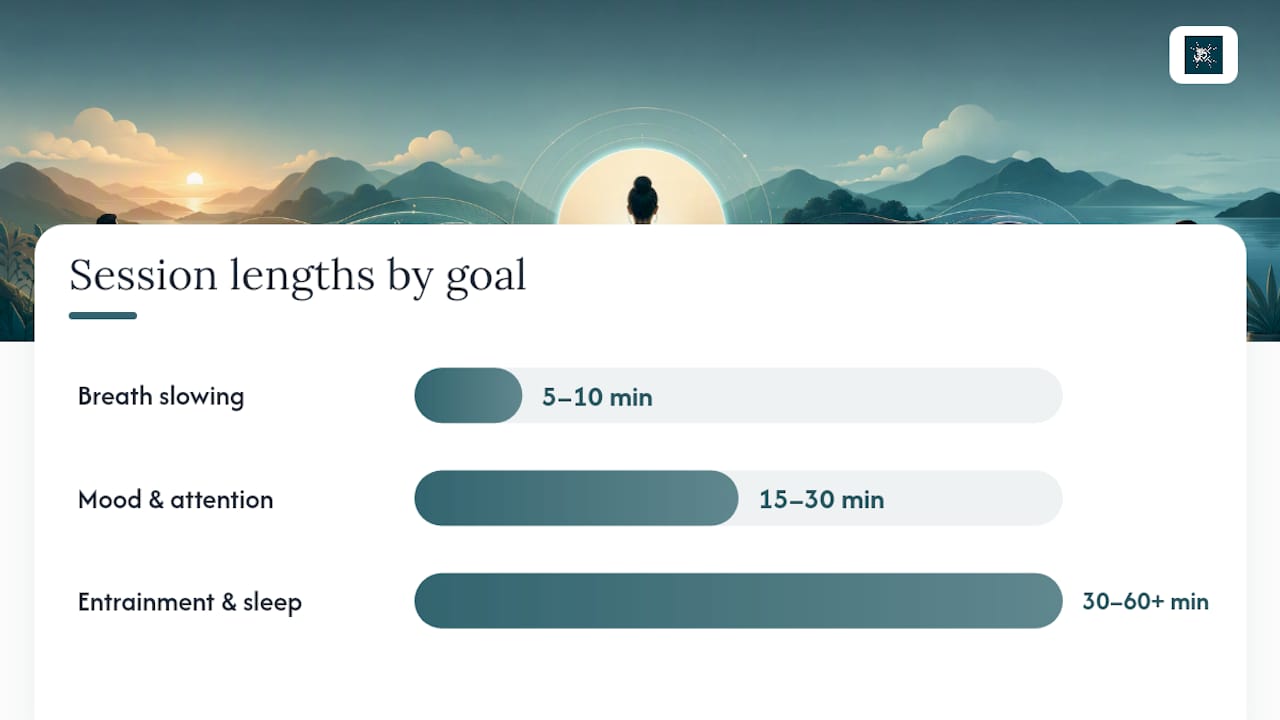
Five to ten minutes suits beginners and anyone squeezing meditation between meetings. It is long enough to slow the breath and short enough that it never feels like a chore. Verywell Mind treats this as a sensible entry point, noting that even short music meditation sessions carry real benefit, which matters if you have ever abandoned meditation because 30 minutes felt unreachable on day one.
Fifteen to thirty minutes is the workhorse range for daily practice. It gives the nervous system enough time to settle past the initial fidgetiness, and Verywell Mind puts 20 minutes forward as a practical minimum once meditation becomes a habit rather than a novelty. This is also the band where mood regulation research tends to focus, since it is long enough to shift state without demanding a spare hour.
Thirty to sixty minutes, or longer, is where deeper entrainment work happens. Curated guidance from Mesmerize sets 30 minutes as roughly the threshold for measurable brainwave entrainment effects, and anything beyond that suits sleep preparation, sound baths, or extended stillness practice.
For quick, single-purpose sittings, one continuous track beats a playlist. Once you are past 30 minutes, a well-sequenced playlist or one long-form recording both work, though the seams between tracks need care, which is the next problem worth solving.
Should you use one long file or a playlist?
A single continuous file has one obvious advantage: nothing interrupts you. No gap of silence, no jarring key change, no phone notification sneaking in during a track transition. The downside is practical rather than musical. Long files are large, awkward to update, and inflexible if you want to reorder sections for a different class length.
Playlists solve the flexibility problem but introduce risk. Get the sequencing wrong and you will hear it the moment attention drifts. Follow this order when assembling one:
- Sequence by energy, not alphabet. Start dense, end sparse, so the arc mirrors how a body actually relaxes.
- Match tempo and density between neighbouring tracks. A brisk piece next to a near-silent drone creates a jolt every time.
- Add a soft transition between tracks, ideally a two to three second crossfade or a shared reverb tail, so nothing cuts abruptly.
- Test the whole playlist with eyes closed. Jarring changes are far more obvious without visual distraction, and a quick fade or low-pass filter usually fixes the worst offenders.
- Check your licence before public or commercial use. A licence covering a five-minute personal clip does not automatically cover a 90-minute public class playlist.
How to extend shorter tracks into seamless long meditation music
This is the part most guides skip, and it is where creators lose the most time. You do not need a two-hour recording session to produce a two-hour meditation track. You need a handful of editing techniques used correctly.
Crossfading is the simplest starting point. For ambient pads and drones, a four to eight second overlap usually disguises the join. Shorter crossfades on textured, evolving sound tend to leave an audible seam; longer ones risk muddying the harmony if two chords clash mid fade. Listen in mono while you work, since phase cancellation between overlapping layers often only reveals itself once the stereo image collapses.
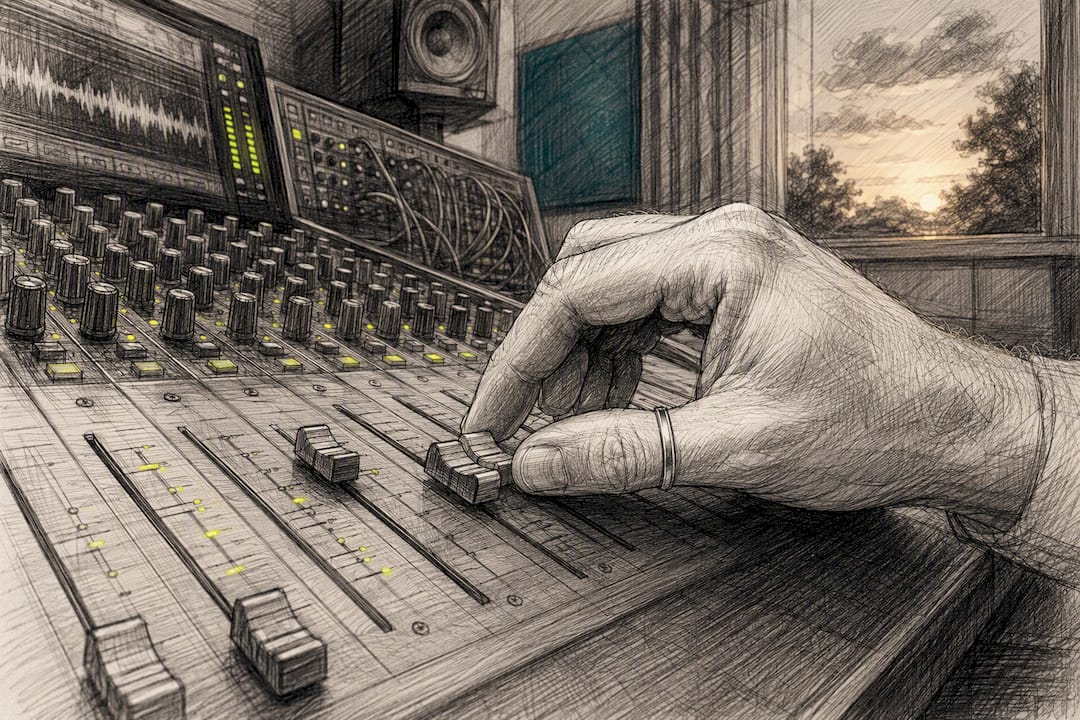
Loop-point creation takes more care but scales better. Pick a section with no obvious attack transient, a bowed string swell rather than a plucked note, and trim so the waveform’s start and end sit at a similar amplitude and noise floor. Reverse-reverb crossfades work particularly well on orchestral textures: blending a mirrored tail of reverb into the loop point smooths over what would otherwise be an audible click.
Layering in a DAW is the professional route. Duplicate an ambient lane, offset it slightly, and let quiet reverb tails overlap the seams so no single edit point is ever exposed. TunePocket’s documented approach uses exactly this layered duplication method to stretch short clips into 30 to 60 minute soundtracks, and the same principle scales to hours if your loop points are genuinely clean.
A rough workflow, whether you are in Audacity, a video editor, or a full DAW:
- Identify a loopable section with stable dynamics and no percussive spike.
- Trim the transient attack from the loop’s start.
- Crossfade the tail into the head, checking in mono for phase issues.
- Duplicate and offset a second ambient layer to mask any remaining seam.
- Export the full loop, then repeat it to reach your target length.
Pro Tip: Always render a test export at half your target length first. Seams that are inaudible in a two-minute preview sometimes become obvious once repeated ten times over an hour, so catch it before the final render.
Tempo, volume, and binaural beats: getting the numbers right
Technical parameters sound dry until you realise they are the difference between music that supports meditation and music that quietly works against it.
Tempo guidance from clinical and curated sources tends to sit around 60 to 80 BPM, roughly matching a resting heart rate, which Mesmerize’s guidance on entrainment links to physiological calm. Many ambient meditation pieces deliberately avoid a clear pulse altogether, since a strong beat can pull attention toward rhythm instead of breath. Both approaches are valid; the choice depends on whether you want the music felt or barely noticed.
Volume should stay comfortable throughout, closer to a quiet conversation than a concert. Mesmerize’s guidance points toward keeping average listening levels gentle rather than pushing dynamic peaks, which matters most during long sessions where sudden swells can startle rather than soothe.
Binaural beats only function correctly through headphones, since each ear needs to receive a slightly different frequency for the brain to perceive the beat. Apple’s own technical notes on stereo playback confirm why this separation depends entirely on two independent audio channels reaching two separate ears. Theta (roughly 4 to 8 Hz) and delta (under 4 Hz) ranges are the ones most associated with deep relaxation and sleep, though comfort varies between listeners, so start with shorter exposure if you are new to binaural audio.
For export:
- Master in WAV, not a compressed format, especially for long fades where compression artefacts become audible.
- Use at least a 44.1kHz sample rate and 24-bit depth for anything destined for further editing.
- Reserve MP3 export for the final distributed file, once all editing is finished.
From selection to export: a creator’s workflow
Before opening any editor, settle three things: the session’s purpose, its target duration, and roughly how long your fade needs to be. That single decision shapes everything downstream.
- Choose your loop source and confirm it has no transient spikes at the start or end.
- Set loop points, crossfade the seam, and check the result in mono.
- Normalise levels so nothing peaks unexpectedly across the full length.
- Export as WAV, then convert to your distribution format last.
- Confirm your licence covers the intended use, whether that is a personal playlist, a public class, or an app integration.
This is where Orchestral Meditations’ catalogue earns its keep. Long-form recordings captured at Abbey Road Studios with the National Philharmonic, mixed in 3D surround, arrive already built for extended listening, which removes several editing steps entirely for creators who need licensed, ready-to-use length.
Why orchestral meditations favour long, unhurried forms
Composer Moritz Schneider’s approach to scoring for meditation leans on slow harmonic movement and extended fades rather than musical climaxes, because a listener 40 minutes into a session should never feel a piece “arriving” somewhere. Recording live musicians in 3D surround at Abbey Road adds a spatial depth that a single stereo synth pad cannot replicate, and that depth changes how duration is perceived: a well-recorded orchestral swell can make 45 minutes feel shorter than a repetitive loop half that length. Try listening to a full-length track timed against your usual session and notice how the ending arrives without you noticing the join.
— ROBERT
Where to find long-form, licensable meditation tracks
There is no shortage of short meditation clips online, and plenty of DIY looping tools if you fancy building your own hour-long track from scratch. But if your time is better spent teaching, practising, or building your own content rather than fighting phase cancellation in an editor, Orchestral Meditations’ shop offers something most royalty-free libraries do not: long-form orchestral recordings built for extended sessions from the first take, not stitched together afterwards.
The catalogue includes tracks running well past 30 minutes, alongside personal and professional licensing options covering therapy sessions, yoga classes, apps, and guided audio releases. Preview a track against your intended session length, check that the licence matches your use case (personal listening versus public or commercial distribution), and download. Browse the full Orchestral Meditations shop to find a length and licence that fits your next session.
Sources
For deeper detail, Verywell Mind covers practical music meditation timing, Mesmerize breaks down tempo and entrainment guidance, and TunePocket documents step-by-step crossfade and loop workflows. Orchestral Meditations also explores the science behind sound and mindfulness in more depth.
- How to practice music meditation | Verywell Mind
- How To Make Long Meditation Music From Shorter Clips | TunePocket
FAQ
Is 20 minutes of meditation too much?
No. Verywell Mind cites 20 minutes as a practical minimum for meaningful music meditation benefits, and many daily practitioners sit comfortably within the 15 to 30 minute range without issue.
Does meditation music actually work?
Curated and clinical guidance links slower tempos, sustained drones, and comfortable volume levels to measurable relaxation effects, particularly in sessions of 30 minutes or longer where entrainment has time to take hold.
How long should a meditation session last?
It depends on your goal: five to ten minutes for a quick reset or as a beginner, 15 to 30 minutes for regular daily practice, and 30 to 60 minutes or more for deep relaxation or sleep preparation.
What is the best meditation music length for beginners?
Five to ten minutes is the easiest starting point, long enough to notice a shift in breathing without feeling like an obligation, before building toward the 20 minute mark as practice becomes routine.
Can I loop shorter meditation tracks to make the m longer?
Yes. Crossfading loop points and layering duplicated ambient tracks, as documented in TunePocket’s editing guide, reliably extends shorter clips into seamless 30 to 60 minute recordings without an audible join.