If you want binaural beats for focus in the meditative sense, the research points to one clear starting place: a theta-frequency track, around 6 Hz, layered into an orchestral or pink-noise bed, played through proper stereo headphones for a short, deliberate session. That’s it. That’s the recommendation.
The evidence behind it isn’t vague wellness talk either. A PLOS One study found that brief, self-administered 6 Hz exposures using a 250 Hz carrier tone produced measurable increases in both calmness and focus, and listeners preferred the beats when they were embedded in pink noise rather than played as isolated tones. That last detail matters more than it sounds. It’s the entire argument for why orchestral production changes the experience.
Here’s how to put that into practice today:
- Put on proper stereo headphones. Binaural beats simply don’t work through speakers.
- Pick a track built around a theta frequency (roughly 4 to 8 Hz), not a random “focus” playlist.
- Start with a short session. You’re testing a response, not running a marathon.
- Sit somewhere you won’t be interrupted, and treat the session as a deliberate act, not background noise.
- Repeat it at the same time of day for a week before judging whether it’s doing anything for you.
Key Takeaways
Theta-frequency binaural beats around 6 Hz, delivered through stereo headphones inside a well-produced orchestral or pink-noise bed, offer the most evidence-backed route to meditative focus and calm.
| Point | Details |
|---|---|
| Use theta, not beta | Frequencies around 4 to 8 Hz suit meditative focus; beta (12 to 30 Hz) suits alert task concentration instead. |
| Headphones are essential | The binaural illusion only works with a genuine stereo signal reaching each ear separately. |
| Start short | Five-minute sessions match the protocol shown to increase calmness and focus in controlled research. |
| Treat the evidence honestly | Subjective calm improves reliably; brainwave entrainment itself remains scientifically mixed. |
| Choose production quality | Orchestral Meditations records theta-based binaural tracks with the National Philharmonic at Abbey Road, produced by Robert Emery, with personal and professional licensing available. |
What are binaural beats for focus and how do orchestral recordings change the effect?
A binaural beat is an auditory illusion, nothing more mysterious than that. Play a tone of, say, 250 Hz in your left ear and 256 Hz in your right ear, and your brain doesn’t hear two separate pitches. It perceives a third, phantom pulse equal to the difference between them, in this case 6 Hz. That pulse only exists inside your head. It’s a trick of neural processing, and it’s why headphones are non-negotiable: split the signal through a speaker and the illusion collapses.
The frequency of that phantom pulse is where things get interesting for meditators specifically. Researchers group brainwave activity into rough bands: delta (roughly 0.5 to 4 Hz, deep sleep), theta (4 to 8 Hz, meditative and hypnagogic states), alpha (8 to 12 Hz, relaxed alertness), beta (12 to 30 Hz, active thinking), and gamma (above 30 Hz, high-level cognitive binding). Theta sits at the sweet spot most associated with meditative depth and free-flowing creative thought, which is exactly why it’s the frequency the meditation research keeps returning to.
Here’s what a lot of people don’t realise: a bare binaural tone, on its own, is not pleasant. It’s a thin, warbling drone that most listeners find grating within minutes. This is precisely why carrier tones matter, and why embedding the beat inside pink noise or a full orchestral texture isn’t just a production flourish. It’s functional. A cello line, a soft string bed, or a wash of ambient pink noise gives your ear something rich to rest on while the underlying pulse does its work quietly in the background.
- Binaural beats require a genuine stereo signal, so wired or wireless stereo headphones are essential, not optional.
- Theta (4 to 8 Hz) is the band most linked to meditative and introspective states.
- A carrier tone (commonly around 250 Hz) sets the pitch the two ears diverge from.
- Orchestral or pink-noise embedding improves comfort and makes longer sessions realistic.
Pro Tip: If a binaural track sounds thin or nasal to you, that’s the raw tone talking. Look for a recording that wraps the beat in a proper musical bed. Your ears will thank you, and you’ll actually finish the session.
What the research actually shows about theta protocols and their limits
The strongest single data point for meditation-focused binaural work comes from the same PLOS One research already mentioned: short, five-minute, self-administered exposures at 6 Hz using a 250 Hz carrier reliably increased self-reported calmness and focus compared with other frequencies and controls. Participants also rated pink-noise-embedded versions as more pleasant than the bare tones, which is a small but telling detail. People don’t just respond to the frequency; they respond to how it’s delivered.
That said, honesty matters more than hype here. A systematic review published via PMC looked across the wider body of binaural beats research and found genuinely mixed results for EEG entrainment, the idea that brainwaves literally sync to the beat frequency. Methodological heterogeneity, different equipment, different session lengths, different measures, makes it hard to draw one clean conclusion. A related PMC review notes associations with reduced anxiety and improved sleep induction in some studies, while flagging that application-specific evidence is still thin.
Short theta exposures can shift subjective calmness and focus within minutes, but the underlying brainwave-entrainment mechanism remains scientifically contested rather than settled fact.
Cedars-Sinai’s clinical guidance adds a useful, grounded note for practitioners: sound therapy tends to work best as a supportive tool woven into an intentional, consistent routine, not as a standalone fix. That lines up with what most experienced meditation teachers already suspect. The track sets the stage. The consistency does the rest.
In short: brief theta sessions have a real, measured effect on subjective calm in controlled studies, but individual response varies, and no reputable review claims binaural beats reliably force brainwaves into lockstep.
How to run a binaural-orchestral session safely, step by step
Getting this right isn’t complicated, but a few details separate a session that works from one that just feels like background music.
- Set the environment. Choose a quiet room, dim the lights if that helps you settle, and commit to being undisturbed for the session length you’ve picked.
- Put on stereo headphones and set a comfortable volume. Loud enough to hear the layers clearly, quiet enough that it never feels harsh. There’s no benefit to cranking the volume; the effect isn’t dose-dependent on loudness.
- Choose your session length deliberately. A five-minute starter mirrors the PLOS One protocol closely. Fifteen to twenty minutes suits a standard daily practice. Twenty-five to thirty minutes works for deeper therapeutic or guided work, particularly in a studio or class setting.
- Check the carrier tone and embedding. Tracks built around a 250 Hz carrier with pink-noise or orchestral embedding tend to be more comfortable for longer listening, echoing what self-administered listening trials found about subjective preference.
- If you’re running a class or therapy session, brief participants first. Explain what they’re about to hear and why, since routine and intention shape outcomes as much as the audio itself. Our guide to science-backed sound and mindfulness covers how to build that kind of routine properly.
- Confirm your licence covers the setting. Personal listening and professional or commercial use (studios, apps, therapy rooms) typically require different licence tiers.
Never listen while driving or operating machinery, since the intended effect is a drop in alertness, exactly what you don’t want behind a wheel. People with epilepsy or significant auditory sensitivity should check with a doctor before trying binaural audio, and anyone should stop immediately if a session triggers discomfort, dizziness, or unease rather than calm.
Pro Tip: Keep a one-line log after each session, noting how alert or calm you felt on a scale of one to five. Three sessions in, patterns start showing up that you’d otherwise miss.
Why the recording itself matters: Abbey Road, live orchestra, and named composers
A binaural tone generated on a laptop and a binaural tone woven through a live orchestral recording are not the same listening experience, even when the underlying frequencies are identical. Live instruments carry natural harmonic complexity, dynamic swells, and spatial cues that a synthesised tone simply can’t replicate. That richness is what keeps a listener engaged through a twenty-minute session instead of reaching for the skip button at minute four.

Orchestral Meditations builds its catalogue around exactly this principle. Tracks are recorded with the National Philharmonic at Abbey Road Studios, the same rooms that have shaped recorded sound for the better part of a century, then finished with 3D mixing techniques designed to give binaural layers genuine spatial depth rather than a flat, mono-ish drone sitting underneath the music.
The composer and producer behind this catalogue is Robert Emery, whose work spans large-scale orchestral production and conducting, giving the recordings a level of musical integrity that a stock sound-library track rarely reaches. Having a named, credentialed creator behind the music matters for therapists and instructors who need to vouch for what they’re playing in a session, not just hope it sounds nice.
A few practical points worth knowing before you licence anything:
- Sample tracks in the actual room or setting you’ll use them in, since headphone quality and room acoustics both shift the experience.
- Personal licences and professional or commercial licences are priced and scoped differently, so check which one covers your studio, app, or class use.
- Royalty-free doesn’t mean unrestricted. Read the licence tier that matches your actual use case.
How binaural beats influence brainwave frequencies to enhance focus
The mechanism, as far as researchers understand it, works through a process called frequency-following response: your auditory system processes the two slightly different tones, and the difference between them, the “beat,” gets picked up by neural circuits involved in timing and rhythm perception. The theory holds that sustained exposure can nudge overall brainwave activity toward matching that beat frequency, a process loosely termed brainwave entrainment for focus.
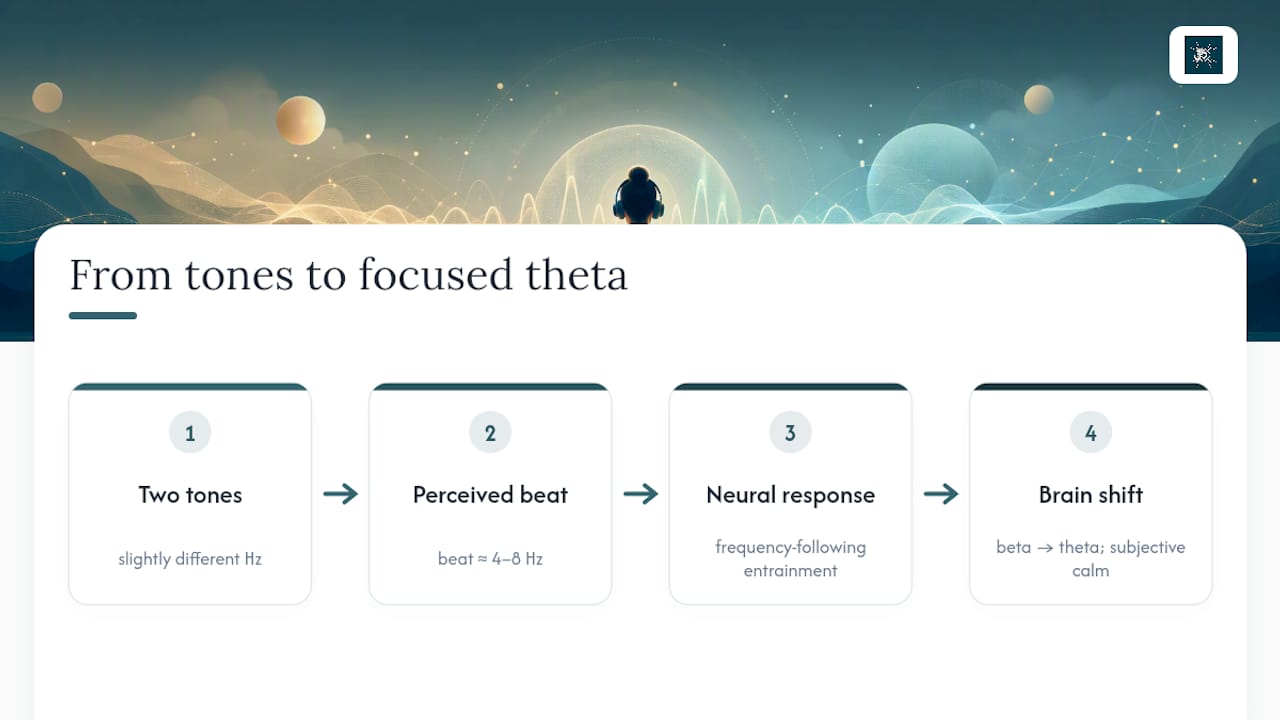
For meditative focus specifically, theta-range beats (around 4 to 8 Hz) are the target, since that band correlates with the drifting, internally-focused attention state meditators describe as “settling in.” This differs meaningfully from beta-range work (12 to 30 Hz), which is associated with alert, externally-directed concentration rather than the calm, receptive focus a meditation practice is built around.
It’s worth being precise about what the science actually supports here. The PMC systematic review found that EEG measurements across studies don’t consistently confirm that brainwaves synchronise cleanly to the beat frequency the way early enthusiasm suggested. What does show up more reliably is the subjective shift: people report feeling calmer and more focused after theta exposure, even where the underlying entrainment mechanism is harder to pin down on a scan. For a meditation practitioner, that subjective shift is often the whole point. You’re not trying to prove a hypothesis in a lab. You’re trying to settle your mind for twenty minutes.
Theta versus other binaural frequencies: which state fits which goal
Not every binaural frequency serves the same purpose, and this is where a lot of generic “focus music” gets it backwards for a meditation audience. Beta-range beats (roughly 12 to 30 Hz) are typically marketed for alertness and task-based concentration, the kind of focus useful for close, analytical work. That’s a genuinely different mental state from what most meditators are chasing.
Theta (4 to 8 Hz) is the frequency most consistently tied to meditative and introspective states, the calm, inward-facing attention that supports breathwork, guided visualisation, and mindfulness practice. Alpha (8 to 12 Hz) sits between the two, often used for relaxed, wakeful states that suit gentle unwinding rather than deep meditation or sharp task focus. Delta (0.5 to 4 Hz) points toward sleep induction, which explains why some binaural sleep tracks and meditation tracks share almost nothing in common beyond the general format.
| Frequency band | Range | Associated state |
|---|---|---|
| Theta | 4 to 8 Hz | Meditative depth, introspection, calm |
| Alpha | 8 to 12 Hz | Relaxed wakefulness |
| Beta | 12 to 30 Hz | Alert, task-based concentration |
| Delta | 0.5 to 4 Hz | Sleep onset |
For meditation and therapeutic practice, theta is the band worth building a routine around. If a track is marketed generically for “focus” without specifying a frequency, it’s worth checking whether it’s actually built for the alert, beta-driven kind of focus, which is a different tool for a different job entirely.
Tips for selecting quality binaural-orchestral recordings
Not every track calling itself a “binaural beats” recording is built with any rigour, and the gap between a well-produced session and a cheap stock file is often obvious within thirty seconds of listening.
- Check whether the frequency is actually specified. A reputable track will tell you it’s built around a theta range or a specific carrier tone, not just “relaxing frequencies.”
- Listen for embedding quality. A beat wrapped inside a genuine orchestral or pink-noise bed, as subjective preference research confirms, tends to hold attention far better than a raw tone with a thin pad underneath.
- Check the recording’s provenance. Live instrumentation recorded in a real studio carries dynamic range and warmth that synthesised orchestral samples rarely match.
- Look for named composer or producer credits. Anonymous stock-library tracks rarely carry the same level of accountability for how the audio is built.
- Confirm the licence terms before using a track professionally. Personal and commercial licences differ, and a therapist or instructor needs the correct tier.
- Always test a sample in your actual listening environment, whether that’s a therapy room, a studio, or your own headphones at home, before committing to a full session or class built around it.
An orchestral-first take on where the evidence actually leads
Here’s the uncomfortable truth about most binaural beats content online: it treats the frequency as if it’s the whole story, and it isn’t. The PLOS One data is genuinely encouraging for short theta protocols, but the same research quietly reveals that delivery, specifically pink-noise or musical embedding, shapes how people actually experience the session. Most advice online skips that part entirely and just tells you to download any 6 Hz file.
What gets overlooked even more is the entrainment question itself. The systematic review evidence is genuinely mixed on whether brainwaves synchronise the way early claims suggested, and pretending otherwise does practitioners a disservice. The honest position is that theta protocols reliably shift subjective calm and focus for many listeners, while the underlying mechanism remains an open scientific question.
What should you prioritise first? Production quality and consistency, not chasing the “perfect” frequency. A well-recorded orchestral theta track, played at the same time each day, will likely serve a meditation practice better than an unlabelled tone file used once and abandoned. Routine, as Cedars-Sinai’s own guidance notes, does more work than most people credit.
— ROBERT
Where to find binaural-orchestral tracks built for professional use
If everything above has you wanting to actually try a proper theta session rather than hunting through anonymous free downloads, Orchestral Meditations is built precisely for that gap. The catalogue is recorded with the National Philharmonic at Abbey Road Studios, produced by Robert Emery, and mixed using 3D techniques designed to give binaural layers real spatial presence rather than a flat drone sitting under the music.
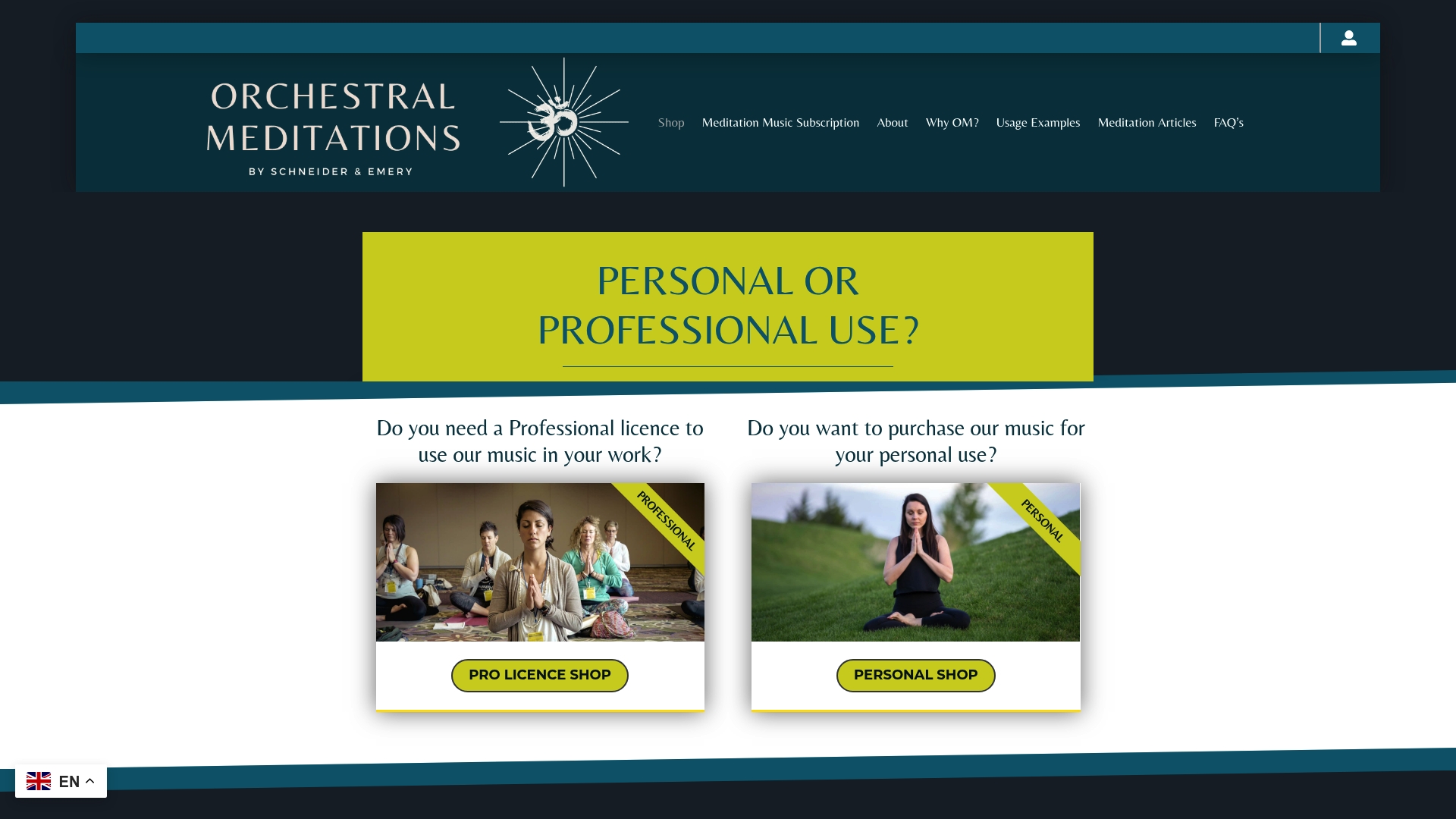
Tracks are available as one-time purchases or through a subscription, with separate personal and professional licensing tiers, so therapists, yoga instructors, and app developers can licence music correctly for classes, guided sessions, or commercial products without a grey area around usage rights. If you’ve been meditating with generic stock audio, sampling a proper theta-based orchestral track is a genuinely different listening experience, and it’s worth hearing the difference before your next session. Browse the Orchestral Meditations shop to sample tracks and find the licence that fits your practice.
Sources
- Effects of self-administered binaural beats on meditative and introspective states | PLOS One
- A systematic review of binaural beats and brainwave entrainment (PMC)
- Sound therapy and binaural beats: do they work? | Cedars-Sinai
FAQ
What are binaural beats for focus in a meditation context?
They’re binaural-beat tracks, typically theta-frequency around 6 Hz, layered into orchestral or pink-noise beds and used to support calm, meditative focus rather than alert task concentration.
How long should a binaural-orchestral session last?
Start with a short session matching the protocol shown effective in self-administered studies, then build toward a longer session for a standard daily practice.
Do binaural beats actually change your brainwaves?
Evidence for genuine EEG entrainment is mixed across studies, according to a systematic review, though subjective calm and focus improvements are more consistently reported.
Is it safe to use binaural beats every day?
For most people, yes, provided sessions happen in a safe, seated setting away from driving or machinery; anyone with epilepsy or significant auditory sensitivity should check with a doctor first.
Why record binaural tracks with a live orchestra instead of synthesised tones?
Live orchestral recording adds natural harmonic richness and dynamic range that reduce listening fatigue, which is why Orchestral Meditations records with the National Philharmonic at Abbey Road under producer Robert Emery.