If you are pairing meditation music with your own voice, or building an app where guided sessions sit on top of a soundtrack, you need a commercial sync and master licence — one that names sync (pairing the recording with voice or video) and master (use of the actual recording) together. If your app streams music on demand as the product itself, that single-track licence will not cover you; you need a streaming licence or a custom enterprise agreement.
Before you publish anything, run this checklist:
- Request a written licence certificate naming your exact permitted uses
- Confirm whether the licence covers sync use, streaming use, or both
- Check the territory and duration (worldwide and lifetime, or something narrower)
- Ask how the vendor handles Content ID and YouTube monetisation
- Establish whether public performance (playing music in a business space) needs a separate PRS or PPL arrangement
Pro Tip: Ask any licensor whether the composer and producer are named on the certificate. Orchestral Meditations credits producer Robert Emery and composer Moritz Schneider on its releases, which gives you a paper trail if a distributor or app store ever queries provenance.
Key Takeaways
Most commercial meditation music use requires a sync and master licence bought together, while apps streaming music as the product need a dedicated streaming or enterprise agreement.
| Point | Details |
|---|---|
| Match licence to use case | Guided voice-over content needs sync+master; on-demand app streaming needs a streaming licence. |
| Royalty-free isn’t copyright-free | You are still buying permission to use a protected recording, not acquiring public-domain music. |
| Get it in writing | Always request a licence certificate naming your specific permitted uses before publishing. |
| Watch subscription lapses | Cancelling a membership licence can retroactively affect previously published content. |
| Choose provenance you can trace | Orchestral Meditations issues licence certificates and credits named composers like Moritz Schneider and producer Robert Emery for verifiable provenance. |
What does a meditation music license actually cover?
Licence names on vendor pages rarely match the plain-English question you actually have, which is: “Am I allowed to do this specific thing with this track?” Here is what the common terms mean in practice.
- Royalty-free is not copyright-free. Every recording you buy is still protected by copyright. “Royalty-free” simply means you pay once (or subscribe) rather than paying every time the track is played, as Feed.fm explains when describing why businesses still need to secure clear permissions before commercial use.
- Sync licences cover pairing the music with your voice, video, or app interface. Master licences cover use of that specific recording rather than a cover version. You typically need both together, which is why most reputable libraries sell them as a combined “sync+master” package.
- Subscription or membership licences let you use a rotating catalogue while you pay, but the rights usually lapse the moment you cancel. Anything you published while subscribed can technically become unlicensed the day your membership ends, so check the small print before building a course library on a subscription plan.
- Streaming licences are a different animal entirely. If users choose tracks on demand inside your app, rather than the music sitting quietly under your guided voice, you are licensing music as the product. TunePocket’s guidance for meditation apps draws exactly this line: background-under-voice needs a Business licence, on-demand playback needs a Streaming licence.
What contract terms should you check before you buy?
Licence PDFs are dull reading, but three or four lines usually decide whether you are covered or exposed. Read for these specifically.

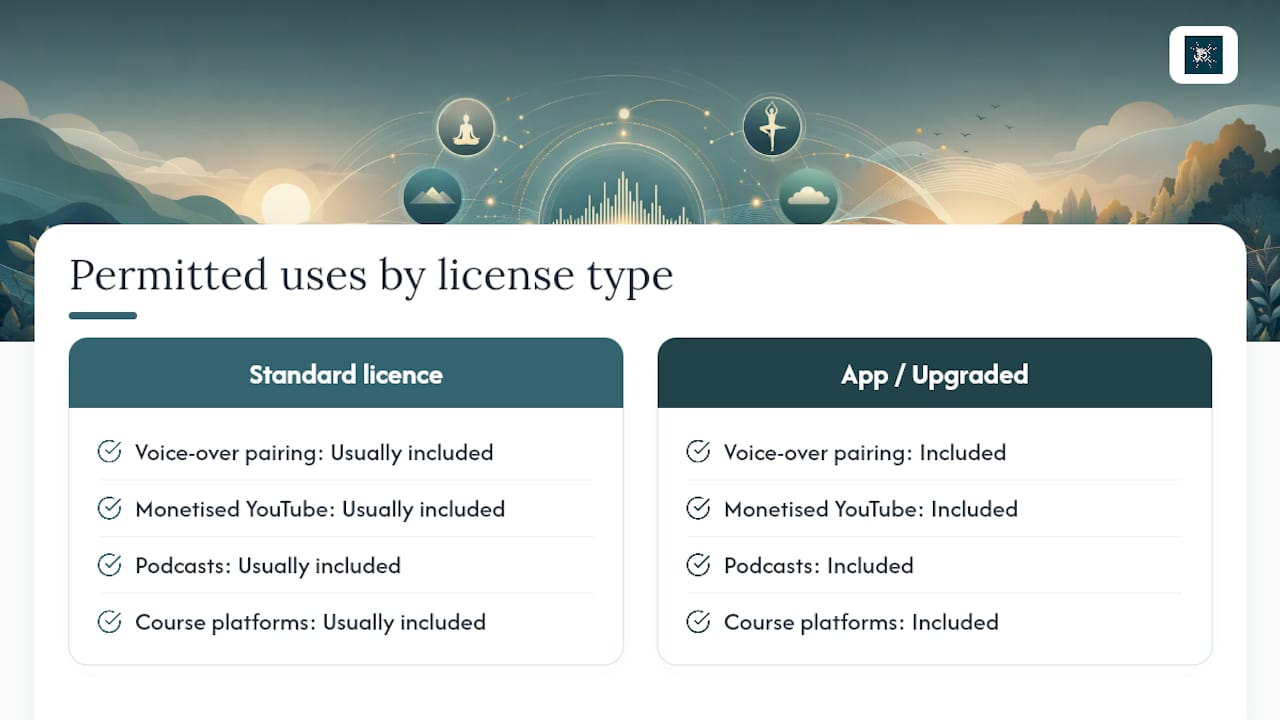
Permitted uses vary more than you’d think. Voice-over pairing, monetised YouTube uploads, podcasts, and course platforms are commonly included in a standard commercial licence. In-app playback and user-facing downloads are not always included, and often need a separate line or an upgraded agreement.
Redistribution is almost always banned. No licence worth buying lets you repackage the track and resell it as part of your own music library. That restriction exists precisely because the vendor is selling the same recording to thousands of other buyers.
Territory and duration matter more for apps than for a single YouTube video. A worldwide, lifetime licence protects you if your app scales into new markets. A time-limited or single-territory licence can quietly expire while your content keeps circulating.
Content ID handling decides your YouTube experience. Some vendors register their catalogue with Content ID and allow monetisation for licensed buyers; others leave you to fight automated claims yourself. Artyfile’s licensing documentation is a good example of a vendor that spells this out clearly rather than leaving it implied.
Watch for these red flags on any licence page: “non-commercial use only” hiding in the terms, no certificate offered on request, vague or missing territory language, or streaming rights described in a way that could mean either background use or full on-demand playback.
How do you choose the right license for your app or course?
The decision comes down to one question: is the music supporting your content, or is the music the content?
- Guided meditations, courses, and voice-led sessions almost always fall under a sync+master or “Business” licence. Your listener hears your voice first; the orchestral or theta-frequency backing sits underneath. This is the most common use case for wellness professionals, and it is the one most one-off licences are built for.
- Music-as-product apps, where a user browses a library and presses play on a track with no voice attached, need a Streaming Licence or a custom enterprise deal. The economics are different because you are competing with (and functioning like) a music streaming service.
- Before signing anything, ask the licensor these questions directly: Can users cache tracks offline? Can they export or remix stems? Does the licence extend to client work if you are a therapist licensing music for sessions you deliver to others? Are there territory caps that would block expansion into a new market?
- Seek a custom agreement once you cross certain thresholds: a large or fast-growing user base, any feature that lets users download or resell tracks, expansion into new territories, or a request for exclusivity over a particular composition. Vendors that sell three-figure one-off licences to individual creators usually have a separate enterprise sales process for exactly this reason.
What does a meditation music license cost?
Pricing splits into four rough tiers, and which one you land in depends almost entirely on scale rather than the music itself.
- One-off per-track licences for individual creators and small course businesses tend to sit at the lower end. Artyfile, for instance, sells a lifetime worldwide sync and master licence at €29.90 per track, which covers guided meditations and course content but excludes streaming-as-product and public performance.
- Bundles and library discounts make sense once you need more than four or five tracks for a course or app soundtrack, since per-track pricing usually drops as volume rises.
- Subscription memberships cost less per month but carry the de-licensing risk mentioned earlier: cancel the plan, and your right to use previously published tracks can lapse with it.
- Custom enterprise agreements scale with user numbers, exclusivity requests, and territory. A licensor pricing an enterprise deal will ask how many active users you have before quoting anything.
What paperwork should you complete before launch?
Treat licensing paperwork the way you’d treat a build checklist, not an afterthought you handle if a platform ever asks.
- Request and save the licence certificate and invoice. It should name your specific permitted uses in writing, not just “commercial use” in general terms.
- Get written confirmation of the Content ID and monetisation policy for every track that will appear on YouTube, so a claim doesn’t surprise you after launch.
- Check public performance obligations separately. If the music will play in a studio, clinic, or retail space rather than through headphones, you may need a PRS or PPL arrangement on top of your creator licence, since Artyfile’s own documentation notes that public performance is handled by collection societies, not the licence itself.
- Store the vendor’s terms and track metadata in your project folder, alongside anything relevant if you’re running the project through wellness studio software that manages client sessions or bookings.
- Get legal sign-off before enabling downloads or resale features. These are the two uses most likely to fall outside a standard licence.
- When in doubt, ask the licensor for a written statement covering your specific use case. A quick email confirming “yes, this covers in-app streaming to 10,000 monthly users” is worth more than any FAQ page.
Orchestral Meditations: production credentials and licence approach
Provenance is the part most licence pages skip, and it is the part that matters most once a distributor or app store starts asking questions. Orchestral Meditations records at Abbey Road Studios with the National Philharmonic, using 3D surround sound, binaural beats, and theta and Solfeggio frequency techniques built specifically for immersive listening rather than background filler.
- Commercial and professional licences cover sync and master use for guided meditations, courses, and app soundtracks
- A licence certificate is issued on request, naming permitted uses in writing
- Enterprise and app-specific negotiations are supported directly for larger user bases or custom streaming needs
- Composer and producer credits, including producer Robert Emery and composer Moritz Schneider, appear on releases as a matter of documented practice
Naming the people behind the recording is not a courtesy line. Distributors, app stores, and payment processors increasingly want proof that a track was produced by a named, traceable team rather than pulled from an anonymous stock library.
A recording with a named composer, a named producer, and a studio credit is one that survives a platform audit. An anonymous file with a “royalty-free” label attached is the one that gets flagged first.
Why the standard licensing advice undersells provenance
Most guides to meditation music licensing treat the licence PDF as the whole story: read the terms, check the boxes, move on. That is necessary but incomplete. The gap in the conventional advice is provenance. A licence certificate tells you what you are allowed to do; it does not tell you whether the recording itself will survive a Content ID dispute, an app store review, or a client asking where the music actually came from.

Named composers and named studios close that gap in a way boilerplate licence language cannot. When a track carries a producer credit and can be traced to a specific recording session, that is evidence a platform or a nervous client can actually verify. Anonymous royalty-free packs, by contrast, often can’t answer the simple question “who made this?”
If you are building anything commercial, prioritise the licence terms first, but treat provenance as the second filter, not an afterthought. Ask who composed and produced the track before you ask about price. The cheapest licence on a track nobody can trace is rarely the cheapest option once something goes wrong.
— ROBERT
Getting a properly licensed soundtrack for your project
Orchestral Meditations gives creators and app developers a licensing route that skips the guesswork of anonymous stock libraries: every track comes from named composers, a documented Abbey Road session, and a licence certificate you can actually hand to an app store or client if asked.
Commercial sync and master licences cover guided meditations, course content, and monetised YouTube uploads, while enterprise streaming agreements are available for apps offering on-demand playback to larger user bases. Certificates are issued on request and name your permitted uses in writing, and Content ID handling is confirmed before you publish, not after a claim lands. For custom pricing on larger user bases or exclusivity requests, get in touch directly rather than guessing at a standard tier.
Browse the licensed meditation music library to find a track and confirm which licence fits your project before you launch.
Sources
- Licensing Meditation Music for Meditation Apps | Feed.fm
- Meditation & Spa Music Licensing – €29.90 Once | Artyfile
- How To Properly License Music For Your Meditation, Relaxation Or Sleep App | TunePocket
FAQ
Are you allowed to meditate with music?
Yes, playing music for personal meditation carries no licensing requirement at all. Licensing only applies when you use the music commercially, such as in a published app, course, or monetised video.
What music can I play without a licence in the UK?
Genuinely public-domain compositions (works old enough that copyright has expired) can be played freely, but almost all modern recordings, including most “free” stock tracks, still carry recording copyright that requires a licence for commercial use.
Where can I find copyright-free meditation music?
True copyright-free music is rare and usually low quality; what most creators actually want is a properly licensed royalty-free library, such as Orchestral Meditations, which issues a certificate confirming your permitted commercial uses.
What kind of music needs to be licensed?
Any recording still under copyright needs a licence for commercial use, which covers the vast majority of meditation, ambient, and orchestral tracks available online, including anything marketed as “royalty-free.”
Do I need a separate licence for YouTube monetisation?
Not usually a separate licence, but you do need to confirm the vendor’s Content ID policy in writing, since some libraries register tracks and allow monetisation for licensed buyers while others leave claims unmanaged.